2.07 Three Trail Plans and a Decision Matrix
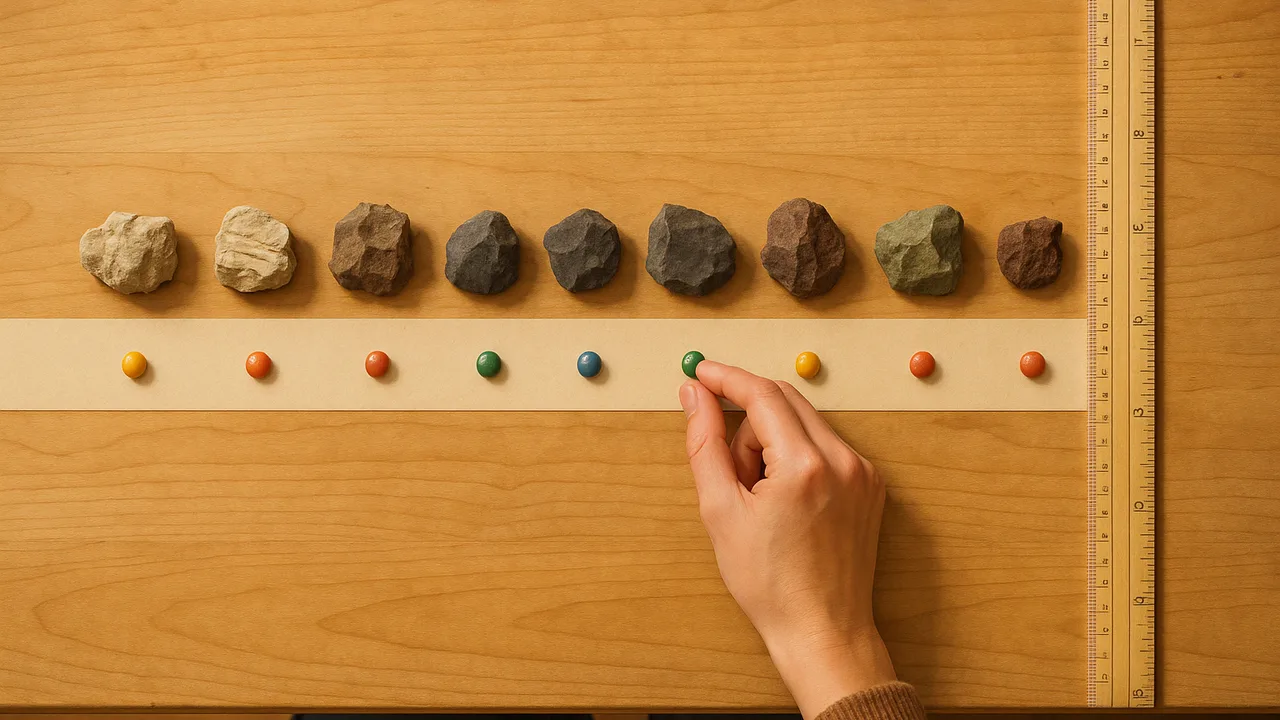
sketch competing Deep Time Trail plans, set measurable criteria and constraints, place stations to scale, and choose a plan with a weighted decision matrix.
- I can use evidence from radiometric dating of lunar rocks, meteorites, and Earth’s oldest rocks to explain that the solar system formed about 4.6 billion years ago and Earth’s solid crust formed about 4.4 billion years ago.
- I can use patterns of impact cratering on other planetary surfaces to infer that Earth also had many impact craters early in its history.
- I can reason that the scarcity of impact craters and the younger age of most rocks on Earth compared to other solar system bodies is due to processes like volcanism, plate tectonics, and erosion reshaping Earth’s surface.
- I can describe scientific explanations about what Earth’s atmosphere was like shortly after the planet formed.
- I can describe what Earth’s atmosphere is like today and explain how it is different from the past.
- I can identify evidence for when photosynthetic organisms first appeared and explain their impact.
Phase 4: Build
Warm-Up ~5 min
Do Now. On the 460 m trail, all of human history fits in about 3 cm. Write one way a sign could still help visitors notice it.
Which criterion is measurable?
Instruction ~10 min
Class criteria and constraints. Criteria: (1) every station within 1 m of its true position at 1 m = 10 million years; (2) at least 8 stations, including 3 that show how we know Earth’s age and 2 that show Earth and life changing together; (3) at least 8 of 10 test visitors can answer “How old is Earth, and how do we know?” after the walk; (4) every fact is accurate and cited. Constraints: the 460 m loop; a budget of 60 sample “sign points”; every station reachable and readable from a wheelchair; weatherproof materials.
Three plans.
- A. Signpost Trail: a weatherproof sign at every station, with a timeline bar on each.
- B. Evidence Trail: fewer signs but touchable objects at key stations: a banded-iron replica, a stromatolite cast, a magnifier over sand-sized grains like zircons, a crater relief model.
- C. Audio Trail: small numbered posts and a free audio tour on visitors’ phones.
Worked example 1: placing stations. Position from the “Today” end = age in millions of years ÷ 10. Meteorites and Earth forming: 454 to 457 m (the start). Oldest zircons: 440 m. Oldest intact rocks: 403 m. Stromatolites: 350 m. Great Oxidation Event: 240 m. Cambrian: 53.9 m. Plants on land: 47 m. End of non-bird dinosaurs: 6.6 m. Homo sapiens: 3 cm. The first 400 m are almost empty of animals, which is itself the lesson; the last 54 m are crowded, so Plan A needs a “zoom-in” sign there.
Worked example 2: a calculation for a station sign. The zircon station shows a worked age: a grain with 0.979 lead-206 atoms per uranium-238 atom (assume no starting lead). n = log2(1.979) ≈ 0.985 half-lives; 0.985 × 4.468 ≈ 4.40 billion years. The sign states the assumption and why zircon makes it reasonable: it rejects lead when it crystallizes.
Worked example 3: a decision matrix (sample scores, 1–5).
| Criterion (weight) | A Signpost | B Evidence | C Audio |
|---|---|---|---|
| Visitors explain Earth’s age (3) | 3 | 4 | 3 |
| Accurate, cited, to scale (3) | 5 | 4 | 4 |
| Accessible to all visitors (2) | 4 | 4 | 3 |
| Within 60 sign points (2) | 2 | 3 | 5 |
| Weatherproof, low upkeep (1) | 3 | 3 | 4 |
| Weighted total |
Totals: A = 9 + 15 + 8 + 4 + 3 = 39; B = 12 + 12 + 8 + 6 + 3 = 41; C = 9 + 12 + 6 + 10 + 4 = 41. B and C tie. A tie is information: a hybrid (objects at five key stations and numbered posts with audio elsewhere) might keep the strengths of both. Note the trade-off: audio is cheap but leaves out visitors without a phone.
Prototype. Each team builds version 1 as a scaled hallway model at 1:10 (46 m, so 1 m = 100 million years) with paper station cards and one full-size sample sign.
Guided Exercises ~15 min
Complete your matrix and station list.
Independent Practice ~10 min
Build version 1.
Lay out your 1:10 hallway model with at least eight station cards, and make one full-size sample sign (80 words or fewer) with a citation. Record your cost in sign points and check every position with a tape measure.
Closure ~5 min
Version 1 is on the hallway floor. Next class, test visitors walk it.
Exit ticket: which criterion is your version 1 most likely to fail, and what would you watch for in the visitor test?
Teacher notes
Materials: tape measures, masking tape, index cards, markers, cardstock for sample signs, the 2.05 timeline photos, a “sign points” price list (sample: sign 5, post 2, touchable object 6, audio script 1 per station).
Setup: the class fixes the criteria and constraints at the start; 2.08 and 2.09 test against these exact values. Name the engineering link: HS-ETS1-1 (criteria and constraints) and HS-ETS1-3 (trade-offs). Accessibility is a criterion students judge, not a code to quote.
Listen for: millions and billions mixed up; stations placed by eye instead of measured; ignoring the accessibility constraint.
Support / stretch: give a station calculator table. Stretch: run a sensitivity check by changing the budget weight from 2 to 3.