3.10 Unit 3 Checkpoint: Plate Tectonics and Fault Systems
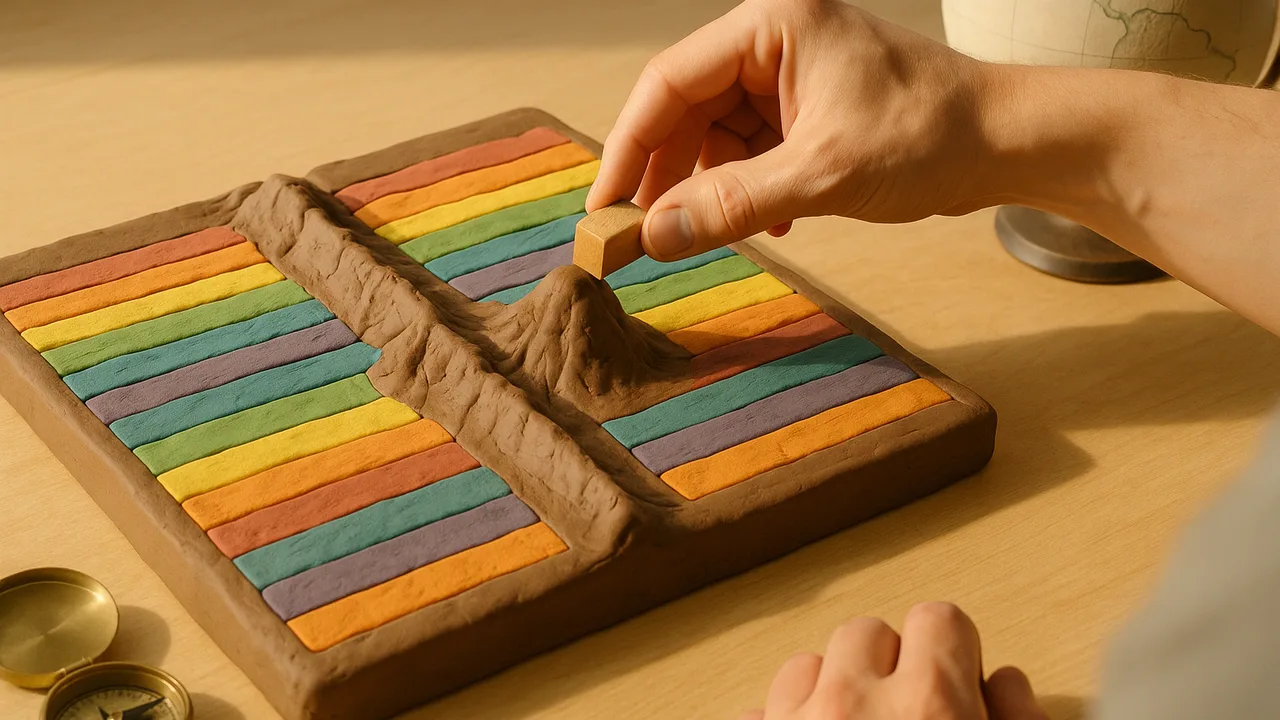
show what I learned about the evidence for plate motion, Earth’s interior, and how internal and surface processes shape a plate boundary, using data questions, a scenario set and short constructed responses.
- I can synthesize evidence to describe how the motion of continental plates explains the patterns in the ages of crustal rocks, including how new rocks form at mid-ocean ridges, why the oldest rocks are found at continental centers, and why oceanic crust is younger and constantly recycled at subduction zones.
- I can use my model to explain how thermal convection in the mantle causes the movement of crustal plates and cycles matter within Earth.
- I can describe how convection in the liquid outer core generates Earth’s magnetic field, including evidence such as polar reversals found in seafloor rocks.
- I can explain how Earth’s interior is organized into radial layers by density and how thermal energy from radioactive decay is added to the system.
- I can use my model to show how Earth’s internal and surface processes, acting over different time and space scales, lead to the formation and change of continental and ocean-floor features.
Phase 5: Prove It
Warm-Up ~5 min
Do Now. Back to the phenomenon: a stream turns sharply along a fault for 130 m, then continues downhill. In three sentences, explain the bend and what it tells us about the fault.
The stream channel offset is evidence that the ground on the two sides of the fault moves sideways past each other.
Instruction ~10 min
Geoscientists, this is the unit checkpoint. Part A is multiple choice with data and a scenario set, where several questions share one situation. Part B is short constructed responses scored 0 to 3. Calculators are allowed. Read each question twice and show your reasoning.
How a 0–3 answer is scored. 3 points: a correct claim, accurate evidence or calculation, and reasoning that links them with science ideas. 2 points: correct claim and evidence, but reasoning missing or partly wrong. 1 point: a correct claim with little or no support, or a partly correct answer. 0 points: incorrect or blank.
Worked example: from 1 point to 3. Question: “Why is ocean crust young?” “Because it gets destroyed” earns 1 point. Ava wrote: “Ocean-floor ages increase with distance from ridges and never exceed about 180 million years. Ocean crust forms at ridges, cools and becomes denser as it moves away, and sinks back into the mantle at subduction zones, so old ocean crust does not survive.” Claim, evidence and reasoning: 3 points.
Scenario set data (sample data). A research ship crosses a different ocean basin from a mid-ocean ridge to a continent with an active trench. Use this table for questions 7–9.
| Site | Distance from ridge (km) | Age of basalt (million years) | Heat flow (mW/m²) | Magnetic polarity |
|---|---|---|---|---|
| P | 0 | 0 | 240 | normal |
| Q | 800 | 20 | 110 | reversed |
| R | 1,600 | 40 | 80 | normal |
| S | 2,400 (at the trench) | ? | 65 | reversed |
| T (continent interior) | — | 2,500 (granite gneiss) | — | — |
Guided Exercises ~15 min
Part A: answer on your own. Your teacher reviews answers after everyone finishes.
Independent Practice ~10 min
Part B: constructed responses, each scored 0–3.
15. Use the scenario data to explain the pattern of crustal rock ages from site P to site T. Your answer must describe the pattern, explain how plate motion produces it, and say why the oldest rocks are found in continental interiors. (0–3)
16. A website claims a fault ‘moves a meter a year.’ Evaluate the claim using the stream channel offset (130 m in about 3,700 years) and GPS. Name the strengths and weaknesses of each kind of evidence. (0–3)
17. Draw and explain a model of a continental margin that shows one internal process and one surface process, the landform each makes, and the time scale of each, from seconds to millions of years. (0–3)
18. Draw a labeled cross-section of Earth's interior that shows the layers by density, the seismic evidence for the liquid outer core, and mantle convection with its energy sources. Explain how matter cycles between crust and mantle. (0–3)
Closure ~5 min
Finished, geoscientists. Your results will guide the review before Unit 4. Next: your 3DX field trip.
Exit ticket: which question was hardest, and which idea do you want to practice next?
How confident are you that you can I can explain plate motion, Earth's interior and the shaping of a plate boundary with evidence and calculations.
Teacher notes
Materials: printed checkpoint with the scenario table, calculators, scoring guide for items 15–18.
Setup: about 40 minutes for Parts A and B, then a short review. Item tags: 1 ESS1-5:1a; 2 ESS1-5:1b; 3 and 4 ESS1-5:2a; 5 ESS1-5:3a; 6 and 16 ESS1-5:3b; 7, 8 and 9 ESS1-5:4a; 15 ESS1-5:4b; 10 ESS2-1:1a; 11 ESS2-1:2a; 17 ESS2-1:3a; 12 and 18 ESS2-3:1a; 13 ESS2-3:2a; 14 and 18 ESS2-3:3a.
Answer notes: 15: ages rise 4 cm/yr away from the ridge, heat flow falls as crust cools, polarity alternates; crust sinks at the trench at about 60 million years; continental crust is buoyant and survives. 16: 1 m/yr would give 130 m in 130 years, about thirty times the measured rate.
Listen for: “the mantle is liquid”; ages from S-P lags; the Sun as the energy source for plate motion.
Support / stretch: read items aloud on request and give a formula card (rate = distance / time, d = 8.4 × lag, energy ratio = 101.5ΔM). Stretch: for item 8, explain how a change in spreading rate would show up in the stripe widths.