2.02 Project Brief and Wonder Board: The Deep Time Trail
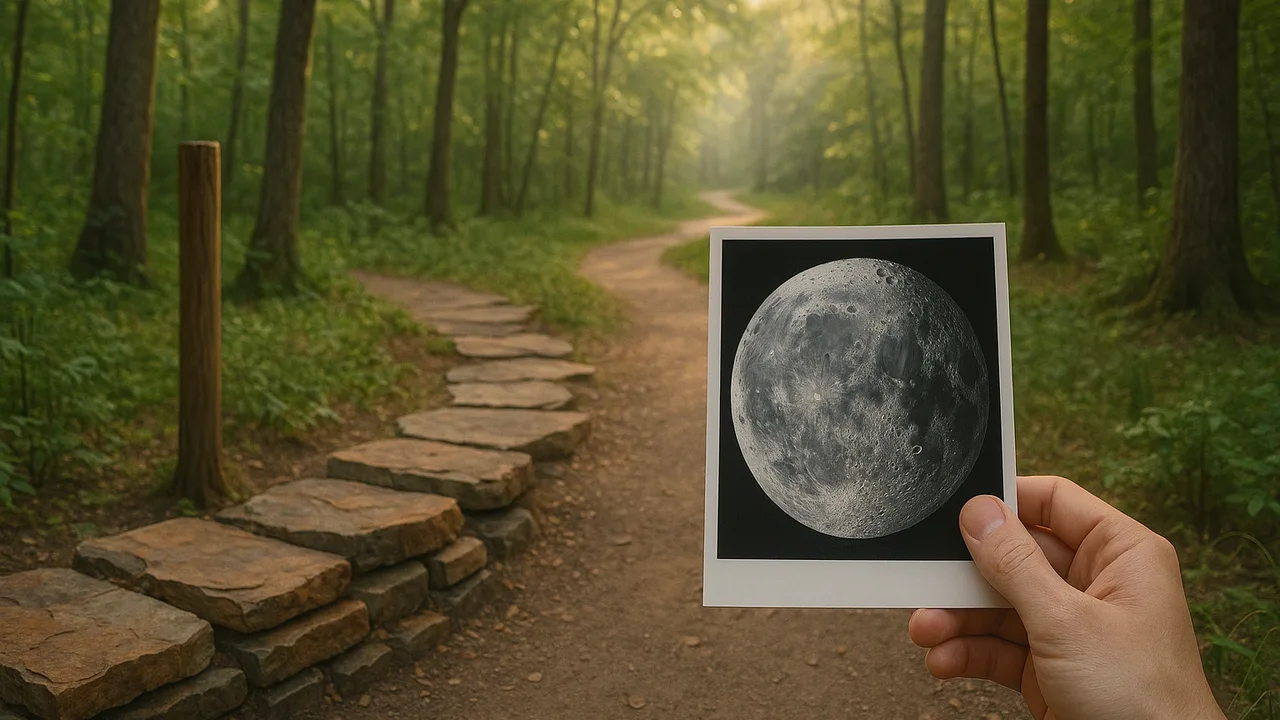
The Deep Time Trail
How can we design a trail that lets visitors walk Earth’s history to scale and see the evidence for its age and its changing systems?
The mystery: A meteorite that fell after a bright fireball over a mountain region is older than any rock found on Earth’s surface.
Questions we will figure out together in this unit:
- How can a meteorite be older than every rock on Earth?
- How do scientists put a number on a rock’s age?
- Why are Earth’s oldest rocks younger than Earth?
- Where did all of Earth’s craters go?
- What was the air like when Earth was young?
- When did life start, and how do we know?
- Did living things change the planet, or only the other way around?
- How long would a to-scale trail need to be to show humans at all?
define the parks department’s trail problem, sort our questions into need-to-knows, and use crater data to ask why Earth’s surface looks younger than the Moon’s.
- I can describe the age and composition of Earth’s oldest rocks, lunar rocks, and meteorites as determined by radiometric dating.
- I can compare the composition of solar system objects.
- I can analyze the size and distribution of impact craters on Earth and other solar system bodies, and describe the activity of plate tectonic and surface processes like volcanism and erosion on Earth.
- I can explain that Earth formed along with the rest of the solar system about 4.6 billion years ago.
- I can describe how the early Earth was bombarded by impacts, similar to other objects in the solar system.
- I can explain why erosion and plate tectonics have destroyed much of the evidence of early impacts on Earth, making impact craters relatively scarce compared to other planetary surfaces.
Phase 1: Spark
Warm-Up ~5 min
Do Now. If all of Earth’s history were squeezed into one school year, in which month do you think the first animals appeared? Write your guess and keep it; we will check it this unit.
The Moon and Earth were hit by impacts at similar rates early on. Which has more craters visible today?
Instruction ~10 min
Meet the client. A county parks department is rebuilding a 460 m walking loop at its nature center and wants to turn it into a “Deep Time Trail”: a to-scale walk through Earth’s 4.6-billion-year history. The director’s letter asks for stations that show how we know Earth’s age, and how Earth and life changed together. The trail must be accurate, readable by families, accessible to visitors using wheelchairs or strollers, and within the department’s sign budget.
Driving question. How can we design a trail that lets visitors walk Earth’s history to scale and see the evidence for its age and its changing systems?
Our mission. Geologists, you will date rocks with half-life models, weigh the evidence for Earth’s age, model how life and Earth’s systems changed together, design and test trail plans, and present the final plan with a written account of Earth’s early history.
Need-to-knows. Sort the question board into what we know, what we need to know and how we could find out. Most need-to-knows fall under four headings: how to get numbers for rock ages, how old Earth is and how we know, what early Earth was like, and how life changed the planet.
Worked example 1: crater evidence (approximate values). The Moon’s ancient highlands are crowded with overlapping craters, and its smoother dark plains (the maria) have far fewer. Earth has only about 200 confirmed impact structures, and most are less than a few hundred million years old. Mars and Mercury, which recycle their surfaces less than Earth does, also keep many ancient craters. Pattern: the more active a surface, the fewer old craters it keeps.
| Surface | Craters (many, some, few) | Active processes (plate tectonics, volcanism, erosion, water) | What it suggests about surface age |
|---|---|---|---|
| Moon highlands | |||
| Moon maria | |||
| Mercury | |||
| Earth’s continents | |||
| Earth’s ocean floor |
Worked example 2: the trail’s scale. 460 m for 4.6 billion years means 1 m = 10 million years. Diego checked one station: the end of the non-bird dinosaurs, 66 million years ago, sits 6.6 m from the “Today” end of the loop. All of human history would fit in a few centimeters.
Teams and roles. Teams of four rotate weekly: Lead Geologist, Data Analyst, Trail Designer and Science Communicator.
Guided Exercises ~15 min
Use the crater table and the client letter.
Independent Practice ~10 min
Team charter and crater analysis.
Complete the crater table. Then write a short explanation: what do the crater patterns on the Moon, Mercury and Earth suggest about how much each surface has been reshaped since it formed?
Write the trail problem in one or two sentences: who the visitors are, what they need to understand, and the main limits.
Closure ~5 min
We have a client, a driving question and a puzzle. Next phase, we find the clock inside rocks.
Exit ticket: why might the oldest rock on Earth be younger than Earth itself? Give one reason.
Teacher notes
Materials: the client letter (a one-page brief from a generic “county parks department”), images of the Moon’s highlands and maria and of Mercury from a space-agency image library, role cards.
Setup: the “about 200 confirmed impact structures” figure is an approximate, rounded count from impact databases; present it as approximate. Keep the question board for the whole unit.
Listen for: “Earth has a shield” or “the atmosphere stops all asteroids” (it burns up small ones, not large ones); scale errors with millions and billions.
Support / stretch: give a millions-to-meters conversion card. Stretch: estimate how far from “Today” the oldest known intact rocks (about 4.0 billion years) would be.