1.02 Project Brief and Wonder Board: The Cosmic Origins Gallery
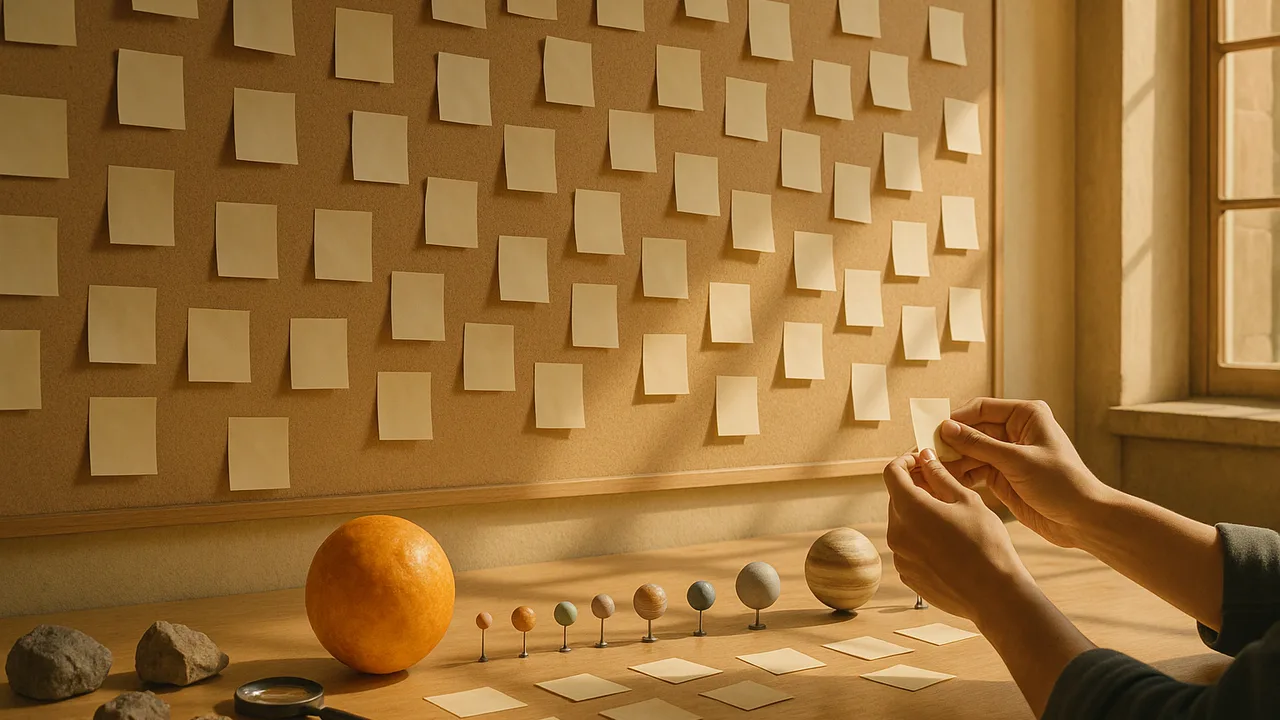
The Cosmic Origins Gallery
How can we show museum visitors, with evidence, how the atoms in a gold ring were made long before the Sun existed?
The mystery: Every atom of gold in a ring, panned long ago from a mountain stream, is older than the Sun. Fusion explains why the Sun shines, but the Sun cannot make gold.
Questions we will figure out together in this unit:
- If the Sun only makes helium, where did gold come from?
- How do scientists know how old the universe is?
- Why do planets move in ellipses and not circles?
- Can we predict when a comet will come back?
- How can light from a star tell us what it is made of?
- What happens to the Sun when its hydrogen runs out?
- Is the universe still getting bigger, and how would we know?
- Which sources about space can a museum trust?
define the museum’s exhibit problem, sort our questions into need-to-knows, and judge which sources are reliable enough to use in a public exhibit.
- I can use valid and reliable sources, such as scientific investigations, theories, simulations, and peer-reviewed research, to gather evidence about the Big Bang theory.
- I can use a model to predict how the amount of hydrogen decreases and the amount of helium increases in the sun as it ages.
Phase 1: Spark
Warm-Up ~5 min
Do Now. Think of the best museum exhibit you have ever seen, in person or online. What made you stop and read, touch or try it? List two features and one thing that made an exhibit boring.
As the Sun ages, what happens to the amounts of hydrogen and helium in its core?
Instruction ~10 min
Meet the client. A regional science museum and planetarium has asked our class for help. Its new “Cosmic Origins Gallery” opens next season, and the director wants one station that answers a visitor’s favorite question: Where did the gold in a ring come from? The station must be accurate, hands-on, readable in about five minutes by a visitor aged 12 or older, and built within the museum’s budget.
Driving question. How can we show museum visitors, with evidence, how the atoms in a gold ring were made long before the Sun existed?
Our mission. Astronomers, this unit you will investigate orbits and the evidence for the Big Bang, model how stars build elements, design competing exhibit concepts, test them on real visitors (your classmates and guests), and present the final station and a written “cosmic biography” of a gold atom.
Need-to-knows. Sort the question board into three columns: what we already know, what we need to know, and how we could find out. Most of the need-to-knows will fall under four headings: how the Sun makes energy, how objects orbit, how the universe began, and how stars make elements.
Worked example 1: modeling a changing core (sample model data). A simple class model tracks the mass fraction of the Sun’s core. It starts at about 70% hydrogen and 28% helium (the rest heavier elements). If fusion turns a steady share of hydrogen into helium, the hydrogen line slopes down and the helium line slopes up, and the two cross partway through the Sun’s life. Total mass of the core stays almost the same, because only 0.7% of the fused mass leaves as energy.
| Sun’s age (billion years) | Core hydrogen (% of mass, sample model) | Core helium (% of mass, sample model) | Your prediction for the trend |
|---|---|---|---|
| 0 | 70 | 28 | |
| 2 | 58 | 40 | |
| 4.6 (today) | 40 | 58 | |
| 7 | |||
| 10 |
Worked example 2: is this source reliable? The exhibit will carry the museum’s name, so every fact needs a reliable source. Mei found three sources on neutron stars: a peer-reviewed research summary, a NASA science page and an anonymous video with no references. She ranked them by asking four questions: Who wrote it and what is their expertise? Is it based on data, models or peer review? Can I check its numbers somewhere else? Is it current? The anonymous video fails all four, so it cannot be the source for an exhibit fact.
Teams and roles. Teams of four rotate roles each week: Lead Astronomer (keeps the team on the driving question), Data Analyst (calculations and graphs), Exhibit Designer (sketches and prototypes) and Science Communicator (writes label text and presents).
Guided Exercises ~15 min
Use the sample model table and the source cards at your table.
Independent Practice ~10 min
Complete your team charter and model.
Finish the sample model table for 7 and 10 billion years and graph both lines. Explain what your model predicts about the core near the end of the Sun's hydrogen-burning life, and name one way the real Sun is more complicated than the model.
Write the exhibit problem in one or two sentences: who the visitors are, what they need to understand, and two criteria and two constraints for the station.
Closure ~5 min
We have a client, a driving question and teams. Next phase we investigate, starting with how planets and comets move.
Exit ticket: name one need-to-know your team chose and the kind of source you would trust to answer it.
Teacher notes
Materials: the client letter (a one-page brief from a generic “regional science museum and planetarium”), role cards, source cards (one peer-reviewed summary, one space-agency page, one anonymous video transcript), graph paper.
Setup: the core-composition numbers are a simplified sample model for practice, not measured values. Real solar models show hydrogen falling most at the very center; say so if students ask.
Listen for: “the Sun will burn out of mass”; treating every web page as equally reliable.
Support / stretch: give a partly filled need-to-know chart. Stretch: invite a local museum educator or planetarium staff member to review the criteria by video call.