4.07 Three Slope-Protection Designs and a Decision Matrix
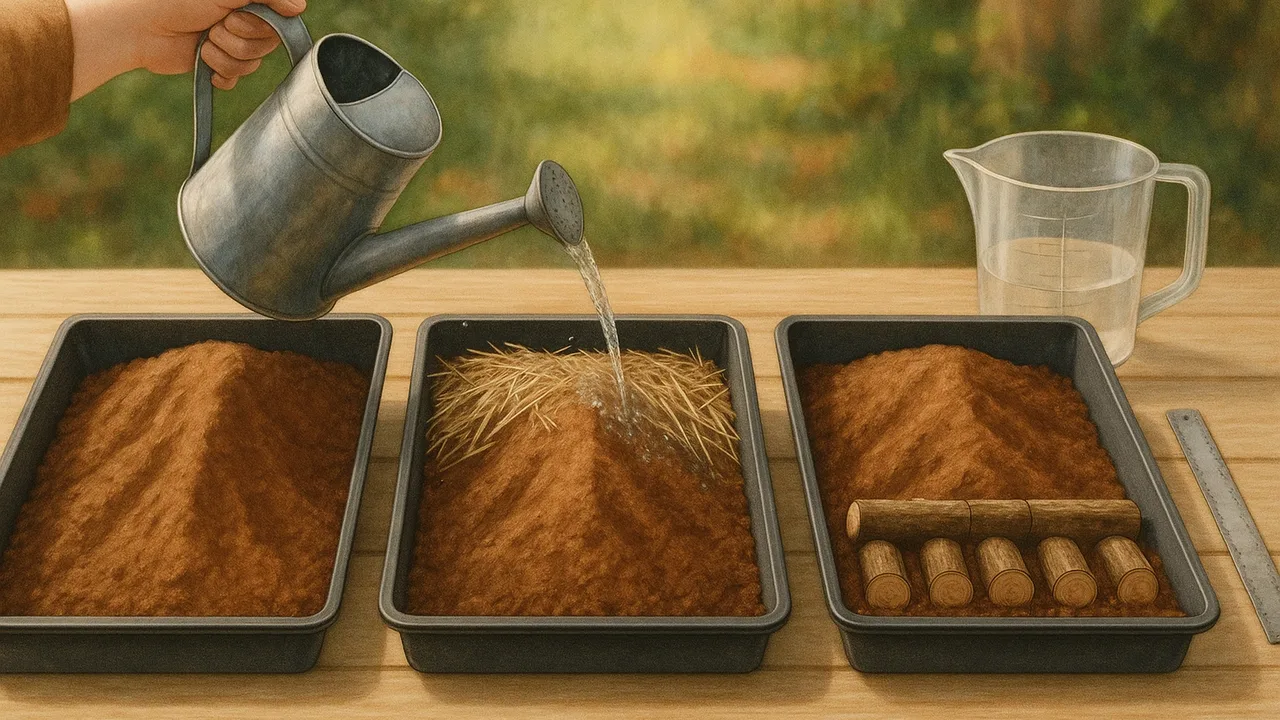
break the burned-slope problem into parts, define measurable criteria and constraints, choose a protection design with a weighted decision matrix, and plan a storm test that will measure how well it works.
- I can include ways to measure or indicate the effects of water’s properties—such as heat capacity, flow, polarity, and density—on Earth’s materials or surface processes in my investigation plan.
- I can state whether I will conduct my investigation individually or as part of a group.
- I can analyze data to identify how human activities or specific technologies affect Earth’s systems.
Phase 4: Build
Warm-Up ~5 min
Do Now. The district’s problem is big: a whole burned hillside, a creek and a road. Break it into three smaller problems that could each be solved and tested on its own.
Which criterion is measurable enough to test in a model storm?
Instruction ~10 min
Breaking the problem down. Following HS-ETS1-2, the class splits the district’s problem into three sub-problems that match the weak links from 4.06: (1) keep rain from striking and loosening bare soil; (2) slow runoff on the slope so it soaks in instead of gathering speed; (3) catch the sediment that still moves before it reaches the creek and the road.
Class criteria and constraints. Criteria: (1) in the storm test, sediment reaching the model creek falls by at least 60% compared with a bare control; (2) runoff volume falls by at least 30%; (3) the measure causes no major unintended effect; (4) crews can install it on the real slope before the rainy season. Constraints: a budget of 50 sample “district points” per tray; only materials that are safe for the creek; nothing that blocks the road ditch.
Three concepts. Teams sketch all three before choosing.
- A. Mulch blanket: a layer of straw or shredded paper spread over the bare soil, absorbing raindrop impact and holding water like leaf litter.
- B. Contour barriers: rolls of straw or fiber laid across the slope along contour lines, so runoff ponds behind them and drops its sediment.
- C. Sediment basin: a small pit with a rock outlet at the foot of the slope, where runoff slows and drops sediment before it reaches the creek.
Worked example 1: a weighted decision matrix (sample scores). Score each concept 1–5 on each criterion, multiply by the weight, and add.
| Criterion (weight) | A Mulch | B Contour barriers | C Sediment basin |
|---|---|---|---|
| Cuts sediment to the creek (3) | 4 | 3 | 4 |
| Cuts runoff (2) | 4 | 3 | 1 |
| Fits budget (2) | 4 | 3 | 2 |
| Installed before the rains (2) | 5 | 3 | 2 |
| Few unintended effects (1) | 4 | 4 | 2 |
| Weighted total |
Totals: A = 12 + 8 + 8 + 10 + 4 = 42; B = 9 + 6 + 6 + 6 + 4 = 31; C = 12 + 2 + 4 + 4 + 2 = 24. A wins clearly. C scores low on unintended effects because a basin must be dug out after every storm and, once full, passes clear water that can scour the channel below (4.06). A smart team might still add a few contour barriers on the steepest part of the slope.
Worked example 2: planning the storm test. Ava’s team writes its plan before building.
| Plan item | Ava’s team | Your team |
|---|---|---|
| Question | Does a mulch blanket reduce the sediment and runoff leaving a 25° slope in a model storm? | |
| Independent variable | Treatment: bare control or mulch | |
| Dependent variables | Dry mass of sediment collected (g); runoff volume (mL) | |
| Controlled variables | Same soil and packing, 25° angle, 1.0 L of ‘rain’ in 60 s from 30 cm, same collection time | |
| Trials | 3 per treatment | |
| How water’s properties show up | Raindrop impact (kinetic energy), infiltration, runoff carrying grains | |
| Individual or group | Group of four: one pours, one times, one collects, one records | |
| Accuracy check | Measure the rain can’s output in a graduated cylinder before each run; dry sediment before weighing |
The storm tray. Version 1 goes on a shallow plastic box (about 40 cm × 25 cm) packed with 3 cm of garden soil, propped at 25°, with a notch at the low end draining into a cup: the ‘creek’. A watering can or a bottle with pin holes in the cap is the storm.
Guided Exercises ~15 min
Complete your team’s decision matrix and test plan, then check these cards.
Independent Practice ~10 min
Plan and build version 1.
Fill in the ‘your team’ column of the test plan: question, variables, at least four controlled variables, trials, how water's properties will show up in your measurements, whether you work individually or as a group, and how you will check accuracy. Then build version 1 on your storm tray, list its materials and their cost in district points, and predict the percent reduction in sediment.
Closure ~5 min
Version 1 and the test plan are ready. Next class the storm comes.
Exit ticket: which part of your test plan is most likely to give imprecise results, and how could you improve it before the test?
Teacher notes
Materials (per team): a shallow plastic box, garden soil, blocks or books to set 25°, a protractor, a watering can or pierced bottle, a graduated cylinder, collection cups, straw or shredded paper, paper-towel rolls or coir for barriers, a kitchen balance, goggles, and a “district points” price list (sample: 10 g of mulch 5, one barrier roll 8, a basin cup 10, rocks 2).
Setup: the class fixes the criteria and constraints at the start; 4.08 and 4.09 test against these exact values. Set up a shared ‘rain rack’ if possible so every team pours from the same height. This lesson follows HS-ETS1-1, HS-ETS1-2 and HS-ETS1-3.
Listen for: no control tray; changing angle and treatment at once; ignoring unintended effects.
Support / stretch: give a half-filled plan. Stretch: add a second independent variable (slope angle) and explain how many trays the test would then need.