1.03 Ellipses, Orbits and Kepler’s Laws
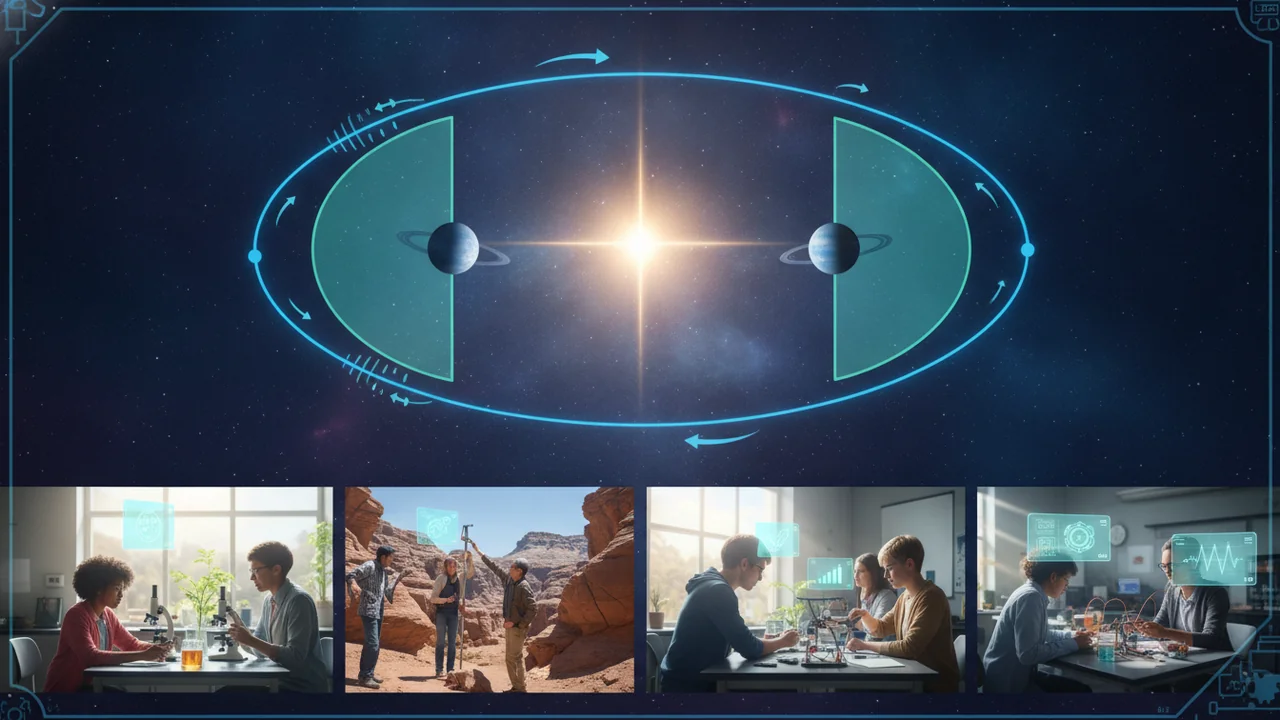
draw and measure ellipses of different eccentricities, and use Kepler’s and Newton’s laws to predict the period, size and speed of an orbit in the solar system.
- I can identify and describe the trajectory of an orbiting body, such as a planet, moon, or spacecraft, using mathematical or computational representations.
- I can explain how the eccentricity of an orbit (e = f/d) is calculated and what it tells us about the shape of the orbit, based on Kepler’s first law.
- I can use mathematical or computational models to show that the square of an orbiting body’s period is proportional to the cube of its distance from the gravitational center, according to Kepler’s third law.
- I can use mathematical or computational models of Kepler’s third law to predict how the orbital period or orbital distance will change if the other variable changes.
Phase 2: Investigate
Warm-Up ~5 min
Do Now. Earth is about 147 million km from the Sun in early January and about 152 million km in early July. Is that why we have seasons? Write a yes or no and one reason.
Earth has summer when it is closest to the Sun.
Instruction ~10 min
Explore first: the lab. Before we name the laws, draw some orbits. (Reading: OpenStax Astronomy 2e, chapter 3, “Orbits and Gravity.”)
Lab: Drawing Orbits with Pins and String. Question: how does the distance between the foci change the shape of an ellipse, and does Kepler’s third law fit the real planets? Materials: cardboard or foam board (about 30 cm × 40 cm), two push pins, a 25 cm loop of string, plain paper, a sharp pencil, a millimeter ruler, a calculator or spreadsheet, goggles.
- Tape paper to the board. Push two pins 2 cm apart near the center and drop the string loop around both.
- Pull the loop taut with the pencil and trace a full ellipse, keeping the string tight.
- Measure the longest diameter (2a) and the distance between the pins (2c) in millimeters. Record a, c and e = c/a.
- Repeat with the pins 4, 6, 8 and 0 cm apart (one pin only for 0 cm). Keep the same loop.
- Mark the ‘Sun’ at one pin on your 6 cm ellipse. Measure the closest (perihelion) and farthest (aphelion) distances and check that they add to 2a.
- Copy the planetary data into your notebook or a spreadsheet. Compute T2 and a3 for each planet and compare.
| Pin separation 2c (mm) | 2a (mm) | a (mm) | c (mm) | e = c/a |
|---|---|---|---|---|
| 0 | ||||
| 20 | ||||
| 40 | ||||
| 60 | ||||
| 80 |
Planetary data (NASA planetary fact sheets): Mercury a = 0.387 AU, T = 0.241 yr; Venus 0.723 AU, 0.615 yr; Earth 1.000 AU, 1.000 yr; Mars 1.524 AU, 1.881 yr; Jupiter 5.203 AU, 11.86 yr; Saturn 9.537 AU, 29.45 yr.
Name the ideas. Johannes Kepler spent years fitting Tycho Brahe’s careful observations of Mars. In the early 1600s he found three rules that describe every orbit in the solar system, and Isaac Newton later showed that all three follow from gravity.
First law: orbits are ellipses with the Sun at one focus. The semi-major axis a is half the longest diameter, c is the center-to-focus distance, and the eccentricity is e = c/a. A circle has e = 0; a very stretched ellipse approaches 1. (Some texts write e = f/d, the distance between the foci divided by the major axis; it is the same ratio.)
Second law: equal areas in equal times. A line from the Sun to a planet sweeps out equal areas in equal times, so a planet moves fastest near the Sun and slowest far from it. For the two ends of the orbit, vp rp = va ra. Earth: 147.1 million km at perihelion and 152.1 million km at aphelion, so it moves about 3.4% faster in January than in July.
Third law: T2 = a3. For anything orbiting the Sun, with T in years and a in AU, T2 = a3.
Worked example 1. Mars has a = 1.524 AU. T = 1.5241.5 ≈ 1.88 years, matching the observed 687 days. Jupiter: a = 5.203 AU gives T ≈ 11.87 years (observed 11.86).
Worked example 2: Halley’s Comet. Halley returns about every 76 years, so a = 762/3 ≈ 17.9 AU. Its closest approach is about 0.586 AU, so its farthest point is 2a − 0.586 ≈ 35.3 AU, beyond Neptune, and e ≈ (17.9 − 0.586)/17.9 ≈ 0.97. By the second law its speed near the Sun is about 35.3/0.586 ≈ 60 times its speed at the far end.
Newton’s version. Gravity gives an acceleration toward the Sun of ag = GM/r2. With GMSun = 1.327 × 10²⁰ m3/s2, Earth at 1.496 × 10¹¹ m accelerates toward the Sun at about 5.9 × 10⁻³ m/s2; double the distance and the acceleration falls to one quarter. By Newton’s third law, the planet pulls the Sun with an equal and opposite force. For orbits around Earth, T = 2π√(a3/GM) with GM = 3.986 × 10¹⁴ m3/s2: the International Space Station, about 420 km up (a = 6,791 km), has T ≈ 92.8 minutes, and a satellite 35,786 km up takes about 1,436 minutes, one sidereal day, so it stays over one spot.
Measurement error. A 2 mm error in c changes e more when the pins are close together, so estimate your uncertainty.
Guided Exercises ~15 min
Use your ellipse data and the planet table. Check answers with your lab partner.
Independent Practice ~10 min
Write up the lab in your Cosmic Notebook.
Claim: how does pin separation affect eccentricity? Support it with your measured values and the definition e = c/a. Then estimate your uncertainty in c and explain why it matters most when the pins are close together.
Plot T² against a³ for the six planets. Describe the pattern and its slope. Use T = a1.5 to predict the period of the dwarf planet Ceres (a = 2.77 AU), then compare with the observed value of about 4.6 years and compute your percent difference.
Closure ~5 min
Orbits follow math we can test. Next class, we turn the telescope outward and weigh the evidence for how the universe began.
How confident are you that you can I can describe orbits with Kepler's laws and use T² = a³ to predict an orbit.
Exit ticket: a planet's period is 8 years. How far is it from the Sun? Show the calculation.
Teacher notes
Timing: Poly ran this lab over two 50-minute periods. Run the drawing and measurements on day 1 and the planet data, sim and write-up on day 2.
Materials (per pair): foam board or corrugated cardboard, 2 push pins, 25 cm string loop, paper, mm ruler, goggles, devices for the PhET sim or the paper alternative.
Alternative: the PhET Kepler’s Laws sim can replace the pins-and-string part; the planetary data analysis is the same.
Listen for: seasons caused by distance; “planets slow down near the Sun”; confusing a with the full diameter.
Support / stretch: give a worked calculator sequence for a1.5. Stretch: use Newton’s form to compute the Moon’s period from its distance of 384,400 km and compare with 27.3 days.