2.08 Trail Walk Critique, Visitor Test and Version 2
test the trail model against the class criteria with visitor data, give and use peer critique, and build an improved version 2.
- I can describe the age and composition of Earth’s oldest rocks, lunar rocks, and meteorites as determined by radiometric dating.
- I can compare the composition of solar system objects.
- I can analyze the size and distribution of impact craters on Earth and other solar system bodies, and describe the activity of plate tectonic and surface processes like volcanism and erosion on Earth.
- I can evaluate scientific evidence by explaining how uncertainty or limitations in the data might affect how useful it is as evidence.
- I can judge whether the data can show a cause-and-effect relationship or just a correlation between changes in the biosphere and changes in other Earth systems.
Phase 4: Build
Warm-Up ~5 min
Do Now. Write the one question you most want a test visitor to answer after walking your trail model.
A useful critique names a specific station and suggests a change that can be tested.
Instruction ~10 min
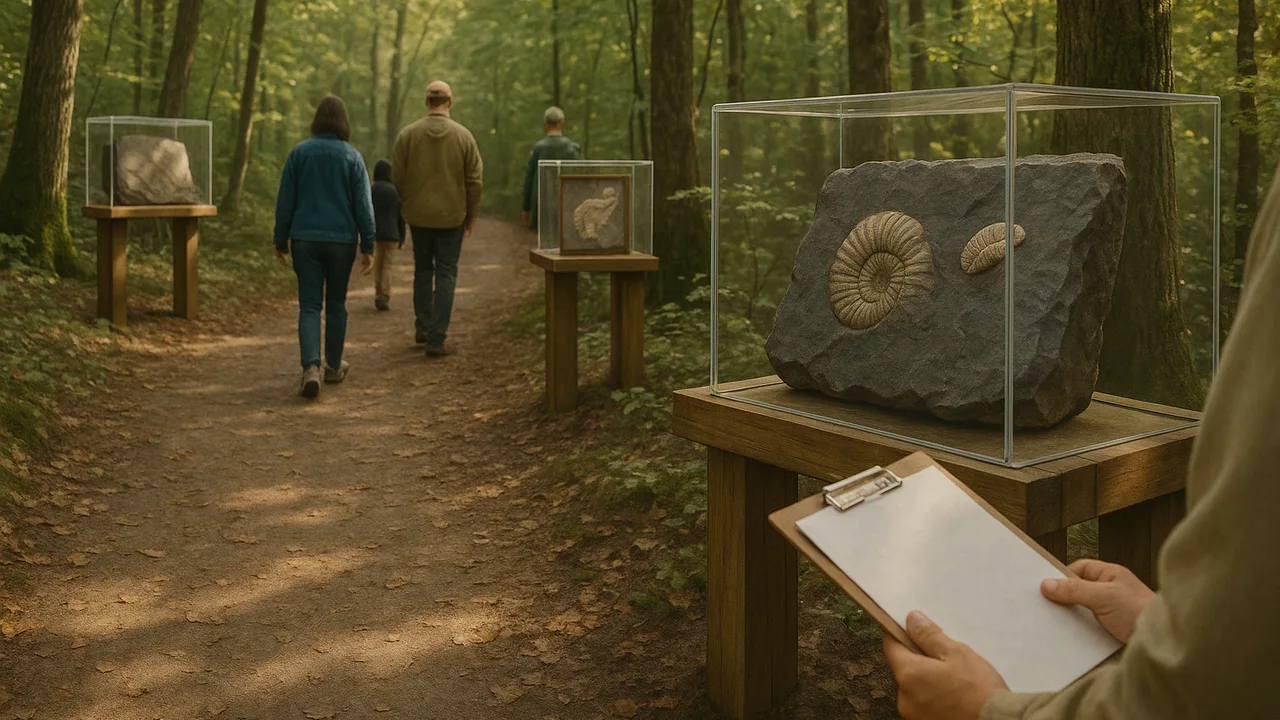
Trail walk critique. Teams walk each other’s hallway models with I like… I wonder… What if… sticky notes, checking scale with a tape measure and reading every sign.
Visitor test. Ten test visitors per team walk the model, then answer: “How old is Earth, and how do we know?” and “Name one way life changed Earth.”
| Criterion | Target | Version 1 result | Pass? | Change for version 2 |
|---|---|---|---|---|
| Stations within 1 m (full scale) | all | |||
| Age-evidence and coevolution stations | 3 and 2 | |||
| Visitors explain Earth’s age | 8 of 10 | |||
| Facts accurate and cited | every fact | |||
| Budget | ≤ 60 points |
Worked example 1: reading the data (sample data). Priya’s team had 6 of 10 visitors say “about 4.5 billion years.” Only 2 named a kind of evidence. Sticky notes said the meteorite station used the word “radiometric” with no explanation. Version 2 added a half-life picture (100, 50, 25, 12.5) and the sentence “Meteorites were never recycled, so they keep the solar system’s starting age.” On retest, 9 of 10 gave the age and 7 named meteorites or zircons as evidence.
Worked example 2: honest uncertainty. Malik’s coevolution sign said “Oxygen appeared exactly 2.4 billion years ago and caused animals.” Critique: too precise and too causal. Version 2: “About 2.4 billion years ago, oxygen from microbes began to build up in the air. Much later, it helped make large, active animals possible.”
Iterate, do not restart. Change one or two things at a time and retest so you know which change worked.
Guided Exercises ~15 min
Use your visitor data and sticky notes.
Independent Practice ~10 min
Build and retest version 2.
Build version 2, retest with at least five visitors, and record the results. Compare version 1 and version 2 with numbers, and name one limitation of your test.
🔎 Mini case study: The age of Earth and a lab that had to get cleaner ~8 min
In the early 1950s the geochemist Clair Patterson set out to measure the lead isotopes in meteorites to find Earth’s age. His early results kept coming out wrong, because lead from the environment was getting into his samples from dust, air and equipment. He iterated: he rebuilt his methods around extreme cleanliness, in one of the first ultra-clean labs used for geochemistry. In 1956 he published an age of about 4.55 billion years, a value close to today’s 4.54.
The contamination problem led him to a second discovery: lead levels in the environment, much of it from leaded gasoline, were far higher than natural levels. He spent years presenting that evidence, and leaded gasoline was later phased out for cars in the United States and many other countries.
Think about it: How did testing and fixing his method change Patterson’s result? What does his story say about checking a design or measurement for hidden problems?
Closure ~5 min
Version 2 is tested. Next phase, we finish the plan and the written account and present both to the parks department.
Exit ticket: which change from version 1 to version 2 made the biggest difference, and what is your evidence?
How confident are you that you can I can use test data and critique to improve a design against its criteria.
Teacher notes
Materials: version 1 hallway models, tape measures, sticky notes, visitor question cards, rebuild materials.
Setup: 12 minutes trail-walk critique, 15 minutes visitor tests, 15 minutes rebuild, 8 minutes case study. Invite staff or another class as visitors.
Listen for: over-precise dates; causal claims the evidence cannot carry; changing everything at once.
Support / stretch: give critique starters and a retest table. Stretch: compute the percent improvement and discuss whether 10 visitors is enough to trust it.