2.05 Earth and Life Changed Together
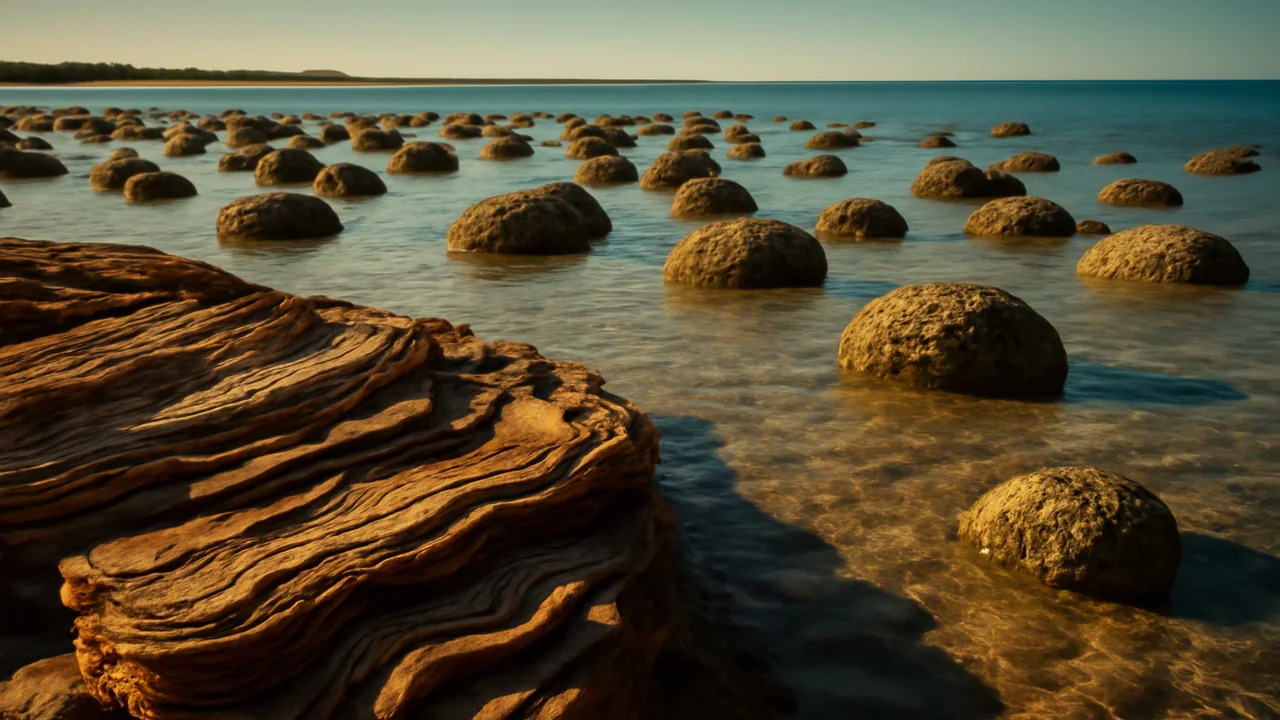
build a to-scale model of Earth’s history and argue from evidence that changes in Earth’s systems and changes in life drove each other.
- I can develop a claim, based on evidence, that Earth’s systems and life on Earth have evolved together at the same time.
- I can describe scientific explanations about what Earth’s atmosphere was like shortly after the planet formed.
- I can describe what Earth’s atmosphere is like today and explain how it is different from the past.
- I can identify evidence for when photosynthetic organisms first appeared and explain their impact.
- I can use at least two examples to construct logical oral and written arguments showing how the evolution of photosynthetic organisms led to major changes in Earth’s atmosphere and oceans, such as the formation of iron oxide deposits, increased weathering, and the evolution of animal life that depends on oxygen.
- I can identify and explain causal links and feedback mechanisms between changes in the biosphere and changes in Earth’s other systems.
Phase 3: Make Sense
Warm-Up ~5 min
Do Now. Check your guess from 2.02: in a one-year version of Earth’s history, which month did you pick for the first animals? Today we find out.
Where did the oxygen in Earth's air come from?
Instruction ~10 min
Explore first: the lab. (Reading: Earle, Physical Geology, chapter 8, and the geologic time scale.)
Lab: A Toilet-Paper Timeline of Earth. Question: where do the major events in Earth’s history fall on a to-scale timeline, and what does the scale reveal about how long Earth existed without complex life? Materials: a roll of toilet paper (at least 460 squares) or adding-machine tape, a tape measure, markers and sticky notes, event cards, masking tape.
- Measure one square and record its length. Scale: 1 square = 10 million years, so 4.6 billion years = 460 squares.
- Unroll and count 460 squares along the hallway. Mark the start ‘Earth forms, 4.6 billion years ago’ and the end ‘Today.’
- For each event card, compute squares from the end = age in millions of years ÷ 10, and record the calculation.
- Count back from ‘Today’ and tape each event card at its position.
- Draw arrows between events where a change in Earth’s systems caused a change in life or the reverse, and label the evidence on each arrow.
| Event | Age (millions of years) | Squares from today |
|---|---|---|
| Oldest zircons | 4,400 | |
| Oldest intact rocks | 4,030 | |
| Oldest widely accepted stromatolites | 3,500 | |
| Great Oxidation Event | 2,400 | |
| Cambrian period begins | 539 | |
| Plants on land (about) | 470 | |
| End of non-bird dinosaurs | 66 | |
| Homo sapiens | 0.3 |
Deep time at scale. On this roll, the first widely accepted fossils (stromatolites, about 3.5 billion years old) sit 110 squares in from the start, all animal life since the Cambrian fits in the last 54 squares, and our species occupies the last 0.03 of a square: about 3 mm if a square is 10 cm.
Coevolution. Life did not simply adapt to a fixed planet. Living things changed the air, oceans and rocks, and those changes shaped what life could evolve next.
1. Oxygen. Early Earth’s atmosphere had almost no free oxygen; it was mostly nitrogen and carbon dioxide with water vapor, from volcanic gases. Photosynthetic bacteria (cyanobacteria), which built layered mounds called stromatolites, released oxygen as a waste product. For hundreds of millions of years that oxygen reacted with dissolved iron in seawater and settled as iron oxide, forming banded iron formations, most of which formed before about 1.8 billion years ago. Once those sinks filled, oxygen built up in the air in the Great Oxidation Event, about 2.4 billion years ago. Evidence: pyrite and uraninite, which break down in oxygen, are found as river-rounded grains in sediments older than about 2.4 billion years but not younger ones; red beds (rusted sandstones) appear after it. Today’s air is about 78% nitrogen and 21% oxygen.
2. Ozone and land. Oxygen in the upper atmosphere forms ozone, which absorbs ultraviolet radiation. With an ozone shield, life could survive on land, and oxygen-breathing animals could grow larger. Plants colonized land roughly 470 million years ago.
3. Plants, soil and climate. Roots break rock and release acids, speeding chemical weathering. Weathering of silicate rocks removes carbon dioxide from the air and locks it into carbonate sediments. Many geologists argue that the spread of forests in the Devonian period lowered carbon dioxide and helped cool the climate. Plants also made true soils and held riverbanks together. Here life changed the geosphere and atmosphere, and the new climate in turn shaped which life thrived: a feedback.
A model as an argument. A timeline becomes an argument when it shows cause and effect across systems, with evidence at each arrow. Scientists still debate timing details, such as exactly when oxygen-producing photosynthesis began, so label those with a question mark rather than false precision.
Guided Exercises ~15 min
Use your timeline and arrows.
Independent Practice ~10 min
Timeline analysis.
For what fraction of Earth's history did life exist only as single cells or simple colonies? Use your timeline positions. Then explain how rounding, uneven squares and uncertainty in the ages (such as the timing of the first land plants) affect your marks.
Closure ~5 min
Life and Earth built each other. Next class, we test how strong that argument really is and start designing the trail.
How confident are you that you can I can model deep time to scale and argue from evidence that Earth's systems and life changed together.
Exit ticket: pick one arrow on your timeline and explain the cause and effect in both directions.
Teacher notes
Timing: Poly ran this workshop over two 50-minute periods: lay out and mark the timeline on day 1, arrows, argument and analysis on day 2. Photograph the timeline before taking it down; 2.07 uses it.
Materials: toilet paper or adding-machine tape, tape measures, markers, sticky notes, event cards, masking tape.
Alternative: build the same timeline on paper at 1 mm = 10 million years (46 cm total) or in a spreadsheet bar chart.
Answer notes: squares from today: 440, 403, 350, 240, 53.9, 47, 6.6, 0.03. Life was single-celled or colonial for roughly 3 of its 3.5 billion years.
Listen for: “oxygen was always there”; one-way arrows only; dinosaurs and humans placed close together.
Support / stretch: give pre-computed positions for half the cards. Stretch: add the oldest banded iron formations and the end of most banded iron deposition (about 1.8 billion years) and explain the gap.