2.01 Reading Time in Rock Layers
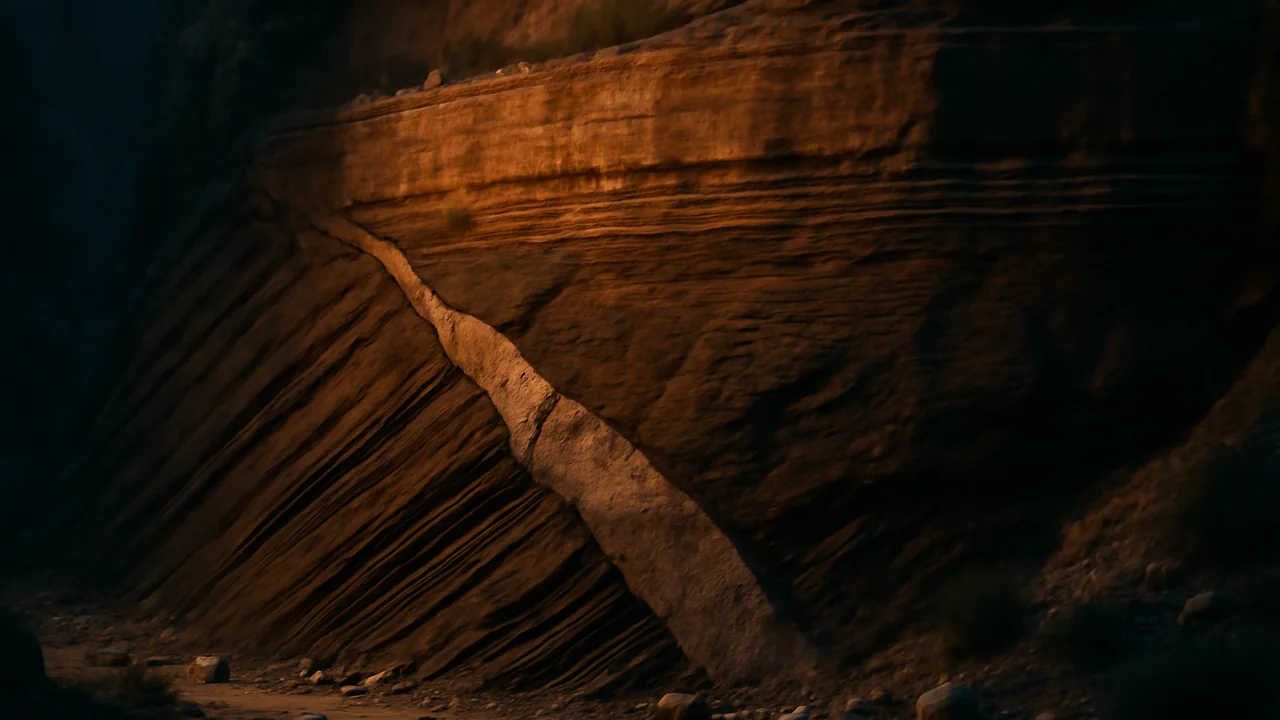
The Deep Time Trail
How can we design a trail that lets visitors walk Earth’s history to scale and see the evidence for its age and its changing systems?
The mystery: A meteorite that fell after a bright fireball over a mountain region is older than any rock found on Earth’s surface.
apply the principles of relative dating to put the events recorded in a rock cross-section in order, and ask questions about how old Earth materials are.
- I can explain that Earth formed along with the rest of the solar system about 4.6 billion years ago.
- I can describe how the early Earth was bombarded by impacts, similar to other objects in the solar system.
- I can explain why erosion and plate tectonics have destroyed much of the evidence of early impacts on Earth, making impact craters relatively scarce compared to other planetary surfaces.
Phase 1: Spark
Warm-Up ~5 min
Do Now. A few years ago a bright fireball crossed the sky over a mountain region with a boom heard for many kilometers. Meteorite hunters found dark, crusty stones in a field near a small town. Write what you would want to know about those stones, and one guess about how old they are.
The meteorite fell a few years ago. Suppose the granite of the nearby mountains crystallized about 100 million years ago. Which is older: the meteorite's minerals or the granite?
Instruction ~10 min
The phenomenon. Laboratory work on falls like this one shows the stones are often carbonaceous chondrites, among the most primitive materials in the solar system, and that meteorites like them are about 4.56 billion years old. No rock yet found on Earth’s surface is that old. How can a stone that fell yesterday be older than every rock around it? To answer that, we first need to read time in rocks. (Reading: Steven Earle, Physical Geology, 2nd ed., chapter 8, “Measuring Geological Time.”)
Relative dating puts events in order without numbers. Geologists use a few principles, set out by Nicolas Steno in 1669 and by James Hutton and others in the 1700s:
- Superposition: in undisturbed sedimentary layers, older layers lie below younger ones.
- Original horizontality: sediments settle in flat layers; tilted or folded layers were disturbed after they formed.
- Cross-cutting relationships: a fault or an igneous intrusion that cuts across rocks is younger than the rocks it cuts.
- Inclusions: a piece of rock inside another is older than the rock that contains it.
- Unconformities: a buried erosion surface marks a gap in the record: time passed, and rock was removed, before deposition resumed.
- Faunal succession: fossils appear in a consistent order, so matching fossils link layers in different places.
Worked example 1. A canyon wall shows layers A (bottom), B and C, all tilted 30°. A granite dike D cuts through A, B and C. Flat layers E and F lie across the eroded top of the tilted layers, and the dike stops at that surface. The order: A, B, C were deposited (superposition), then tilted (they began flat), then the dike D intruded (cross-cutting), then erosion made the unconformity (the dike is cut off by it), then E and F were deposited. The erosion surface is an angular unconformity, and it may represent millions of years that left no rock at all.
Worked example 2: an inclusion. A lava flow contains chunks of the sandstone below it. The chunks were broken off and carried by the lava, so the sandstone is older than the lava.
What relative dating cannot do. It tells you C is younger than A, but not whether the difference is a thousand years or a hundred million. In the 1800s geologists estimated rates of deposition and erosion and realized Earth must be very old, but the estimates disagreed widely. Numerical ages came only after the discovery of radioactivity.
Scale and the puzzle. Keep two numbers in mind: the solar system formed about 4.57 billion years ago, with Earth forming alongside it, and Earth’s oldest known intact rocks are about 4.0 billion years old. Early Earth was bombarded by impacts, like every other body in the solar system, yet very few craters survive here. The gap between those numbers, and the missing craters, are today’s puzzle.
Guided Exercises ~15 min
Use the cross-section card at your table and the principles list.
Independent Practice ~10 min
Start your Deep Time Notebook.
Write two questions about the meteorite and Earth's age that relative dating cannot answer. Explain what kind of measurement you would need for each.
Closure ~5 min
We can put rocks in order, but we cannot yet give them numbers. Next class, we meet the client who needs both.
How confident are you that you can I can put the events in a rock cross-section in order using the principles of relative dating.
Exit ticket: in one sentence, why is a meteorite that fell recently older than the rocks it landed on?
Teacher notes
Materials: cross-section cards (generic canyon wall), the principles list, Deep Time Notebooks. If possible, show a photo of any meteorite from a public collection.
Setup: keep the phenomenon generic; do not name a real fall. Start a class question board; 2.02 sorts it into need-to-knows.
Listen for: “the meteorite is new because it just fell”; “tilted layers were laid down tilted”; confusing inclusions with fossils.
Support / stretch: give a cross-section with numbered features and a word bank. Stretch: add a second unconformity and explain how much time could be missing.