3.03 Seismic Waves and Earth’s Layered Interior
model compressional and shear waves, use S-P arrival times to locate an earthquake, and explain how seismic evidence reveals a layered interior that cycles matter by convection.
- I can develop a model of Earth’s interior that shows and describes the crust, mantle, liquid outer core, and solid inner core as layers determined by density, using evidence from seismic and magnetic data.
- I can use my model to show how plate activity occurs in the outer part of the geosphere and explain how radioactive decay and leftover heat from Earth’s formation provide energy for these processes.
- I can explain in my model how heat is lost at Earth’s surface and how convection causes hot material to rise and cool material to sink within Earth’s interior.
- I can use my model to explain how thermal convection in the mantle causes the movement of crustal plates and cycles matter within Earth.
- I can describe how convection in the liquid outer core generates Earth’s magnetic field, including evidence such as polar reversals found in seafloor rocks.
- I can explain how Earth’s interior is organized into radial layers by density and how thermal energy from radioactive decay is added to the system.
Phase 2: Investigate
Warm-Up ~5 min
Do Now. The deepest hole ever drilled reached about 12 km. Earth’s radius is 6,371 km. What percent of the way to the center is that? Then write one way we could learn what lies deeper without drilling.
Scientists have drilled through Earth's crust into the mantle.
Instruction ~10 min
Explore first: the lab. Before we name the layers, make two kinds of wave and time them. (Reading: Earle, Physical Geology, chapter 9.)
Lab: Spring-Toy Seismic Waves and Locating an Earthquake. Question: how do compressional and shear waves differ in how they move and how fast they travel, and how can the difference in their arrival times locate an earthquake? Materials: a metal or plastic spring toy per group, a stopwatch or phone timer, a meter stick and masking tape, a small ribbon to mark one coil, a printed map with a distance scale, a drawing compass and ruler, a calculator, goggles.
- Two partners stretch the spring to 3.0 m along the floor, measured with tape marks. Tie or tape the ribbon to a coil near the middle.
- Make a P wave: one partner pushes the end sharply forward and back once, along the spring’s length. Record the direction the ribbon moves compared with the direction the pulse travels.
- Make an S wave: flick the end sharply sideways once, along the floor. Record how the ribbon moves.
- Time each kind of pulse traveling the 3.0 m length. Take three trials each and compute the average speed = 3.0 m / average time.
- Triangulate: use the S-P lags for three stations below, compute each distance with d = 8.4 × lag, draw a circle of that radius around each station on the map, and mark where the three circles meet.
| Wave | Trial 1 time (s) | Trial 2 (s) | Trial 3 (s) | Average (s) | Speed (m/s) | Ribbon motion |
|---|---|---|---|---|---|---|
| Compressional (P) | ||||||
| Shear (S) |
Triangulation data (illustrative, for the printed map): Station A S-P lag 5.0 s; Station B 8.0 s; Station C 12.0 s.
Name the ideas: two kinds of body waves. P waves (primary) are compressional: rock is squeezed and stretched in the direction the wave travels, like your push along the spring. S waves (secondary) are shear waves: rock moves side to side, at right angles to the direction of travel, like your flick. In the crust, P waves travel at about 6 km/s and S waves at about 3.5 km/s. Liquids cannot be sheared, so S waves cannot travel through liquid. That single fact is one of the most powerful clues we have.
Worked example 1: how far away was the earthquake? Both waves leave the focus at the same moment, but the P wave arrives first, and the gap grows with distance. For distance d, the lag is d/3.5 − d/6.0, which works out to d = 8.4 × (S − P lag in seconds) km. A seismometer that records a 12-second lag is about 8.4 × 12 ≈ 101 km from the earthquake. One station gives only a distance, a circle on the map. Three stations give three circles, and the earthquake is where they cross: triangulation.
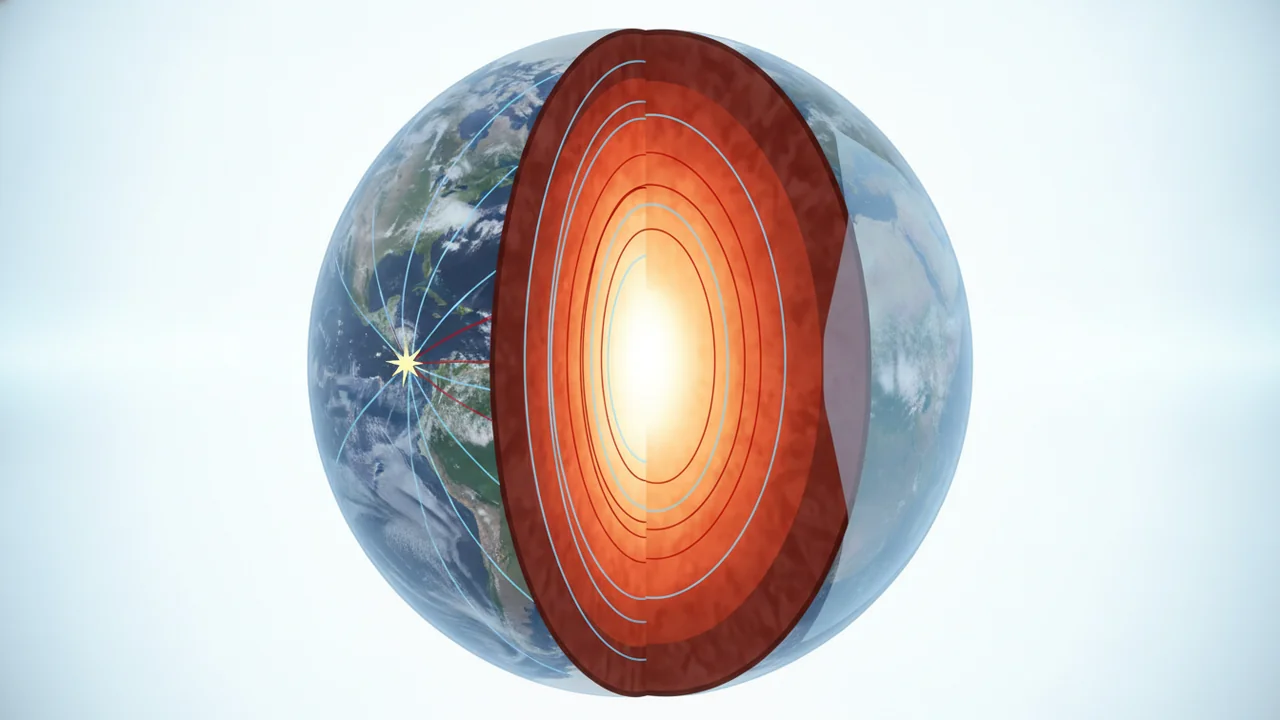
What the waves reveal. Seismometers around the world show that waves speed up with depth and bend (refract) as they cross layers, and that some boundaries reflect them. More than about 104° of arc away from a large earthquake, direct S waves vanish: there is an S-wave shadow zone on the far side of the planet. In 1914 Beno Gutenberg used such evidence to place the core-mantle boundary at about 2,900 km depth, and the missing S waves show that the outer core is liquid. In 1936 Inge Lehmann found faint P waves inside the shadow that could be explained only by a solid inner core. The layers, from outside in: crust (5–70 km thick), mantle (to about 2,900 km), liquid outer core (to about 5,150 km) and solid inner core (to the center, 6,371 km).
Worked example 2: density evidence. Earth’s average density, calculated from its mass (5.97 × 1024 kg) and volume (1.08 × 10²¹ m3), is about 5.5 g/cm3. Surface rocks such as granite are only about 2.7 g/cm3. The interior must therefore hold much denser material: an iron-nickel core, around 10–13 g/cm3, consistent with iron meteorites. The layers are sorted by density, densest at the center.
A solid mantle that flows. The mantle lets S waves through, so it is solid. But over millions of years hot rock creeps like very stiff putty. Heat left over from Earth’s formation and heat from the radioactive decay of uranium, thorium and potassium warm the rock; warm rock expands, becomes less dense and rises; cold ocean plates, denser than the mantle around them, sink at subduction zones. This thermal convection cycles matter between the surface and the deep Earth, and heat escapes at the surface, most of all at mid-ocean ridges. Seismic images (tomography) show cold slabs of old sea floor sinking deep into the mantle. The plates are the cold top of the convecting system, and the pull of sinking slabs is thought to be the largest force moving them. Convection in the liquid iron of the outer core also generates Earth’s magnetic field, the field recorded in the sea-floor stripes of 3.01.
Guided Exercises ~15 min
Use your spring-toy data and the triangulation map.
Independent Practice ~10 min
Write up the lab in your Fault Notebook.
Claim: how do P and S waves differ in particle motion and speed? Use your ribbon observations and timings as evidence, and explain why a liquid could carry a P wave but not an S wave. Then compare with real Earth (P about 6 km/s, S about 3.5 km/s) and say whether the spring is a good model of speed as well as motion.
Where is the epicenter on your map, and how close did the three circles come to crossing at one point? Name two sources of error (reaction time, uneven stretching, pencil-line width) and how you would reduce each.
Closure ~5 min
Seismic waves show a layered Earth with a convecting mantle. Next class we measure how fast the fault at the top of that system moves.
How confident are you that you can I can use seismic waves to locate an earthquake and explain how they reveal Earth's layers and mantle convection.
Exit ticket: name one observation that shows the outer core is liquid and explain the reasoning in one sentence.
Teacher notes
Timing: Poly ran this lab over two 50-minute periods. Run the spring-toy waves and timing on day 1 and the triangulation, USGS event and interior model on day 2.
Materials (per group): spring toy, stopwatch, meter stick, masking tape, ribbon, printed map with a scale, compass, ruler, calculator, goggles.
Alternative: use the PhET Wave on a String sim for transverse (S-like) pulses and a printed diagram of compressional pulses; complete the same triangulation on the printed map.
Listen for: “the mantle is liquid magma”; “S waves are slower because they are weaker”; thinking one station can locate an earthquake.
Support / stretch: give a worked triangulation for Station A. Stretch: derive d = 8.4 × lag from the two speeds and redo it for P = 8 km/s and S = 4.5 km/s in the upper mantle.