3.07 Three Crossing Designs and a Decision Matrix
set a design offset from fault data, define measurable criteria and constraints, and choose a water-main crossing with a weighted decision matrix.
- I can describe how measuring parent and daughter atoms from radioactive decay helps determine the ages of rocks.
- I can identify and describe data about the ages and locations of continental rocks, and rocks on opposite sides of mid-ocean ridges, that are relevant to explaining crustal rock ages.
- I can describe how the type and location of plate boundaries relate to the type, age, and location of crustal rocks.
- I can explain how internal processes like volcanism, mountain building, and tectonic uplift build up Earth’s surface over time, and how surface processes like weathering and erosion wear it down.
- I can describe how internal and surface processes interact and affect each other, such as how mountain building can change weather patterns and influence erosion rates.
- I can relate the rate of change in Earth’s features to the time scales of the processes involved, identifying which features change slowly or quickly based on the processes acting on them.
Phase 4: Build
Warm-Up ~5 min
Do Now. Your 3.04 exit ticket found that about 5.6 m of slip has been stored on the crossing’s stretch of the fault in 160 years. Should the pipe be designed for exactly 5.6 m? Write yes or no and one reason.
Which criterion is measurable enough to test on a model?
Instruction ~10 min
Setting the design offset (sample site data). The utility’s geologist dug a trench across the fault near the crossing and found evidence of four past large earthquakes. Their offsets were about 4.5 m, 6.0 m, 5.0 m and 7.0 m (sample data). The stored slip since the last event is 0.035 m/yr × 160 yr ≈ 5.6 m. Because the next earthquake could come early or late, and past events varied, the class adopts a design offset equal to the largest observed past slip, 7 m, sideways along the fault.
Class criteria and constraints. Criteria: (1) the pipe survives a 7 m sideways offset without breaking; (2) water service can be restored within 24 hours, using shut-off valves on both sides; (3) the design does not block or re-route the stream channel; (4) the crossing can be inspected easily. Constraints: a budget of 100 sample “utility points”; the crossing must stay inside a 200 m wide right-of-way; the pipe diameter is fixed by the city’s demand.
Three concepts. Teams sketch all three before choosing.
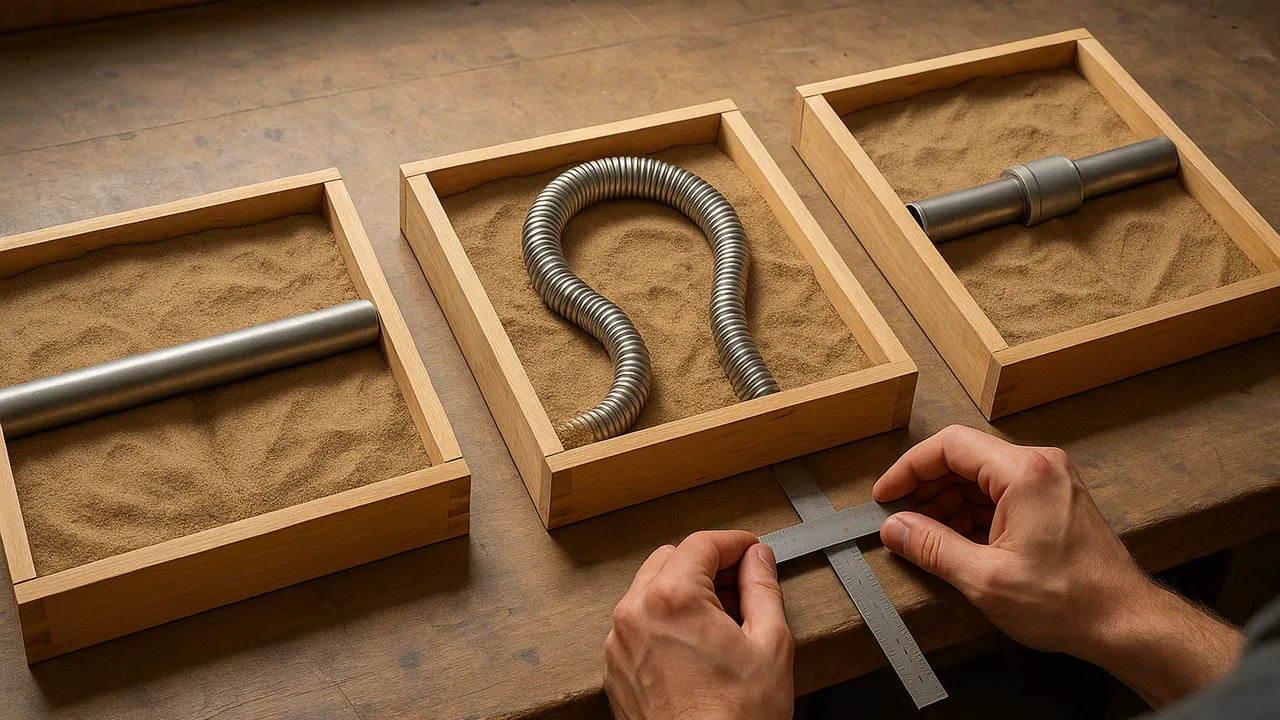
- A. Buried flexible crossing: the pipe lies in a wide, shallow trench filled with loose sand so the ground can shift around it, with ball-and-socket joints that let it bend.
- B. Above-ground slider crossing: the pipe rests on long horizontal beams with low-friction shoes, so it can slide sideways when the ground moves.
- C. Oversized vault: the pipe runs inside a large buried concrete box that leaves room for it to shift, with flexible couplings where it enters and leaves.
Worked example 1: how much extra length? Suppose the pipe is held by anchors 50 m from the fault on each side, so 100 m of pipe is free to move. A 7 m sideways offset moves one anchor 7 m along the fault. The new straight-line distance between anchors is √(1002 + 72) = √10,049 ≈ 100.24 m. The pipe must lengthen by about 0.24 m, or slide, or bend, or it breaks. Doubling the free length to 200 m cuts the stretch: √(2002 + 72) ≈ 200.12 m, only 0.12 m. Spreading the offset over a longer free length is one reason designs A and B leave the pipe unanchored near the fault.
Worked example 2: a weighted decision matrix (sample scores). Score each concept 1–5 on each criterion, multiply by the weight, and add.
| Criterion (weight) | A Buried flexible | B Slider | C Vault |
|---|---|---|---|
| Survives 7 m offset (3) | 3 | 5 | 4 |
| Service restored in 24 h (2) | 3 | 4 | 4 |
| Fits budget (2) | 4 | 3 | 2 |
| Protects the stream channel (2) | 4 | 2 | 3 |
| Easy to inspect (1) | 2 | 5 | 4 |
| Weighted total |
Totals: A = 9 + 6 + 8 + 8 + 2 = 33; B = 15 + 8 + 6 + 4 + 5 = 38; C = 12 + 8 + 4 + 6 + 4 = 34. B wins, but its weakest row is the stream channel. A smart team keeps B and moves the crossing to the far side of the right-of-way, well away from the channel, with a low profile. The matrix makes the trade-off visible.
Prototype. Each team builds version 1 at 1:100 scale for a fault box: two shoebox lids or shallow trays side by side, filled with damp sand. The joint between them is the fault. At 1:100, the 7 m design offset is a 7 cm slide. Model pipes: a stiff drinking straw (a rigid pipe), flexible aquarium tubing, or short straw segments joined with pipe cleaners (ball joints).
Guided Exercises ~15 min
Complete your team’s decision matrix, then check these cards.
Independent Practice ~10 min
Build version 1.
Build your 1:100 version 1 in the fault box. Sketch or photograph it, list its materials and their cost in utility points, mark where the valves would go, and predict what will happen to the pipe when the tray slides 7 cm.
Closure ~5 min
Version 1 exists. Next class we slide the fault and see what survives.
Exit ticket: which criterion is your version 1 most likely to fail, and why?
Teacher notes
Materials (per team): two shoebox lids or shallow trays, damp sand, stiff straws, bendy straws, aquarium tubing, pipe cleaners, tape, scissors, rulers, a cutting mat, goggles, and a “utility points” price list (sample: tubing 10 per 30 cm, straw 2, pipe cleaner 1, cardboard beam 5, ‘valve’ bead 4).
Setup: the class fixes the criteria, the 7 m design offset and the constraints at the start; 3.08 and 3.09 test against these exact values. Point out that this follows HS-ETS1-1 (criteria and constraints), HS-ETS1-2 (breaking the problem into slip, shaking and repair) and HS-ETS1-3 (trade-offs).
Listen for: designing for the slip rate instead of the earthquake offset; choosing by excitement instead of the matrix; scale errors.
Support / stretch: give a half-filled matrix. Stretch: change the survival weight from 3 to 2 and see whether the winner changes.