3.08 Fault-Box Critique, Offset Test and Version 2
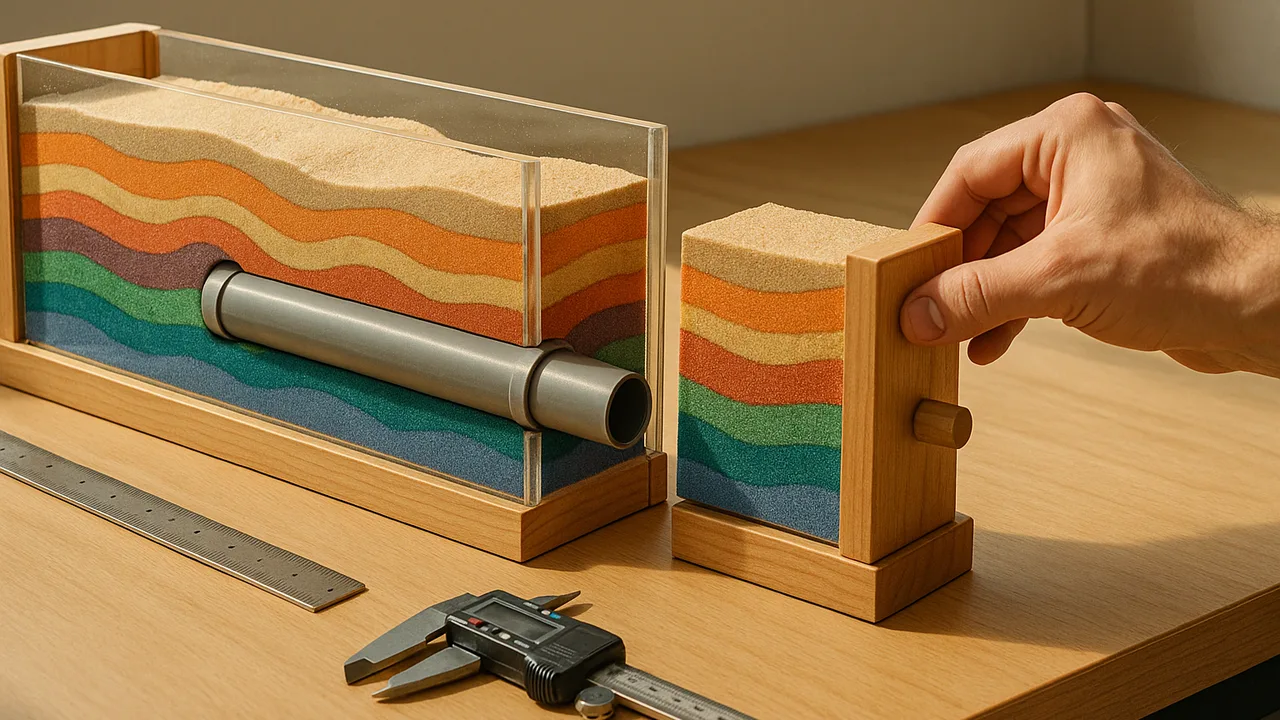
test version 1 against the class criteria in a scale fault box, evaluate the evidence behind our design numbers, give and use peer critique, and build an improved version 2.
- I can use additional evidence to assess and evaluate how valid the given evidence is for explaining the ages of crustal rocks.
- I can evaluate the reliability, strengths, and weaknesses of the given evidence and explain how well it supports arguments about plate motion.
Phase 4: Build
Warm-Up ~5 min
Do Now. Reread your exit ticket from 3.07. Write the one measurement that would tell you, most clearly, whether your pipe survived.
A good critique names a specific part of the design and suggests a change that could be tested.
Instruction ~10 min
The offset test. Each team runs its fault box three times. Before the slide, pour 250 mL of water through the model pipe and time it. Slide one tray 7 cm along the fault, slowly and steadily. Then (1) look for kinks, tears or pulled-out joints, (2) measure the sharpest bend angle with a protractor, and (3) time 250 mL of water again. A pipe that leaks or takes more than twice as long counts as a failure.
| Trial | Flow time before (s) | Flow time after (s) | Sharpest bend (°) | Leak or tear? | Pass? |
|---|---|---|---|---|---|
| 1 | |||||
| 2 | |||||
| 3 |
Gallery critique. Half of each team stays with the fault box; the other half visits. Visitors use I like… I wonder… What if… on sticky notes, then the halves swap.
Worked example 1: reading the test data (sample data). Priya’s team built concept A with a stiff straw. Flow time rose from 6 s to 19 s and the straw folded flat at the fault in all three trials: fail. The sticky notes said, “I wonder if the sand grips the pipe too tightly.” Version 2 used flexible tubing in looser, drier sand with no anchor within 10 cm of the fault. Flow times after the slide were 7 s, 6 s and 8 s, bends about 35°: pass in three of three.
Worked example 2: how good is our design number? A design is only as good as the evidence behind its numbers. The 7 m design offset rests on one trench with four past earthquakes (sample data). Strengths: it measures this fault at this place, and the stored slip from the slip rate (5.6 m) is in the same range. Weaknesses: four events is a small sample; offsets measured in trenches have uncertainties of tens of centimeters; and a nearby fault strand could also slip. A second trench, GPS data and the sizes of offset channels along the fault would make the number stronger. Engineers state these limits and often add a margin of safety.
Iterate, do not restart. Change one or two things at a time and retest, so you know which change made the difference.
Guided Exercises ~15 min
Use your test data and sticky notes.
Independent Practice ~10 min
Build and retest version 2.
List the two changes your team will make for version 2, each with the sticky note or data that led to it. Build version 2, retest it three times, and write three sentences comparing version 1 and version 2 with numbers, plus one limitation of a sand-box test.
🔎 Mini case study: The pipeline built to slide ~8 min
In the 1970s, engineers designing the Trans-Alaska oil pipeline had to carry it across the Denali Fault, a major strike-slip fault. Geologists studied the fault’s past offsets, and the crossing was designed to allow several meters of sideways movement. Instead of burying the pipe, the engineers set it above ground on long horizontal steel beams, with low-friction shoes so the pipe could slide and flex.
In November 2002 a magnitude 7.9 earthquake ruptured the Denali Fault, and the ground at the crossing shifted roughly 4 m sideways. The pipe slid along its beams as designed. Some supports were damaged, but the pipe did not break and no oil spilled, and the line was back in service within days. The design worked because it was based on evidence about the fault and allowed for the motion instead of resisting it.
Think about it: Which of our three concepts is closest to this design? What evidence did the engineers need, and what does the story say about designing for a number with a margin of safety?
Closure ~5 min
Version 2 is tested. Next phase we write the public explanation and present the crossing to the utility.
Exit ticket: which change from version 1 to version 2 made the biggest difference, and what is your evidence?
How confident are you that you can I can evaluate the evidence behind a design number and use test data to improve a design.
Teacher notes
Materials: version 1 fault boxes, a measuring cup, water, a funnel, a stopwatch, protractors, sticky notes in two colors, materials for the rebuild, towels.
Setup: 15 minutes offset tests, 10 minutes gallery critique, 15 minutes rebuild and retest, 8 minutes case study. Run water tests over a tub. If time is short, retest at the start of 3.09.
Listen for: vague critique; changing everything at once; claims that a sand-box pass proves a real pipe is safe; treating one trench as certain.
Support / stretch: give critique sentence starters. Stretch: compute the standard deviation of the four trench offsets and argue for a design offset of mean plus two standard deviations.