4.07 Designing the Half-Life Interactive and Drafting the Panels
compare competing designs for a museum half-life model with a weighted decision matrix, build version 1 that correctly models decay for real clocks, and draft exhibit panels that explain radiometric dating and Earth’s age with evidence.
- I can develop and use models to show how fission, fusion, and three types of radioactive decay (alpha, beta, gamma) change the nucleus of an atom.
- I can use evidence from radiometric dating of lunar rocks, meteorites, and Earth’s oldest rocks to explain that the solar system formed about 4.6 billion years ago and Earth’s solid crust formed about 4.4 billion years ago.
- I can use patterns of impact cratering on other planetary surfaces to infer that Earth also had many impact craters early in its history.
- I can reason that the scarcity of impact craters and the younger age of most rocks on Earth compared to other solar system bodies is due to processes like volcanism, plate tectonics, and erosion reshaping Earth’s surface.
Phase 4: Build
Warm-Up ~5 min
Do Now. A museum designer suggests using an hourglass to show half-life: “the sand runs out like the atoms do.” Write one thing that is good about the idea and one thing that is scientifically wrong.
In an hourglass, half the sand falls in the first 2 minutes. How long until three-quarters has fallen?
Instruction ~10 min
The design brief. The museum’s gallery needs one interactive station near the zircon display. Visitors should leave able to say, “Half of the parent atoms change every half-life, and scientists read the age from how much daughter has built up.” Our model from 4.03 and our clocks from 4.04 are the science; now we design for real visitors.
Four competing concepts.
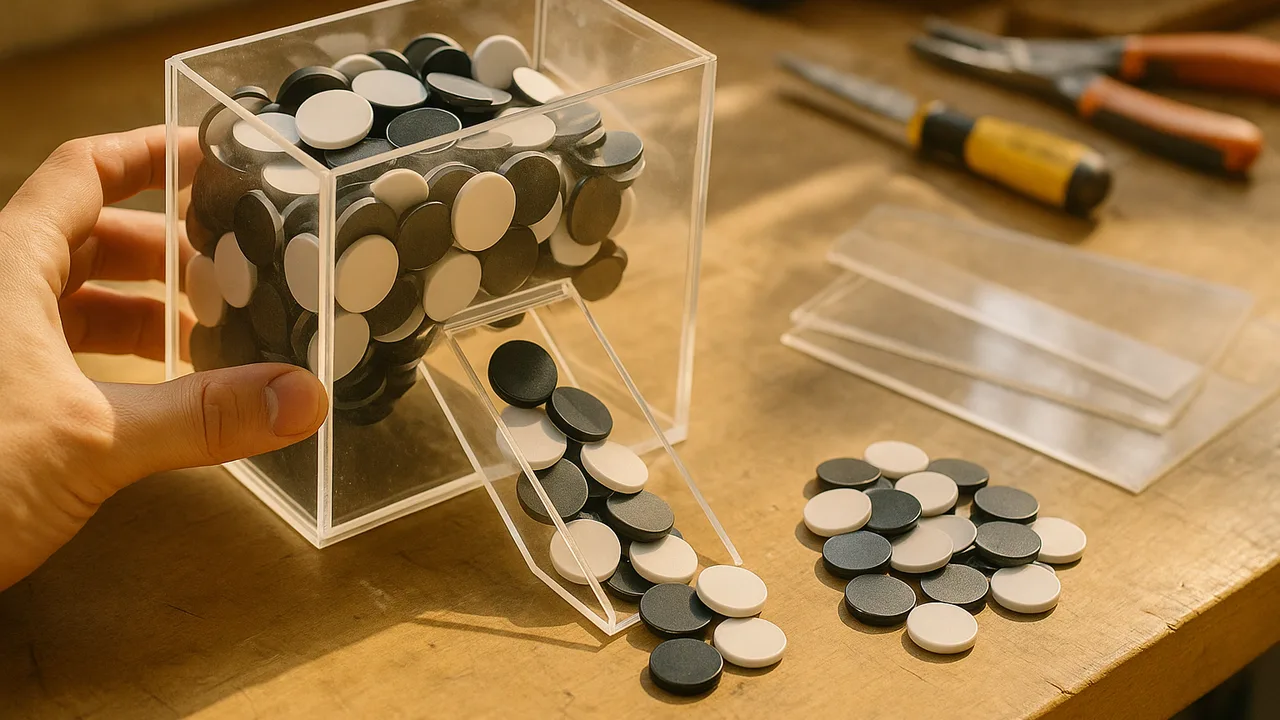
- A. Shake box. A sealed clear box of 100 two-sided tokens. A visitor shakes, then slides the “decayed” tokens into a daughter channel and reads a count. Hands-on and random like real decay, but only 100 “atoms,” so the counts scatter, and staff must reset it.
- B. Decay dial. A sturdy rotating wheel. Turn it to 1, 2, 3… half-lives and a window shows a shaded circle for the parent left and the daughter made, with a scale for each clock in years.
- C. Digital slider. A tablet or spreadsheet with an isotope menu and a time slider; a graph of parent and daughter updates as the visitor drags.
- D. Hourglass. Simple and familiar, but it models a straight-line loss, not halving.
Class criteria and constraints for the interactive (sample values set by the class). The half-life model must (1) show the correct exponential shape: after 1, 2 and 3 half-lives it shows 50%, 25% and 12.5% of the parent remaining, within 5 percentage points; (2) show parent and daughter together, so the ratio is visible; (3) be usable by a 10-year-old visitor in under 2 minutes without staff help; (4) work for at least two real clocks (carbon-14 and uranium-238); (5) be readable without relying on color alone and reachable from a seated position; and (6) cost no more than 15 sample budget points.
Worked example 1: the math behind the slider (concept C). Sofia set up a spreadsheet with time in years in column A. In B2 she typed =100*0.5^(A2/5730) for percent carbon-14 left and in C2 =100-B2 for percent decayed. Results: at 0 years 100 and 0; at 2,865 years 70.7 and 29.3; at 5,730 years 50 and 50; at 11,460 years 25 and 75; at 17,190 years 12.5 and 87.5. Changing 5,730 to 4.47E9 makes the same sheet a uranium-238 clock: the shape is identical, only the time axis stretches. That is the big idea for the panel: every clock follows the same curve.
Worked example 2: a weighted decision matrix (sample scores). Weights: accuracy ×3, shows parent and daughter ×2, usable in 2 minutes ×2, durability ×1, cost ×1. Scores 1–3.
| Criterion (weight) | A Shake box | B Dial | C Slider | D Hourglass |
|---|---|---|---|---|
| Accuracy (×3) | 2 → 6 | 3 → 9 | 3 → 9 | 1 → 3 |
| Parent and daughter (×2) | 3 → 6 | 2 → 4 | 3 → 6 | 1 → 2 |
| Usable in 2 min (×2) | 3 → 6 | 2 → 4 | 3 → 6 | 3 → 6 |
| Durability (×1) | 1 → 1 | 3 → 3 | 2 → 2 | 3 → 3 |
| Cost (×1) | 3 → 3 | 3 → 3 | 1 → 1 | 3 → 3 |
| Total | 22 | 23 | 24 | 17 |
The top three are close, and the hourglass loses because it fails the most heavily weighted criterion. Teams may combine concepts (a dial with a small shake box beside it) if they can still meet the cost constraint. Name what each combination gains and what it costs.
Drafting the panels. Each panel has a question headline (“How old is this charcoal?”), 150–200 words, one balanced nuclear equation, one graphic, and a one-line “Try it” that points to the interactive. Five panels: carbon-14; uranium–lead in zircon; potassium–argon in volcanic ash; Earth’s age from meteorites, Moon rocks, zircons and missing craters; and the medical isotope panel you will research next lesson. A panel about the uranium chain can note that each alpha step is a tiny split of the nucleus, a lopsided fission, while each beta step changes a neutron into a proton without splitting anything.
| Measure | Target | Version 1 | Meets criterion? |
|---|---|---|---|
| % parent shown at 1 / 2 / 3 half-lives | 50 / 25 / 12.5 (±5) | ||
| Parent and daughter both visible | yes | ||
| Time for a test visitor to use it (s) | < 120 | ||
| Clocks supported | C-14 and U-238 | ||
| Budget points | ≤ 15 |
Guided Exercises ~15 min
Answer before you choose your concept.
Independent Practice ~10 min
Fill your own decision matrix, build version 1 and draft two panels.
Score all four concepts with your team's weights. Write a claim about which to build, citing two rows of the matrix and one reason from the physics of decay. Then record version 1's test results in the measures table.
Draft the carbon-14 panel and the Earth's Age panel (150–200 words each). The Earth's Age panel must use at least three kinds of evidence (meteorites, Moon rocks, zircons, crater patterns) and explain why Earth's oldest rocks are younger than the planet.
🔎 Mini case study: Clair Patterson: dating the Earth in a clean room ~8 min
In the early 1950s the geochemist Clair Patterson set out to measure the age of Earth from the isotopes of lead. His idea was to date meteorites, assuming they formed at the same time as Earth from the same material. He compared the lead in an iron meteorite, which contains almost no uranium and so preserves the solar system’s starting lead, with lead from stony meteorites and Earth sediments. In 1956 he published an age of 4.55 billion years, give or take about 70 million years. Today’s best value, 4.54 billion years, is almost the same.
The hardest part was not the math. Patterson’s early measurements kept showing far too much lead. He traced the problem to contamination: lead was in the air, the dust, the glassware and the water, largely from leaded gasoline. He built one of the first ultra-clean laboratories, with filtered air and acid-washed equipment, to get trustworthy numbers. He then spent decades presenting evidence that lead pollution was harming people, which helped lead to leaded gasoline being phased out of road fuel around the world.
Think about it: Which assumption of radiometric dating did lead contamination threaten, and how did Patterson’s clean room protect it? Which of your design choices protects your model’s accuracy in the same way?
Closure ~5 min
Version 1 and two draft panels exist. Next class: gallery critique, the medical isotope panel and version 2.
Exit ticket: write the one sentence your interactive should leave every visitor able to say, and explain how your design makes it happen.
Teacher notes
Materials (per team): card stock, poster board, brass fasteners for dials, a clear lidded box and 100 two-sided counters, laptops or tablets with a spreadsheet, scissors, rulers, markers, glue sticks. Panel template with word-count box.
Setup: sample budget prices: poster board 2 points, card stock 1, lidded box 3, 100 counters 2, tablet station 8, printed graph 1. Test visitors can be students from another class or staff; time them with a phone.
Answers: 22,920 years = 4 half-lives, 6.25%. Dial at 3 half-lives on U-238: 13.4 billion years, a teaching point that the uranium scale needs only about one half-life to cover Earth’s history.
Listen for: “after two half-lives it’s all gone” in panel drafts; panels that say carbon dating shows Earth’s age; designs chosen for looks with no data.
Support / stretch: a sub-problem flowchart and a panel sentence bank. Stretch: add a uranium-235 → lead-207 column to the spreadsheet and show why the Pb-207/Pb-206 ratio alone can date a very old sample.