3.01 Shells in Vinegar: What Makes Something an Acid?
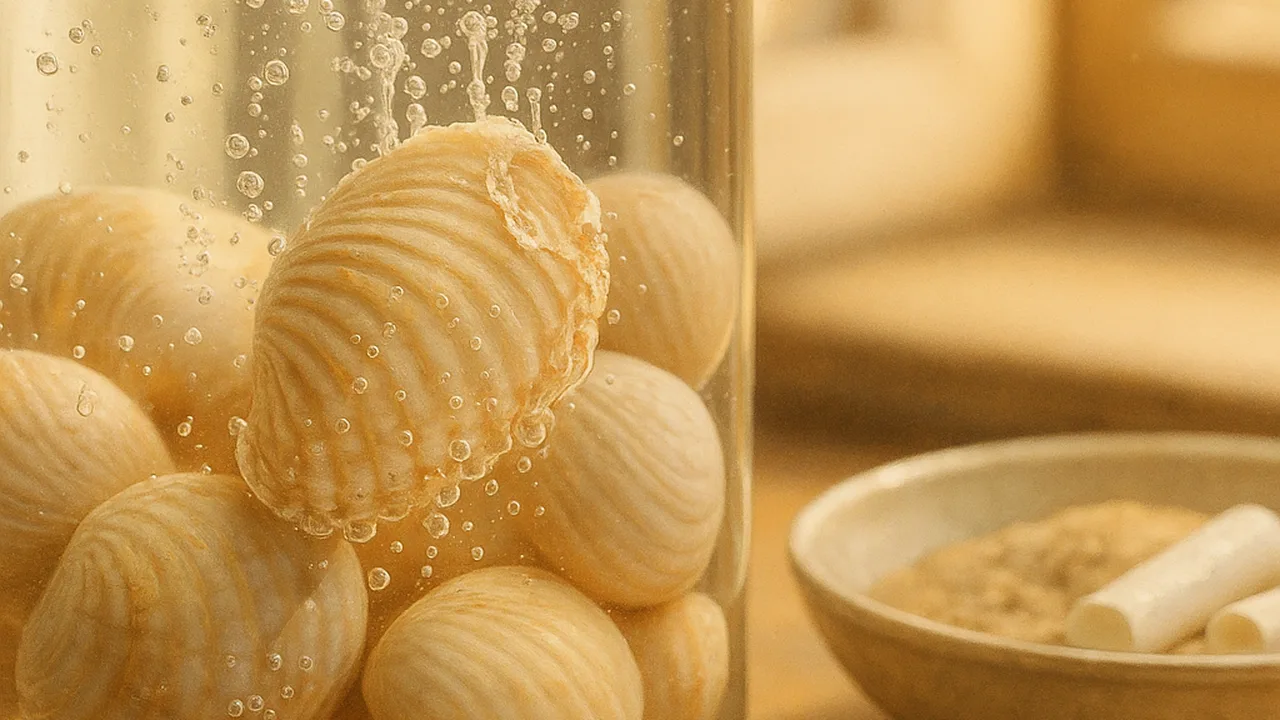
Shells in Sour Water: A Water Chemistry Brief for a Shellfish Hatchery
Why do oyster and clam larvae die when CO2-rich water reaches a hatchery’s intake, how is that water connected to the carbon in the air, the rocks and living things, and how can the hatchery protect its larvae as atmospheric CO2 keeps rising?
The mystery: Drop a piece of chalk or a seashell into vinegar and it fizzes and slowly disappears. Along cold, windy coasts, shellfish hatcheries have watched most of a week’s oyster larvae die on days when deep, CO2-rich water welled up to the surface and flowed into their tanks; the larvae could not build their first shells.
describe acids and bases with the Arrhenius and Brønsted–Lowry models, write the balanced equation for calcium carbonate dissolving in acid, and explain where the carbon in a shell goes.
- I can identify and compare the amounts of carbon found in the hydrosphere, atmosphere, geosphere, and biosphere.
- I can create a model that shows how carbon moves between the hydrosphere, atmosphere, geosphere, and biosphere.
Phase 1: Spark
Warm-Up ~5 min
Do Now. Your teacher sets a seashell and a piece of calcium carbonate chalk in two cups of white vinegar on a balance. Before you watch: predict what you will see in the cups and what will happen to the balance reading over ten minutes. Give a reason.
A cup of vinegar with a seashell in it sits on a balance. What happens to the total mass reading over ten minutes?
Instruction ~10 min
The phenomenon. Shells, chalk, limestone, marble and eggshell are all made mostly of calcium carbonate, CaCO3. Drop any of them in vinegar and bubbles stream off the surface; leave a thin shell overnight and it turns soft or falls apart. Along cold, windy coasts, shellfish hatcheries have seen the same chemistry at work in a slower, deadlier form: on some days the seawater pumped into their tanks was just acidic enough that oyster larvae could not build their first shells, and most of a batch died. This unit explains that water, where its carbon comes from, and what a hatchery can do about it.
The Arrhenius model. The first useful definition, from the 1880s: an acid is a substance that produces hydrogen ions (H+) when it dissolves in water, and a base produces hydroxide ions (OH−). Hydrochloric acid, HCl → H+ + Cl−, is an Arrhenius acid; sodium hydroxide, NaOH → Na+ + OH−, is an Arrhenius base. In water a bare H+ never floats alone; it attaches to a water molecule as the hydronium ion, H3O+. Chemists write H+ and H3O+ interchangeably.
The Brønsted–Lowry model. Arrhenius cannot explain why carbonate, which contains no hydroxide, acts as a base. The broader model: an acid is a proton donor and a base is a proton acceptor (an H+ ion is just a proton). When an acid gives away its proton, what is left is its conjugate base; when a base accepts a proton, it becomes its conjugate acid. Carbonate, CO32−, is a base because it accepts protons: CO32− + H+ → HCO3−.
Worked example 1: naming the pairs. Acetic acid, the acid in vinegar, reacts with water: CH3COOH + H2O ⇌ H3O+ + CH3COO−. Amara labeled it: CH3COOH donates a proton, so it is the acid; water accepts it, so water is the base. The conjugate pairs are CH3COOH / CH3COO− and H3O+ / H2O. She noticed that water can also act as an acid (with ammonia, for example); a substance that can do both is amphoteric. Bicarbonate, HCO3−, is amphoteric too, and that will matter for seawater.
Why the shell dissolves. Acid supplies protons; carbonate accepts them. In vinegar the overall reaction is CaCO3(s) + 2CH3COOH(aq) → Ca(CH3COO)2(aq) + H2O(l) + CO2(g). Written with just the ions that change: CaCO3 + 2H+ → Ca2+ + H2O + CO2. The solid becomes dissolved calcium ions, water and a gas. The same reaction runs, far more slowly, whenever seawater holds extra H+.
Worked example 2: where the carbon goes. Jonah’s chalk piece has a mass of 1.00 g. CaCO3 has a molar mass of 40.08 + 12.01 + 3(16.00) = 100.09 g/mol, so the chalk is 1.00 ÷ 100.09 = 0.00999 mol. The equation makes 1 mol CO2 per mol CaCO3, so 0.00999 mol × 44.01 g/mol = 0.440 g of CO2 leaves the cup if the chalk dissolves completely. That is the mass drop the balance should show (assuming the chalk is pure). Every one of those carbon atoms moved from a solid to the air.
Carbon has many homes. The carbon in a shell is part of the geosphere once the shell sinks and becomes limestone. Carbon also sits in the atmosphere (as CO2), the hydrosphere (mostly as dissolved bicarbonate in the ocean) and the biosphere (in living and dead organisms). By far the most carbon on Earth is locked in sedimentary rocks such as limestone, tens of millions of billions of tonnes; the deep ocean holds about forty times as much as the atmosphere. Our shell in vinegar just moved a tiny bit of geosphere carbon into the atmosphere.
Reading. OpenStax Chemistry 2e, chapter 14.1 (Brønsted–Lowry acids and bases) and chapter 4.2 (classifying chemical reactions: acid–base and gas-forming reactions), CC BY 4.0.
Guided Exercises ~15 min
Work with a partner. Label every acid, base and conjugate in writing.
Independent Practice ~10 min
In your Water Chemistry Notebook, label the acid, base, conjugate acid and conjugate base in each reaction.
- HCl + H2O → H3O+ + Cl−
- NH3 + H2O ⇌ NH4+ + OH−
- H2CO3 + H2O ⇌ H3O+ + HCO3−
- CO32− + H3O+ → HCO3− + H2O
In reactions 2 and 3, water plays two different roles. Name the role in each and explain what word describes a substance that can do both.
The demonstration shell lost 0.31 g on the balance (sample). Estimate the mass of CaCO3 that dissolved, showing the mole steps, and name one reason the real shell may differ from pure CaCO3.
Closure ~5 min
We have a phenomenon and two models of acids. Next class, you meet the hatchery that needs them, and we build the Wonder Board.
Exit ticket: in two sentences, explain why a shell dissolves in vinegar. Use the words proton and carbonate.
Teacher notes
Materials: a top-loading balance (0.01 g), two clear cups, white vinegar (5%), a clean seashell piece and a calcium carbonate chalk stick, splash goggles, a projector or document camera for the balance reading.
Check your chalk. Much classroom chalk is calcium sulfate (gypsum) and barely fizzes. Use sidewalk chalk labeled calcium carbonate, a plain calcium carbonate antacid tablet, or eggshell. Test it in vinegar before class.
Listen for: “the shell is melting”; “the mass disappeared”; acids described only as “things that burn.”
Support / stretch: give a two-column frame (gives H+ / takes H+) for labeling pairs. Stretch: explain why phosphoric acid, H3PO4, can donate three protons in turn and name each conjugate base.