1.05 One Equation for Every Gas: Combined Gas Law, PV = nRT and Partial Pressures
use the combined and ideal gas laws to find balloon volumes and moles of helium, use molar volume and Dalton’s law, and find the molar mass of carbon dioxide collected over water.
- I can describe how changes in the positions of objects in gravitational, magnetic, or electrostatic fields affect the energy stored in those fields.
- I can explain that thermal energy includes both the kinetic and potential energy of particle vibrations in solids or molecules, and the kinetic energy of freely moving particles in liquids and gases.
- I can describe how the total energy of a system and its surroundings is conserved at both the macroscopic and molecular/atomic levels.
- I can use my models to illustrate that energy at the macroscopic scale can be explained as a combination of energy from the motion of particles or objects and energy from their relative positions, at both the macroscopic and microscopic scales.
Phase 3: Make Sense
Warm-Up ~5 min
Do Now. On the way to 10 km, the balloon’s outside pressure drops to about a quarter and its temperature drops from 288 K to 223 K. Write which change makes the balloon bigger, which makes it smaller, and which you think wins.
Which change in conditions makes a balloon's volume increase?
Instruction ~10 min
Combining the laws. Boyle’s and Charles’s laws join into one relationship for a fixed amount of gas: P1V1/T1 = P2V2/T2, with T in kelvin. This combined gas law is the main tool for the flight profile, because pressure and temperature both change on the way up.
Worked example 1: the balloon at 10 km. Priya used the station’s plan: 2.0 m3 at 101.3 kPa and 288 K. At 10 km: 26.5 kPa, 223 K. V2 = V1 × (P1/P2) × (T2/T1) = 2.0 × (101.3/26.5) × (223/288) = 2.0 × 3.82 × 0.774 = 5.9 m3. Pressure alone would give 7.6 m3; the cold takes back about a fifth. The pressure effect wins by a wide margin, and it keeps winning all the way up.
The ideal gas law. Adding the amount of gas, n (in moles), gives one equation for any gas that behaves ideally: PV = nRT. The gas constant R = 8.314 L·kPa/(mol·K) (equal to 8.314 J/(mol·K)), or 0.08206 L·atm/(mol·K). Use units that match R: kPa, liters, moles, kelvin. Real gases behave ideally when particles are far apart and moving fast, which is true for helium and air at the conditions of the whole flight.
Worked example 2: how much helium? Marisol found the moles and mass for the 2.0 m3 fill (2,000 L) at 101.3 kPa and 15 °C (288 K): n = PV/RT = (101.3 × 2,000) / (8.314 × 288) = 84.6 mol. Helium’s molar mass is 4.003 g/mol, so the mass is 84.6 × 4.003 = 339 g. About a third of a kilogram of gas fills a balloon taller than a person.
Molar volume. PV = nRT says that equal volumes of different gases at the same T and P hold equal numbers of particles (Avogadro’s law). One mole of any ideal gas fills 22.4 L at 0 °C and 1 atm (STP), and 23.6 L at 15 °C and 101.3 kPa. Check: 2,000 L ÷ 23.6 L/mol = 84.7 mol, matching example 2 within rounding.
PV is an energy. Check the units: 1 kPa × 1 L = 1,000 N/m2 × 0.001 m3 = 1 N·m = 1 J. For an ideal gas the total kinetic energy of all its particles is (3/2)nRT = (3/2)PV. The launch balloon holds (3/2) × 101.3 kPa × 2,000 L ≈ 304,000 J of particle motion. A large-scale reading you can take with a gauge and a tape measure is really a count of tiny particles’ motion; for a gas, almost none of the energy is in particle positions, because the particles barely attract one another.
Dalton’s law of partial pressures. In a mixture, each gas hits the walls independently, so the total pressure is the sum of each gas’s partial pressure: Ptotal = P1 + P2 + … Each partial pressure is the gas’s mole fraction times the total. Dry air is 78.08% N2, 20.95% O2 and 0.93% Ar by moles. At sea level PO2 = 0.2095 × 101.3 = 21.2 kPa; at 10 km it is 0.2095 × 26.5 = 5.55 kPa, which is why aircraft cabins are pressurized.
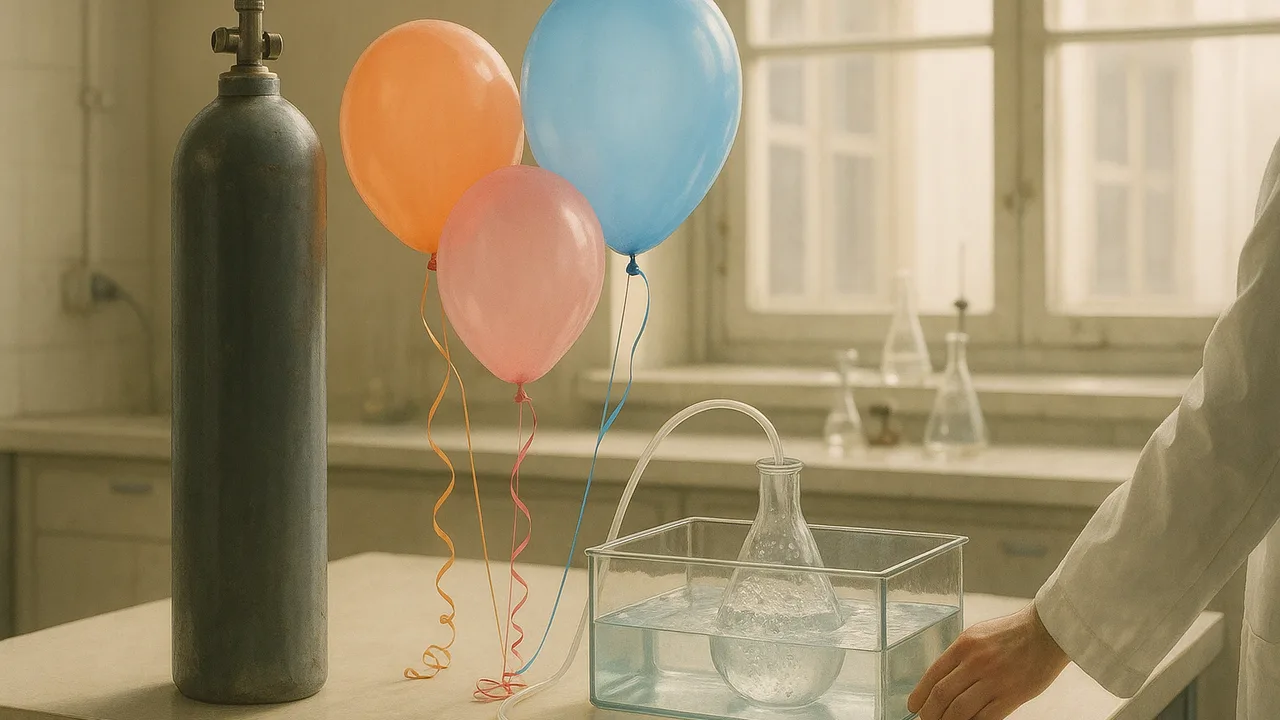
Today’s lab: molar mass of CO2 collected over water. A quarter of an effervescent antacid tablet reacts in a flask of water and gives off carbon dioxide, which travels through a tube into an upside-down bottle filled with water in a tub. Gas collected over water is wet: Proom = PCO2 + PH2O. Water’s vapor pressure is 2.64 kPa at 22 °C (standard vapor-pressure tables). Weigh the flask before and after to get the mass of CO2 that left. Sample data: 120. mL collected at 22 °C, room pressure 100.8 kPa, mass lost 0.212 g. PCO2 = 100.8 − 2.6 = 98.2 kPa; n = (98.2 × 0.120) / (8.314 × 295) = 0.00480 mol; molar mass = 0.212 g ÷ 0.00480 mol = 44.2 g/mol. The accepted value is 44.01 g/mol.
Reading. OpenStax Chemistry 2e, sections 9.2 and 9.3 (the ideal gas law, molar volume, Dalton’s law and collecting gases over water), CC BY 4.0.
Guided Exercises ~15 min
Show units in every step. Use R = 8.314 L·kPa/(mol·K).
Independent Practice ~10 min
Start the flight-profile table in your launch notebook.
Use the combined gas law and the standard-atmosphere table to find the balloon's volume at 5, 20 and 30 km for a 2.0 m3 launch at 101.3 kPa and 288 K. Show one full calculation and list the other two answers to two significant figures.
PV = nRT says nothing about what kind of gas it is. Explain, with the particle model, why equal volumes of helium and air at the same temperature and pressure contain equal numbers of particles even though helium atoms are much lighter.
Closure ~5 min
One equation now covers the whole flight. Next class, we ask what is happening to the energy of the gas on the way up.
Exit ticket: the helium in the balloon keeps the same n all flight. Which of P, V and T change on the way to 30 km, and in which direction?
Teacher notes
Materials (per team): a 250 mL flask with a one-hole stopper and tubing, a tub of water, a 250 mL plastic bottle or graduated cylinder to fill and invert, quarter pieces of an effervescent antacid tablet, a balance (0.01 g), thermometer, the room barometer reading, a vapor-pressure table.
Gas choice: the butane-lighter molar-mass lab is not used. It puts a flammable gas into the room. CO2 from an antacid tablet teaches the same ideas (collecting over water, Dalton’s correction, PV = nRT) with no fire risk. If your department chooses to show the butane version, it is a teacher demo only, with no ignition sources in the room.
Listen for: Celsius in PV = nRT; mL not converted to L; “heavier gases take up more room.”
Support / stretch: give a units grid (P in kPa, V in L, T in K). Stretch: compute the density of air and of helium at 101.3 kPa and 288 K from d = PM/RT (1.23 and 0.169 kg/m3) and explain why the balloon rises.