2.09 Performance Task: The Rate and Stability Brief
explain at the molecular level what speeds up and slows down peroxide decomposition, support it with my rate data, and justify a refined equilibrium-based indicator and storage plan against prioritized criteria and constraints.
- I can explain that molecules must collide to break bonds and form new molecules during a reaction.
- I can describe how the probability of bonds breaking in a collision depends on whether the colliding molecules have enough kinetic energy.
- I can explain that higher temperature means molecules have more kinetic energy, so collisions are more likely to break bonds and form new molecules.
- I can identify and describe how changing one component of a chemical reaction system (such as adding a reactant or removing a product) will affect the amounts of substances at equilibrium, using evidence and Le Chatelier’s Principle.
- I can explain, at the molecular level, how a change in concentration of one component causes the rates of the forward and backward reactions to change until equilibrium is re-established.
- I can describe a system at equilibrium by explaining that both the forward and backward reactions are happening at the same rate, so the system appears stable overall.
- I can refine a chemical system by making tradeoffs to optimize product formation and explain the reasoning behind my design choices.
Phase 5: Prove It
Warm-Up ~5 min
Do Now. Write your cleaner’s version 2 in one sentence and your indicator’s version 2 in one sentence. Under each, write the single strongest piece of evidence for it.
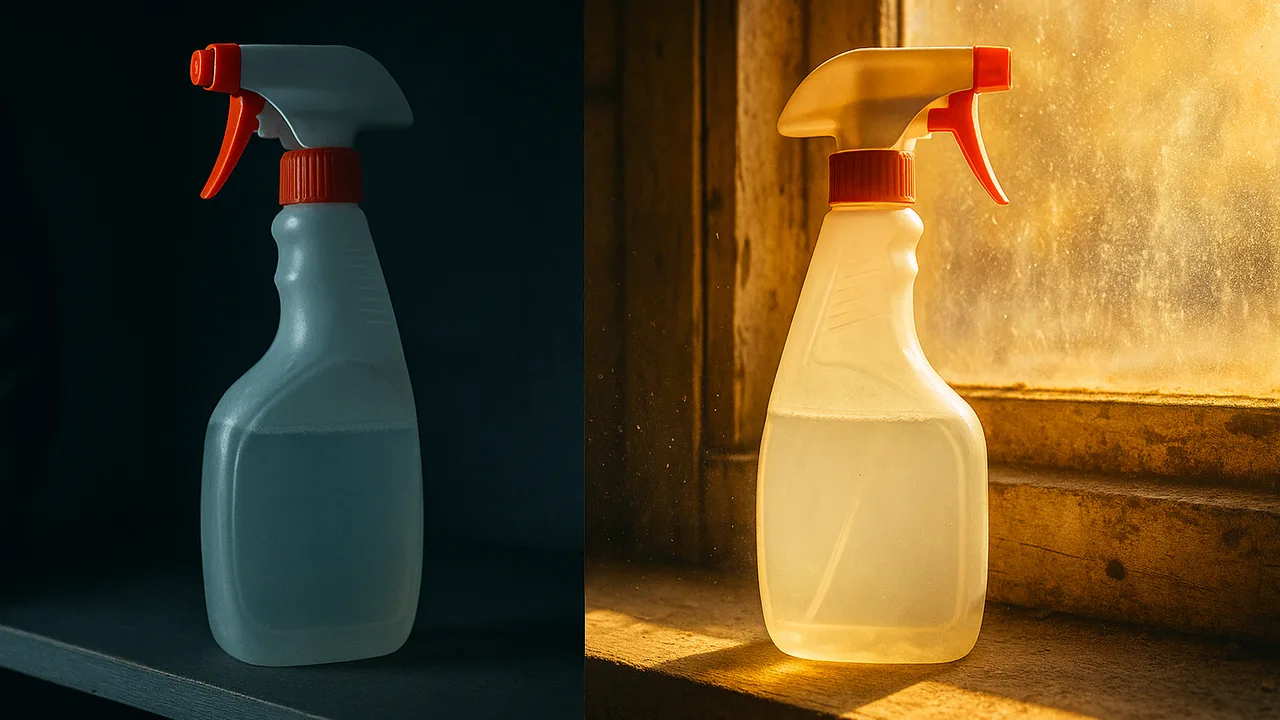
Which sentence explains the window bottle best for the brief?
Instruction ~10 min
The context. Every product on a store shelf is a chemical system changing slowly. Medicines lose potency, foods go stale, cleaners weaken. Companies that make them must explain why, decide how to package and store them, and tell customers when something has spoiled. That is the job you now do for the cleaning co-op.
Your job. Write the rate and stability brief. It has three sections and goes to the co-op’s board, whose members are not chemists, so every technical idea needs a plain-language sentence beside it.
1. Why the rate changes (HS-PS1-5). Explain, with collisions, kinetic energy and activation energy, how temperature, concentration, surface area, catalysts and light change the rate of peroxide decomposition. Include an energy diagram with and without a catalyst. Support each claim with your 2.03 and 2.04 data (at least one graph) and the co-op’s shelf data, and note how precise your trials were. Use the phenomenon: why the flask foamed in seconds and the window bottle faded over a year.
2. The storage-check indicator (HS-PS1-6). Describe the cobalt equilibrium, write its K expression, and explain how temperature and chloride shift it, molecule by molecule, using forward and reverse rates. Show how you refined version 1 to version 2 by shifting the equilibrium, with your tuning data, and the trade-offs you accepted. Address the cobalt safety question from the case study.
3. Recommendations (HS-ETS1-3). Give the co-op your packaging, stabilizer and storage-label advice with your prioritized criteria and decision matrix. State honestly where your evidence is thin, for example that a 7-day hot box is only a stand-in for months on a shelf, and what test the co-op should run next.
Worked example: from a 1-point to a 3-point claim. “Keep it cool” earns 1. “Keep it below 25 °C: our warm cabinet sample kept 84% against 96% in a cool closet” earns 2. Adding “because at lower temperature fewer peroxide molecules collide with enough energy to get over the activation energy hill” earns 3.
Quality bar. Strong briefs never say a catalyst “adds energy” or that equilibrium means “the reaction stopped.” They keep sample data labeled as sample data, cite OpenStax Chemistry 2e chapters 12 and 13 for the science, and do not state a figure they cannot source.
Stages. Plan, draft, peer review with the checklist, revise, and present to the co-op’s members (your class and visitors) for four minutes, live or recorded, answering one question about your evidence.
Guided Exercises ~15 min
Plan and peer-review checks.
Independent Practice ~10 min
Write and revise the brief across the work sessions.
Write section 1 (about 500 words) with your energy diagram and at least one rate graph.
Write sections 2 and 3 with the K expression, the tuning data, the decision matrix and a one-paragraph recommendation to the co-op.
Project task: Rate and Stability Brief (1,000-1,300 words) + four-minute presentation
Task: For the cleaning co-op, explain at the molecular level why hydrogen peroxide decomposes faster or slower under different conditions, support it with your rate data and the co-op’s shelf data, and justify a refined storage-check indicator and storage plan, showing how you shifted the indicator’s equilibrium and what you traded off. Include one energy diagram, one rate graph, the K expression and a prioritized criteria table.
Submission workflow
- Stage 1 — Plan. Outline the three sections, choose your graph and diagram, and list your evidence and sources.
- Stage 2 — Peer-reviewed draft. A partner checks that every rate claim names collisions or energy and every equilibrium claim names forward and reverse rates; submit their notes and your revision plan.
- Stage 3 — Final brief. 1,000–1,300 words with the diagram, graph, K expression, criteria table and cited sources.
- Stage 4 — Presentation and defense. Four minutes to the co-op, live or recorded, answering one question about your evidence or trade-offs.
How it is scored
| Criterion | What proficient looks like |
|---|---|
| Molecular explanation of rate (HS-PS1-5) | Explains each factor with collisions, kinetic energy and activation energy, and supports it accurately with rate data. |
| Equilibrium and Le Chatelier (HS-PS1-6) | Describes dynamic equilibrium, predicts shifts correctly and explains them with forward and reverse rates. |
| Refinement and trade-offs (HS-PS1-6, HS-ETS1-3) | Prioritizes and quantifies criteria and constraints, compares options, and justifies version 2 with data and honest trade-offs. |
| Use of evidence | Uses lab and shelf data with precision noted, labels sample data, and states the limits of the tests. |
| Communication | Clear structure, diagram and graph, plain-language summaries; the presentation answers a question with evidence. |
Closure ~5 min
Your brief turns lab evidence into advice a co-op can use. Next: the unit checkpoint.
Exit ticket: what evidence would make you change your indicator recommendation?
Teacher notes
Timing: the brief runs across about three sessions: this lesson launches it and covers planning and peer review; drafting and presentations need further work time.
Materials: peer-review checklist, all unit data tables, OpenStax links, rubric copies for visiting “co-op members.”
Listen for: “the catalyst gives energy”; “equilibrium means it stopped”; hot-box results treated as exact shelf-life predictions.
Support / stretch: provide a claim-evidence-reasoning frame for each section and a criteria-table template. Stretch: propose a real-time shelf test for the co-op (conditions, sampling times, assay) and say how its data would confirm or overturn the hot-box result.