1.08 Gallery Critique and Version 2: Testing the Payload Box Against the Criteria
give and use evidence-based critique, retest my team’s payload box and flight plan against every criterion, and justify version 2 with energy conservation and the particle model.
- I can use my models to show that in closed systems, energy is conserved at both the macroscopic and molecular/atomic scales, so that as one form of energy changes, the total energy stays constant, as shown by other forms of energy changing by the same amount or only by the energy transferred into or out of the system.
- I can use my models to illustrate that energy at the macroscopic scale can be explained as a combination of energy from the motion of particles or objects and energy from their relative positions, at both the macroscopic and microscopic scales.
Phase 4: Build
Warm-Up ~5 min
Do Now. Reread your version 1 data. Circle the criterion you came closest to missing. Write one change that might fix it without breaking another criterion.
A team's box kept the bottle at 34 °C but weighed 210 g. What is the best version 2 direction?
Instruction ~10 min
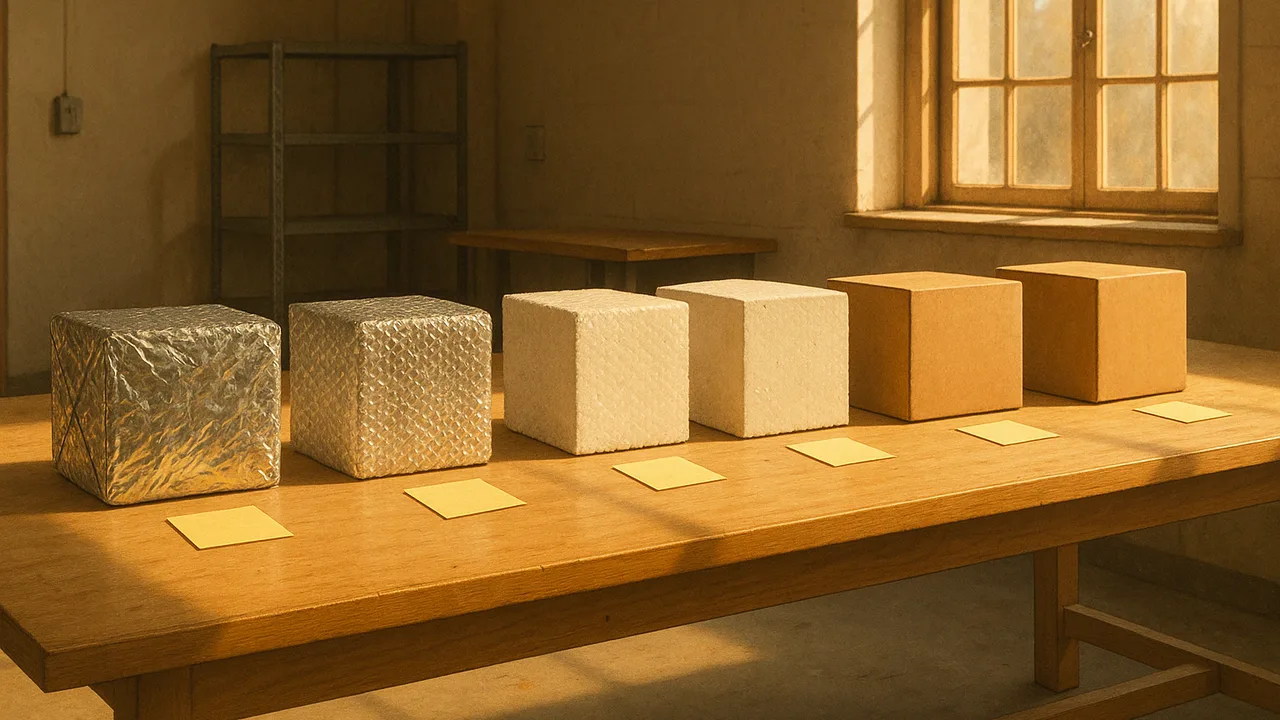
Gallery critique protocol. Each team posts its flight profile, decision matrix, box and version 1 data. Visitors leave three sticky notes: I like… (a strength tied to a criterion), I wonder… (a question about evidence or the science), and What if… (one specific change). Notes must cite a number or a particle-model reason; “looks good” does not count.
Class criteria and constraints (sample values set by the class and the station). The flight plan must (1) give the helium fill as a volume, moles and mass, with the conditions stated; (2) give the balloon’s volume and diameter at 0, 5, 10, 20, 25 and 30 km; (3) estimate the burst altitude from the balloon’s rated burst diameter of 6.0 m (sample spec for a 600 g latex balloon). The payload box must (4) keep the battery stand-in (100 mL of water starting at 40 °C in a capped bottle) at or above 30 °C after 30 minutes in the class freezer (about −18 °C); (5) weigh no more than 150 g empty; (6) cost no more than 10 sample budget points; and (7) leave room for the sensor board and an opening for the antenna wire.
Worked example 1: turning critique into a change. Nadia’s team got the note: “I wonder if cold air is getting in at the antenna hole. Your bottle dropped fastest in the first 10 minutes.” Their reasoning: an open gap lets cold air flow past the bottle, so energy is carried off by convection, not just slowly conducted. Version 2 sealed the hole around the wire with foam tape. Result (sample data): 31.0 °C after 30 minutes became 33.5 °C, with 2 g of added mass.
Worked example 2: a trade-off made visible. Diego’s team added a 50 g pack of water at room temperature beside the bottle. Sample data: 35.0 °C after 30 minutes, but the box now weighed 175 g, over the 150 g limit. They swapped the cardboard outer shell for a thinner foam sheet, saving 30 g, and retested: 34.5 °C at 145 g. Their energy reasoning: the 50 g pack must lose 209 J for every 1 °C it cools, and on a real flight it would release 16.7 kJ more while freezing, energy stored in molecular positions.
| Criterion | Version 1 | Change made | Version 2 | Met? |
|---|---|---|---|---|
| Fill (volume, moles, mass) | ||||
| Flight profile | ||||
| Burst estimate | ||||
| Bottle ≥ 30 °C at 30 min | ||||
| Mass ≤ 150 g | ||||
| Budget | ||||
| Fits sensor and antenna |
Energy accounting for version 2. Every team adds a short energy statement: energy lost by the stand-in (Q = mcΔT), where it went, and which feature slowed it. Total energy is conserved; a good box only slows how fast it leaves.
What our freezer test cannot show. The real flight lasts about two hours and passes through air as cold as −56.5 °C, colder than the freezer. But at 20 km the air is so thin (5.5 kPa) that far fewer air particles hit the box each second, so conduction and convection to the air are weaker than in the freezer, while sunlight and radiation matter more. A real battery also warms itself a little as it runs. Your recommendation must name at least one limit of the test.
Guided Exercises ~15 min
Use your version 1 data and the sticky notes you received.
Independent Practice ~10 min
Run version 2 and complete the comparison table.
Compare version 1 and version 2 on every criterion. Which criterion improved most, and what did you give up to get it? Include Q for both versions.
🔎 Mini case study: Weather balloons around the world, every day ~8 min
National weather services launch helium- or hydrogen-filled balloons from hundreds of stations around the world, usually twice a day at the same universal times, so that forecasters get a snapshot of the whole atmosphere at once. Each balloon carries a radiosonde, a small instrument package that measures temperature, humidity and pressure, tracks wind from its GPS position, and radios the data down. The balloons expand as they rise and typically burst somewhere above 20 km, and the radiosonde falls back on a small parachute.
Radiosondes face the same problems as our payload: their electronics and batteries ride in light foam housings through air far below freezing, and their designs balance mass, cost and reliability, since most are never recovered. The data feed the computer models behind daily weather forecasts, and long records of them are used to study how the atmosphere is changing.
Think about it: Which of our class criteria match the trade-offs radiosonde designers face, and which constraint (cost, recovery, safety for aircraft) should the station add to its plan?
Closure ~5 min
Version 2 is tested and justified. Next phase, you write the launch brief and present it to the station’s volunteers.
Exit ticket: in two sentences, explain why filling the balloon with more helium makes it burst lower. Use the combined gas law.
Teacher notes
Materials: version 1 boxes, sticky notes in three colors, fresh warm-water bottles, thermometers, the freezer, scales, extra foam and tape.
Timing: critique 15 minutes, version 2 rebuild 10 minutes, freezer retest 30 minutes (write the comparison and read the case study while it runs).
Listen for: “more insulation is always better” (mass limit); changes with no reason; critique that targets people instead of designs.
Support / stretch: provide critique sentence starters. Stretch: from version 2 data, estimate the average rate of energy loss in watts (J ÷ 1,800 s) and compare it with the control bottle.