2.03 Lab: Measuring Rate by Collecting Oxygen
measure the rate of yeast-catalyzed peroxide decomposition by collecting oxygen, and analyze my data to show how reactant concentration and temperature change the rate.
- I can analyze data to identify that increasing the concentration of reactants increases the reaction rate, and decreasing concentration decreases the rate.
- I can analyze data to identify that increasing the temperature usually increases the reaction rate, and decreasing temperature decreases the rate.
Phase 2: Investigate
Warm-Up ~5 min
Do Now. You will run the yeast and peroxide reaction with full-strength, half-strength and quarter-strength peroxide. Sketch the graph of oxygen volume against time you expect for all three on one set of axes.
If you halve the peroxide concentration and keep everything else the same, what happens to the initial rate of oxygen release?
Instruction ~10 min
Why a lab here. Our collision model predicts that more crowded reactant molecules and faster-moving molecules should both raise the rate. Today we test those predictions with numbers, not impressions. This lab runs two 50-minute periods: concentration on day 1, temperature on day 2.
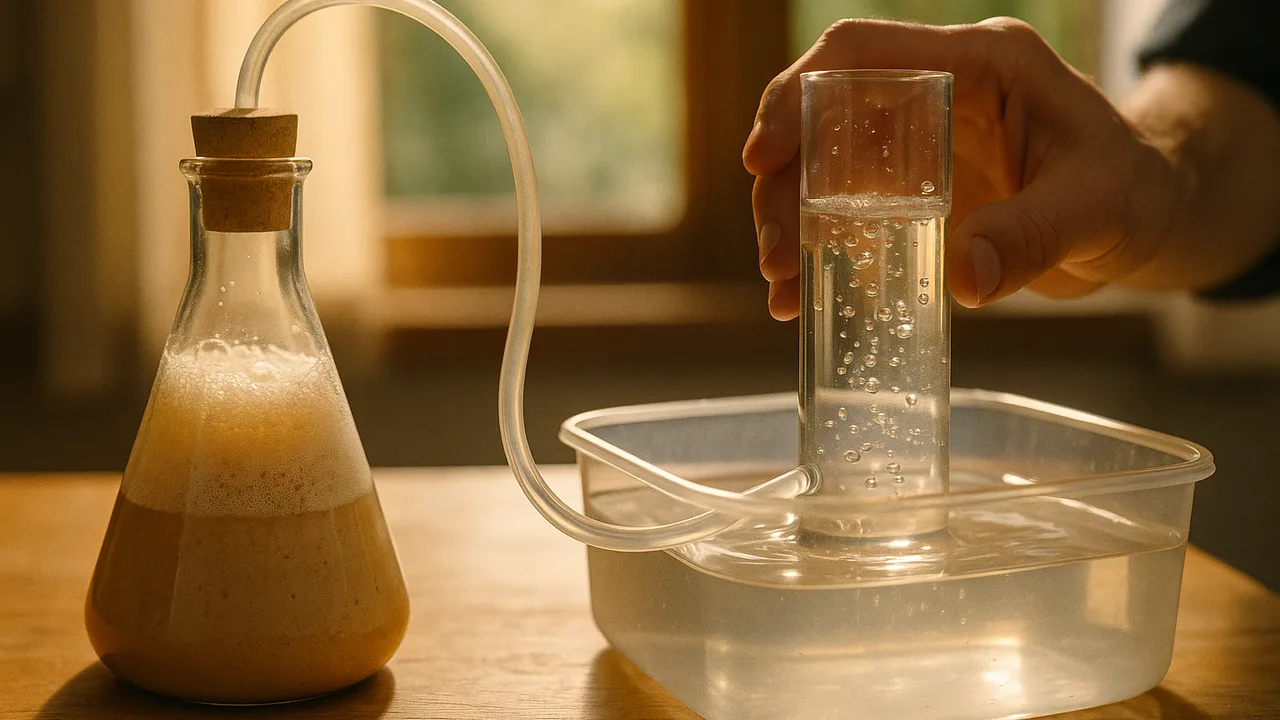
Measuring a gas by water displacement. Fill a 100 mL graduated cylinder with water, cover it, and turn it upside down in a tub of water so no air gets in. A tube runs from a stoppered flask to under the cylinder’s mouth. Oxygen made in the flask bubbles up and pushes water out of the cylinder; the gas volume is read directly from the scale. (No cylinder? A balloon stretched over the flask works for comparisons, measured by its circumference.)
Controlling variables. Each trial uses 10.0 mL of peroxide solution and 2.0 mL of the same stirred yeast suspension, in the same flask with the same stopper and tube. On day 1 the independent variable is concentration (3.0%, 1.5% and 0.75%, made by your teacher by diluting with water); temperature is held at room temperature. On day 2 it is temperature (an ice bath, room temperature and a 35 °C water bath) at 3.0%. The dependent variable is the oxygen volume every 10 s for 60 s.
Procedure. (1) Set up the inverted cylinder and zero the reading. (2) Bring the peroxide and the yeast to the bath temperature for 5 minutes, in separate tubes. (3) Add the yeast to the flask, stopper it at once and start the timer. (4) Swirl gently every 10 s and read the volume. (5) Run three trials per condition. (6) Record the gas temperature.
| Condition (sample data) | O2 at 30 s, trials (mL) | Mean (mL) | Initial rate (mL/s) |
|---|---|---|---|
| 3.0%, 22 °C | 23, 25, 24 | 24 | 0.80 |
| 1.5%, 22 °C | 12, 11, 13 | 12 | 0.40 |
| 0.75%, 22 °C | 6, 7, 5 | 6 | 0.20 |
| 3.0%, 8 °C | 10, 12, 11 | 11 | 0.37 |
| 3.0%, 35 °C | 40, 43, 40 | 41 | 1.4 |
Worked example 1: initial rate from a slope. Lena used the first 30 s, where the graph is nearly straight, because later the peroxide is being used up. For 3.0% at 22 °C: 24 mL ÷ 30 s = 0.80 mL/s. For 1.5%: 12 mL ÷ 30 s = 0.40 mL/s. Halving the concentration halved the rate. For 0.75%: 0.20 mL/s, halved again. The pattern: rate is proportional to peroxide concentration in this range.
Worked example 2: comparing temperatures. Omar compared 35 °C with 22 °C at 3.0%: 1.4 mL/s ÷ 0.80 mL/s = 1.75, so the rate was about 1.8 times faster for a 13 °C rise. Cooling to 8 °C cut the rate to 0.37 mL/s, less than half. Warmer peroxide reacted faster; colder reacted slower.
A caution about enzymes. Catalase is a protein. Above roughly 45–50 °C many enzymes start to lose their shape and stop working, so a very hot bath would slow the yeast reaction. That is why the trend says temperature usually raises rates. Our 35 °C bath stays well below that range.
Reading. OpenStax Chemistry 2e, chapter 12.2 (factors affecting reaction rates), CC BY 4.0.
Guided Exercises ~15 min
Answer as you collect data; finish the analysis after clean-up.
Independent Practice ~10 min
Lab analysis, in your Rate Notebook.
Graph oxygen volume against time for the three concentrations on one set of axes. Label each line with its initial rate. Describe the pattern in one sentence.
Use your temperature data to advise the co-op: would a bottle stored in a 35 °C garage lose strength faster or slower than one in a 22 °C closet? Explain why your yeast data are evidence for the uncatalyzed shelf reaction too, and name one limit of that evidence.
Closure ~5 min
Concentration and temperature both move the rate. Next class: catalysts, surface area and light.
Exit ticket: the co-op is thinking of selling a 6% cleaner. Predict its rate on a surface compared with the 3% cleaner, and one problem it might create on the shelf.
Teacher notes
Materials (per team): 3% hydrogen peroxide and teacher-made 1.5% and 0.75% dilutions, yeast suspension (one 7 g packet in 100 mL warm water, stirred), a 125 mL flask with a one-hole stopper and tubing, a 100 mL graduated cylinder, a tub, a 10 mL graduated cylinder, ice bath, 35 °C water bath, thermometer, timer, goggles, tray.
Two periods: day 1 concentration, day 2 temperature and the CER. No-lab alternative: the balloon method, or the sample data table above with a teacher video of one trial.
Note: 10.0 mL of 3% peroxide can release at most about 107 mL of oxygen at 22 °C, so stop at 60 s before the cylinder overflows.
Listen for: “the yeast gets tired” to explain the curve bending (it is the peroxide running out); rate confused with total volume.
Support / stretch: give a rate-table template. Stretch: convert 0.80 mL/s to mol O2 per second at 22 °C (0.80 × 10⁻³ L ÷ 24.2 L/mol = 3.3 × 10⁻⁵ mol/s).