2.02 Project Brief and Wonder Board: The Cleaning Co-op’s Shelf-Life Problem
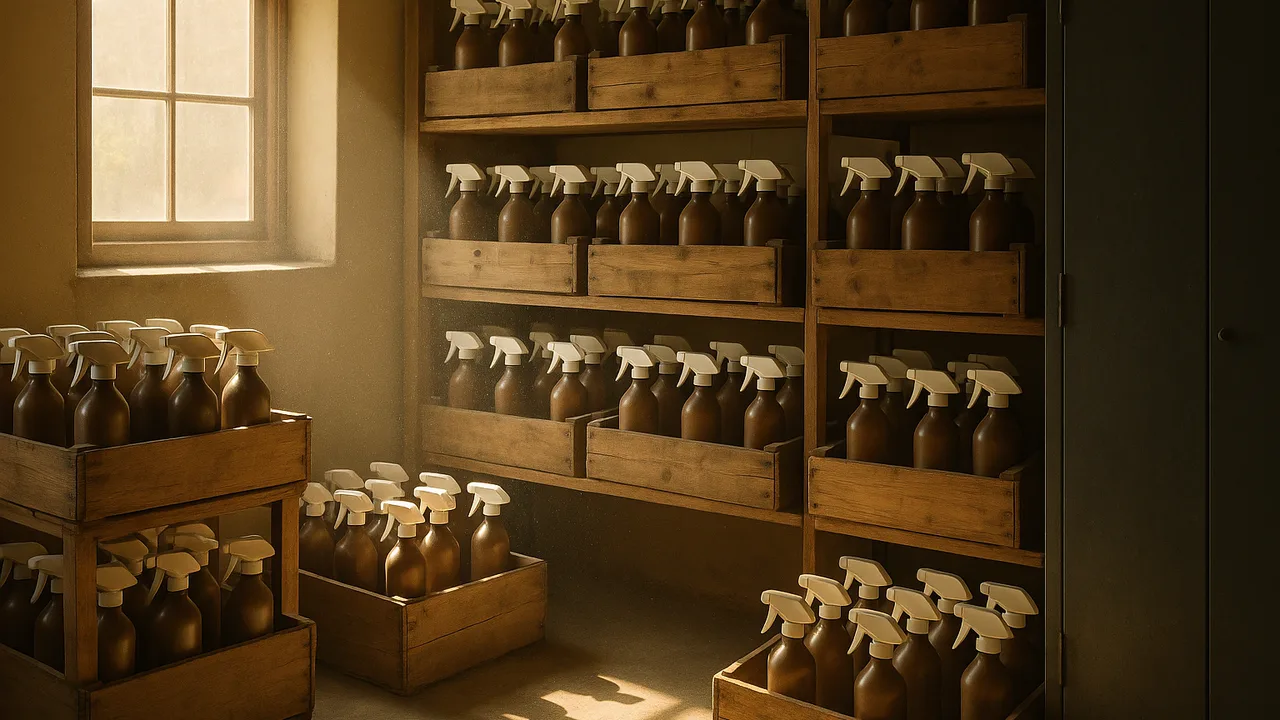
Fast on the Surface, Stable on the Shelf: A Rate and Stability Brief for a Cleaning Co-op
Why does the same hydrogen peroxide foam out of a flask in seconds yet slowly fade in a bottle over months, and how can a cleaning co-op use reaction rates and equilibrium to keep its cleaner strong on the shelf and warn customers when storage is spoiling it?
The mystery: In a teacher demo, warm yeast and a squirt of dish soap turn a flask of drugstore hydrogen peroxide into a column of foam that climbs out of the flask in seconds. Beside it stands a clear bottle of the same peroxide that sat on a sunny windowsill for a year. Poured on yeast, it barely fizzes.
Questions we will figure out together in this unit:
- Why does yeast make peroxide foam so fast?
- Does sunlight spoil peroxide, or just the heat that comes with it?
- How much faster is the reaction in a warm garage than in a cool closet?
- Is a stronger peroxide also a faster one?
- Why are peroxide bottles often brown or opaque?
- Can something slow the reaction on the shelf without slowing it on the counter?
- How can a color change tell you that a storage spot is too warm?
- Can a reaction run backward?
explain the cleaning co-op’s two requests, name the criteria and constraints the co-op cares about, and turn our questions about speed and stability into need-to-knows.
- I can explain that increasing the kinetic energy of colliding particles and increasing the number of collisions both cause the reaction rate to increase.
- I can describe and prioritize the criteria and constraints for refining a chemical system, including factors like cost, energy needed, safety, and resource availability, and quantify them when possible.
Phase 1: Spark
Warm-Up ~5 min
Do Now. A cleaner should work fast on a kitchen counter but stay strong for months in its bottle. Write why those two wishes seem to pull against each other.
Which change would most likely make more peroxide molecules collide with energy enough to react each second?
Instruction ~10 min
Meet the client. A small cleaning-products cooperative, owned by the people who make and sell its products, has written to our class. Its best seller is a 3% hydrogen peroxide surface cleaner: peroxide kills many germs and breaks down to nothing but water and oxygen. Customers are unhappy: some say a bottle that sat in a warm garage or a sunny kitchen “stopped fizzing” within months. The co-op’s board has two requests:
- A rate and stability brief that explains, at the level of molecules, what speeds up and what slows down peroxide decomposition, backed by our own rate data, plus packaging and storage advice that keeps the cleaner strong on the shelf while it still acts fast on a surface.
- A design for a storage-check indicator, a sealed, reusable color card or vial for store shelves and supply closets that changes color when a storage spot gets warm enough to spoil the cleaner, and changes back when it cools. It must be safe, cheap and easy to read.
Driving question. Why does the same peroxide foam out of a flask in seconds yet fade in a bottle over months, and how can the co-op use reaction rates and equilibrium to keep its cleaner strong and warn customers when storage is spoiling it?
Two levers on every collision. Our collision model already suggests two ways to change a rate. More collisions per second (more molecules packed in, or molecules moving faster) means more chances to react. More energetic collisions (faster molecules) means a bigger share of those chances succeed. Heating does both at once. The co-op’s problem is that the same levers that help on the counter work against it in the bottle.
Worked example 1: reading a complaint as data. The co-op’s sample complaint log lists 40 complaints in a year: 23 from bottles kept in sunny or warm spots, 11 from bottles opened and used for months, 6 with no storage details. Sofia turned this into need-to-knows: “How much faster does peroxide decompose when warm? Does light matter on its own, apart from heat?” Each points to a test.
Worked example 2: criteria and constraints. A criterion is what a good solution must achieve; a constraint is a limit it must stay within. Kwame listed the co-op’s: criteria, keep at least 90% of its strength for 6 months in normal storage, still release oxygen quickly on a surface, and make the indicator easy to read; constraints, low cost per bottle, safe for families, no ingredient that leaves harmful residue on food surfaces, recyclable packaging. He ranked safety first because the product is used where people eat.
Breaking the problem down. (a) Measure how temperature, concentration and catalysts change the rate; (b) explain it with collisions and energy; (c) choose packaging and storage advice; (d) design the indicator around a reaction that runs both ways; (e) weigh cost and safety. 2.03–2.05 tackle (a) and (b); 2.06–2.08 take on (c) to (e).
Team roles. Teams of four rotate weekly: Lead Chemist, Data Analyst (tables, graphs, rate calculations), Lab Manager (materials and safety checks) and Communicator (shares findings and questions with the client).
Guided Exercises ~15 min
Use the client letter and the sample complaint log.
Independent Practice ~10 min
Start your Rate Notebook and the team charter.
In 3–4 sentences, restate the co-op's two requests. Then list three criteria and three constraints and rank all six by priority, giving a reason for your top choice.
Add two questions to the Wonder Board: one about what makes reactions fast or slow, one about the indicator.
Closure ~5 min
We know the client, the driving question and our teams. Next phase, we measure rates in the lab.
Exit ticket: why might advice that helps the cleaner work faster on a surface also make it spoil faster on the shelf? Use the word collision.
Teacher notes
Materials: the client letter (generic, on co-op letterhead you design), the sample complaint log, role cards, chart paper for the Wonder Board.
Setup: keep the Wonder Board posted all unit; 2.05 and 2.09 return to it. The co-op is fictional and its log is sample data; keep real shelf-life claims out of the letter so students do not treat them as fact.
Listen for: “a tighter cap keeps the peroxide in” (the reaction still happens inside); criteria and constraints used interchangeably.
Support / stretch: give a sentence frame (“We need to know ___ so that we can ___”). Stretch: estimate how many 100 mL bottles’ worth of oxygen (about 1.1 L each) a 24-bottle case could release if it fully decomposed, and say why a sealed case must still vent.