2.08 Refining the Design: Shifting the Equilibrium and Testing Version 2
test version 1 against every criterion, refine the indicator by shifting its equilibrium and the cleaner plan by changing rate factors, and justify the trade-offs in version 2.
- I can systematically evaluate different ways to refine a chemical system by comparing how well each option meets the criteria for increasing product and fits within the given constraints.
- I can refine a chemical system by making tradeoffs to optimize product formation and explain the reasoning behind my design choices.
Phase 4: Build
Warm-Up ~5 min
Do Now. Read your version 1 hot-box bottle: a 5.0 mL sample with excess yeast. Record the total oxygen and decide whether it passes the 48 mL criterion.
A fresh 5.0 mL sample releases 53 mL of O2; a hot-box sample releases 44 mL. What percent of its strength is left?
Instruction ~10 min
Where 53 mL comes from. 5.0 mL of 3% peroxide holds about 0.15 g of H2O2: 0.15 ÷ 34.01 = 0.0044 mol, which releases 0.0022 mol O2, or 0.0022 × 24.2 L/mol = 0.053 L at 22 °C. The assay measures how much peroxide is left, not how fast it reacts.
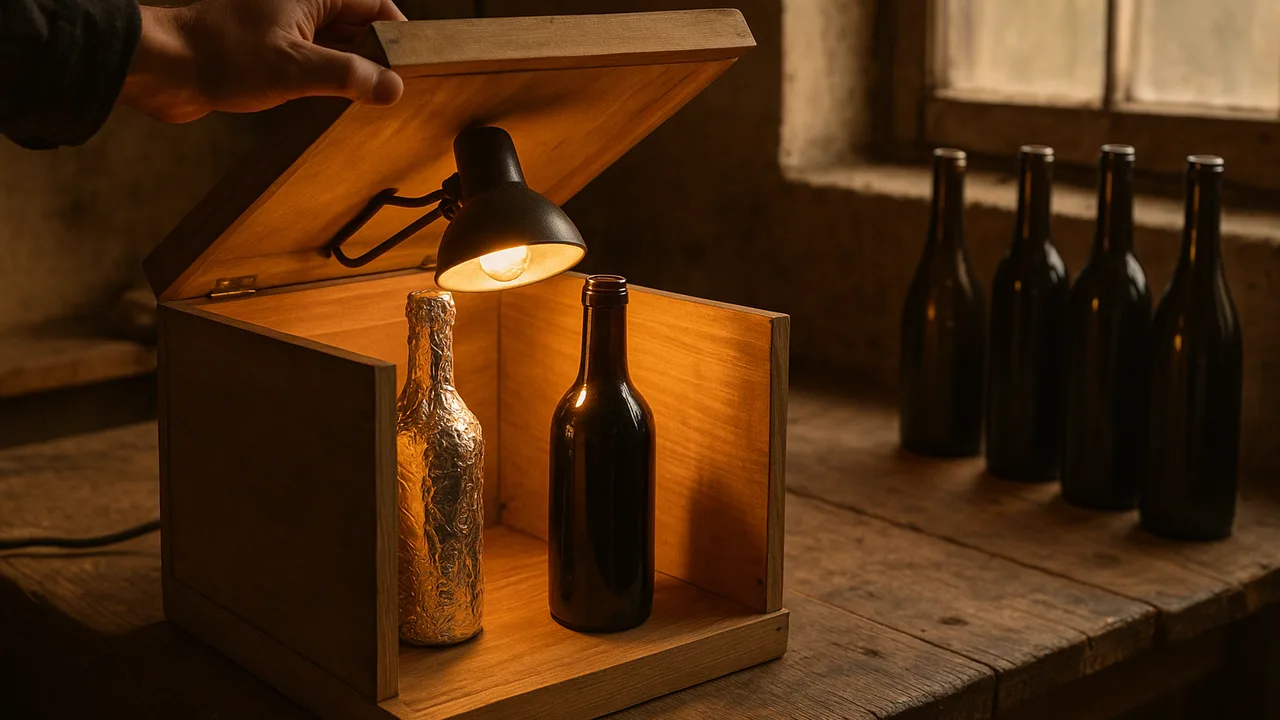
Class criteria and constraints (sample values set by the class with the co-op). Cleaner: (1) after the class 7-day hot-box test (a lamp-lit box at 35 °C, a stand-in for months of poor storage), a 5.0 mL sample must still release at least 48 mL of oxygen with excess yeast, which is 90% of the 53 mL a fresh sample releases at 22 °C; (2) it must still act fast on a surface: initial rate at least 0.60 mL/s with 2.0 mL of yeast suspension; (3) cost at most 10 sample budget points per bottle; (4) nothing added that is unsafe on food-contact surfaces; (5) recyclable packaging. Storage-check indicator: (6) clearly pink at 25 °C or below and clearly blue at 30 °C or above; (7) reverses at least 10 times; (8) cobalt fully sealed with no way for a user to touch it; (9) cost at most 3 points.
Version 1 results (sample data). Clear bottle with label advice: 44 mL (83%), fails. Brown bottle: 48 mL (91%), just passes. Indicator vial version 1 (cobalt chloride in a water–ethanol mix, no added chloride): still pink at 30 °C and only turned blue near 45 °C, so it fails criterion 6: it would warn far too late.
Worked example 1: shifting the indicator’s equilibrium. The teacher prepared sealed vials with increasing calcium chloride added (sample data, switch temperature where the vial turns clearly blue): 0 g, 45 °C; 1 g, 39 °C; 2 g, 33 °C; 3 g, 24 °C. Marcus reasoned: more Cl− lowers Q, so the mixture sits closer to blue and needs less heat to tip over. To switch at 30 °C he interpolated between 2 g and 3 g: the switch falls 9 °C per gram, and 33 − 30 = 3 °C, so about 2 + 3/9 ≈ 2.3 g. The 3 g vial would already be blue at 25 °C and fail the other half of criterion 6.
Worked example 2: pushing an equilibrium toward more product. Engineers use the same principle to make more product. The co-op’s glass cleaner uses a fruity-smelling ester, ethyl acetate, which its supplier makes from acetic acid and ethanol: CH3COOH + C2H5OH ⇌ CH3COOC2H5 + H2O, with K ≈ 4 near room temperature (all four counted, since water is a product, not the solvent). Starting with 1 mol of each, x mol of ester forms: x2 ÷ (1 − x)2 = 4, so x ÷ (1 − x) = 2 and x = 0.67: a 67% yield. Elena refined the design with 3 mol of ethanol per mole of acid: x2 ÷ ((1 − x)(3 − x)) = 4 gives 3x2 − 16x + 12 = 0, so x = 0.90: a 90% yield. Removing water as it forms pushes the yield higher still. An acid catalyst only gets to equilibrium faster; it does not change the yield. The trade-off: the extra ethanol costs money and must be recovered.
Refining the cleaner. Version 2 options: brown bottle plus a low dose of metal-binding stabilizer, and a label that says “store below 25 °C, away from sunlight; do not pour used product back.” Sample result: 50 mL (94%), passes; surface rate 0.78 mL/s, still above 0.60. The stabilizer slowed the shelf reaction because it removed a catalyst (stray metal ions), not by blocking catalase, which is why the surface action barely changed.
| Criterion | Version 1 | Change made and why | Version 2 | Met? |
|---|---|---|---|---|
| Hot-box O2 ≥ 48 mL | ||||
| Surface rate ≥ 0.60 mL/s | ||||
| Cost ≤ 10 points | ||||
| Indicator pink ≤ 25 °C, blue ≥ 30 °C | ||||
| Cobalt sealed; cost ≤ 3 points |
Guided Exercises ~15 min
Use your version 1 data and the sample tuning data.
Independent Practice ~10 min
Report version 2 in two formats.
Complete the version 1 / version 2 table. Make one bar graph of hot-box oxygen for both cleaner versions and one graph of switch temperature against added calcium chloride, with the 25 °C and 30 °C lines marked.
🔎 Mini case study: Humidity cards and the move away from cobalt ~8 min
For decades, packages of electronics, medicines and dry foods have shipped with small humidity indicator cards. Many used cobalt(II) chloride: blue when dry, pink when it takes up water, and blue again when dried. The same reversible reaction that makes the cards so useful made them a concern once cobalt(II) chloride was recognized as toxic and a suspected carcinogen.
Chemical regulators in some regions have since restricted cobalt salts, and many manufacturers now offer cobalt-free cards based on other colored compounds. Designers weigh the trade-offs: how sharp the color change is, how many times the card can reverse, its cost and its safety. The lesson: a design that works chemically must still fit the safety and regulatory constraints of the people who use it.
Think about it: Should the co-op’s storage-check indicator use sealed cobalt chloride or a cobalt-free alternative? Name the criteria that decide it and the evidence you would need.
Closure ~5 min
Version 2 is tested and justified. Next phase: the rate and stability brief for the co-op.
Exit ticket: name the change that improved your design most, and the piece of data that proves it.
Teacher notes
Materials: version 1 hot-box bottles, yeast suspension, the gas-collection setups, teacher-prepared sealed cobalt vials with 0, 1, 2 and 3 g calcium chloride per 50 mL of the ethanol–water mix (in blister packs), water baths at 20, 25, 30, 35 and 45 °C, thermometers, gloves, goggles.
Note: exact switch temperatures depend on the cobalt and water content of your mix; trial the vials ahead of time and replace the sample values with yours. Only the teacher prepares or opens vials.
Listen for: “the catalyst increases the yield”; “more chloride raises K”; changes made without a reason.
Support / stretch: a version-change frame (change, because, evidence, trade-off). Stretch: solve 3x2 − 16x + 12 = 0 with the quadratic formula and explain why only the root below 1 makes sense.