1.03 Hot and Cold Baths: Temperature, Volume and the Kelvin Scale
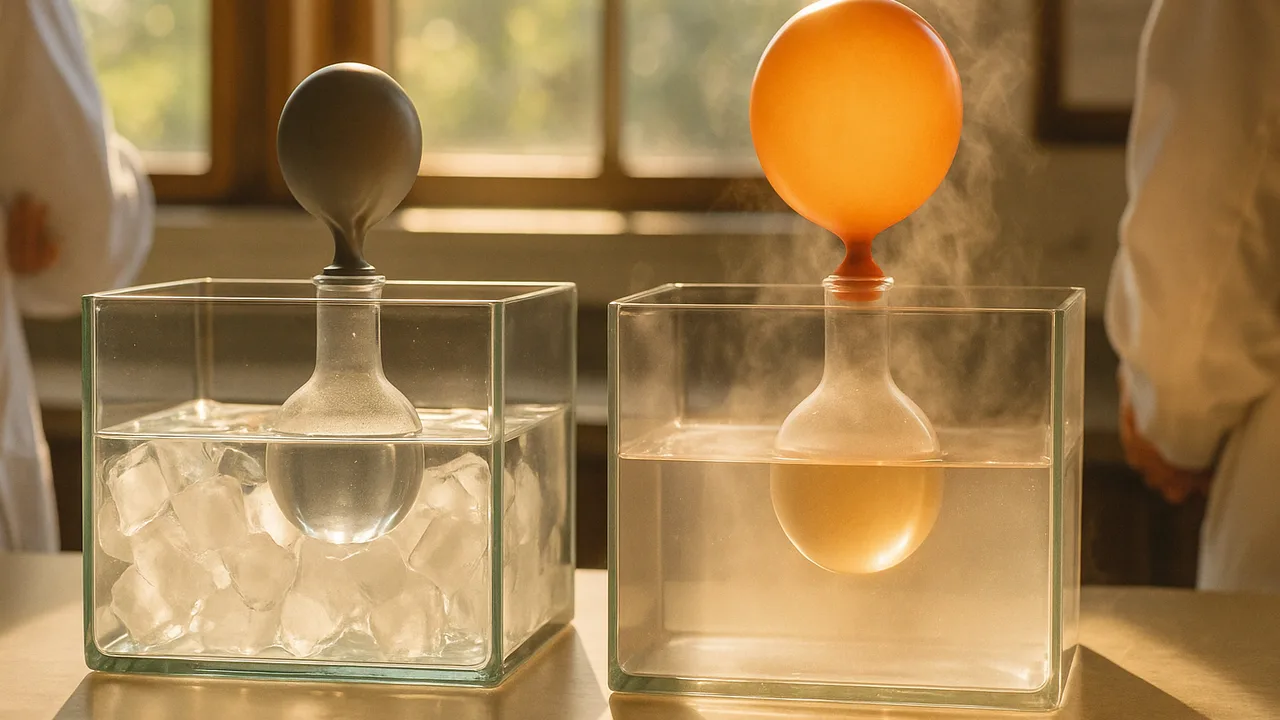
measure how a balloon’s volume changes with temperature, convert Celsius to kelvin, and use Charles’s and Gay-Lussac’s laws to explain the results as changes in average particle kinetic energy.
- I can describe how changes in the positions of objects in gravitational, magnetic, or electrostatic fields affect the energy stored in those fields.
- I can explain that thermal energy includes both the kinetic and potential energy of particle vibrations in solids or molecules, and the kinetic energy of freely moving particles in liquids and gases.
- I can describe how the total energy of a system and its surroundings is conserved at both the macroscopic and molecular/atomic levels.
- I can use my models to illustrate that energy at the macroscopic scale can be explained as a combination of energy from the motion of particles or objects and energy from their relative positions, at both the macroscopic and microscopic scales.
Phase 2: Investigate
Warm-Up ~5 min
Do Now. A balloon measures 60.0 cm around at room temperature. Predict its circumference after five minutes in ice water, and after five minutes in warm tap water. Write your two numbers before any balloons come out.
If you cool a balloon from 22 °C to 0 °C, how much does its volume change?
Instruction ~10 min
Why a lab here. The freezer balloon told us cold gas takes up less space. The launch brief needs a number: how much less, for each degree? Today you measure it. This lab runs two 50-minute periods.
Temperature is average kinetic energy. In the particle model, the temperature of a gas measures the average kinetic energy of its particles. Warmer gas has faster particles on average; colder gas, slower ones. Not every particle has the same speed (some are fast, some slow, like cars on a highway), but the average rises and falls with temperature. The total thermal energy of a gas is almost all this kinetic energy of freely moving particles, because they are far apart and barely pull on one another.
The Kelvin scale. If particles slowed down more and more, there would be a lowest possible temperature where their motion is at a minimum: absolute zero, −273.15 °C. The Kelvin scale starts there, with degrees the same size as Celsius degrees: T(K) = T(°C) + 273.15 (273 is fine for most class work). Because kelvin temperature is proportional to average kinetic energy, gas-law calculations must use kelvin. Doubling the kelvin temperature doubles the average kinetic energy; doubling a Celsius number does not.
Charles’s law. For a fixed amount of gas at constant pressure, volume is proportional to kelvin temperature: V1/T1 = V2/T2. Particle reason: faster particles hit the walls harder and more often, so a flexible wall moves out until the pressure matches the outside again. A balloon is a good constant-pressure container: its inside pressure stays close to the outside air pressure.
Worked example 1: the freezer balloon. Jamal’s balloon holds 3.0 L at 22 °C. His freezer is at −18 °C. Convert: T1 = 22 + 273 = 295 K; T2 = −18 + 273 = 255 K. V2 = 3.0 L × 255 / 295 = 2.6 L. The balloon loses about 13% of its volume, enough to wrinkle the rubber.
Gay-Lussac’s law. If the container cannot stretch (a sealed steel can or a car tire, nearly), volume stays fixed and pressure follows kelvin temperature instead: P1/T1 = P2/T2. That is why tire pressure drops on a cold morning and why sealed spray cans carry a warning not to heat them.
Worked example 2: a cold tire. Rosa’s bike tire reads 400 kPa (absolute pressure) on a 27 °C afternoon. At dawn it is 7 °C. P2 = 400 kPa × 280 K / 300 K = 373 kPa, a drop of about 7% from cooling alone, with no air leaking out.
Procedure. Balloon volume comes from its circumference. Treat the balloon as a sphere: radius r = C / (2π), and V = (4/3)πr3 = C3 / (6π2). (1) Inflate a balloon to about 60 cm around and tie it. (2) Measure its widest circumference with string and a meter stick at room temperature; record the room temperature. (3) Hold it under in the ice bath for 5 minutes (a tongs or a weighted net keeps it under); measure at once. (4) Repeat in the warm bath (40–50 °C). (5) Each partner measures independently; record both. (6) Convert every temperature to kelvin and every circumference to volume.
| Bath | T (°C) | T (K) | C, partner A (cm) | C, partner B (cm) | V (cm3) | V/T (cm3/K) |
|---|---|---|---|---|---|---|
| Ice water | ||||||
| Room air | ||||||
| Warm water |
Reading the result. Sample data from one class: 58.6 cm at 1 °C, 60.0 cm at 22 °C, 61.4 cm at 45 °C, giving volumes of about 3,400, 3,650 and 3,910 cm3. The circumference changes only a centimeter or two, so careful string work matters. V/T should come out nearly constant (about 12.4 cm3/K in the sample). If you graph V against T in kelvin and extend the line down, it heads toward zero volume near 0 K: the evidence behind absolute zero.
Reading. OpenStax Chemistry 2e, section 9.2 (relating pressure, volume, amount and temperature), CC BY 4.0.
Guided Exercises ~15 min
Answer as you collect data; return to the cards after clean-up.
Independent Practice ~10 min
Lab analysis, in your Gas Notebook.
Graph volume (cm3) against temperature (K) and draw the best-fit line. Extend it to zero volume. At what temperature does your line reach zero, and how close is that to 0 K? Name two sources of error that could explain the difference.
The station's balloon cools from 15 °C to −56.5 °C on the way to 20 km. If pressure stayed the same, by what fraction would its volume shrink? Explain why the real balloon still grows (hint: look at the pressure column).
Closure ~5 min
Temperature changes volume, in proportion to kelvin. Next class, we change the pressure instead and measure what the gas does.
Exit ticket: explain to a younger student why a balloon in ice water shrinks. Use the words particles, speed and kinetic energy, and say where the energy went.
Teacher notes
Materials (per team): two latex-free round balloons, string, meter stick, thermometer, an ice-water bath and a warm-water bath (hot tap water, 40–50 °C, checked by the teacher) in large tubs, tongs or a mesh bag to hold the balloon under, paper towels, calculators.
Two periods: day 1 measurements; day 2 conversions, graph and CER. No-lab alternative: the sample data above plus the PhET Gases Intro Laws screen with pressure held constant.
Listen for: Celsius used in a ratio; “particles expand”; volume read from circumference without cubing.
Support / stretch: give the formula card V = C3 / (6π2) with one row worked. Stretch: a balloon is not a perfect sphere and its rubber adds a little pressure; estimate how either effect changes V/T.