3.05 Neutralization, Titration and Buffers: Why Seawater Resists Change
carry out a titration to find the concentration of an acid, explain how a buffer resists pH change, and describe the surface ocean as a system with boundaries, starting conditions, inputs and outputs.
- I can identify and describe the main parts of each Earth system shown in a computational model, including their boundaries, starting conditions, inputs and outputs, and how they interact (such as how atmospheric CO2 affects photosynthetic biomass and ocean acidification).
- I can use my model to show that carbon is conserved as it cycles through Earth’s systems.
Phase 3: Make Sense
Warm-Up ~5 min
Do Now. Rain is about pH 5.6, yet the surface ocean, which touches the same air, is about pH 8.1. Write one hypothesis for the difference.
Two drops of dilute acid go into 100 mL of distilled water and into 100 mL of seawater. What happens to each pH?
Instruction ~10 min
Neutralization. An acid and a base react to form water and a salt. For a strong base and any acid, the core is H+ + OH− → H2O. With acetic acid: CH3COOH + NaOH → NaCH3COO + H2O. With baking soda (a base by Brønsted–Lowry): CH3COOH + NaHCO3 → NaCH3COO + H2O + CO2. Because the reactions go in fixed mole ratios, we can count an unknown amount of acid by measuring how much base it takes to use it up.
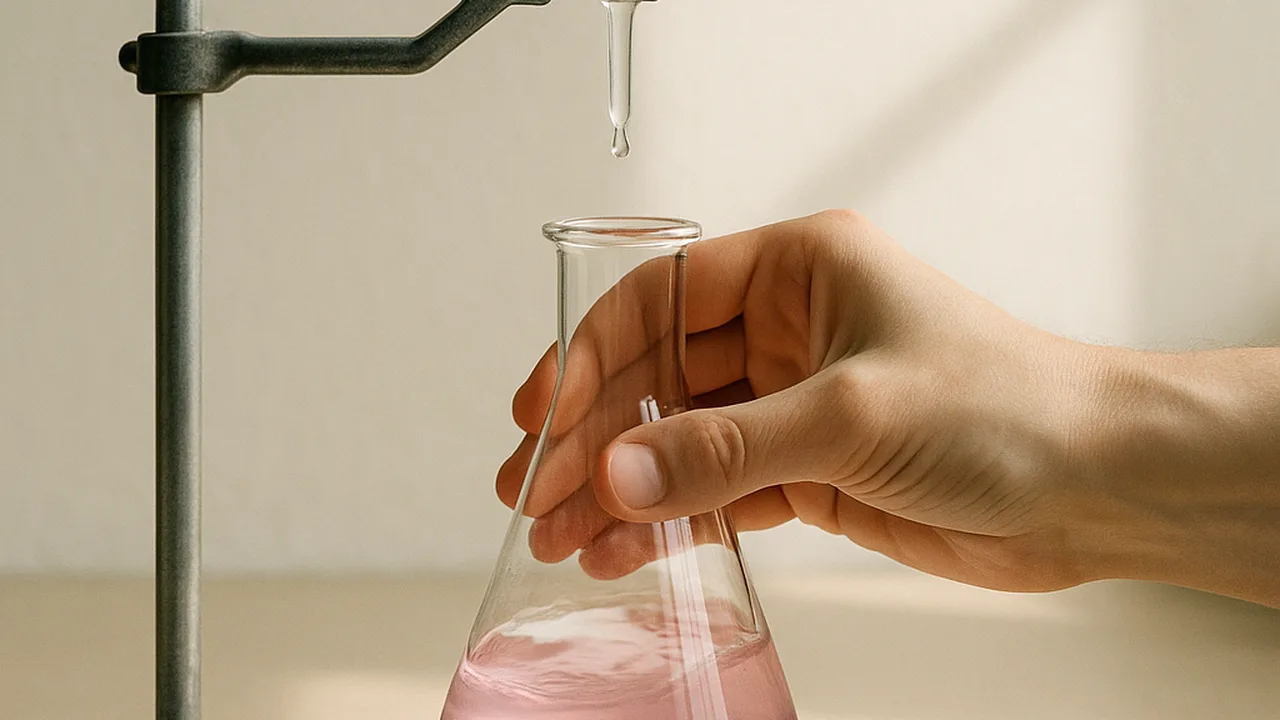
Titration. In a titration you add a base of known concentration (the titrant) to a measured volume of acid until the moles of base equal the moles of acid: the equivalence point. An indicator signals it. Phenolphthalein is colorless in acid and turns pink above about pH 8.2, so the first pink that lasts 30 seconds marks the endpoint. This lab runs two 50-minute periods: titration on day 1, buffer tests on day 2.
Worked example 1: how strong is the vinegar? Marcus titrated 2.00 mL of vinegar (diluted with about 20 mL of distilled water) with 0.100 M NaOH. Endpoint: 16.6 mL (sample). Moles NaOH = 0.100 mol/L × 0.0166 L = 1.66 × 10⁻³ mol = moles acetic acid (1 : 1). Concentration = 1.66 × 10⁻³ ÷ 0.00200 L = 0.830 M. In grams: 0.830 mol/L × 60.05 g/mol = 49.8 g/L, about 5.0 g per 100 mL, matching the “5% acidity” on the label. Three significant figures throughout, set by the 2.00 mL, 0.100 M and 16.6 mL measurements.
Buffers. A buffer is a mixture of a weak acid and its conjugate base (or a weak base and its conjugate acid). Added H+ is taken up by the base; added OH− is neutralized by the acid. Seawater is buffered mostly by the bicarbonate–carbonate pair: CO32− + H+ → HCO3− and HCO3− + H+ → H2CO3. The ocean’s ability to neutralize acid is called its alkalinity; typical surface seawater has about 2,300 micromoles per kilogram, and hatcheries measure it by titrating a sample with acid.
Worked example 2: buffer versus no buffer. Lena added 0.10 mL (two drops) of 0.10 M HCl, 1.0 × 10⁻⁵ mol of H+, to 100 mL of distilled water. [H+] = 1.0 × 10⁻⁵ ÷ 0.100 L = 1.0 × 10⁻⁴ M, so pH fell from about 6 to 4.0. The same two drops in 100 mL of artificial seawater moved the meter from 8.1 to 7.9 (sample). The buffer did not stop the change; it shrank it. And a buffer has a limited capacity: every H+ it absorbs uses up some carbonate, which is the same carbonate the larvae need.
The surface ocean as a system. To model the ocean we must say what is inside the model. Boundary: the sunlit mixed layer, roughly the top 50–100 m. Starting conditions: pH about 8.2 and atmospheric CO2 about 280 ppm before industrialization. Inputs: CO2 from the air, upwelled deep water, alkalinity carried by rivers from weathered rock. Outputs: CO2 released back to the air, carbon carried down by sinking shells and plankton. Interactions: more CO2 in the air means more dissolved CO2, lower pH and less carbonate; plankton photosynthesis removes CO2 by day and raises pH.
Reading. OpenStax Chemistry 2e, chapter 4.5 (titrations), 14.6 (buffers) and 14.7 (acid–base titrations), CC BY 4.0.
Guided Exercises ~15 min
Use your titration data and the buffer-test table.
Independent Practice ~10 min
Buffer tests (day 2): add 0.5 mL portions of vinegar to 50 mL each of distilled water, baking-soda solution and artificial seawater, recording pH after each portion up to 3.0 mL.
Graph pH against vinegar added for all three liquids on one set of axes. Which liquid held its pH best, and how can you tell from the graph where a buffer is running out?
Draw the surface ocean as a system diagram: a box with its boundary, two inputs, two outputs, one starting condition and one interaction inside. Label each.
Closure ~5 min
We know why the ocean resists change and where that resistance comes from. Next: the whole carbon cycle, by the numbers.
Exit ticket: the hatchery's buffering fix will add a base to intake water. Using today's lab, explain what the base will do to the H+ and to the carbonate.
Teacher notes
Materials (per team): 25 or 50 mL buret on a stand (or a graduated 10 mL syringe or 1 mL pipets for counting), 0.100 M NaOH prepared by the teacher, phenolphthalein (1% in alcohol) with a dropper, white vinegar, a 2.00 mL volumetric pipet with a bulb, flasks, white paper, pH meter, baking-soda solution, artificial seawater (aquarium sea salt at about 35 g/L), goggles and gloves.
Baking-soda option: if burets are not available, titrate vinegar with a 0.50 M baking-soda solution, adding 1 mL at a time until fizzing stops and cabbage indicator turns blue. Less precise, but the mole reasoning is the same.
Listen for: “equivalence point means pH 7” (not for weak acid with strong base; it is above 7); “buffers stop pH from changing.”
Support / stretch: give a titration calculation frame (mol = M × L; mole ratio; M = mol ÷ L). Stretch: use the Henderson–Hasselbalch equation, pH = pKa + log([base] ÷ [acid]), to find the pH of a buffer with equal amounts of acetic acid and acetate (pH = 4.74).