3.09 Performance Task: The Hatchery Water Chemistry Brief
explain how CO2, pH and carbonate saturation control shell-building, connect the hatchery’s water to a quantitative carbon cycle and a computational model of human impact, and recommend a tested buffering fix and monitoring plan.
- I can use a model to describe how carbon cycles between the hydrosphere, atmosphere, geosphere, and biosphere.
- I can explain the amounts and rates at which carbon moves between different spheres of the Earth.
- I can show in my model how plants capture carbon dioxide and how human activities increase carbon dioxide in the atmosphere, affecting the climate.
- I can use my model to show that carbon is conserved as it cycles through Earth’s systems.
- I can use a computational model to explain how at least two Earth systems are connected.
- I can describe how changes in one Earth system can cause changes in another system, using examples from the model.
- I can use evidence from a computational model to explain how human activities might change the relationships between Earth systems.
Phase 5: Prove It
Warm-Up ~5 min
Do Now. Reweigh your 3.08 shell chips. Then list the three strongest pieces of evidence you have from this unit (a lab result, a NOAA value, a model run, a dose test). Next to each, write the claim it supports.
Why can oyster larvae fail in water that is still basic (pH about 7.7)?
Instruction ~10 min
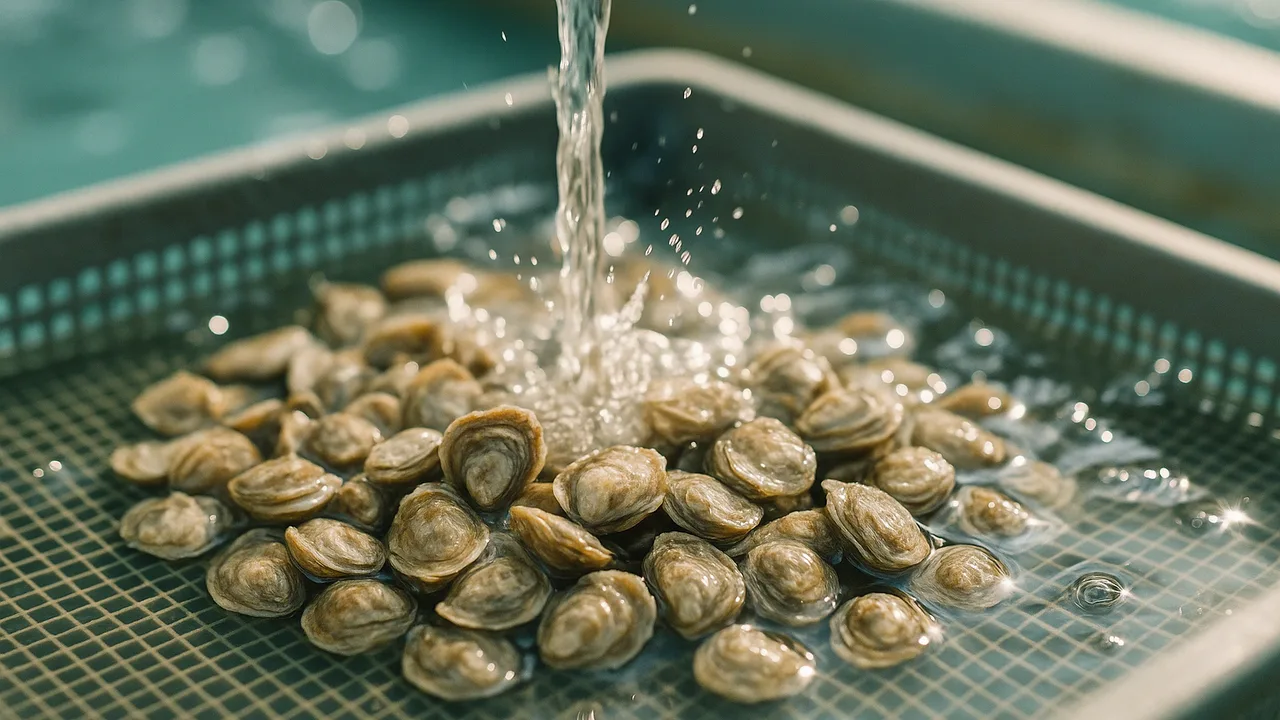
The context. Shellfish farming feeds people and supports coastal jobs, and every farm depends on a steady supply of young shellfish from hatcheries. On upwelling coasts those hatcheries face water whose chemistry is shifting, partly from natural upwelling and partly from the CO2 people add to the air. Our client needs to understand both, and to act on what it can control.
Your job. Write a water chemistry brief that explains the science, presents your models and recommends a tested fix and a monitoring plan. You are not asked to set climate policy; you are asked to explain the system and specify criteria and constraints, which is how engineers begin (HS-ETS1-1).
What the science section must do. (a) Explain acids, bases and pH, with at least one pH ↔ [H+] calculation from your lab data. (b) Write the carbonate equilibria and explain why added CO2 lowers carbonate and Ω. (c) Report your 3.04 shell mass-loss results. (d) Present your quantitative carbon-cycle model (reservoirs in GtC, fluxes in GtC/yr, NOAA CO2 values) and show that the human carbon budget balances. (e) Name at least two limitations of the carbon-cycle model.
What the model and engineering sections must do. (f) Present your computational model: systems, boundary, starting conditions, inputs, outputs, parameters, the calibration of β, and at least two scenario runs. (g) Use it to explain how human activity is changing the relationship between the atmosphere and the ocean, and what that means for the hatchery’s bad-water days. (h) Recommend your version 2 fix with dose, chip results and scale-up, against the class criteria. (i) Give the monitoring plan with thresholds. Cite OpenStax Chemistry 2e, NIST, NOAA and IPCC; do not state figures you cannot source, and label sample data.
Worked example: a strong paragraph. “When atmospheric CO2 rose from about 280 to about 420 ppm (NOAA), surface ocean pH fell from about 8.2 to about 8.1, a 26% rise in [H+]. Most of the extra H+ combined with carbonate (CO32− + H+ → HCO3−), so carbonate fell and Ω fell with it. In our tests, shell chips in pH 4 seltzer lost 4.8% of their mass in three days (sample), while chips in our treated water lost none.” Every sentence names a number, a reaction or a mechanism.
Quality bar. Strong briefs connect global and local scales, separate what the hatchery controls from what it does not, compare at least two sources, and state each model’s limits plainly.
Stages. Plan, draft, get a peer review with a checklist, revise, and present to the hatchery’s owners (your class and visitors). The presentation is four minutes, live or recorded, followed by one question about your evidence.
Guided Exercises ~15 min
Plan and peer-review checks.
Independent Practice ~10 min
Write and revise the brief across the work sessions.
Write the science section of your brief (about 500 words), with the shell data table, the carbon-cycle diagram and one pH calculation.
Write the model and engineering sections: the model card and scenario table, the fix with dose and chip results, the monitoring plan, and one limitation of each model, with sources cited.
Project task: The Hatchery Water Chemistry Brief (1,000-1,300 words) + four-minute presentation
Task: For the coastal shellfish hatchery, explain how CO2, pH and carbonate saturation control shell-building; present a quantitative carbon-cycle model and a computational model of how rising atmospheric CO2 changes surface-ocean pH; and recommend a bench-tested buffering fix and a monitoring plan. Include at least one data table, one diagram and at least three cited sources (OpenStax Chemistry 2e, NIST, NOAA, IPCC or the Global Carbon Budget).
Submission workflow
- Stage 1 — Plan. Outline with your claims, the evidence for each (lab data, NOAA values, model runs, dose tests) and a list of sources.
- Stage 2 — Peer-reviewed draft. A partner checks each claim for a mechanism and each number against its source; submit their notes and your revision plan.
- Stage 3 — Final brief. 1,000–1,300 words with the carbon-cycle diagram, the model card and scenario table, the version 2 results and the monitoring plan.
- Stage 4 — Presentation and defense. Four minutes to the hatchery owners, live or recorded, answering one question about your evidence.
How it is scored
| Criterion | What proficient looks like |
|---|---|
| Carbon-cycle model (HS-ESS2-6) | Reservoirs and fluxes with correct units and sources; shows conservation in the human carbon budget; names at least two model limitations. |
| Computational model (HS-ESS3-6) | Identifies systems, boundary, starting conditions, inputs, outputs and parameters; reports scenario runs; explains how human activity changes the atmosphere–ocean relationship with evidence from the runs. |
| Acid–base chemistry | Correct pH calculations, carbonate equilibria and explanation of why Ω falls; lab data used accurately. |
| Fix and monitoring (HS-ETS1-1, HS-ETS1-3) | Dose scaled correctly with molar mass, tested against every criterion, with thresholds for monitoring and one stated limitation of the bench test. |
| Communication | Clear structure; the presentation answers a question with evidence. |
Closure ~5 min
Your brief turns a unit of evidence into advice. Next: the unit checkpoint.
Exit ticket: what question did the owners ask your team, and how did you answer it with evidence?
Teacher notes
Timing: the brief runs across about three sessions: this lesson launches it and covers planning and peer review; drafting and the presentations need further work time.
Materials: peer-review checklist, the NOAA and IPCC tables from 3.06, each team’s spreadsheet, dried 3.08 chips and a balance, rubric copies for visiting “owners.”
Listen for: numbers with no source; model output reported as measurement; a fix described as “solving” ocean acidification.
Support / stretch: give a paragraph frame for each of (a)–(i). Stretch: add a section on how warming water (which holds less CO2) would change the model’s predictions.