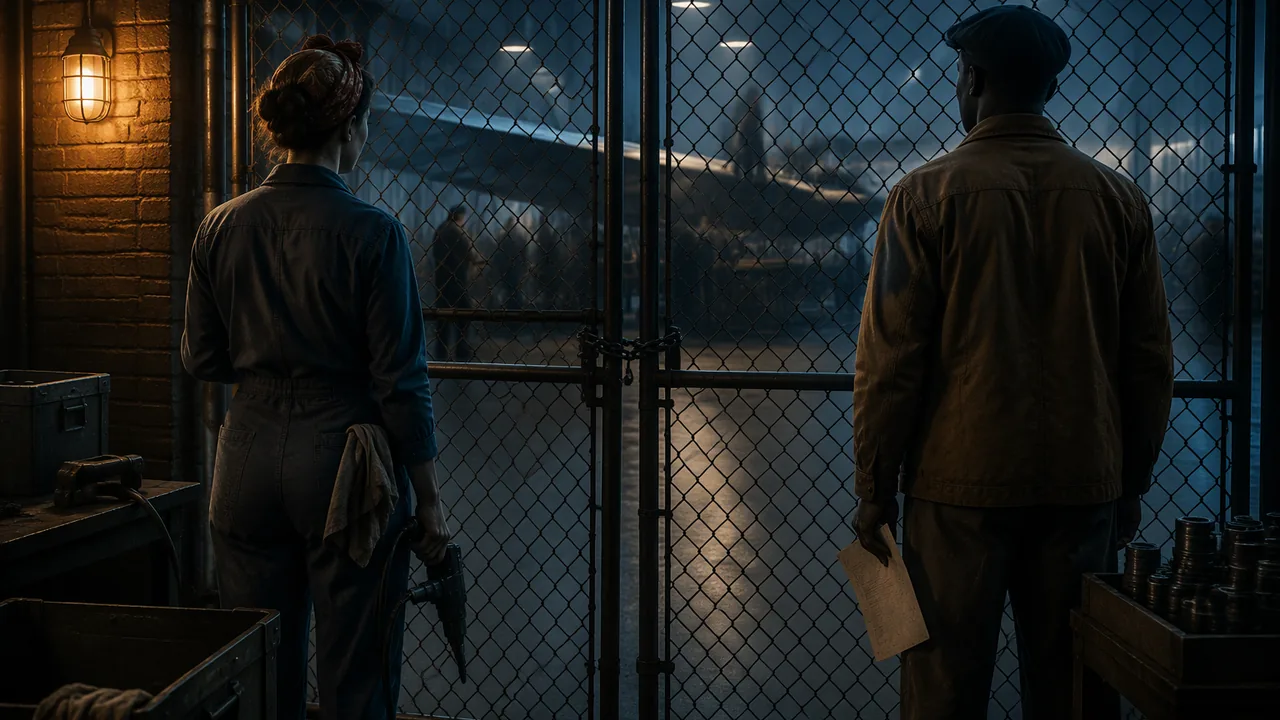
analyze the home front’s constitutional issues and contradictions — women’s war work, the demands of African Americans, the Bracero program, restrictions on enemy aliens and the response to the Holocaust — and explain them in writing using primary sources.
Instruction
Content note: this lesson discusses racial violence on the home front, including the 1943 race riot in Detroit, and the forced removal and incarceration of Japanese Americans.
The United States fought for the Four Freedoms abroad while denying some of them at home. The home front was a place of opportunity, sacrifice and injustice at once. This workshop asks you to explain one of its contradictions precisely.
Mobilization. The federal government directed production through the War Production Board, rationed sugar, meat, gasoline and tires through the Office of Price Administration, sold war bonds, and began withholding income tax from paychecks in 1943. Unemployment nearly disappeared.
Women. Millions of women took jobs in aircraft plants, shipyards and offices; “Rosie the Riveter” became the symbol. Women were paid less than men for similar work, and most were expected to give up their jobs when men returned. Many did, but women’s work outside the home never fell back to prewar levels.
African Americans’ demands. Defense plants hiring in 1941 often refused Black workers. A. Philip Randolph, leader of the Brotherhood of Sleeping Car Porters, threatened a march of 100,000 people on Washington. Roosevelt issued Executive Order 8802, banning discrimination in defense industries and government and creating the Fair Employment Practice Committee; Randolph called off the march. The Pittsburgh Courier launched the “Double V” campaign: victory over fascism abroad and racism at home. The armed forces remained segregated. In St. Louis, the local branch of the March on Washington Movement was one of the most active chapters in the country, according to the Missouri Historical Society: defense production was booming in the city, but the jobs were not going to African Americans. Black veterans came home determined to claim their rights. In 1948, facing pressure from Randolph and others and courting Black voters, President Truman issued Executive Order 9981, the beginning of the end of segregation in the military (US.11.10.1).
Mexican Americans and braceros. Hundreds of thousands of Mexican Americans served in the military. Farms faced labor shortages, and in 1942 the United States and Mexico agreed on the Bracero program, which brought Mexican men on temporary contracts to farms and railroads. It lasted until 1964 and issued millions of contracts, shaping farm labor across the Southwest and West (US.11.8.2); braceros often faced poor housing and unpaid wages.
Racial violence at home. On 20-21 June 1943, fighting between Black and white youths at Belle Isle in Detroit spread through the city. Nine white and 25 Black people were killed, and 17 of the Black victims died at the hands of police. After Black community leaders asked for help, the mayor requested national troops, and more than 3,500 arrived. A state committee’s report on the riot, according to the Detroit Historical Society, largely ignored the social inequities behind it.
Enemy aliens. Non-citizens from Germany, Italy and Japan were designated “enemy aliens,” registered, subjected to curfews and travel limits, and barred from coastal zones; thousands of Germans and Italians were interned. On the Pacific coast, Italian fishermen were kept off the water and some families were forced to move inland. Restrictions on Italians were lifted in October 1942. For Japanese Americans — citizens and non-citizens alike — the government went much further, as you will examine in the moot court.
The Holocaust. Nazi Germany and its collaborators murdered about six million Jews, along with Roma, disabled people, Poles, Soviet prisoners and others. Before the war, American immigration quotas stayed restrictive: in 1939 the refugee ship St. Louis was refused entry. By late 1942 the government had confirmed reports of mass murder. State Department officials obstructed rescue until a Treasury report in January 1944 accused them of acquiescence; Roosevelt then created the War Refugee Board, which helped save tens of thousands. Historians still debate whether bombing the rail lines or gas chambers at Auschwitz was possible and would have saved lives.
Skill: bias and point of view. HR.2 asks you to identify prejudice in sources and interpretations. An official report that ignores the causes of a riot, such as the state committee’s report on the 1943 Detroit riot, is evidence of the committee’s point of view, not a full account of what happened. RH.11-12.6 asks you to compare points of view: Randolph and Roosevelt both claimed credit for Order 8802.
Writing the explanation. WHST.11-12.2 asks you to examine a complex topic clearly. Choose one contradiction and build the essay around a controlling idea. Example: “Executive Order 8802 opened defense jobs to Black workers because organized protest made discrimination politically costly, not because the government’s war aims required it — and the order’s limits show how far that pressure could reach.” WHST.11-12.2.b asks you to select the most significant facts, quotations and examples.
📖 Read for this lesson
The reading opens over the lesson; close it to come back to exactly where you were. The checks below draw on it.
Reading: Two executive orders, seven years apart
Executive Order 8802 (25 June 1941); Executive Order 9981 (26 July 1948) · Public domain (U.S. government works)
Neither order was a gift. Look for who pressed for each, and what each leaves out.
Executive Order 8802: …there shall be no discrimination in the employment of workers in defense industries or government because of race, creed, color, or national origin…
Executive Order 9981: It is hereby declared to be the policy of the President that there shall be equality of treatment and opportunity for all persons in the armed services without regard to race, color, religion or national origin.
Formative check
Work through these before moving on. They are not graded — they tell you whether the standard below has landed yet.
What led Roosevelt to issue Executive Order 8802 in June 1941?
Restrictions on Italian resident aliens remained in place throughout the war.
Write an explanatory essay (600-750 words) on one home-front contradiction: Executive Order 8802, the Bracero program, the Detroit riot of 1943, the treatment of enemy aliens, or the response to the Holocaust. State a controlling idea, use at least two primary sources, identify one point of view or bias in a source, and explain what the case shows about the gap between the Four Freedoms and life at home.
How confident are you that you can explain the home front’s contradictions using primary sources and identify bias and point of view?
Practice
Work these on paper or in your notebook, then open Check your answer. Aim for all of Fluency and Application; try at least one Challenge.
Printable version: this unit’s practice workbook (PDF)
Fluency
Build speed and accuracy with the core skill.
- Order: Executive Order 9981; Detroit race riot; Bracero program begins; Executive Order 8802; War Refugee Board created.
Check your answer
Answer: EO 8802 (June 1941); Bracero program (1942); Detroit riot (June 1943); War Refugee Board (January 1944); EO 9981 (July 1948). - What was the ‘Double V’ campaign?
Check your answer
Answer: The Black press’s call, launched by the Pittsburgh Courier, for victory over fascism abroad and racism at home.
Application
Use the skill in context. Show your reasoning.
- Executive Order 8802 declared ‘there shall be no discrimination in the employment of workers in defense industries or government because of race, creed, color, or national origin.’ Who pressed for it, and what does the order leave out?
Check your answer
Answer: A. Philip Randolph, threatening a march of 100,000 on Washington. It did not desegregate the armed forces, which remained segregated until Executive Order 9981 began that change in 1948. - A state committee’s 1943 report on the Detroit riot, in which nine white and 25 Black people died and 17 of the Black victims were killed by police, is described by the Detroit Historical Society as largely ignoring the social inequities behind the riot. How should a historian use such a report?
Check your answer
Answer: As evidence of the committee’s point of view and what officials chose to see, not as a complete account of what happened or why; corroborate with the casualty record and other accounts, such as Black community leaders’ appeals for troops. - Randolph threatened a march in 1941 and Roosevelt issued Order 8802 that June. Cause or sequence?
Check your answer
Answer: Cause, with evidence: the order came in direct response to the threatened march, and Randolph called the march off when it was issued. The labor shortage in defense industries was a contributing condition.
Review
Keep earlier skills sharp.
- Semester A review: which 1913 amendment changed how U.S. senators are chosen, giving voters rather than state legislatures the choice?
Check your answer
Answer: The Seventeenth Amendment.
Granted and Withheld: Four Home-Front Documents, 1941-1948
Executive Order 8802 (25 June 1941); Public Law 45, 57 Stat. 70 (26 April 1943); Executive Order 9417 (22 January 1944); Executive Order 9981 (26 July 1948) · Public domain (U.S. government works)
Why this reading. Content note: this reading concerns wartime discrimination, forced removal and the government’s response to the murder of Europe’s Jews. The workshop asks for an explanatory essay built on “at least two primary sources” with “one point of view or bias” identified in one of them. The lesson supplies one clause from each of two executive orders, seven years apart, which is not two sources; it is two sentences on the same subject. Here are four documents covering four of the five contradictions the essay may choose from, each complete enough to quote, compare and argue with. What to look for: every one of these documents grants something and withholds something in the same paragraph. Find the withholding.
1. Executive Order 8802, 25 June 1941 — what was granted and what was not
WHEREAS it is the policy of the United States to encourage full participation in the national defense program by all citizens of the United States, regardless of race, creed, color, or national origin, in the firm belief that the democratic way of life within the Nation can be defended successfully only with the help and support of all groups within its borders; and
WHEREAS there is evidence that available and needed workers have been barred from employment in industries engaged in defense production solely because of considerations of race, creed, color, or national origin, to the detriment of workers’ morale and of national unity:
NOW, THEREFORE, by virtue of the authority vested in me by the Constitution and the statutes, and as a prerequisite to the successful conduct of our national defense production effort, I do hereby reaffirm the policy of the United States that there shall be no discrimination in the employment of workers in defense industries or government because of race, creed, color, or national origin…
1. All departments and agencies of the Government of the United States concerned with vocational and training programs for defense production shall take special measures appropriate to assure that such programs are administered without discrimination…
2. All contracting agencies of the Government of the United States shall include in all defense contracts hereafter negotiated by them a provision obligating the contractor not to discriminate against any worker…
3. There is established in the Office of Production Management a Committee on Fair Employment Practice… The Committee shall receive and investigate complaints of discrimination in violation of the provisions of this order and shall take appropriate steps to redress grievances which it finds to be valid.
Point of view. Read the reasons the order gives for itself. Discrimination is described as a problem because it harms “workers’ morale,” “national unity” and the “defense production effort” — not because it is unjust. The order covers defense industries and government, and nothing else: not housing, not schools, not the armed forces. The committee may investigate and recommend; the order gives it no power to punish. A. Philip Randolph, who had threatened a march of 100,000, called the march off when this was issued. Both men afterwards claimed the credit, and the text lets you judge which of them got what he wanted.
2. Executive Order 9981, 26 July 1948
1. It is hereby declared to be the policy of the President that there shall be equality of treatment and opportunity for all persons in the armed services without regard to race, color, religion or national origin. This policy shall be put into effect as rapidly as possible, having due regard to the time required to effectuate any necessary changes without impairing efficiency or morale.
2. There shall be created in the National Military Establishment an advisory committee to be known as the President’s Committee on Equality of Treatment and Opportunity in the Armed Services, which shall be composed of seven members to be designated by the President.
Point of view. The order never uses the word “desegregation,” and the second sentence of paragraph 1 is a schedule written by whoever is doing the effectuating. Compare it with paragraph 3 of the 1941 order: seven years apart, a president again answers organized pressure with a declaration and a committee. What had changed by 1948 was who was pressing — a million Black veterans, Randolph again, and an election in which Black votes in Northern cities mattered.
3. Public Law 45, 26 April 1943 — the Bracero program in the words of the appropriation
Congress funded the wartime farm labor program in a joint resolution. One proviso decides who in an American field could be protected by federal money and who could not:
…no part of the funds herein appropriated or made available to any agency of the Government for the recruiting, transportation, or placement of agricultural workers, shall be used directly or indirectly to fix, regulate, or impose minimum wages or housing standards, to regulate hours of work, or to impose or enforce collective-bargaining requirements or union membership, with respect to any agricultural labor, except with respect to workers imported into the United States from a foreign country and then only to the extent required to comply with agreements with the government of such foreign country…
What this says. Federal money may not set a minimum wage, a housing standard or an hours limit for farmworkers — unless the worker was brought in from abroad, in which case it may, but only as far as the agreement with Mexico requires. A bracero therefore had a written contract with terms; the Mexican American or Black or Dust Bowl worker in the next row had none, and by section 2(3) of the Wagner Act (Lesson 1.4) could not lawfully organize for one. Growers understood this. So did the workers.
4. Executive Order 9417, 22 January 1944 — the War Refugee Board
Eighteen months after the government had confirmed reports of mass murder, and days after Treasury officials handed Roosevelt a report accusing the State Department of obstruction, the president ordered:
…it is the policy of this Government to take all measures within its power to rescue the victims of enemy oppression who are in imminent danger of death…
and created a board of the Secretaries of State, the Treasury and War to carry it out. Point of view. The word “policy” is doing heavy work. Compare the date — January 1944 — with the date the government confirmed the killings, late 1942, and with the fact that the immigration quotas set in 1924 were never raised. The Board is credited with helping to save tens of thousands of people. It was created in the twenty-seventh month of American belligerency, by an order that describes rescue as something the government had been in favor of all along.
Writing the explanation
This section is ours, not quoted. The rubric wants a controlling idea, two primary sources and one identified bias or point of view. The four documents above make three strong essays:
- Order 8802 and Order 9981 together. Controlling idea: in both cases a president acted when organized Black pressure made inaction costly, and in both cases he granted the narrowest thing that would end the pressure. Bias to identify: the 1941 order’s own stated reasons.
- Public Law 45 with the Wagner Act’s section 2(3). Controlling idea: the wartime labor shortage was solved by importing workers with contracts into a system that forbade federal protection for the workers already there. Bias to identify: an appropriation that never states the policy it is enacting, only what money may not be spent on.
- Order 9417 and the refugee record. Controlling idea: the gap between the Four Freedoms and the quota system was closed, partly, only after officials inside the government accused other officials of obstruction. Bias to identify: an order that announces a policy in the present tense to cover a change of course.
Whichever you choose, the essay’s job is to explain the gap between what the Four Freedoms promised and what the home front delivered — and to be exact about who was on which side of the gap. “Americans” is not exact. “An agricultural laborer who was not imported from a foreign country” is.
Sources: Executive Order 8802 (1941), National Archives milestone documents (archives.gov); Executive Order 9981 (1948), National Archives milestone documents (archives.gov); Public Law 45, 57 Stat. 70 (1943), United States Statutes at Large, govinfo.gov (govinfo.gov); Executive Order 9417, Establishing the War Refugee Board (1944), American Presidency Project (presidency.ucsb.edu)