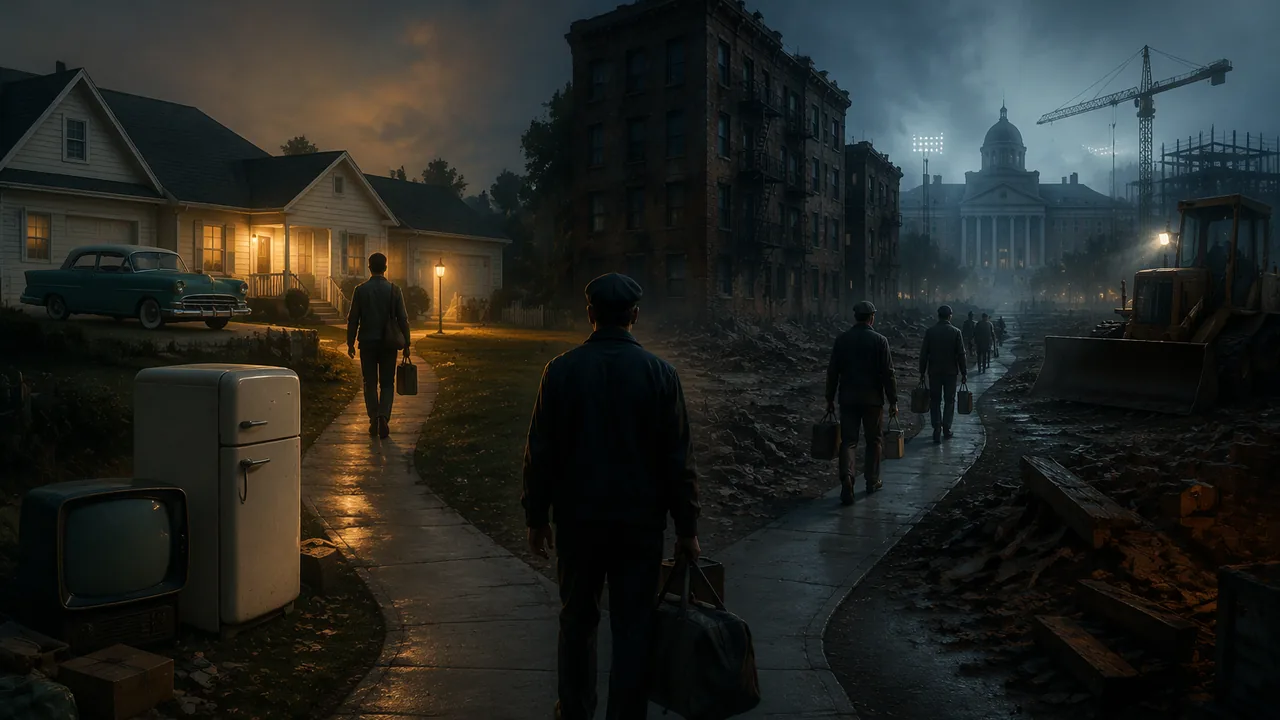
analyze the postwar economic boom and social transformation — service and professional jobs, Truman’s labor policy, federal and state spending including the Truman Commission on Higher Education and urban renewal in St. Louis, popular culture — and discuss the persistence of poverty and competing policies to address it.
Instruction
Between 1945 and the early 1970s, the American economy grew faster and spread its gains more widely than ever before. Millions of families bought homes, cars and televisions and sent children to college. Millions of others were left out. This seminar asks who shared the affluent society and what government did about those who did not.
New work. The economy shifted from making goods to providing services. By the mid-1950s white-collar workers outnumbered blue-collar workers for the first time. Jobs grew fastest in offices, sales, finance, health care, education and government, including defense agencies and state universities. Corporations grew larger and more bureaucratic.
Truman and labor. In 1946 the largest strike wave in American history hit steel, autos, coal and railroads. Truman, a friend of labor, threatened to draft striking railroad workers into the army. In 1947 the new Republican Congress passed the Taft-Hartley Act over his veto: it banned the closed shop, permitted state right-to-work laws, allowed the president to seek an eighty-day “cooling-off” injunction against strikes that endangered the nation, and required union officers to swear they were not communists. Truman used its injunctions anyway. In 1952 he seized the steel mills to prevent a strike during the Korean War; the Supreme Court held the seizure unconstitutional in Youngstown Sheet & Tube Co. v. Sawyer.
Where the money went. Federal spending stayed far above prewar levels. Defense took the largest share through the 1950s. Social Security was expanded to cover more workers and, from 1956, disabled workers. Interest on the large war debt was a major cost, though the debt shrank relative to the growing economy. The GI Bill paid college costs and backed home loans for millions of veterans, although local administrators often denied Black veterans its full benefits. The Interstate Highway Act (1956) built 41,000 miles of highway, justified partly by defense. States spent heavily on schools for the baby-boom generation. Missouri was quick to use the new highway money: on 2 August 1956 the Missouri State Highway Commission awarded the first Interstate construction contract under the new law, 13.3 miles of U.S. 66 (now I-44) in Laclede County, and a contract for 2.6 miles of U.S. 40 (now I-70) in St. Charles County became the first on which construction actually began. In higher education, President Truman’s Commission on Higher Education reported in December 1947 and recommended doubling college attendance by 1960, free public education through the first two years of college, community colleges, an end to racial and religious discrimination and expanded federal aid — a blueprint for broad, low-cost access.
Suburbs. Federal mortgage insurance and highways built the suburbs, from Levittown, New York, to the new neighborhoods around St. Louis and Kansas City. Many developers and lenders excluded Black families. The Supreme Court’s 1948 decision in Shelley v. Kraemer began in St. Louis, where in 1911 thirty owners on Labadie Avenue had signed an agreement barring occupancy by anyone “not of the Caucasian race”; the Court held that state courts could not enforce such covenants, but lending discrimination continued.
Popular culture. Television reached nearly nine in ten homes by 1960. Rock and roll grew from Black rhythm and blues and gospel and white country music; it spread through radio, records and television, and often white performers covered Black artists’ songs for larger audiences. Jazz moved from dance halls to bebop and cool jazz. Chuck Berry of St. Louis blended jazz-inspired guitar riffs, jump blues and country storytelling; his 1955 recording “Maybellene,” adapted from the country song “Ida Red,” sold a million copies. Jackie Robinson, who played for the Kansas City Monarchs of the Negro Leagues in 1945, integrated major-league baseball in 1947.
Urban renewal. Cities used public money to clear neighborhoods they labeled slums. St. Louis voters approved a bond issue for the clearance of Mill Creek Valley, where demolition began in 1959 and about 20,000 Black St. Louisans were displaced. Pruitt-Igoe, a public housing complex of 33 eleven-story buildings with nearly 3,000 units, was completed in 1954 and torn down in 1972. Who benefited from this spending, and who paid for it, is part of the answer to the seminar question.
Poverty amid plenty. In The Other America (1962) Michael Harrington described tens of millions of poor Americans invisible to the suburbs; read it through your library. The Census Bureau measured the poverty rate at 22.4 percent in 1959. Johnson’s War on Poverty (the reading) created Job Corps, Head Start, food stamps, Medicare and Medicaid; the poverty rate fell to 11.1 percent by 1973. Americans still disagree about why poverty persists and what to do. Structural analyses stress a lack of jobs, low wages and discrimination, and favor public jobs, training and health coverage. Behavioral or incentive analyses argue that some programs discouraged work and marriage, and favor work requirements. Those arguments shaped the 1996 welfare reform, which replaced cash aid with time-limited, work-conditioned grants, and the long fight over health insurance, from Medicare to the Affordable Care Act of 2010.
Seminar question: Who shared the affluent society, and what should government have done for those who did not? HI.6 asks you to use indicators carefully: the poverty rate is one measure, and you should say what it counts. SL.11-12.1.d asks you to respond to diverse perspectives and to resolve contradictions where you can.
📖 Read for this lesson
The reading opens over the lesson; close it to come back to exactly where you were. The checks below draw on it.
Reading: Three presidents on the nation’s welfare
Harry S. Truman, Annual Message to Congress (5 January 1949); Lyndon B. Johnson, Annual Message to Congress (8 January 1964); Ronald Reagan, Inaugural Address (20 January 1981); William J. Clinton, Address before a Joint Session of Congress on the State of the Union (23 January 1996) · Public domain (U.S. government works)
Four presidents across forty-seven years. Trace how each describes government’s responsibility for economic security.
Truman (1949): Every segment of our population, and every individual, has a right to expect from our Government a fair deal.
Johnson (1964): This administration today, here and now, declares unconditional war on poverty in America.
Reagan (1981): In this present crisis, government is not the solution to our problem; government is the problem.
Clinton (1996): The era of big government is over.
Formative check
Work through these before moving on. They are not graded — they tell you whether the standard below has landed yet.
Truman’s 1947 on Higher Education urged community colleges and an end to discrimination in admissions; the official poverty rate fell from 22.4 percent in 1959 to 11.1 percent in ; the 1996 law replaced cash aid with time-limited, -conditioned grants.
Rock and roll grew out of Black rhythm and blues and gospel as well as white country music.
For the seminar, analyze two of the four speeches: what problem each president names, what role he assigns government, and what evidence of the time supports or challenges his view. Record a 90-second contribution answering the seminar question, then write two replies, each to a position you disagree with (a parent, guardian or study partner can supply one), that find common ground and state precisely where you still disagree.
How confident are you that you can explain the postwar boom and its limits, and discuss competing analyses of poverty and policy?
Practice
Work these on paper or in your notebook, then open Check your answer. Aim for all of Fluency and Application; try at least one Challenge.
Printable version: this unit’s practice workbook (PDF)
Fluency
Build speed and accuracy with the core skill.
- Order: Truman Commission on Higher Education report; Taft-Hartley Act; Interstate Highway Act; War on Poverty declared; GI Bill; Youngstown steel-seizure decision.
Check your answer
Answer: GI Bill (1944); Taft-Hartley (June 1947); Truman Commission report (December 1947); Youngstown (1952); Interstate Highway Act (1956); War on Poverty (1964). - Name four recommendations of the Truman Commission on Higher Education (December 1947).
Check your answer
Answer: Any four of: doubling college attendance by 1960; free public education through the first two years of college; community colleges; ending racial and religious discrimination in admissions; expanded federal scholarships and aid.
Application
Use the skill in context. Show your reasoning.
- Compare Johnson’s 1964 ‘This administration today, here and now, declares unconditional war on poverty in America’ with Reagan’s 1981 ‘government is not the solution to our problem; government is the problem.’ What does each speech’s occasion tell you about its purpose?
Check your answer
Answer: Model answer: Johnson’s was an annual message to Congress seeking legislation; Reagan’s was an inaugural address, during inflation and recession, setting the tone for cutting government. Both are persuasion from presidents of different parties. Strong answers test each against evidence of its time, such as the poverty rate falling from 22.4 percent (1959) to 11.1 percent (1973). - The official poverty rate fell from 22.4 percent in 1959 to 11.1 percent in 1973. What can this indicator show about the War on Poverty, and what can it not show on its own?
Check your answer
Answer: It shows that poverty fell sharply over the period. It cannot on its own separate the effect of War on Poverty programs from economic growth, Social Security expansion or other causes; the decline began before 1964. - Truman vetoed Taft-Hartley in 1947 and Congress overrode him. Strikes never again reached the scale of the 1946 wave. Did Taft-Hartley cause the decline?
Check your answer
Answer: Model answer: it may have contributed by limiting union tactics, but prosperity and long-term contracts that raised wages also mattered. A strong answer asks what evidence isolates the law’s effect.
Review
Keep earlier skills sharp.
- From Unit 1: what did the Wagner Act (1935) create to hold union elections?
Check your answer
Answer: The National Labor Relations Board.
Who Shared It: Four Presidents and the Poverty Series
Truman, Annual Message to Congress (5 January 1949); Johnson, Annual Message to Congress (8 January 1964); Reagan, Inaugural Address (20 January 1981); Clinton, Address before a Joint Session of Congress (23 January 1996); U.S. Census Bureau, Historical Poverty Tables, Table 2 · Public domain (U.S. government works)
Why this reading. The seminar asks who shared the affluent society and what government should have done for those who did not, and the preparation sheet asks you to analyze two of four presidential speeches: what problem each names, what role he gives government, and what evidence of the time supports or challenges his view. The lesson gives you one line of each speech and one pair of poverty figures. A line is not an argument and two figures are not a series. Here are the four passages at the length where the argument is visible, and the federal poverty series they all have to answer to. What to look for: the poverty rate falls fastest in the years between Johnson’s declaration and his programs taking full effect. That timing is a problem for more than one of these speeches.
1. Truman, Annual Message to Congress, 5 January 1949
Truman had just won an election almost everyone expected him to lose. He describes a country that has already built a great deal and has stopped too soon:
The American people have decided that poverty is just as wasteful and just as unnecessary as preventable disease. We have pledged our common resources to help one another in the hazards and struggles of individual life. We believe that no unfair prejudice or artificial distinction should bar any citizen of the United States of America from an education, or from good health, or from a job that he is capable of performing.
We have made tremendous public investments in highways, hydroelectric power projects, soil conservation, and reclamation. We have established a system of social security… These Federal policies have paid for themselves many times over.
The present coverage of the social security laws is altogether inadequate; the benefit payments are too low. One-third of our workers are not covered…
We must spare no effort to raise the general level of health in this country. In a nation as rich as ours, it is a shocking fact that tens of millions lack adequate medical care… we need—and we must have without further delay—a system of prepaid medical insurance which will enable every American to afford good medical care.
At present, the working men and women of the Nation are unfairly discriminated against by a statute that abridges their rights… That statute is the Labor-Management Relations Act of 1947, sometimes called the Taft-Hartley Act.
I hope for cooperation from farmers, from labor, and from business. Every segment of our population and every individual has a right to expect from our Government a fair deal.
A note on the famous sentence. It is often quoted as “from his Government.” The Public Papers text reads “from our Government.” Quote it as printed above, and treat this as a small lesson in checking. Note also that the sentence is not a grand opening: it is the last line of a passage asking three interest groups to cooperate.
2. Johnson, Annual Message to Congress, 8 January 1964
Unfortunately, many Americans live on the outskirts of hope—some because of their poverty, and some because of their color, and all too many because of both. Our task is to help replace their despair with opportunity.
This administration today, here and now, declares unconditional war on poverty in America. I urge this Congress and all Americans to join with me in that effort.
It will not be a short or easy struggle, no single weapon or strategy will suffice, but we shall not rest until that war is won. The richest Nation on earth can afford to win it. We cannot afford to lose it. One thousand dollars invested in salvaging an unemployable youth today can return $40,000 or more in his lifetime.
Poverty is a national problem, requiring improved national organization and support. But this attack, to be effective, must also be organized at the State and the local level…
For the war against poverty will not be won here in Washington. It must be won in the field, in every private home, in every public office, from the courthouse to the White House.
Two things worth noticing: Johnson names race and poverty together in the first sentence, and he justifies the program with a rate of return, not only with justice.
3. Reagan, Inaugural Address, 20 January 1981
The economic ills we suffer have come upon us over several decades. They will not go away in days, weeks, or months, but they will go away.
In this present crisis, government is not the solution to our problem; government is the problem. From time to time we’ve been tempted to believe that society has become too complex to be managed by self-rule, that government by an elite group is superior to government for, by, and of the people. Well, if no one among us is capable of governing himself, then who among us has the capacity to govern someone else?
We hear much of special interest groups. Well, our concern must be for a special interest group that has been too long neglected. It knows no sectional boundaries or ethnic and racial divisions, and it crosses political party lines. It is made up of men and women who raise our food, patrol our streets, man our mines and factories, teach our children, keep our homes, and heal us when we’re sick—professionals, industrialists, shopkeepers, clerks, cabbies, and truckdrivers. They are, in short, “We the people,” this breed called Americans.
The full sentence is conditional: “In this present crisis…” The crisis he means is the inflation and unemployment of 1979–1981, and the speech is an argument about who governs, not only about how much government there should be.
4. Clinton, Address before a Joint Session of Congress, 23 January 1996
…give the American people a smaller, less bureaucratic Government in Washington. And we have to give the American people one that lives within its means. The era of big Government is over. But we cannot go back to the time when our citizens were left to fend for themselves.
He repeated it at the end of the speech: “I say again, the era of big Government is over. But we can’t go back to the era of fending for yourself.” The half-sentence that is always quoted and the half-sentence that never is were spoken in the same breath, twice. That is an analytical point about the speech, and about quotation.
5. The series all four have to answer to
From the Census Bureau’s historical poverty tables, the official poverty rate for all people:
| Year | Number (thousands) | Poverty rate |
|---|---|---|
| 1959 | 39,490 | 22.4% |
| 1960 | 39,850 | 22.2% |
| 1962 | 38,630 | 21.0% |
| 1964 | 36,060 | 19.0% |
| 1965 | 33,190 | 17.3% |
| 1966 | 28,510 | 14.7% |
| 1969 | 24,150 | 12.1% |
| 1973 | 22,970 | 11.1% |
| 1980 | 29,270 | 13.0% |
What the rate counts, and what it does not (HI.6). The official measure counts pre-tax cash income against a threshold built in the early 1960s from the cost of a minimum food budget multiplied by three, adjusted since only for prices. It therefore excludes food stamps, Medicaid, housing assistance and refundable tax credits — that is, most of what the War on Poverty and later programs actually delivered. A student who says “the rate fell from 22.4 to 11.1 percent, so the programs worked” has to face the fact that the measure does not count the programs; a student who says the programs did nothing has to explain why the rate fell by half in fourteen years anyway. Both sides of the seminar have work to do here.
Using this in the seminar
This section is ours, not quoted. For each speech, the sheet wants a problem, a role for government, and evidence that supports or challenges it.
- Truman 1949 names the problem as gaps in a system already built — one third of workers outside Social Security, tens of millions without medical care. Supporting evidence: the coverage gap was real, and the 1950s amendments closed much of it. Challenging evidence: he got the housing and minimum wage, and lost health insurance entirely; a president with a mandate could not move Congress, which is evidence about how change happens.
- Johnson 1964 names poverty amid plenty and makes the federal government the organizer. Supporting evidence: the rate fell from 19.0 to 11.1 percent between 1964 and 1973. Challenging evidence: most of the fall had happened by 1969, and a growing economy was moving at the same time; and the measure ignores the in-kind benefits his programs provided.
- Reagan 1981 names government itself, in a crisis of inflation and unemployment. Supporting evidence: the 1970s record of inflation and slow growth. Challenging evidence: the poverty rate rose from 11.1 percent in 1973 to 13.0 percent in 1980 and higher in the early 1980s, which cuts both ways — it is evidence that the previous approach had stopped working, and evidence about what followed.
- Clinton 1996 names the size of government, and then immediately limits his own claim. The 1996 welfare law replaced cash aid with time-limited, work-conditioned grants; the caseload fell sharply, employment among single mothers rose, and deep poverty among the least employable did not improve. That is a genuinely contested result and a good place to find common ground with a position you disagree with, which is what your two replies are for.
The Missouri evidence belongs here too. In December 1947 President Truman’s Commission on Higher Education recommended doubling college attendance by 1960, extending free public education through the first two years of college for all youth who could profit from it, establishing community colleges, and eliminating racial and religious discrimination, and it urged expanded federal support through scholarships, fellowships and general aid (Truman Library, statement of 15 December 1947). Some of the same decade’s spending went to St. Louis, where voters approved a bond issue for clearing Mill Creek Valley, demolition began in 1959 and about 20,000 Black St. Louisans were displaced, and where the Pruitt-Igoe complex, 33 eleven-story buildings with nearly 3,000 units, was completed in 1954 and torn down in 1972. Ask who each of these reached and who it did not, and set them against the GI Bill, whose benefits local administrators often denied to Black veterans.
Sources: Truman, Annual Message to the Congress on the State of the Union (5 January 1949), Truman Library (trumanlibrary.gov); Johnson, Annual Message to the Congress on the State of the Union (8 January 1964), American Presidency Project (presidency.ucsb.edu); Reagan, Inaugural Address (20 January 1981), Reagan Presidential Library (reaganlibrary.gov); Clinton, Address Before a Joint Session of the Congress on the State of the Union (23 January 1996), Public Papers, govinfo.gov (govinfo.gov); Historical Poverty Tables: People and Families, Table 2, U.S. Census Bureau (www2.census.gov); Statement by the President Making Public a Report of the Commission on Higher Education (15 December 1947), Truman Library (trumanlibrary.gov); Remembering Mill Creek Valley, once home to 20,000 Black St. Louisans, St. Louis Public Radio (stlpr.org); Wendell O. Pruitt Homes and William Igoe Apartments (Pruitt-Igoe), The Cultural Landscape Foundation (tclf.org)