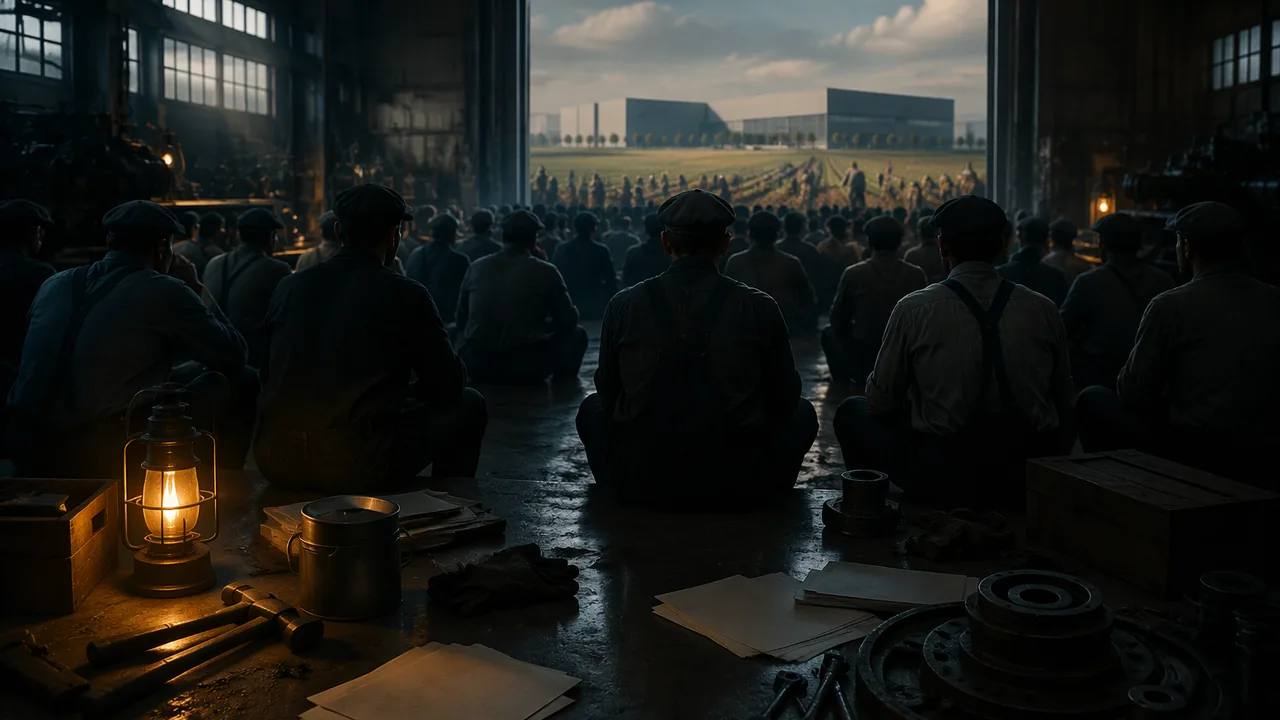
trace the advances and retreats of organized labor from the AFL and CIO to the United Farm Workers and today’s post-industrial economy, and write an argument about a turning point.
Instruction
Organized labor’s history is not a straight line. Unions grew, collapsed, surged and shrank again, and at each turn law, politics, the economy and workers’ own choices mattered. This workshop follows the line and asks you to argue about a turning point.
Craft unions. The American Federation of Labor, founded in 1886 under Samuel Gompers, organized skilled workers by craft — carpenters, cigar makers, machinists. It pursued “pure and simple” goals: wages, hours and conditions through collective bargaining, not political revolution. It largely excluded unskilled workers, most women and, in many unions, Black and Asian workers. The Industrial Workers of the World (1905) tried to organize everyone, including migrant farmworkers, and was crushed during the First World War. In the 1920s employers promoted the “open shop,” and membership fell.
The New Deal surge. The Wagner Act of 1935 put federal law behind the right to organize and created the National Labor Relations Board to hold union elections and stop unfair practices. John L. Lewis of the Mine Workers led a breakaway from the AFL to form the Committee (later Congress) of Industrial Organizations, the CIO, which organized whole industries — steel, autos, rubber — including unskilled, immigrant and Black workers. In the Flint sit-down strike of 1936-1937, auto workers occupied General Motors plants for six weeks until GM recognized the United Auto Workers. Among farm tenants, the interracial Southern Tenant Farmers’ Union organized cotton country, and by late 1938 it had more than thirty locals and about 4,500 members in Missouri’s Bootheel (Lesson 1.2). Union membership more than quadrupled between 1933 and 1945.
Peak and retreat. By the mid-1950s about one in three nonfarm workers belonged to a union, and the AFL and CIO merged in 1955. The Taft-Hartley Act of 1947 (Unit 3) limited union tactics and let states pass “right-to-work” laws. From the 1970s, factories closed or moved to the South and abroad, and industries with strong unions shrank. In 1981 President Reagan fired more than 11,000 striking air traffic controllers, and many private employers took a harder line. In recent Bureau of Labor Statistics counts, about one in ten wage and salary workers belongs to a union, and public employees are far more likely to be members than private ones.
The farmworkers. Look at section 2(3) of the reading: the Wagner Act excluded agricultural and domestic workers, a concession to Southern members of Congress. Farmworkers struck many times without legal protection, and the Missouri sharecroppers of 1939 had to go out on the roadside because the law gave them no ballot (Lesson 1.2). When the Bracero program ended in 1964, organizing became more possible. On 8 September 1965, Filipino grape workers of the Agricultural Workers Organizing Committee, led by Larry Itliong, struck growers around Delano, California. Days later the mostly Mexican American National Farm Workers Association, led by César Chávez and Dolores Huerta, voted to join them. The unions merged into what became the United Farm Workers. They used nonviolence, a long march, and a national consumer boycott of table grapes; in 1970 major growers signed contracts. The Filipino workers who began the strike are often left out of the story; historians now restore them.
Missouri’s record. Missouri’s Constitution of 1945 says, in Article I, Section 29: “That employees shall have the right to organize and to bargain collectively through representatives of their own choosing.” Section 14(b) of the Taft-Hartley Act lets each state decide whether to permit agreements that require union membership. In 2017 the General Assembly passed a right-to-work law, Senate Bill 19; opponents gathered enough signatures to force a referendum, and on 7 August 2018 Missouri voters rejected the law, 939,973 to 453,283 — 67.47 percent no. Supporters argue that workers should decide for themselves whether to pay a union; opponents argue that everyone who benefits from a contract should share its cost. The vote is a documented example of how power over union security passed from Congress to the states.
Today. Questions of a post-industrial, multinational economy are live everywhere: whether app-based drivers are employees or independent contractors, how global supply chains affect wages, and how to organize workers who move between jobs.
Writing the argument. WHST.11-12.1.a asks for a precise claim. Example: “The Wagner Act was the most important turning point in American labor history, because it moved the right to organize from the picket line into federal law — but by excluding farmworkers it also set the terms of the farmworkers’ struggle for decades.” WHST.11-12.1.c asks you to link claims and evidence with transitions that show relationships of cause, contrast and consequence. CST.2 asks you to show that change happens at different rates: labor rose fast in the 1930s and declined slowly after the 1950s.
📖 Read for this lesson
The reading opens over the lesson; close it to come back to exactly where you were. The checks below draw on it.
Reading: The right to organize — and who it left out
National Labor Relations Act (Wagner Act), 5 July 1935, sections 7 and 2(3) · Public domain (U.S. government work)
Section 7 grants the right; section 2(3) defines who counts as an ’employee’. Read the definition closely: who is excluded?
Section 7: Employees shall have the right to self-organization, to form, join, or assist labor organizations, to bargain collectively through representatives of their own choosing, and to engage in concerted activities, for the purpose of collective bargaining or other mutual aid or protection.
Section 2(3): The term “employee…” shall not include any individual employed as an agricultural laborer, or in the domestic service of any family or person at his home…
Formative check
Work through these before moving on. They are not graded — they tell you whether the standard below has landed yet.
What was the main difference between the AFL and the CIO?
The Delano grape strike of 1965 was begun by Filipino workers of the Agricultural Workers Organizing Committee.
Write an argument essay (600-750 words): What was the most important turning point in American labor history between 1886 and today? State a precise claim, support it with evidence from at least two periods, include the farmworkers’ experience, develop and answer a counterclaim, and use transitions that make the causal logic explicit.
How confident are you that you can trace labor’s advances and retreats from the AFL to the UFW and argue about a turning point?
Practice
Work these on paper or in your notebook, then open Check your answer. Aim for all of Fluency and Application; try at least one Challenge.
Printable version: this unit’s practice workbook (PDF)
Fluency
Build speed and accuracy with the core skill.
- Order: Missouri Proposition A vote on right-to-work; AFL founded; Flint sit-down strike ends; Delano grape strike begins; Taft-Hartley Act.
Check your answer
Answer: AFL (1886); Flint (1937); Taft-Hartley (1947); Delano (1965); Proposition A (2018). - Distinguish a craft union from an industrial union, with an example of each organization.
Check your answer
Answer: A craft union organizes skilled workers in one trade (the AFL’s unions); an industrial union organizes all workers in an industry (the CIO’s United Auto Workers).
Application
Use the skill in context. Show your reasoning.
- The Wagner Act’s section 7 gave employees ‘the right to self-organization.’ Section 2(3) says ’employee’ ‘shall not include any individual employed as an agricultural laborer.’ Why was that exclusion included, and what did it mean for farmworkers such as the Missouri Bootheel sharecroppers?
Check your answer
Answer: It was a concession to Southern members of Congress. It left farmworkers without federal protection for organizing: Bootheel sharecroppers facing eviction in 1939 had only the roadside, and the Delano strikers of 1965 had to win by consumer boycott because there was no ballot to win. - Popular accounts credit César Chávez with starting the Delano grape strike. Corroborate with the lesson’s account.
Check your answer
Answer: Filipino workers of the Agricultural Workers Organizing Committee, led by Larry Itliong, struck first on 8 September 1965; Chávez and Huerta’s NFWA joined days later. - The Bracero program ended in 1964 and the Delano strike began in 1965. Did the end of the program cause the strike?
Check your answer
Answer: It made organizing more possible by reducing growers’ supply of contract labor, so it is a contributing cause. The strike also grew from years of organizing, low wages and the Filipino and Mexican American unions’ own decisions. A strong answer names the link and the other causes. - In the 7 August 2018 vote on Missouri Proposition A, 453,283 voted yes and 939,973 voted no. What percentage voted no, and what did a no vote do?
Check your answer
Answer: 939,973 ÷ 1,393,256 ≈ 0.6747, or 67.47 percent. A no vote rejected Senate Bill 19, so the right-to-work law did not take effect and was repealed.Total votes: 453,283 + 939,973 = 1,393,256.
Review
Keep earlier skills sharp.
- Semester A review: which 1894 strike was broken by federal troops?
Check your answer
Answer: The Pullman strike. - From Lesson 1.3: which original Social Security exclusion parallels the Wagner Act’s section 2(3)?
Check your answer
Answer: The exclusion of agricultural and domestic workers.
The Right to Organize in Law and at the Ballot Box: 1935, 1947 and Missouri
National Labor Relations Act, 49 Stat. 449 (1935), sections 1, 2(3), 7, 8, 9(a); Labor Management Relations Act, 61 Stat. 136 (1947), section 14(b), codified at 29 U.S.C. 164(b); Missouri Constitution of 1945, Article I, Section 29; Missouri Senate Bill 19 (2017) and Proposition A (7 August 2018), as reported by Ballotpedia from certified results · Public domain (U.S. government works and Missouri constitutional text); vote figures reported from certified results
Why this reading. The workshop asks you to argue for a turning point in labor history “with evidence from at least two periods” and to include the farmworkers’ experience. The lesson gives you two sentences of one statute. This reading gives you the law itself across three periods — 1935, 1947 and Missouri’s own record from 1945 to 2018 — so that the turning point you choose can be defended from what Congress and Missourians actually wrote and voted, and so that the gap the farmworkers fell into can be traced word by word rather than asserted. What to look for: section 1 of the Wagner Act contains an economic theory. Section 2(3) contains an exclusion. Section 14(b) of the 1947 Act contains a veto that each state may use — and in 2018 Missouri voters used theirs. Each is a candidate turning point, and each can be argued against.
1935: Congress explains why the right to organize is an economic policy
National Labor Relations Act (Wagner Act), 5 July 1935, section 1, Findings and Policy:
The denial by employers of the right of employees to organize and the refusal by employers to accept the procedure of collective bargaining lead to strikes and other forms of industrial strife or unrest, which have the intent or the necessary effect of burdening or obstructing commerce…
The inequality of bargaining power between employees who do not possess full freedom of association or actual liberty of contract, and employers who are organized in the corporate or other forms of ownership association substantially burdens and affects the flow of commerce, and tends to aggravate recurrent business depressions, by depressing wage rates and the purchasing power of wage earners in industry and by preventing the stabilization of competitive wage rates and working conditions within and between industries.
Experience has proved that protection by law of the right of employees to organize and bargain collectively safeguards commerce from injury, impairment, or interruption… and by restoring equality of bargaining power between employers and employees.
It is hereby declared to be the policy of the United States to eliminate the causes of certain substantial obstructions to the free flow of commerce… by encouraging the practice and procedure of collective bargaining…
Read that second paragraph again. Congress is saying that weak unions helped cause the Depression, because underpaid workers cannot buy what the country makes. That is a Keynesian argument (Lesson 1.1) written into a labor statute, and it is why the Wagner Act is a strong candidate for a turning point: it changed what the federal government thought unions were for.
Section 7 — the right:
Employees shall have the right to self-organization, to form, join, or assist labor organizations, to bargain collectively through representatives of their own choosing, and to engage in concerted activities, for the purpose of collective bargaining or other mutual aid or protection.
Section 8 — what an employer may no longer do. It became an unfair labor practice for an employer “(1) To interfere with, restrain, or coerce employees in the exercise of the rights guaranteed in section 7”; “(2) To dominate or interfere with the formation or administration of any labor organization” — which outlawed the company union; “(3) By discrimination in regard to hire or tenure of employment… to encourage or discourage membership in any labor organization”; “(4) To discharge or otherwise discriminate against an employee because he has filed charges or given testimony under this Act”; and “(5) To refuse to bargain collectively with the representatives of his employees.”
Section 9(a) — the mechanism that made all of it work: representatives chosen “by the majority of the employees in a unit appropriate for such purposes, shall be the exclusive representatives of all the employees in such unit.” A union that wins an election speaks for everyone in the unit. That is the machinery the Flint sit-down strikers were fighting to switch on.
Section 2(3) — who is left out:
The term “employee” shall include any employee… but shall not include any individual employed as an agricultural laborer, or in the domestic service of any family or person at his home, or any individual employed by his parent or spouse.
1947: Congress hands part of the decision back to the states
Labor Management Relations (Taft-Hartley) Act, 23 June 1947, section 14(b), passed over President Truman’s veto and still in force as 29 U.S.C. 164(b):
Nothing in this subchapter shall be construed as authorizing the execution or application of agreements requiring membership in a labor organization as a condition of employment in any State or Territory in which such execution or application is prohibited by State or Territorial law.
One sentence, and it is the whole legal basis of “right-to-work” laws. The 1947 Act also banned the closed shop, allowed the president to seek an eighty-day injunction against strikes that imperil national health or safety, made unions liable to suit, and required union officers to file affidavits that they were not Communists. If you argue that 1947 is the turning point, this is your evidence: the federal government stopped being only a protector of organizing and became a regulator of unions, and it let each state decide how much union security to permit inside its own borders.
The farmworkers’ gap
For decades the exclusion in section 2(3) meant that farmworkers who struck had no federal election machinery, no protection against being fired for organizing, and no legal obligation on the grower to bargain. The Delano grape strike of 1965–1970 was won by a consumer boycott because there was no ballot to win. The Missouri Bootheel sharecroppers of 1939 (Lesson 1.2) were in the same position: their only tool was to make themselves seen.
Missouri, 1945: the right written into the state constitution
Missouri Constitution of 1945, Article I, Section 29 (effective 27 February 1945), “Organized labor and collective bargaining”:
That employees shall have the right to organize and to bargain collectively through representatives of their own choosing.
The wording is close to section 7 of the Wagner Act. This section is ours, not quoted: the clause does not define “employees,” and it does not create an election procedure like the one in section 9(a). Whether it protected a sharecropper — who was a tenant, not a wage worker — is exactly the kind of question the Wagner Act’s own section 2(3) answered for federal law.
Missouri, 2017–2018: section 14(b) in use
Section 14(b), above, lets each state decide whether to permit agreements that require union membership. In 2017 the Missouri General Assembly passed Senate Bill 19, a “right-to-work” law (Senate 21–12, House 100–59), and Governor Eric Greitens signed it. Opponents collected enough signatures to force a veto referendum, so the law did not take effect, and it went to the voters as Proposition A on 7 August 2018. The ballot’s fair summary read, in part:
A “yes” vote will adopt Senate Bill 19 (“right-to-work”), passed by the general assembly in 2017. If adopted, Senate Bill 19 will amend Missouri law to prohibit, as a condition of employment, forced membership in a labor organization (union) or forced payments of dues or fees, in full or pro-rata (“fair-share”), to a union… A “no” vote will reject Senate Bill 19 (“right-to-work”), and will result in Senate Bill 19 not becoming Missouri law.
| Vote | Votes | Percent |
|---|---|---|
| Yes (uphold SB 19) | 453,283 | 32.53 |
| No (repeal SB 19) | 939,973 | 67.47 |
| Total | 1,393,256 |
The measure was defeated and the law was repealed. The two sides made different arguments, and both are documented. Supporters, such as the National Right to Work Foundation, argue that workers should be allowed to decide for themselves whether to give a union financial support. Opponents, such as the Utility Workers Union of America, argue that when everyone benefits from a contract but not everyone pays toward it, it creates a “free-rider” problem that divides workers. Your essay does not have to take a side on right-to-work; it has to say what the vote shows about where the power over union security lies.
Using this in the essay
This section is ours, not quoted. A turning-point claim needs three parts: what changed, what it changed from, and how you know the change mattered. The documents above let you do all three from text. Three defensible claims, each with its own strongest counterclaim:
- 1935. Claim: the Wagner Act moved the right to organize from the picket line into federal law, and union membership more than quadrupled between 1933 and 1945. Counterclaim: rights on paper do not organize anyone — the Flint sit-down strike and the CIO’s organizers did that, and the Act helped because workers were already moving.
- 1947. Claim: Taft-Hartley set the ceiling that everything since has run into, and section 14(b) is why union density differs so sharply between states today. Counterclaim: density held near a third of nonfarm workers into the 1950s, so the decline that followed has more to do with factory closures and industry shifts than with a 1947 statute.
- Missouri, 2018. Claim: Proposition A is the turning point that matters for Missouri workers, because it shows that section 14(b) of 1947 puts the decision about union security in each state’s hands — and that a state’s voters can reverse its legislature. Counterclaim: one state’s vote in one year says little about the national decline of unions, which began decades earlier and followed factory closures and industry shifts; and farmworkers remain outside the Wagner Act’s section 2(3) whichever way Missouri voted.
On rates of change (CST.2): membership rose in roughly a decade after 1935 and fell over roughly four decades after the mid-1950s. In recent Bureau of Labor Statistics counts about one in ten wage and salary workers belongs to a union, with public employees several times more likely to be members than private-sector workers. Say which of your two periods moved fast and which moved slowly, and what that difference suggests about law versus economics.
Sources: National Labor Relations Act, 49 Stat. 449 (1935), United States Statutes at Large, govinfo.gov (govinfo.gov); 29 U.S.C. 164, Limitations (Taft-Hartley section 14), Office of the Law Revision Counsel (uscode.house.gov); Union Members news release, U.S. Bureau of Labor Statistics (bls.gov); Missouri Constitution, Article I, Section 29, Revisor of Statutes (revisor.mo.gov); Missouri Proposition A, Right to Work Referendum (August 2018), Ballotpedia (certified results, SB 19 votes, ballot summary) (ballotpedia.org)