analyze how the Great Depression and World War II changed American arts and culture, using the federal arts programs, Thomas Hart Benton’s Missouri Capitol mural, Kansas City jazz and wartime posters as evidence.
Instruction
Culture is what people make, perform and see together: paintings, books, music, posters. In the 1930s and 1940s two crises changed who made culture, who paid for it and what it said. The Great Depression emptied the market that had supported many artists. World War II turned the whole country’s attention to one goal. This lesson asks you to analyze the impact on the arts, which means giving evidence for each change, not just naming the period.
When the government became the patron. The National Archives records that the federal arts program was approved on September 12, 1935 as Federal Project No. 1 of the Works Progress Administration, to employ qualified artists, musicians, actors and authors. It consisted of the Federal Art, Music, Theatre and Writers’ Projects. It ended on June 30, 1939, though except for the Theatre Project, which was abolished in July 1939, the arts programs continued as state projects. The Federal Writers’ Project produced the American Guide Series of state guidebooks, published from 1937 to 1941, and gathered more than 2,300 first-person accounts from former slaves in 17 states; later critics said the accounts gave a distorted view of slavery, yet the collection preserved a large volume of narratives that might otherwise have been lost. The change here is in who paid: public money, not private buyers, kept artists working, and the work was meant for the public.
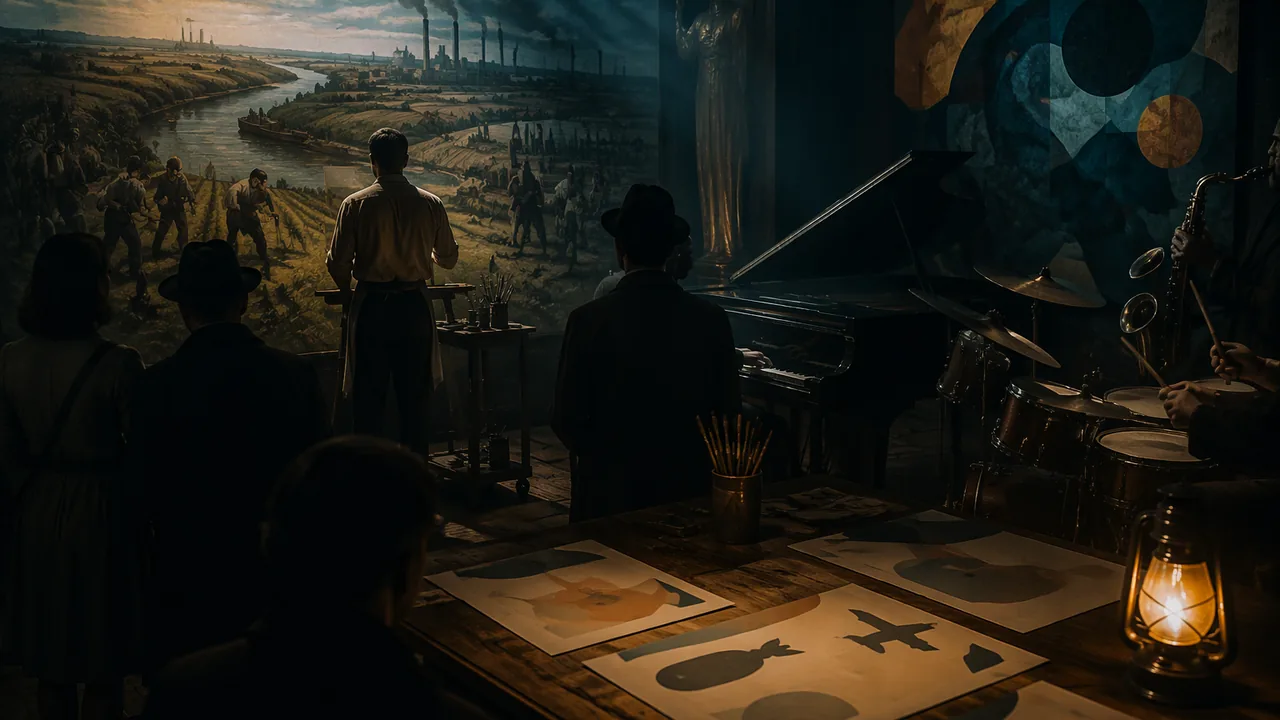
A Missouri mural. In May 1935 the Missouri legislature approved $16,000 for Thomas Hart Benton to paint the House Lounge of the State Capitol in Jefferson City. He finished A Social History of the State of Missouri on December 19, 1936. The Missouri State Archives says the mural is a visual timeline of the state and that it brought criticism because Benton did not shy away from controversial aspects of Missouri’s history. Heritage-trail sources describe panels showing enslaved persons, industrial and farm workers, an Osage meeting with traders, the political boss Tom Pendergast and the developer J. C. Nichols seated together, and Jesse James’s gang robbing a bank, and report that Benton withheld his plans from the government because he feared censorship. What changed: the subject. A public building showed working people and uncomfortable parts of the past in a plain, regional style.
Kansas City jazz. Culture also thrived without federal money, for complicated reasons. The Encyclopedia of the Great Plains says that from about 1925 until his indictment in 1938 for income tax fraud, the political boss Tom Pendergast virtually controlled Kansas City, and that his permissive policies unwittingly nurtured jazz. Kansas City was a hub for traveling “territory” bands, clubs clustered between Twelfth and Eighteenth Streets, and the most famous was the Reno Club, where the Count Basie Orchestra got its start. The city’s tourism office adds that Kansas City bands kept playing while other bands across the nation folded, and that the great era slowed by 1944 after the Pendergast machine fell and many musicians were drafted. The tourism office is promoting the city, so treat its claims as ones to test; the encyclopedia explains the cause. The lesson: a boom in culture can have an uncomfortable cause, and a historian must say so.
Culture at war. After 1941, the government needed Americans to buy war bonds, conserve materials, work in factories and avoid careless talk. The National Archives writes that words, posters and films waged a constant battle for the hearts and minds of the American public, that persuading the public became a wartime industry almost as important as manufacturing bullets and planes, and that the government recruited leading artists to do it. Rosie the Riveter, in overalls and bandanna, was introduced as a symbol of patriotic womanhood to bring women into war jobs. The change here is in purpose: art for shared mobilization.
Analyze the impact. For each work or program ask: Who paid? Who was meant to see it? What did it show that earlier art did not? Then state the change in one sentence. From the evidence: the Depression moved art toward public funding and ordinary people; the war moved it toward persuasion and unity; and in Missouri, a mural, a music scene and a roadside protest photographed for the nation all show that culture follows the pressures of its time.
📖 Read for this lesson
The reading opens over the lesson; close it to come back to exactly where you were. The checks below draw on it.
Formative check
Work through these before moving on. They are not graded — they tell you whether the standard below has landed yet.
Missouri standard: 9-12.AH.4.PC.D
Which projects made up Federal Project No. 1, approved on September 12, 1935?
Missouri standard: 9-12.AH.4.PC.D
Thomas Hart Benton’s Missouri Capitol mural, completed on December 19, 1936, avoided controversial parts of the state’s history.
Missouri standard: 9-12.AH.4.PC.D
According to the Encyclopedia of the Great Plains, how did Tom Pendergast affect Kansas City jazz in the 1920s and 1930s?
Missouri standard: 9-12.AH.4.PC.D
In World War II the government recruited leading artists because words, and films waged a constant battle for the hearts and minds of the public.
Missouri standard: 9-12.AH.4.PC.D
A student claims the Depression changed American art because the federal government became a major patron. Which evidence best supports that claim?
How confident are you that you can analyze how the Depression and World War II changed arts and culture, using evidence from Missouri and the nation?
Practice
Work these on paper or in your notebook, then open Check your answer. Aim for all of Fluency and Application; try at least one Challenge.
Printable version: this unit’s practice workbook (PDF)
Fluency
Build speed and accuracy with the core skill.
- On what date was Federal Project No. 1 approved?
Check your answer
Answer: September 12, 1935. - Name the four projects that made up Federal Project No. 1.
Check your answer
Answer: The Federal Art, Music, Theatre and Writers’ Projects. - When did Benton finish the Capitol mural, and how much did the legislature approve?
Check your answer
Answer: December 19, 1936; $16,000. - Between which two streets were the main Kansas City jazz clubs clustered?
Check your answer
Answer: Twelfth Street (north) and Eighteenth Street (south). - What is the title of the National Archives online exhibit about wartime posters?
Check your answer
Answer: “Powers of Persuasion.”
Application
Use the skill in context. Show your reasoning.
- For the Federal Writers’ Project American Guide Series, state who paid, who the audience was and what it showed.
Check your answer
Answer: The federal government paid; the audience was the public; it showed each state’s history, culture and sights, in guidebooks published from 1937 to 1941. - The encyclopedia and the tourism office both describe Kansas City jazz. Which claims would you test against a second source, and why?
Check your answer
Answer: The tourism office’s claim that bands kept playing while others folded, because it is promoting the city; the encyclopedia’s explanation about Pendergast is more analytical, but should still be checked. - Explain how Benton’s mural shows a change in the subject matter of public art. Use the Missouri State Archives’ comment.
Check your answer
Answer: A public building showed working people and difficult parts of Missouri history; the Archives says the mural brought criticism because Benton did not shy away from controversial aspects of the past. - How does the Rosie the Riveter image reflect the wartime labor shortage?
Check your answer
Answer: It was introduced as a symbol of patriotic womanhood to bring women who had not held jobs into war work, which the Archives describes as a response to acute labor shortages.
Challenge
Stretch problems. Expect to think before you write.
- In 150 words, compare one way the Depression and one way World War II changed American art or culture. Use two pieces of evidence.
Check your answer
Answer: Model answer: in the Depression the federal government paid artists through Federal Project No. 1, and Benton painted ordinary and difficult Missouri history; in the war the government recruited artists to produce posters that mobilized the public.
Review
Keep earlier skills sharp.
- Which Kansas City political boss does the encyclopedia say unwittingly nurtured jazz?
Check your answer
Answer: Tom Pendergast. - In 5.3 you read about the 1939 roadside protest. What year was it, and along which highways?
Check your answer
Answer: 1939; U.S. Highways 60 and 61.
Art in Hard Times and War: Federal Project Number One, Benton’s Capitol Mural, Kansas City Jazz and the Posters of World War II
National Archives, Records of the Work Projects Administration (RG 69) and FDR Library blog on the Federal Writers’ Project; Missouri State Archives, Timeline of Historic Missouri 1900-1949; Clio (Thomas Hart Benton Missouri Heritage Trail), “A Social History of the State of Missouri” (summarized in our words); Encyclopedia of the Great Plains, “Kansas City Jazz”; Visit KC, “The History of Kansas City Jazz”; National Archives, “Powers of Persuasion”; Jarod Roll, Southern Spaces (2010); all retrieved 9 Nov. 2026 · Public domain (U.S. government works and Missouri State Archives), with one short marked quotation each from the Encyclopedia of the Great Plains, Visit KC and Southern Spaces and a Clio entry summarized in our words
Why this reading. The lesson says the Depression and the war changed American art and culture and asks you to show it with evidence, not adjectives. Here are four kinds: a government record of the arts programs of the New Deal, the Missouri State Archives and a heritage-trail entry on Thomas Hart Benton’s Capitol mural, two accounts of Kansas City jazz in the 1930s (one from a regional encyclopedia, one from a tourism office, so you can compare their claims), and the National Archives on the posters that carried the government’s message in World War II. What to look for: who paid for the work, who it was meant to reach, and what it chose to show.
1. Paying artists: Federal Project Number One
History: Federal arts program approved as WPA-sponsored Federal Project No. 1 on September 12, 1935, to provide employment for qualified artists, musicians, actors, and authors. Superseded all art projects operating under FERA or WPA state administrations. Consisted of the Federal Art, Music, Theatre, and Writers’ Projects; and until October 1936, the Historical Records Survey. Terminated June 30, 1939. Except for the Federal Theater Project, abolished July 1939, the arts programs continued as state projects.
Published from 1937-1941, the American Guide Series was a collection of guidebooks for each state
a compilation of over 2,300 first person accounts from former slaves, across 17 states
2. A Missouri mural
Thomas Hart Benton’s mural A Social History of Missouri in the State Capitol’s House Lounge was completed on December 19, 1936. A visual timeline of the state of Missouri, the mural brought criticism as Benton did not shy away from controversial aspects of Missouri
The Missouri Heritage Trail entry on the mural (the Clio project, “A Social History of the State of Missouri”) adds details, in our words: the legislature approved $16,000 for the work on May 28, 1935; Benton traveled the state sketching people and places; he declined to tell the government his plans because he feared censorship of the subjects he wanted to include; and the panels show enslaved persons, industrial and farm workers, an Osage meeting with traders, the political boss Tom Pendergast and the real-estate developer J. C. Nichols sitting together, and Jesse James’s gang robbing a bank.
3. Kansas City jazz in the Depression
From about 1925 until his indictment in 1938 for income tax fraud, Pendergast virtually controlled the city
Most famous of all was the Reno Club, where the Count Basie Orchestra got its start.
Throughout the Depression, Kansas City bands continued to play while other bands across the nation folded.
by 1944, the great Kansas City jazz era slowed down
Notice the difference in purpose. The encyclopedia explains how Pendergast’s political machine, its permissive policies and the city’s role as a hub for traveling “territory” bands helped the music flourish. The tourism office wants visitors to enjoy the story. Both agree on the timing: the scene thrived in the 1930s and faded as the Pendergast machine fell and musicians were drafted.
4. Persuasion as culture: World War II posters
Guns, tanks, and bombs were the principal weapons of World War II, but there were other, more subtle forms of warfare as well.
Persuading the American public became a wartime industry, almost as important as the manufacturing of bullets and planes.
5. Photographs as protest art
The visual narrative of the protest attracted attention all the way to the White House.
Questions
- List the four kinds of art or performance in this reading. For each, who paid, who the audience was, and what the work said about the nation.
- Benton declined to share his plans with the legislature. What does that choice tell you about the risk of public funding for art? What did the State Archives record about the reaction?
- Compare the two jazz sources. Which claims would you trust without checking, and which would you test against a second source?
- Write a thesis sentence that begins “The Great Depression and World War II changed American art and culture by…” and finish it using at least two items from the reading.
Sources: Records of the Work Projects Administration (RG 69), National Archives (archives.gov); The Federal Writers’ Project, FDR Library blog, National Archives (fdr.blogs.archives.gov); Timeline of Historic Missouri: 1900-1949, Missouri State Archives (sos.mo.gov); A Social History of the State of Missouri, Clio (theclio.com); Kansas City Jazz, Encyclopedia of the Great Plains (plainshumanities.unl.edu); The History of Kansas City Jazz, Visit KC (visitkc.com); Powers of Persuasion, National Archives (archives.gov); Jarod Roll, Out Yonder on the Road, Southern Spaces (southernspaces.org)