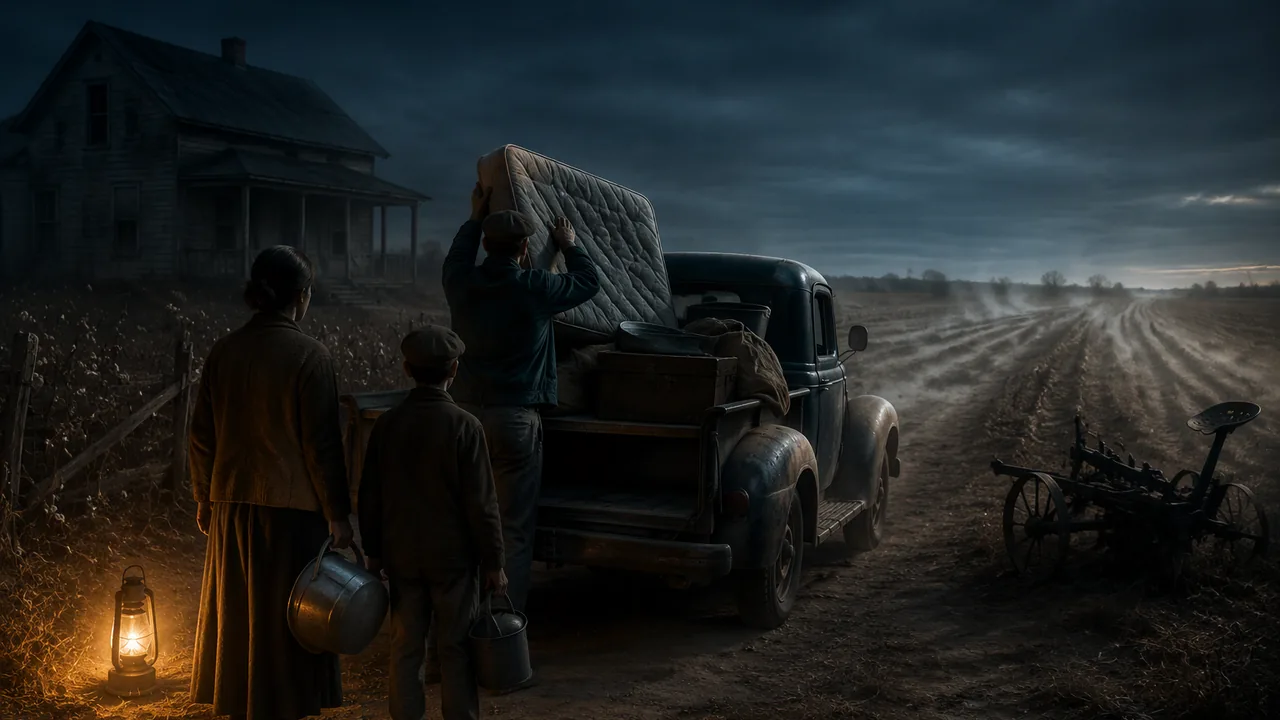
explain how the Depression, drought, farm policy and unwise farming practices pushed rural families off the land, analyze the Dust Bowl, the Missouri Bootheel sharecroppers’ roadside demonstration of 1939 and the Mexican Repatriation, and describe the political movements of left and right that the crisis produced.
Instruction
Numbers such as “25 percent unemployment” describe the Depression. Photographs, letters and migration records show what it did to people. This lab looks at two places where farm families were squeezed — the Southern Plains and the cotton lowlands of Missouri’s Bootheel — and at a migration that ran in the opposite direction.
The Dust Bowl. The Southern Plains — western Oklahoma and Kansas, the Texas and Oklahoma panhandles, eastern Colorado and New Mexico — are semi-arid grassland where rain varies widely from year to year. During the First World War and the 1920s, high wheat prices and new tractors led farmers to plow up millions of acres of native grass. When severe drought struck in the 1930s, there was nothing to hold the soil. Winds lifted it into “black blizzards”; on 14 April 1935, “Black Sunday,” a storm turned day into night across the region. This is a case of human modification of a landscape (HI.5): an environmental disaster that people helped make. The federal response included the Soil Conservation Service (1935), which paid farmers to plant cover crops and contour their fields, and a shelterbelt of trees from the Dakotas to Texas. Missouri was dry too, if less severely: in NOAA’s record the state’s 1936 total of 28.99 inches was far below its 1895-1950 average of 40.60.
Why people left. Drought was only one cause. Falling cotton prices, debt, and New Deal crop payments that went to landowners — who sometimes used them to buy tractors and replace tenants with day laborers — pushed tenant farmers off the land, especially in eastern Oklahoma, Arkansas and the Missouri Bootheel, outside the Dust Bowl itself. Hundreds of thousands of people left Oklahoma, Texas, Arkansas and Missouri during the 1930s. By historians’ estimates, roughly 300,000 to 400,000 of them ended up in California’s farm valleys, many traveling along Route 66, which crosses Missouri. Most were white; many were not farmers at all.
The Missouri Bootheel. The Bootheel is the flat, flood-prone cotton country of far southeastern Missouri. Many of its farmers were tenants and sharecroppers, Black and white, who worked a planter’s land for a share of the crop. In January 1937 the Army Corps of Engineers announced that it would deliberately breach a levee to relieve pressure on the levees protecting Cairo, Illinois; the stretch of Mississippi County it flooded held about twelve thousand tenants and sharecroppers. Then farm policy turned against them. Federal crop payments went to landowners, and planters who collected them found it paid to replace tenants with day laborers, who had no claim on the crop or the payment, and to buy tractors. Between 1936 and 1941 the Bootheel’s tenancy rate fell from 77 percent to 64 percent. The Southern Tenant Farmers’ Union, an organization of Black and white tenants, had organized there since 1936 and by late 1938 had more than thirty locals and about 4,500 dues-paying members in the Bootheel; a cotton pickers’ strike that autumn failed when planters brought in replacement workers.
Out on the road. The union’s local leaders, among them Owen Whitfield, decided that ordinary strikes would not work and that the evictions planned for early 1939 needed a public answer. They tipped off the St. Louis Post-Dispatch, and in the early morning of 10 January 1939 more than 1,500 men, women and children — over 200 of them white — moved their belongings onto the shoulders of U.S. Highways 60 and 61 and set up camps from blankets and sheets stretched over stick frames. “We have no place to go,” a camp leader told reporters, but the demonstration “will show the people what we are up against.” Photographers, including Arthur Rothstein of the Farm Security Administration, recorded it. Nine days later President Roosevelt told Secretary of Agriculture Henry Wallace to “do everything within our power to assist the families,” and Eleanor Roosevelt wrote about the camps in her newspaper column.
Removal and relief. The state of Missouri used the camps’ visibility against them. The state health commissioner declared them a menace to public health, and state police tore them down on 14 and 15 January; on 18 January, when the Farm Security Administration planned to deliver tents and money, police scattered the demonstrators to farms in four counties. Federal help came anyway: emergency grants, relocation loans and, by January 1941, more than six hundred single-family homes in nine Bootheel settlements built by the agency — six for white families and three for Black families, although Black sharecroppers had led the demonstration. A protest can win aid and still lose ground.
Moving was itself contested. Poor families who crossed state lines met states that did not want them. In Edwards v. California (1941) the Supreme Court struck down a state law that made it a crime to bring an indigent non-resident into the state, holding that no state may isolate itself from hardship by “shutting its gates to the outside world.” The decision applies in every state.
The Mexican Repatriation. At the same time, a movement ran the other way. From 1929 through the 1930s, federal immigration raids, county relief officials and private pressure drove hundreds of thousands of people of Mexican descent to Mexico; estimates range from about 400,000 to more than a million. Many of those removed were United States citizens, especially children born here, who were in effect exiled. Content note: families of Mexican descent live in every region of the country; discuss this history with care, and never assume or ask about anyone’s family history.
Politics of left and right. The crisis radicalized politics. On the left, organizers such as the Southern Tenant Farmers’ Union built unions across the color line, which is how the Bootheel protest became possible. Dr. Francis Townsend proposed a monthly pension for everyone over sixty, and millions joined Townsend clubs. Senator Huey Long of Louisiana promised to “share our wealth.” On the right, the radio priest Charles Coughlin turned from supporting Roosevelt to attacking him, and his broadcasts became openly anti-Semitic. These movements pressured Roosevelt toward the larger reforms of 1935.
Skill: images as evidence. RH.11-12.7 asks you to integrate visual and quantitative information. A Farm Security Administration photograph is a government record made to build support for relief. Ask what the photographer chose to include and leave out, who else shaped the scene — here, the demonstrators planned to be photographed — and corroborate the image with data.
📖 Read for this lesson
The reading opens over the lesson; close it to come back to exactly where you were. The checks below draw on it.
Reading: Out on the road, January 1939
Arthur Rothstein, Evicted sharecroppers along Highway 60, New Madrid County, Missouri (January 1939), Farm Security Administration, Library of Congress FSA-OWI Collection; statement of William H. Jones, leader of the camp near Sikeston, to the St. Louis Post-Dispatch (10 January 1939), as printed in Jarod Roll, “Out Yonder on the Road,” Southern Spaces (16 March 2010) · Public domain (U.S. government work: the photograph). Quotation: short excerpt from a scholarly article.
Find the photograph in the Library of Congress catalog by searching ‘Rothstein New Madrid County Missouri 1939.’ Rothstein worked for a federal agency that wanted public support for relief. Compare what the demonstrators said with what the camera chose to show.
We have no place to go… We don’t know whether this will do us any good, but it will show the people what we are up against.
On 10 January 1939 more than 1,500 men, women and children, Black and white, moved their belongings onto the shoulders of U.S. Highways 60 and 61 in the Missouri Bootheel and set up camps. They had told reporters in advance. A historian uses both facts: the image is a federal record made to win support for relief, and a scene the people in it had arranged to be seen.
Formative check
Work through these before moving on. They are not graded — they tell you whether the standard below has landed yet.
Which combination best explains the Dust Bowl?
Many of the people removed to Mexico during the Mexican Repatriation were United States citizens.
Why did Bootheel planters replace sharecroppers with day laborers in the late 1930s?
The Bootheel’s tenancy rate fell from 77 percent in 1936 to 64 percent in 1941. By how many percentage points did it fall?
Simulation & tools
Read the drought in NOAA’s precipitation record
Every route answers the same question: does the precipitation record alone explain the Dust Bowl and the evictions that followed? Choose one. All three earn full credit and all three use the same federal data.
Option A — The southern Plains, at the source. Open NOAA’s Climate at a Glance statewide time series. Set Parameter to Precipitation, Time scale to 12-month, Month to December, Start year 1895 and End year 1950, and State to Oklahoma, then plot. Record the long-term average the graph reports and the annual totals for 1930 through 1940, and count how many of those eleven years fell below the average. Repeat for Kansas.
Option B — Missouri, the state the Bootheel is in. Same settings, but plot Missouri. Record the same values. The Bootheel’s planters began evicting tenants in early 1939: does Missouri’s rainfall record show a drought behind it, and does it look like Oklahoma’s or Kansas’s?
Option C — No internet needed. Use the table below, which is the same NOAA series, 12-month precipitation ending in December, in inches. The averages are the mean of all 56 years from 1895 through 1950.
| Year | Oklahoma | Kansas | Missouri |
|---|---|---|---|
| 1930 | 30.60 | 26.24 | 31.25 |
| 1931 | 31.56 | 25.17 | 40.59 |
| 1932 | 33.71 | 22.97 | 36.92 |
| 1933 | 30.28 | 21.32 | 36.64 |
| 1934 | 27.11 | 19.10 | 34.45 |
| 1935 | 37.48 | 26.85 | 47.83 |
| 1936 | 22.77 | 17.84 | 28.99 |
| 1937 | 28.44 | 20.29 | 36.20 |
| 1938 | 33.40 | 26.30 | 41.04 |
| 1939 | 26.46 | 19.16 | 37.83 |
| 1940 | 33.73 | 24.57 | 32.60 |
| 1895-1950 average | 33.08 | 26.48 | 40.60 |
Count how many of the eleven years fell below each state’s average, and notice that the three states do not give the same answer.
Then, whichever route you took: answer the question. Use the lesson to explain what the rainfall record cannot tell you — what had been done to the soil, who owned the land, who worked it, what a tractor and a federal crop payment did, and who was pushed out of the fields as planters switched to day labor.
Open NOAA ↗ · NOAA · Public domain (U.S. federal)
Analyze one Farm Security Administration photograph of the Missouri Bootheel demonstration from the Library of Congress (search ‘Rothstein New Madrid County Missouri 1939’): source it, describe it, and name what it cannot show. Then draw or describe a cause-and-effect map of the two movements of the 1930s — farm families pushed off the land in the Plains and the Bootheel, and people of Mexican descent pushed out of the country — with at least three causes and two consequences for each, and one sentence on how they affected each other.
How confident are you that you can explain the Dust Bowl, the Bootheel roadside demonstration and the Mexican Repatriation and their effects on farm families and politics?
Practice
Work these on paper or in your notebook, then open Check your answer. Aim for all of Fluency and Application; try at least one Challenge.
Printable version: this unit’s practice workbook (PDF)
Fluency
Build speed and accuracy with the core skill.
- Order: Edwards v. California; ‘Black Sunday’ dust storm; Soil Conservation Service created; Bootheel roadside demonstration; Corps of Engineers announces it will breach a levee near Cairo.
Check your answer
Answer: Black Sunday (14 April 1935); Soil Conservation Service (1935); levee announcement (January 1937); roadside demonstration (10 January 1939); Edwards (November 1941). - Define the Mexican Repatriation in one sentence, including who was affected.
Check your answer
Answer: The removal during the 1930s of hundreds of thousands of people of Mexican descent to Mexico, many of them U.S. citizens, especially children.
Application
Use the skill in context. Show your reasoning.
- Rothstein’s photograph is titled ‘Evicted sharecroppers along Highway 60, New Madrid County, Missouri, January 1939.’ Who made it, for which agency and why, and what does the title leave out?
Check your answer
Answer: Arthur Rothstein, for the Farm Security Administration’s Historical Section, to build support for federal relief. The title leaves out the people’s names, their union (the Southern Tenant Farmers’ Union) and the fact that they had told reporters in advance and chosen to be on the roadside — they were making a protest, not only suffering a hardship.A strong answer treats the image as both a record of hardship and a government persuasion piece, and as a scene the subjects helped plan. - Corroborate the Bootheel evictions with NOAA precipitation records for Missouri (1895-1950 average 40.60 inches; 1938 total 41.04; 1939 total 37.83). What can the data add, and what can they not show about why families were evicted?
Check your answer
Answer: Missouri’s 1938 total was above its long-term average and 1939 was less than three inches below it (40.60 − 37.83 = 2.77), so drought does not explain the evictions of January 1939. The data cannot show the causes the lesson names: crop payments that went to landowners, mechanization, and planters’ decision to replace tenants with day laborers. - The drought struck in the 1930s and people left the Plains and the Bootheel. A student says ‘the drought caused the migration.’ Evaluate.
Check your answer
Answer: The drought was a cause on the Plains, but many migrants came from eastern Oklahoma, Arkansas and the Missouri Bootheel outside the Dust Bowl, pushed by cotton prices, debt, tractors and New Deal crop payments that went to landowners. A strong answer names several causes.
Review
Keep earlier skills sharp.
- Semester A review: which 1924 law first limited immigration by national origin while leaving Western Hemisphere immigration uncapped?
Check your answer
Answer: The Immigration Act of 1924.
Out on the Road: The Missouri Bootheel Demonstration of 1939 and the Migrations of the 1930s
Jarod Roll, “Out Yonder on the Road”: Working Class Self-Representation and the 1939 Roadside Demonstration in Southeast Missouri, Southern Spaces (16 March 2010), quoting the St. Louis Post-Dispatch (10 January 1939), the New York Times (14 January 1939) and Roosevelt’s memorandum to Henry Wallace (19 January 1939); Edwards v. California, 314 U.S. 160 (1941): opinion of Justice Byrnes; concurring opinions of Justices Douglas and Jackson · Public domain (U.S. government works: the Edwards opinion and the FSA photograph). The Roll article is a scholarly work summarized in our words with short marked quotations.
Why this reading. The lab prints its own rainfall table, so the weather half of the question is answerable here. The other half is not: the cause-and-effect map needs three causes and two consequences for each migration, and the lesson gives the story but not one document. Here are the pieces of a Missouri case you can source — a historian’s account of the sharecroppers’ roadside demonstration of January 1939, words spoken on the roadside and words officials said about it, and the Supreme Court’s 1941 answer to the question every state was asking about poor people who moved. What to look for: who decided that the protest should be seen, and who decided that it should stop.
1. The Missouri Bootheel, January 1939
This section summarizes, in our words, Jarod Roll, “Out Yonder on the Road: Working Class Self-Representation and the 1939 Roadside Demonstration in Southeast Missouri,” Southern Spaces (16 March 2010). Short quotations are marked. Roll is a historian at the University of Sussex.
- The people and the place. The Bootheel is the lowland cotton country of southeast Missouri. In the decade before 1939 its tenant farmers had lived through flood, falling crop prices, worsening poverty and disease, New Deal agricultural policy, and the mechanization of cotton. In January 1937 the Army Corps of Engineers announced that it would deliberately breach a levee to relieve pressure on the levees guarding Cairo, Illinois; Roll puts the number of tenants and sharecroppers in the threatened stretch of Mississippi County at about twelve thousand.
- Why planters changed the work. Federal crop payments went to landowners. Planters who collected them found it paid to hire day laborers, who had no claim on the crop or the payment, to stop supplying credit to landless families in the winter months, and to buy tractors. Between 1936 and 1941 the Bootheel’s tenancy rate fell from 77 percent to 64 percent. Evictions were planned for early 1939.
- The union. The Southern Tenant Farmers’ Union, Black and white, had organized in the Bootheel since 1936. By late 1938 it had more than thirty locals and about 4,500 dues-paying members there. A cotton-pickers’ strike that autumn failed within a week when planters brought in replacement pickers from Cairo, Illinois. Local leader Owen Whitfield and others concluded that ordinary strikes would not work and that the union needed federal attention.
- The demonstration. Whitfield told the press, including the St. Louis Post-Dispatch, what was coming and held a rally of about 350 followers at the Sikeston First Baptist Church on 7 January. In the early morning of 10 January 1939 more than 1,500 men, women and children — Black and white, over 200 of them white — moved their belongings onto the shoulders of U.S. Highways 60 and 61 and set up camps in over a dozen places, with blankets and sheets stretched over stick frames. Arthur Rothstein of the federal Farm Security Administration was among the photographers.
- The response. President Roosevelt told Secretary of Agriculture Henry Wallace in a private memorandum of 19 January to “do everything within our power to assist the families of the sharecroppers, farm tenants and farm laborers in southern Missouri who ‘went out on the road.’” The state of Missouri moved the other way. After touring the camps on 13 January, State Health Commissioner Harry Parker declared them a “menace to public health,” and state police demolished them on 14 and 15 January. On 18 January, after learning that the Farm Security Administration meant to deliver tents and money, police tore down the largest replacement camp and scattered the demonstrators to farms in four counties. The federal agency then made emergency grants and relocation loans, and by January 1941 it had built over six hundred single-family homes in nine Bootheel settlements — six for white families and three for Black families, although Black sharecroppers had led the demonstration.
2. What was said on the roadside, and what was said about it
From the St. Louis Post-Dispatch of 10 January 1939, as printed by Roll. William H. Jones, leader of the camp near Sikeston, told reporters that after being turned out of their homes the families had nowhere to go:
We have no place to go… We don’t know whether this will do us any good, but it will show the people what we are up against.
A year later, Roll reports, the union put up signs on the same roadsides on 7 January 1940:
Lest You Forget… One Year Ago, sat on this roadside, 1,500 croppers shelterless for days in snow and freezing cold.
The signs added that “the abuses remain and grow.” Compare the state’s side. Colonel B. M. Casteel of the Highway Patrol, ordered to clear the camps, told reporters that he did not know where the people would go, “but if they threaten public health they must be moved somewhere.” (Roll quotes this from the New York Times of 14 January 1939.) And Roosevelt, Roll reports, concluded:
this situation, serious as it is for the individual families … is even more serious as a symptom of the widespread situation existing throughout the South.
The photograph. Rothstein’s frame Evicted sharecroppers along Highway 60, New Madrid County, Missouri, January 1939 is in the Library of Congress FSA-OWI Collection; Roll gives its call number as LC-USF33-002967-M4. (We did not open the catalog record ourselves while writing this reading, so confirm the number there.) Roll’s point about such images: the demonstrators knew they would be photographed and planned the scene for the cameras, and the people in the pictures understood the politics of representation as well as the photographers did.
3. The constitutional question: Edwards v. California, 314 U.S. 160, decided 24 November 1941
People who moved because they were poor ran into a second problem: states that did not want them. The Supreme Court’s answer applies to every state, Missouri included; the case carries the name of the state whose law was struck down. The facts and the holding, from the opinion:
What the statute was for. The Court accepted the state’s own narrow reading of “indigent person”: someone “presently destitute of property and without resources to obtain the necessities of life, and who have no relatives or friends able and willing to support them,” and noted that the term “is not confined to those who are physically or mentally incapacitated.” Similar California statutes had been on the books since 1860.
California’s argument, in the Court’s summary. This is the sentence to put on your map:
The State asserts that the huge influx of migrants into California in recent years has resulted in problems of health, morals, and especially finance, the proportions of which are staggering. It is not for us to say that this is not true. We have repeatedly and recently affirmed, and we now reaffirm, that we do not conceive it our function to pass upon “the wisdom, need, or appropriateness” of the legislative efforts of the States to solve such difficulties.
The holding, by Justice Byrnes for the Court.
But this does not mean that there are no boundaries to the permissible area of State legislative activity. There are. And none is more certain than the prohibition against attempts on the part of any single State to isolate itself from difficulties common to all of them by restraining the transportation of persons and property across its borders. It is frequently the case that a State might gain a momentary respite from the pressure of events by the simple expedient of shutting its gates to the outside world. But, in the words of Mr. Justice Cardozo: “The Constitution was framed under the dominion of a political philosophy less parochial in range. It was framed upon the theory that the peoples of the several States must sink or swim together, and that in the long run prosperity and salvation are in union and not division.”
Its express purpose and inevitable effect is to prohibit the transportation of indigent persons across the California border. The burden upon interstate commerce is intended and immediate; it is the plain and sole function of the statute. Moreover, the indigent non-residents who are the real victims of the statute are deprived of the opportunity to exert political pressure upon the California legislature in order to obtain a change in policy.
The old law the Court had to get around. A century of cases had repeated language from City of New York v. Miln (1837) that a State may guard against “the moral pestilence of paupers, vagabonds, and possibly convicts,” as it guards against physical disease. Byrnes answered that “the theory of the Elizabethan poor laws no longer fits the facts,” and that poverty in an industrial society is not a moral condition.
Justice Jackson, concurring, thought the commerce clause the wrong tool:
But the migrations of a human being, of whom it is charged that he possesses nothing that can be sold and has no wherewithal to buy, do not fit easily into my notions as to what is commerce. To hold that the measure of his rights is the commerce clause is likely to result eventually either in distorting the commercial law or in denaturing human rights. I turn, therefore, away from principles by which commerce is regulated to that clause of the Constitution by virtue of which Duncan is a citizen of the United States and which forbids any State to abridge his privileges or immunities as such.
Justice Douglas, concurring, made the same move in different words:
Freedom of movement and of residence must be a fundamental right in a democratic State. Whether within the privileges and immunities clause of the Fourteenth Amendment or within the term liberty in the due process clause, it is a basic constitutional right, the more valuable to those who migrate because of economic compulsions… The Fourteenth Amendment is no fair weather protection of the liberties of persons. Its operation is not limited to times of economic security when there is no pressure upon States to curtail liberty.
All nine justices agreed on the result and split on the reason. That disagreement is worth a sentence in your analysis: was the right at stake the right of a carrier to move people, or the right of a citizen to move?
Using this in the cause-and-effect map
This section is ours, not quoted.
- Causes, farm families pushed off the land (Southern Plains and Bootheel): drought (the NOAA table in this lesson does not by itself explain the timing, and Missouri’s record looks different from Kansas and Oklahoma), plowed-up grassland on the Plains, the 1937 levee breach in the Bootheel, falling cotton prices and debt, and crop-payment money that went to landowners who replaced tenants with day laborers and tractors. The last is a federal policy cause, and the strongest maps name it.
- Consequences: the roadside demonstration itself; the state’s removal of the camps; federal emergency grants, relocation loans and the segregated Delmo homes; and, for families who went west, wages driven down where workers outnumbered jobs, followed by the legal reaction that ended in Edwards.
- Causes and consequences, people of Mexican descent pushed out of the country: Depression unemployment, relief budgets, immigration raids and pressure from local officials and private groups; the removal of hundreds of thousands of people, many of them United States citizens by birth; and a labor shortage that the Bracero program would later be created to fill (Lesson 2.4).
- How they affected each other: the one sentence the task asks for. A suggestion: in both movements the people with the least power paid for the farm economy’s adjustment, and the labor gap left by the first helped create the contract-labor system that brought workers back from Mexico a few years later.
For the photograph analysis, the sourcing rule is the one you used in the first semester: name the maker, the agency that paid for it, the date, and what the image cannot show. A Farm Security Administration photograph is a federal record made to build support for relief; it is evidence of hardship and of persuasion at once — and here, of the demonstrators’ own planning.
Sources: Jarod Roll, Out Yonder on the Road: Working Class Self-Representation and the 1939 Roadside Demonstration in Southeast Missouri, Southern Spaces, 16 March 2010 (DOI 10.18737/M7KP47) (southernspaces.org); Edwards v. California, 314 U.S. 160 (1941), official U.S. Reports (tile.loc.gov); Farm Security Administration/Office of War Information Black-and-White Negatives, Library of Congress (loc.gov); NOAA National Centers for Environmental Information, Climate at a Glance: Statewide Time Series (precipitation; Missouri, Oklahoma, Kansas) (ncei.noaa.gov)