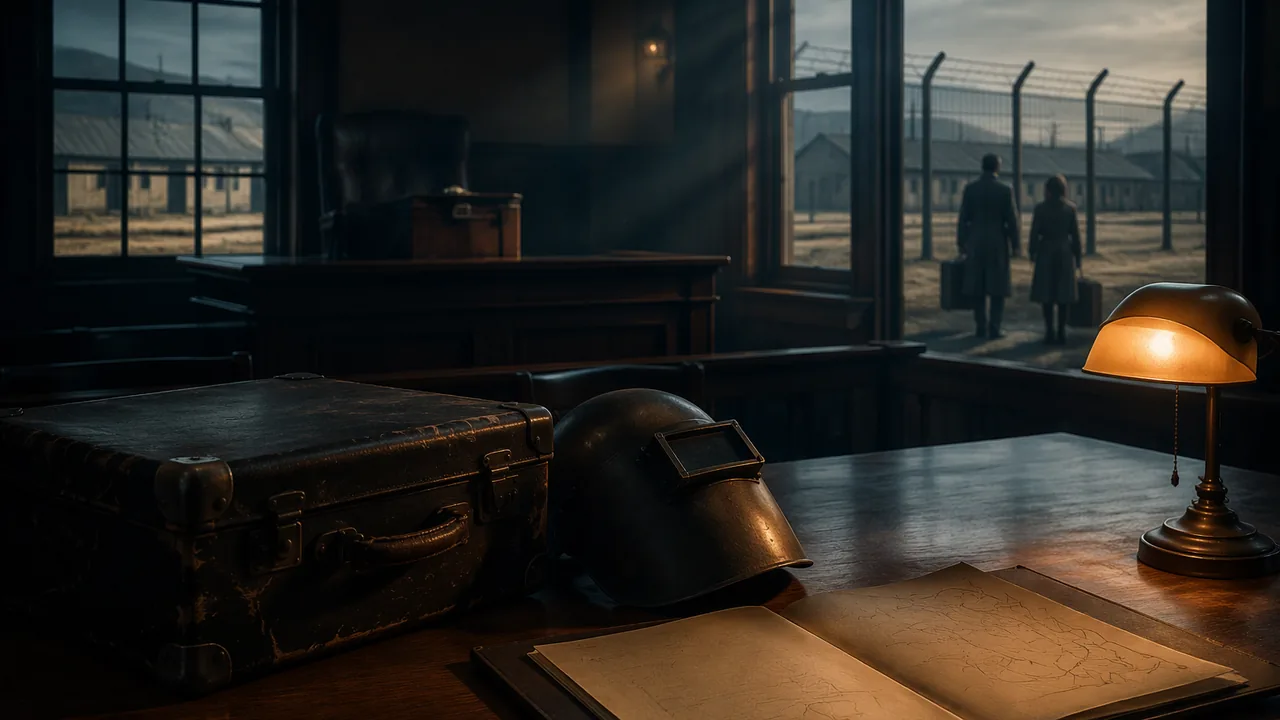
analyze the incarceration of Japanese Americans and the Korematsu case, write a brief or bench memorandum, and argue or decide the case before a moot court.
Instruction
Content note: this task examines the forced removal and incarceration of Japanese Americans. Students with family connections to this history may choose any role, or a non-speaking clerk’s role, and are never asked to share family experiences.
What happened. After Pearl Harbor, fear and long-standing anti-Asian prejudice on the West Coast combined. On 19 February 1942 Roosevelt signed Executive Order 9066. General John DeWitt then ordered everyone of Japanese ancestry removed from California, western Washington and Oregon, and southern Arizona. About 120,000 people, roughly two-thirds of them United States citizens, were forced from their homes, first into temporary “assembly centers” at racetracks and fairgrounds, then into ten camps run by the War Relocation Authority in remote parts of the West and in Arkansas. Families sold farms and businesses at a loss or lost them entirely. In Hawaii, where people of Japanese ancestry were a large share of the population and the workforce, there was no mass removal. In 1943 a loyalty questionnaire divided families, and those judged disloyal were segregated in a separate camp.
Missouri’s part. No camp was in Missouri, but two of the ten, Jerome and Rohwer, were in nearby Arkansas, and people leaving the Arkansas camps at the war’s end passed through St. Louis’s Union Station; many stayed. Washington University’s chancellor, George Throop, agreed to accept students of Japanese ancestry, saying that “these students, if American citizens, have exactly the same rights as other students.” About thirty transferred to the university.
The case. Fred Korematsu, a 23-year-old welder born in the United States, refused to report for removal and was arrested in May 1942. In December 1944 the Supreme Court upheld his conviction, 6-3. Justice Black declared that racial restrictions are “immediately suspect” but found the exclusion justified by military necessity. The same day, in Ex parte Endo, the Court held that the government could not continue to detain a citizen it conceded was loyal, and the camps began to close.
What the Court was not told. In the 1980s researchers found that government lawyers had withheld reports from the FBI, the Federal Communications Commission and Naval Intelligence that contradicted the military’s claims of espionage and sabotage. In 1983 a federal district judge, Marilyn Hall Patel, vacated Korematsu’s conviction. The congressional Commission on Wartime Relocation and Internment of Civilians concluded that the causes were “race prejudice, war hysteria and a failure of political leadership.” The Civil Liberties Act of 1988 apologized and paid $20,000 to each surviving person who had been incarcerated. In Trump v. Hawaii (2018), the Supreme Court stated that Korematsu “was gravely wrong the day it was decided.”
The moot court. You will rehear the case in December 1944, but with the withheld reports now part of the record. Roles: counsel for Korematsu; counsel for the United States; justices of a seven-member bench. Everyone writes. Counsel write a brief: the question presented, the facts, the argument with authorities (the Fifth Amendment’s due process clause, the war powers, Hirabayashi (1943), Executive Order 9066, the withheld reports), and the relief requested. Justices write a bench memorandum: each side’s strongest argument, the weakest premise of each, and six questions to ask. If you are working alone, write the brief for one side and the bench memorandum as a justice, and record your argument answering questions you wrote in advance.
Arguing the government’s side. Counsel for the United States must make the strongest argument available in 1944 — deference to military judgment in wartime and the danger of invasion after Pearl Harbor — without inventing evidence and while confronting the withheld reports. Arguing a position is not endorsing it; it is how you learn where it fails (SL.11-12.3).
Oral argument. Each side has eight minutes; justices interrupt with questions. SL.11-12.4 asks you to present a clear line of reasoning with alternative perspectives addressed; SL.11-12.6 asks you to adapt to a formal context. Answer the question asked, then return to your argument. Justices then deliberate briefly and announce a decision with reasons.
📖 Read for this lesson
The reading opens over the lesson; close it to come back to exactly where you were. The checks below draw on it.
Reading: The order and the Court
Executive Order 9066 (19 February 1942); Korematsu v. United States, 323 U.S. 214 (1944): opinion of Justice Black; dissents of Justices Murphy and Jackson · Public domain (U.S. government works)
Executive Order 9066 never names Japanese Americans. The opinions do.
Executive Order 9066: …I hereby authorize and direct the Secretary of War, and the Military Commanders whom he may from time to time designate… to prescribe military areas in such places and of such extent as he or the appropriate Military Commander may determine, from which any or all persons may be excluded…
Black, for the Court: It should be noted, to begin with, that all legal restrictions which curtail the civil rights of a single racial group are immediately suspect… Korematsu was not excluded from the Military Area because of hostility to him or his race.
Murphy, dissenting: Such exclusion goes over “the very brink of constitutional power” and falls into the ugly abyss of racism.
Jackson, dissenting: The principle then lies about like a loaded weapon, ready for the hand of any authority that can bring forward a plausible claim of an urgent need.
Formative check
Work through these before moving on. They are not graded — they tell you whether the standard below has landed yet.
What did the Commission on Wartime Relocation and Internment of Civilians conclude were the causes of the incarceration?
Most of the people removed from the West Coast under Executive Order 9066 were United States citizens.
How confident are you that you can argue or decide a constitutional case from the record, answering questions and addressing the other side?
Unit 2 checkpoint
Do this before you start the task. It covers the whole unit and tells you what to review first.
What did the Lend-Lease Act (1941) allow?
Germany declared war on the United States after Pearl Harbor.
Which battle is considered the turning point of the Pacific war?
The Regimental Combat Team was made up of Japanese American soldiers; the Airmen were the first Black military pilots.
Which document set out shared war aims of Roosevelt and Churchill in August 1941?
About two-thirds of the people removed under Executive Order 9066 were U.S. citizens.
What did the Court decide in Ex parte Endo (1944)?
The program brought Mexican workers on temporary contracts from 1942 to .
Which Black surgeon helped develop large-scale blood-plasma programs?
The Soviet Union declared war on Japan between the bombings of Hiroshima and Nagasaki.
What did Executive Order 9981 (1948) begin?
Which claim confuses sequence with cause?
Submit: Brief or bench memorandum (900-1,100 words) + moot-court argument
Task: Rehear Korematsu v. United States with the withheld evidence in the record. Counsel argue for Korematsu or the United States; justices question counsel and decide.
Submission workflow
- Stage 1 — Plan. Role, question presented, list of authorities and evidence (at least five primary sources), and the strongest argument of the other side.
- Stage 2 — Reviewed draft. A reader who takes the opposing side — a parent, guardian, mentor or study partner, or you in the other role — tests whether you have stated their best argument fairly; submit a revision note.
- Stage 3 — Revised final. Brief (counsel) or bench memorandum with six questions (justices), 900-1,100 words, with citations to the record.
- Stage 4 — Oral argument. Recorded or live argument with questions from the bench; justices announce and explain the decision. A recorded argument answering questions submitted in advance is an equal-credit alternative.
How it is scored
| Criterion | What proficient looks like |
|---|---|
| Oral argument (SL.11-12.4) | Clear line of reasoning; alternative perspectives addressed; questions answered directly. |
| Evaluating reasoning (SL.11-12.3) | Identifies and tests the premises and evidence of the other side or of both sides. |
| Formal speech (SL.11-12.6) | Language and delivery suited to a courtroom. |
| Written argument (WHST.11-12.1, WHST.11-12.9) | Brief or memo builds a precise argument from constitutional text, precedent and the record. |
| Historical accuracy (US.11.7.5) | Accurate account of removal, incarceration, the case and its later reversal in the court of history. |
| Revision (WHST.11-12.5) | Revision note shows substantive changes in response to the opposing reviewer. |
The Korematsu Record: Order, Opinions, Dissents and Findings
Executive Order 9066 (19 February 1942); Korematsu v. United States, 323 U.S. 214 (1944); Ex parte Endo, 323 U.S. 283 (1944); Commission on Wartime Relocation and Internment of Civilians, Personal Justice Denied (1982-1983); Civil Liberties Act of 1988, 102 Stat. 903, sec. 2 · Public domain (U.S. government works)
Why this reading. Content note: this reading concerns the forced removal and incarceration of Japanese Americans, and includes the words of people who were removed. The task requires a brief or bench memorandum citing at least five primary sources, and the lesson supplies four short quotations. This is the record: the order, the opinion, the three dissents, the words the general actually used, the facts the Court was not given, and the findings Congress later made. Counsel for either side can build a brief from this page alone. What to look for: Justice Black and Justice Murphy are describing the same order. One says race had nothing to do with it; the other quotes the commanding general.
1. The order: Executive Order 9066, 19 February 1942
Now, therefore, by virtue of the authority vested in me as President of the United States, and Commander in Chief of the Army and Navy, I hereby authorize and direct the Secretary of War, and the Military Commanders whom he may from time to time designate, whenever he or any designated Commander deems such action necessary or desirable, to prescribe military areas in such places and of such extent as he or the appropriate Military Commander may determine, from which any or all persons may be excluded, and with respect to which, the right of any person to enter, remain in, or leave shall be subject to whatever restrictions the Secretary of War or the appropriate Military Commander may impose in his discretion…
I hereby further authorize and direct the Secretary of War and the said Military Commanders to take such other steps as he or the appropriate Military Commander may deem advisable to enforce compliance with the restrictions applicable to each Military area… including the use of Federal troops and other Federal Agencies, with authority to accept assistance of state and local agencies.
The order names no group and no place. Everything that followed was done by military proclamation under it, and by an Act of Congress of 21 March 1942 making violation of such orders a crime.
2. The Court: Korematsu v. United States, 18 December 1944
Justice Black, for the Court:
It should be noted, to begin with, that all legal restrictions which curtail the civil rights of a single racial group are immediately suspect. That is not to say that all such restrictions are unconstitutional. It is to say that courts must subject them to the most rigid scrutiny. Pressing public necessity may sometimes justify the existence of such restrictions; racial antagonism never can.
Regardless of the true nature of the assembly and relocation centers—and we deem it unjustifiable to call them concentration camps with all the ugly connotations that term implies—we are dealing specifically with nothing but an exclusion order. To cast this case into outlines of racial prejudice, without reference to the real military dangers which were presented, merely confuses the issue. Korematsu was not excluded from the Military Area because of hostility to him or his race. He was excluded because we are at war with the Japanese Empire, because the properly constituted military authorities feared an invasion of our West Coast and felt constrained to take proper security measures, because they decided that the military urgency of the situation demanded that all citizens of Japanese ancestry be segregated from the West Coast temporarily, and finally, because Congress, reposing its confidence in this time of war in our military leaders—as inevitably it must—determined that they should have the power to do just this.
This is the government’s best argument, and counsel for the United States must be able to state it in that form. Note the structure: a standard of review that sounds demanding, followed by deference that makes the standard do no work.
Justice Murphy, dissenting:
This exclusion of “all persons of Japanese ancestry, both alien and non-alien,” from the Pacific Coast area on a plea of military necessity in the absence of martial law ought not to be approved. Such exclusion goes over “the very brink of constitutional power” and falls into the ugly abyss of racism.
…bona fide military necessity is evidenced by the Commanding General’s Final Report on the evacuation from the Pacific Coast area. In it he refers to all individuals of Japanese descent as “subversive,” as belonging to “an enemy race” whose “racial strains are undiluted,” and as constituting “over 112,000 potential enemies . . . at large today” along the Pacific Coast. In support of this blanket condemnation of all persons of Japanese descent, however, no reliable evidence is cited to show that such individuals were generally disloyal, or had generally so conducted themselves in this area as to constitute a special menace to defense installations or war industries, or had otherwise by their behavior furnished reasonable ground for their exclusion as a group.
Murphy’s footnote records that General DeWitt’s Final Report is dated 5 June 1943 “but was not made public until January, 1944” — eleven months in which the Court was being asked to defer to a judgment it could not read.
Justice Jackson, dissenting:
A military order, however unconstitutional, is not apt to last longer than the military emergency. Even during that period a succeeding commander may revoke it all. But once a judicial opinion rationalizes such an order to show that it conforms to the Constitution, or rather rationalizes the Constitution to show that the Constitution sanctions such an order, the Court for all time has validated the principle of racial discrimination in criminal procedure and of transplanting American citizens. The principle then lies about like a loaded weapon ready for the hand of any authority that can bring forward a plausible claim of an urgent need. Every repetition imbeds that principle more deeply in our law and thinking and expands it to new purposes… A military commander may overstep the bounds of constitutionality, and it is an incident. But if we review and approve, that passing incident becomes the doctrine of the Constitution.
Justice Roberts also dissented, on the ground that Korematsu had been caught between two contradictory orders — one forbidding him to leave the area, the other forbidding him to remain in it — so that obedience was impossible.
3. The same day: Ex parte Endo
On 18 December 1944 the Court also decided Ex parte Endo, holding unanimously that the War Relocation Authority had no authority to keep detaining a citizen whose loyalty the government conceded. The camps began closing. Counsel on both sides should ask why one case was won and the other lost on the same morning: Korematsu tested a criminal conviction for refusing to leave; Endo tested continued detention of a person the government admitted was loyal. The Court found a way to end the detention without holding the removal unconstitutional.
4. What the Court was not told, and what Congress later found
The congressional Commission on Wartime Relocation and Internment of Civilians reported in 1982, after hearings at which more than 750 witnesses testified. Its central finding:
The promulgation of Executive Order 9066 was not justified by military necessity, and the decisions which followed from it — detention, ending detention and ending exclusion — were not driven by analysis of military conditions. The broad historical causes which shaped these decisions were race prejudice, war hysteria and a failure of political leadership. Widespread ignorance of Japanese Americans contributed to a policy conceived in haste and executed in an atmosphere of fear and anger at Japan. A grave injustice was done to American citizens and resident aliens of Japanese ancestry who, without individual review or any probative evidence against them, were excluded, removed and detained by the United States during World War II.
Congress adopted that finding in the Civil Liberties Act of 1988, which states that the actions
were carried out without adequate security reasons and without any acts of espionage or sabotage documented by the Commission, and were motivated largely by racial prejudice, wartime hysteria, and a failure of political leadership.
In the early 1980s researchers found in government files reports from the FBI, the Federal Communications Commission and Naval Intelligence contradicting the espionage and signaling claims the government had pressed on the Court, and evidence that Justice Department lawyers had known. In 1983 Judge Marilyn Hall Patel vacated Fred Korematsu’s conviction. In your moot court those reports are in the record. That is the one change from December 1944, and both sides must argue around it: counsel for the United States can no longer rest on the Final Report without confronting what other federal agencies had told the government.
5. The people the order moved
Argument about a removal should be made with some knowledge of what a removal was. These are the words of people who were removed, recorded in testimony to the Commission and printed in its federal report:
On May 16, 1942, my mother, two sisters, niece, nephew, and I left . . . by train. Father joined us later. Brother left earlier by bus. We took whatever we could carry. So much we left behind, but the most valuable thing I lost was my freedom.
I lost my identity. At that time, I didn’t even have a Social Security number, but the WRA gave me an I.D. number. That was my identification. I lost my privacy and dignity.
Henry went to the Control Station to register the family. He came home with twenty tags, all numbered 10710, tags to be attached to each piece of baggage, and one to hang from our coat lapels. From then on, we were known as Family #10710.
About 92,000 people passed through the sixteen temporary assembly centers, all but three of them in California, staying about a hundred days on average; roughly seventy percent were United States citizens. About 120,000 people in all were removed. (These passages are transcribed from the scanned federal report; we have corrected obvious scanning errors in spacing and have changed no words.)
Using the record
This section is ours, not quoted. For Korematsu: the Fifth Amendment’s due process clause; Murphy’s demonstration that the stated military necessity rests on race; Jackson on what a judicial approval does that a military order does not; the withheld agency reports; Endo, decided the same day, as proof the Court could act. For the United States, as it must be argued in 1944: Black’s deference passage; the war powers; Hirabayashi v. United States (1943) as controlling precedent; the impossibility of individual loyalty hearings for 112,000 people in the weeks after Pearl Harbor; and the honest concession that the withheld reports damage the necessity claim, met by the argument that a court reviewing a commander’s judgment in February 1942 cannot use what was found in 1983. Arguing that position is not endorsing it. For the bench: the six questions should test premises, not facts. The sharpest ones ask each side what evidence would change its mind.
Sources: Executive Order 9066 (1942), National Archives milestone documents (archives.gov); Korematsu v. United States, 323 U.S. 214 (1944), official U.S. Reports (tile.loc.gov); Personal Justice Denied, summary, Commission on Wartime Relocation and Internment of Civilians, National Archives (archives.gov); Personal Justice Denied, chapter 5 (Assembly Centers), National Archives (archives.gov); Civil Liberties Act of 1988, 102 Stat. 903, United States Statutes at Large, govinfo.gov (govinfo.gov)