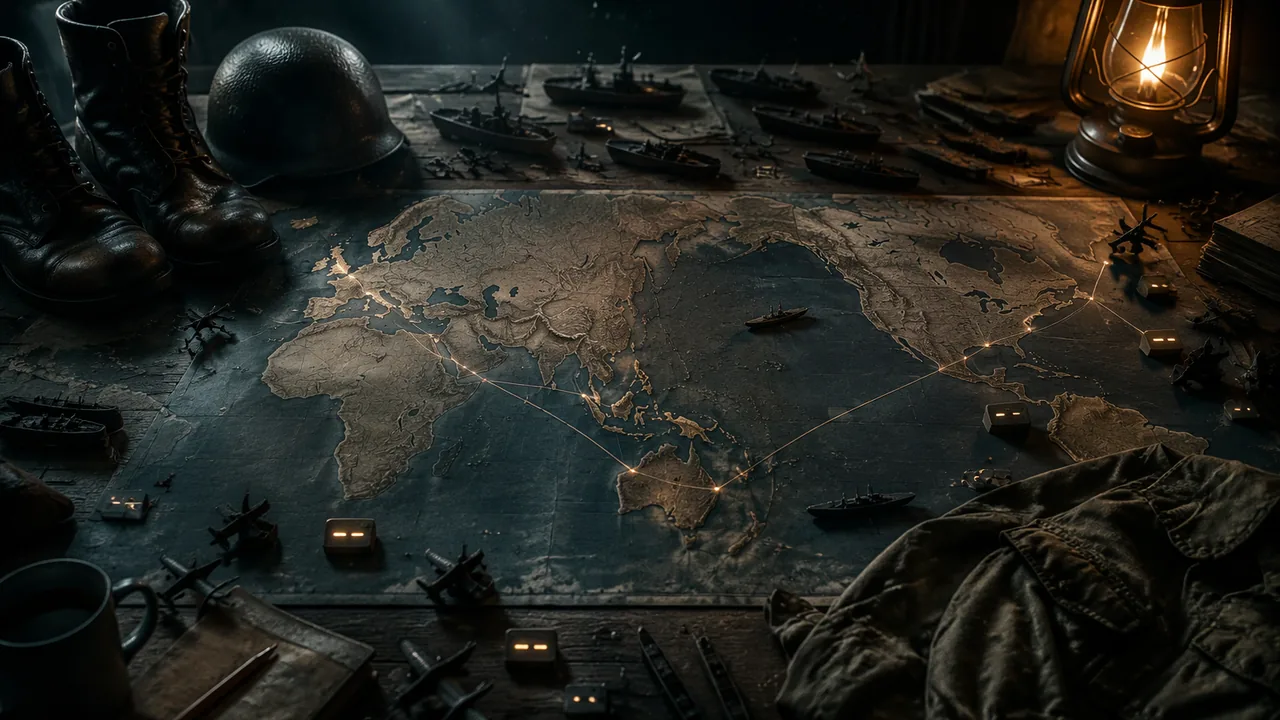
explain U.S. and Allied strategy and the major battles of Midway, Normandy, the Bulge, Iwo Jima and Okinawa, identify the roles and sacrifices of individual soldiers and special units, and describe the war’s technological and industrial effects, especially in Missouri.
Instruction
The United States fought across two oceans at once. Strategy decided where its forces went first; the courage and suffering of individuals decided whether the plans worked.
Europe First. Roosevelt and Churchill agreed that Germany, the stronger enemy, must be defeated first while the Pacific war was held and then pressed. American and British forces landed in North Africa in November 1942, then invaded Sicily and Italy in 1943. The Soviet Union bore the heaviest land fighting and the greatest losses of any ally. At the Casablanca conference in 1943 the Allies agreed to demand unconditional surrender. British and American bombers struck German cities and industry.
Normandy. On 6 June 1944, D-Day, about 156,000 Allied troops landed on five beaches in Normandy, supported by thousands of ships and aircraft. American losses were worst at Omaha Beach. Eisenhower’s unsent note in the reading shows that success was not certain. The Allies broke out in July, liberated Paris in August, and pushed toward Germany. In December 1944 Germany counter-attacked in the Ardennes; the Battle of the Bulge was the largest battle the U.S. Army fought in the war, with about 19,000 American soldiers killed. Germany surrendered on 8 May 1945.
The Pacific. After Pearl Harbor, Japan seized the Philippines, where American and Filipino prisoners died on the Bataan Death March. At Midway in June 1942, code-breakers let the U.S. Navy ambush the Japanese fleet; American aircraft sank four Japanese carriers, and Japan never regained the initiative. The United States then “island-hopped,” capturing some islands as bases and bypassing others. At Iwo Jima (February-March 1945), about 6,800 Americans and nearly all of the more than 20,000 Japanese defenders died. At Okinawa (April-June 1945), more than 12,000 Americans were killed, kamikaze pilots attacked the fleet, and historians estimate that about 100,000 or more Okinawan civilians died. These losses shaped American leaders’ expectations of an invasion of Japan (Lesson 2.3).
Individual sacrifice. About 16 million Americans served; about 400,000 died. Most were draftees. Units remained segregated. The Tuskegee Airmen, the first Black military pilots, flew bomber-escort missions over Europe with a strong record, while facing discrimination at home. The 442nd Regimental Combat Team, made up of Japanese American soldiers — many of whose families were held in incarceration camps — fought in Italy and France and became, for its size and length of service, the most decorated unit in American military history. Navajo Code Talkers in the Marine Corps sent messages in a code based on the Navajo language that the Japanese never broke. Mexican American, Filipino, Chinese American and Native soldiers served in large numbers, and about 350,000 women served in uniform as nurses, clerks, mechanics and pilots.
Technology. Radar, sonar and code-breaking changed war at sea and in the air. The B-29 bomber, the proximity fuse and, at the end, the atomic bomb changed firepower. Medicine advanced: mass production of penicillin saved thousands of wounded, and the Black surgeon Charles Drew helped develop large-scale blood-plasma programs. The first electronic general-purpose computers were built for military calculations.
Where industry went. The war put factories and workers on the move across the country, and Missouri’s factories went on a war footing. In St. Louis the Curtiss-Wright plant at Lambert Field put up its first buildings in 1941 and built A-25 dive bombers, C-46 Commando transports and AT-9 and CW-22 trainers; it became a leader in training women as welders, riveters, inspectors and assembly-line workers. About 450,000 Missourians served in the armed forces, roughly 300,000 of them draftees; more than 8,000 died; and Missourians bought more than $3 billion in war bonds. Fort Leonard Wood and Camp Crowder trained soldiers, and Camps Clark, Crowder and Weingarten and Fort Leonard Wood also housed prisoners of war. Military production eventually created a labor shortage in the state, and women and teenagers entered the workforce in large numbers. Missouri’s own senator, Harry S. Truman, chaired the Senate committee created on 1 March 1941 to investigate waste and fraud in war contracts. Rationing, scrap drives and synthetic rubber managed scarce resources. CST.4 asks you to relate present places to their past: look for the war’s marks in the Missouri place you know best — a plant, a base, a park or a memorial.
Skill: structure. RH.11-12.5 asks how a text’s structure serves its purpose. Eisenhower’s unsent note uses “I” and takes blame alone. A commander who prepares that sentence in advance has decided in advance where responsibility lies.
📖 Read for this lesson
The reading opens over the lesson; close it to come back to exactly where you were. The checks below draw on it.
Reading: A commander’s two messages
Dwight D. Eisenhower, Order of the Day to the Allied Expeditionary Force (6 June 1944), and handwritten note prepared in case the landings failed (June 1944), Eisenhower Presidential Library / National Archives · Public domain (U.S. government works)
Eisenhower wrote both before the invasion. The second was never needed. What does writing it tell you about command?
Order of the Day: Soldiers, Sailors and Airmen of the Allied Expeditionary Force! You are about to embark upon the Great Crusade, toward which we have striven these many months.
Unsent note: Our landings in the Cherbourg-Havre area have failed to gain a satisfactory foothold and I have withdrawn the troops.
Formative check
Work through these before moving on. They are not graded — they tell you whether the standard below has landed yet.
Why is Midway (June 1942) considered the turning point of the Pacific war?
Normandy (6 June 1944)
Tap to revealAbout 156,000 Allied troops land; the second front in Western Europe opens.
Battle of the Bulge
Tap to revealDecember 1944-January 1945; largest U.S. Army battle of the war.
Iwo Jima
Tap to revealFebruary-March 1945; about 6,800 Americans killed taking the island.
Okinawa
Tap to revealApril-June 1945; heavy losses to both sides and to Okinawan civilians.
Tuskegee Airmen
Tap to revealFirst Black military pilots; bomber escorts over Europe.
About two of every three Missourians who served in the armed forces in the Second World War were draftees.
On a blank world map (printed or digital), mark the five battles in the standard with date, outcome and why each mattered to the overall strategy. Then write a profile (200-250 words) of one special unit or one wartime technology, connecting it to a larger trend — civil rights, the growth of wartime industry in places such as St. Louis, or the nuclear age.
How confident are you that you can explain Allied strategy and the major battles, the service of special units, and the war’s effects on technology and industry?
Practice
Work these on paper or in your notebook, then open Check your answer. Aim for all of Fluency and Application; try at least one Challenge.
Printable version: this unit’s practice workbook (PDF)
Fluency
Build speed and accuracy with the core skill.
- Order: Okinawa; Midway; Battle of the Bulge; Normandy; Iwo Jima.
Check your answer
Answer: Midway (June 1942); Normandy (June 1944); Bulge (December 1944-January 1945); Iwo Jima (February-March 1945); Okinawa (April-June 1945). - Match each unit to its description: Tuskegee Airmen; 442nd Regimental Combat Team; Navajo Code Talkers — (a) Japanese American soldiers, most decorated unit for its size and length of service; (b) Marines who sent messages in an unbroken code; (c) first Black military pilots.
Check your answer
Answer: Tuskegee–(c); 442nd–(a); Code Talkers–(b).
Application
Use the skill in context. Show your reasoning.
- Eisenhower’s unsent note reads: ‘Our landings in the Cherbourg-Havre area have failed to gain a satisfactory foothold and I have withdrawn the troops.’ What kind of source is it, and what does it show that the published Order of the Day does not?
Check your answer
Answer: A private note drafted before D-Day in case of failure, never used. It shows that success was uncertain and that Eisenhower was prepared to take responsibility himself; the public order was written to inspire. - About 450,000 Missourians served in the armed forces in the Second World War, roughly 300,000 of them draftees, and Missourians bought more than $3 billion in war bonds. Compute the draftee share, and the war bonds per Missourian using the 1940 population of 3,784,664. What would you check before calling the second figure the average purchase?
Check your answer
Answer: 300,000 ÷ 450,000 ≈ 0.67, about two-thirds. $3,000,000,000 ÷ 3,784,664 ≈ $793 per Missourian, and because the total is ‘more than’ $3 billion it is a floor. The figure is a per-capita average that includes children and people who bought none; you would also check whether the bond total covers the whole war and the same population.Strong answers separate the arithmetic from what the average hides. - Code-breakers read Japanese plans before Midway, and the U.S. Navy won. Did the code-breaking cause the victory?
Check your answer
Answer: It was a major cause — it let the Navy ambush the Japanese fleet — but the outcome also depended on carrier aircraft, decisions in battle and chance. A strong answer credits intelligence while naming other factors.
Review
Keep earlier skills sharp.
- Semester A review: which First World War migration drew Black Southerners north, and what wartime conditions drove it?
Check your answer
Answer: The Great Migration; the war cut off European immigration while factories needed workers.
Two Messages, One Week: Command, Structure and the Five Battles
Dwight D. Eisenhower, Order of the Day to the Allied Expeditionary Force (6 June 1944) and handwritten message prepared in case of failure (5 June 1944), Dwight D. Eisenhower Presidential Library, National Archives · Public domain (U.S. government works)
Why this reading. The lab asks for a map with five battles, each with its outcome and why it mattered to the strategy, and a 200–250 word profile connecting a unit or a technology to a larger trend. The lesson supplies the facts for the map but gives you one sentence of each of Eisenhower’s two June 1944 messages — and then asks, under RH.11-12.5, how a text’s structure serves its purpose. Two sentences have no structure. Here are both messages complete. They are short, they were written by the same man in the same week, and they are opposites in every choice they make. What to look for: count the pronouns.
1. Order of the Day, issued to the Allied Expeditionary Force, 6 June 1944
Soldiers, Sailors, and Airmen of the Allied Expeditionary Force!
You are about to embark upon the Great Crusade, toward which we have striven these many months. The eyes of the world are upon you. The hope and prayers of liberty-loving people everywhere march with you. In company with our brave Allies and brothers-in-arms on other Fronts, you will bring about the destruction of the German war machine, the elimination of Nazi tyranny over the oppressed peoples of Europe, and security for ourselves in a free world.
Your task will not be an easy one. Your enemy is well trained, well equipped and battle-hardened. He will fight savagely.
But this is the year 1944! Much has happened since the Nazi triumphs of 1940-41. The United Nations have inflicted upon the Germans great defeats, in open battle, man-to-man. Our air offensive has seriously reduced their strength in the air and their capacity to wage war on the ground. Our Home Fronts have given us an overwhelming superiority in weapons and munitions of war, and placed at our disposal great reserves of trained fighting men. The tide has turned! The free men of the world are marching together to Victory!
I have full confidence in your courage, devotion to duty and skill in battle. We will accept nothing less than full Victory!
Good luck! And let us beseech the blessing of Almighty God upon this great and noble undertaking.
It was drafted months in advance and printed for distribution to about 175,000 men.
2. The message written in case the landings failed, 5 June 1944
Our landings in the Cherbourg-Havre area have failed to gain a satisfactory foothold and I have withdrawn the troops. My decision to attack at this time and place was based upon the best information available. The troops, the air and the Navy did all that Bravery and devotion to duty could do. If any blame or fault attaches to the attempt it is mine alone.
Eisenhower wrote it by hand the night before the landings, put it in his wallet, and mis-dated it “July 5.” He did not need it, and later threw it away; an aide kept it. Its every verb is in the past tense: he wrote the defeat as though it had already happened, which is how you make yourself decide in advance who is responsible.
3. Reading the structure (RH.11-12.5)
This section is ours, not quoted. Put the two texts side by side and the analysis writes itself.
- Pronouns. The Order of the Day uses you and we: the task belongs to the force and the victory belongs to everyone. The unsent note uses I and my four times in four sentences, and the only they is the troops, who are praised.
- Order of information. The public message names the mission before it names the difficulty, then answers the difficulty with four sentences of evidence — defeats inflicted, air superiority, home-front production, reserves — before returning to confidence. It is an argument, not a cheer. The private message states the failure first and the blame last, which is the order that makes the last sentence unavoidable.
- Audience. One was printed for 175,000 people. The other was for nobody, unless it was for everybody. That is the sourcing question worth asking: does a note written to be read only in defeat tell you more about a commander than one written to be read by an army?
4. For the map and the profile
This section is ours, not quoted. The figures below are the ones the lesson gives; use them, and say which are firm and which are estimates.
| Battle | Date | Outcome | Why it mattered to the strategy |
|---|---|---|---|
| Midway | June 1942 | Four Japanese carriers sunk | Code-breaking turned defense into offense; Japan never regained the initiative in the Pacific |
| Normandy | 6 June 1944 | About 156,000 Allied troops landed on five beaches | Opened the second front in western Europe that the Soviet Union had demanded since 1941 |
| The Bulge | December 1944 – January 1945 | German counter-offensive halted; about 19,000 Americans killed | Largest battle the U.S. Army fought in the war; exhausted Germany’s last reserves |
| Iwo Jima | February – March 1945 | About 6,800 Americans and nearly all of more than 20,000 defenders killed | Air base within range of Japan; the casualty ratio shaped invasion planning |
| Okinawa | April – June 1945 | More than 12,000 Americans killed; an estimated 100,000 or more Okinawan civilians died | The expected cost of invading Japan itself — the premise of the argument in Lesson 2.3 |
For the profile, the connection to a larger trend is the part that is graded, and each of these has one available. The 442nd Regimental Combat Team fought in Italy and France while many of its soldiers’ families were held in the camps you will argue about in the moot court; the Tuskegee Airmen flew escort over Europe from a segregated air force that Executive Order 9981 began to desegregate three years after the war; the Navajo Code Talkers used a language federal boarding schools had punished children for speaking. On the technology side: radar and code-breaking made information a weapon; mass-produced penicillin and blood plasma changed what a wound meant; and the federal contracts that put Missouri factories on a war footing. In St. Louis the Curtiss-Wright plant at Lambert Field put up its first buildings in 1941 and went on to build A-25 dive bombers, C-46 Commando transports and AT-9 and CW-22 trainers, and became a leader in training women as welders, riveters, inspectors and assembly-line workers; Curtiss-Wright gave up the plant in July 1945 and McDonnell Aircraft leased it in 1948. Around 450,000 Missourians served in the armed forces, roughly 300,000 of them draftees; more than 8,000 died; and Missourians bought more than $3 billion in war bonds. Missouri’s own senator, Harry S. Truman, chaired the Senate committee created on 1 March 1941 to investigate waste and fraud in war contracts. Pick one thread and follow it to the present.
Sources: General Dwight D. Eisenhower’s Order of the Day (1944), National Archives milestone documents (archives.gov); Eisenhower’s Two D-Day Messages, Prologue (Summer 2004), National Archives (archives.gov); World War II, State Historical Society of Missouri research guide (Missourians who served, draftees, war bonds, casualties) (shsmo.org); Curtiss-Wright in St. Louis, St. Louis Lambert International Airport history (flystl.com); Truman Committee, U.S. Senate historical office (senate.gov)