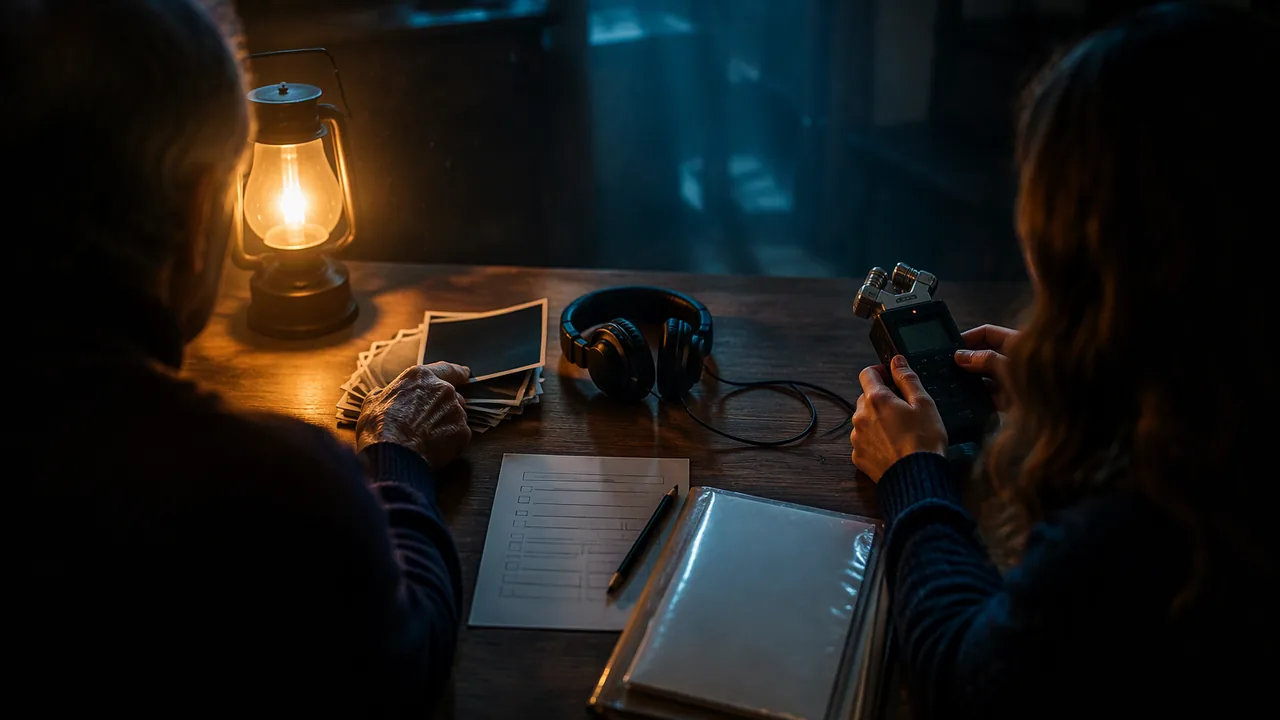
plan and conduct an ethical oral-history interview (or analyze an archived one), corroborate it with documentary sources, and interpret it for the public.
Instruction
Oral history records the memories of people who lived through events, in their own words. It lets historians hear voices missing from official records — farmworkers, refugees, veterans, neighborhood activists. It also demands care, because memory is powerful evidence and imperfect evidence at once.
Choose a narrator and a subject. Your narrator is an adult who lived through a change you studied this semester: the civil rights or Chicano movements, farm-labor organizing, the Vietnam War or military service, arrival as an immigrant or refugee, urban renewal, the Hancock Amendment’s effect on a local school or town, or the transformation of a neighborhood in your own community. You do not have to interview a family member, and you are never required to share your own family’s history. If a live interview is not possible, analyze an archived oral history instead — the Library of Congress Veterans History Project and the State Historical Society of Missouri hold many, including its Oral History Collection of St. Louis interviews (1971-1995) — citing it and not republishing it.
Ethics first. Historians follow the principles of the Oral History Association. Explain the project’s purpose and how the recording will be used. Obtain informed consent and a signed release (the course template), including whether the narrator wants to be named. The narrator may skip any question, stop at any time, and withdraw. Do not publish a recording or transcript without written permission. Some memories are painful — incarceration, war, deportation, discrimination. Do not press; let the narrator decide what to share.
Prepare. Research the period and place first; good questions come from knowledge. Write a question guide that moves chronologically and uses open questions. Weak: “Was the protest hard?” Strong: “Can you describe a day during the protest, from when you woke up?” Plan follow-ups: “What did you see?” “How did you feel then, and how do you see it now?” Avoid leading questions that suggest the answer you want.
Record and log. Record 30-45 minutes in a quiet place with a phone or free software. Afterward, make a transcript or a timed log summarizing each segment and transcribing key passages exactly.
Interpret: memory as evidence. Memory is excellent evidence of experience, feeling and meaning — what an event was like and what it meant to someone. It is weaker on dates, numbers and events the narrator did not witness, and it is shaped by everything that happened since. WHST.11-12.8 asks you to assess the strengths and limitations of each source. Corroborate the interview with at least four documentary sources — newspapers, government records, photographs, census data, secondary histories. Where memory and documents disagree, do not simply choose one; ask why they differ. Worked example (imagined): a narrator remembers the 1963 Jefferson Bank picketing in St. Louis as lasting “just a few weeks”; city and newspaper accounts say the demonstrations ran from late August 1963 until March 1964. Both can be true to their purpose: the memory records how long the protest felt to someone on the picket line, and the documents record its measurable length.
Connect past and present. CST.1 asks you to compare the present with the past and evaluate consequences. Your essay should say what the narrator’s experience reveals about the larger history and what it adds to or challenges in the textbook account.
Go public. Share the project as a short audio feature with narration, a story map, or an exhibit panel — using only material your narrator has approved for release. SL.11-12.5 asks you to use digital media strategically; SL.11-12.2 asks you to integrate sources in different formats.
📖 Read for this lesson
The reading opens over the lesson; close it to come back to exactly where you were. The checks below draw on it.
Formative check
Work through these before moving on. They are not graded — they tell you whether the standard below has landed yet.
Simulation & tools
Optional: set your narrator’s life against the history with TimelineJS
Build a TimelineJS timeline with two kinds of entries, distinguished by the “group” column in the Google Sheets template: narrator (at least six events from the interview, each with a short approved quotation or paraphrase and the timestamp in your log) and history (at least six events from this course, each linked to a documentary source). Then answer on your planning sheet: where does the narrator’s timeline match the documented one, where does it differ, and what might explain each difference? Use only material your narrator approved for release. No-tool route: a two-row paper timeline with the same entries.
Open Knight Lab ↗ · Knight Lab, Northwestern University (TimelineJS, StoryMapJS) · MPL-2.0 open source
Which is the strongest oral-history question?
How confident are you that you can conduct and interpret an ethical oral history, corroborate memory with documents, and present it publicly?
Unit 4 checkpoint
Do this before you start the task. It covers the whole unit and tells you what to review first.
What did Chief Justice Taney hold in Dred Scott v. Sandford (1857)?
Charles Hamilton Houston chose to begin the NAACP’s attack on segregation with graduate and professional schools.
In Shelley v. Kraemer (1948), a case that began in St. Louis, the Court held that state courts could not enforce racial restrictive ; in Schuette (2014) it upheld Michigan’s voter-approved ban on racial in public university admissions.
Which organization did James Farmer co-found, and which campaign did it organize in 1961?
What did President Eisenhower do at Little Rock in 1957?
The Twenty-fourth Amendment banned poll taxes in federal elections.
In Mississippi, Black voter registration after the Voting Rights Act rose from under 7 percent in 1964 to about what share by 1968?
The Rights Amendment passed Congress in 1972 but fell three states short; Title (1972) banned sex discrimination in federally funded education.
According to BLS data, about what share of adult women were in the labor force in 2000?
The Immigration Reform and Control Act of 1986 legalized about 2.7 million undocumented immigrants.
In 1979 three Kansas City consultants founded the firm that became which health-information technology company?
Which statement confuses sequence with cause?
Submit: Research brief + question guide + consent form + transcript or log + interpretive essay (1,000-1,200 words) + public product and 5-minute talk
Task: Conduct an ethical oral-history interview with an adult narrator (or analyze an archived oral history), corroborate it with at least four documentary sources, interpret it in an essay, and present it publicly.
Submission workflow
- Stage 1 — Plan. Research brief (the change, the place, four documentary sources), question guide of 15-20 open questions with follow-ups, and signed consent and release form (or the citation of the archived interview).
- Stage 2 — Reviewed draft. Transcript or timed log and a draft essay; a parent, guardian or study partner checks that every claim from memory is corroborated or qualified and that release terms are respected. Save a revision note.
- Stage 3 — Revised final. 1,000-1,200 word interpretive essay with citations, and the transcript or log.
- Stage 4 — Public product and talk. An audio feature, story map or exhibit panel using only approved material, with a five-minute recorded or live talk.
How it is scored
| Criterion | What proficient looks like |
|---|---|
| Research and ethics (WHST.11-12.7) | Well-prepared, open question guide; informed consent and release obtained and honored. |
| Evaluating memory and documents (WHST.11-12.8) | Strengths and limits of the interview and documents assessed; disagreements analyzed, not ignored. |
| Historical interpretation (US.11.11, 9-12.AH.1.CC.A) | Connects the narrator’s experience to the larger history and compares past with present. |
| Use of evidence (9-12.AH.1.CC.C / 9-12.AH.1.CC.D) | Oral and documentary evidence collected, evaluated and applied in writing and presentation. |
| Integrating sources (SL.11-12.2) | Combines interview, documents and data into a coherent account. |
| Public product (SL.11-12.5) | Strategic use of audio, images or maps; clear for a public audience. |
Living Memory: Archived Testimony, the Record Behind It, and How to Interview
Commission on Wartime Relocation and Internment of Civilians, Personal Justice Denied (1982-1983), summary and chapter 5; Civil Liberties Act of 1988, 102 Stat. 903 · Public domain (U.S. government work); the interview protocol and consent template are SLS original
Why this reading. Content note: the testimony below describes the forced removal and incarceration of Japanese Americans, in the words of people it happened to. The task asks you to plan an interview, obtain consent, produce a transcript, and then interpret memory against documents — and the lesson contains no consent form, no transcript and no archived interview. This reading supplies all three, so that a student with nobody to interview can complete every analytical part of the task from this page. The live-interview route stays open, and this reading gives you the protocol for it. The archived route is not a lesser option: analyzing testimony somebody else recorded is what most historians actually do.
Part A. An archive you can work from
The Commission on Wartime Relocation and Internment of Civilians, created by Congress in 1980, held twenty days of hearings in 1981 in Washington, Los Angeles, San Francisco, Seattle, Chicago, New York, Anchorage and the Aleutians, and heard more than 750 witnesses. Most had never spoken publicly about what happened to them. Its report, Personal Justice Denied, is a United States government publication and is in the public domain. The passages below are transcribed from the scanned report; we have corrected obvious scanning errors in spacing and have changed no words.
Leaving.
On May 16, 1942, my mother, two sisters, niece, nephew, and I left . . . by train. Father joined us later. Brother left earlier by bus. We took whatever we could carry. So much we left behind, but the most valuable thing I lost was my freedom.
Registering.
I lost my identity. At that time, I didn’t even have a Social Security number, but the WRA gave me an I.D. number. That was my identification. I lost my privacy and dignity.
Henry went to the Control Station to register the family. He came home with twenty tags, all numbered 10710, tags to be attached to each piece of baggage, and one to hang from our coat lapels. From then on, we were known as Family #10710.
The journey. Grace Nakamura told the Commission:
On May 16, 1942 at 9:30 a.m., we departed . . . for an unknown destination. To this day, I can remember vividly the plight of the elderly, some on stretchers, orphans herded onto the train by caretakers, and especially a young couple with 4 pre-school children. The mother had two frightened toddlers hanging on to her coat. In her arms, she carried two crying babies. The father had diapers and other baby paraphernalia strapped to his back. In his hands he struggled with duffle bag and suitcase. The shades were drawn on the train for our entire trip. Military police patrolled the aisles.
Arriving. William Kochiyama, on entering Tanforan:
At the entrance . . . stood two lines of troops with rifles and fixed bayonets pointed at the evacuees as they walked between the soldiers to the prison compound. Overwhelmed with bitterness and blind with rage, I screamed every obscenity I knew at the armed guards daring them to shoot me.
A soldier’s account of the same event. Leonard Abrams was with a Field Artillery Battalion that guarded Santa Anita:
We were put on full alert one day, issued full belts of live ammunition, and went to Santa Anita Race Track. There we formed part of a cordon of troops leading into the grounds; busses kept on arriving and many people walked along . . . many weeping or simply dazed, or bewildered by our formidable ranks.
Conditions, in evacuees’ own descriptions to the Commission. Of Pinedale: “The hastily built camp consisted of tar paper roofed barracks with gaping cracks that let in insects, dirt from the . . . dust storms… no toilet facilities except smelly outhouses, and community bathrooms with overhead pipes with holes punched in to serve as showers. The furniture was camp cots with dirty straw mattresses.”
Part B. The documentary record to test it against
Oral history is only half the work. Here is the documentary half, from the same report and from the statutes, so you can do the corroboration the rubric asks for without leaving this page.
- Scale and timing. The evacuation began 31 March 1942 and continued until 7 August 1942. About 92,000 people passed through sixteen temporary assembly centers — all in California except Puyallup in Washington, Portland in Oregon and Mayer in Arizona — and stayed an average of about a hundred days. About 120,000 people in all were removed. Roughly seventy percent were United States citizens.
- The stated policy. The Wartime Civil Control Administration’s own rules provided that families be kept together, that units be furnished with cots, mattresses, blankets and pillows and have electrical outlets, and that each traveling group include a doctor and a nurse with one seat in four left vacant for hand luggage. Set that beside the Pinedale description above. That gap between policy and testimony is a finished piece of historical analysis, and you can do it from this reading alone.
- The authority. Executive Order 9066 (19 February 1942) and the Act of 21 March 1942 making violation of exclusion orders a crime — both in the reading for Lesson 2.5.
- The official finding, forty years later. The Commission concluded that Executive Order 9066 “was not justified by military necessity” and that the causes were “race prejudice, war hysteria and a failure of political leadership.” Congress adopted that finding in the Civil Liberties Act of 1988.
Part C. What memory is good evidence of, and what it is not
This section is ours. Work through it with the passages in Part A in front of you.
- Strong. Experience, sensation, meaning, and the emotional shape of an event. “The shades were drawn on the train for our entire trip” is exactly what documents lose. So is the number 10710 — a fact about administration that the administrators would never have written down as a fact about a family.
- Weak. Dates, counts, and events the narrator did not witness. Two of the passages above give the same date, 16 May 1942, for different journeys; that is a coincidence a careless reader could turn into a false pattern.
- Shaped by everything since. These witnesses spoke in 1981, during a campaign for redress. That does not make the testimony false; it makes the occasion part of the evidence. Ask what a person is being asked to remember, by whom, and for what.
- Worked example of a disagreement. Kochiyama remembers troops with fixed bayonets “pointed at” the arriving people. Abrams, one of the soldiers, remembers forming a cordon and people walking between the ranks, weeping or dazed. These accounts do not match, and neither is lying. One is recording what it felt like to be marched between armed men; the other is recording what the order to the battalion was. A good essay does not choose. It says what each source is well placed to know.
Part D. Three routes, all full credit
This section is ours. Choose one. Nobody has to find you an interviewee, and nobody has to approve your choice.
Route 1 — Archived testimony, using this reading. Take four or more of the passages in Part A as your “interview.” Build your research brief from the documentary record in Part B and from Lesson 2.5. Log the passages by speaker where named, subject and theme, exactly as you would log a recording. A Missouri complement is the State Historical Society of Missouri’s collection of oral histories of the Japanese American community in St. Louis (S0682), which documents internment and life after relocation; use it to ask what a Missouri narrator adds to the Commission’s record. Then write the interpretive essay: what does this testimony reveal that the Commission’s findings and the executive order cannot, and where must it be tested? Cite the report by chapter and page.
Route 2 — A different archived collection. If you would rather work on another subject from this semester — military service, refugee arrival, farm-labor organizing, a neighborhood’s transformation — large archives of recorded interviews exist: the Veterans History Project at the Library of Congress, and the State Historical Society of Missouri, whose Oral History Collection (S0829) holds interviews and transcripts with African American community leaders, labor leaders, immigrants and jazz musicians in St. Louis. Cite what you use, quote briefly, and do not republish a recording or a full transcript: those interviews belong to the people who gave them.
Route 3 — Conduct an interview. Below is the protocol. You are never required to interview a relative, and you are never asked to share your own family’s history.
Part E. Protocol for a live interview
Consent and release — a template you can copy.
I, [narrator’s name], agree to be interviewed by [student’s name] for a school history project on [subject]. I understand that the interview will be recorded. I have been told the purpose of the project and how the recording will be used.
I may decline to answer any question, may stop the interview at any time, and may withdraw my participation, in which case the recording and transcript will be destroyed.
I choose to be identified as: [ ] my full name [ ] first name only [ ] anonymously.
I permit the following uses: [ ] quotation in a written essay [ ] use of recorded audio in a public presentation [ ] neither.
Signed: __________ Date: __________ Interviewer: __________ Date: __________
Question design. Research first; good questions come from knowledge. Move chronologically. Use open questions and follow them. Weak: “Was the protest hard?” — it can be answered with one word and it tells the narrator what you expect. Strong: “Can you describe a day during the protest, from when you woke up?” Follow-ups that always work: “What did you see?” “Who else was there?” “How did you feel then, and how do you see it now?” Never ask a question with the answer inside it (“Didn’t you think the bank was unfair?”). Save dates and numbers for documents; ask people for scenes.
During. Record 30–45 minutes in a quiet room. State the date, place and both names at the start. Then be quiet: silence is where the best material arrives. Some subjects are painful — incarceration, war, deportation, discrimination. Do not press. The narrator decides what to share.
After. Make a transcript, or a timed log summarizing each segment with key passages transcribed exactly. Use only material the narrator released.
Part F. What the essay must do, whichever route you took
This section is ours. Corroborate every claim drawn from memory with at least four documentary sources, or qualify it. Where memory and documents disagree, explain the disagreement instead of picking a winner — the worked example in Part C shows how. Connect the account to the larger history: what does one person’s experience reveal about the change you studied, and what in the textbook version does it complicate? For the public product, use only material you are permitted to use; for Route 1, the report is public domain, so you may quote it freely with citation.
Sources: Personal Justice Denied, chapter 5 (Assembly Centers), Commission on Wartime Relocation and Internment of Civilians, National Archives (archives.gov); Personal Justice Denied, summary and findings, National Archives (archives.gov); Civil Liberties Act of 1988, 102 Stat. 903, United States Statutes at Large, govinfo.gov (govinfo.gov); Veterans History Project, American Folklife Center, Library of Congress (loc.gov); Oral History Collection, 1971-1995 (S0829), State Historical Society of Missouri (collections.shsmo.org); Oral Histories of the Japanese American Community in St. Louis Collection, 1906-1988 (S0682), State Historical Society of Missouri (collections.shsmo.org)