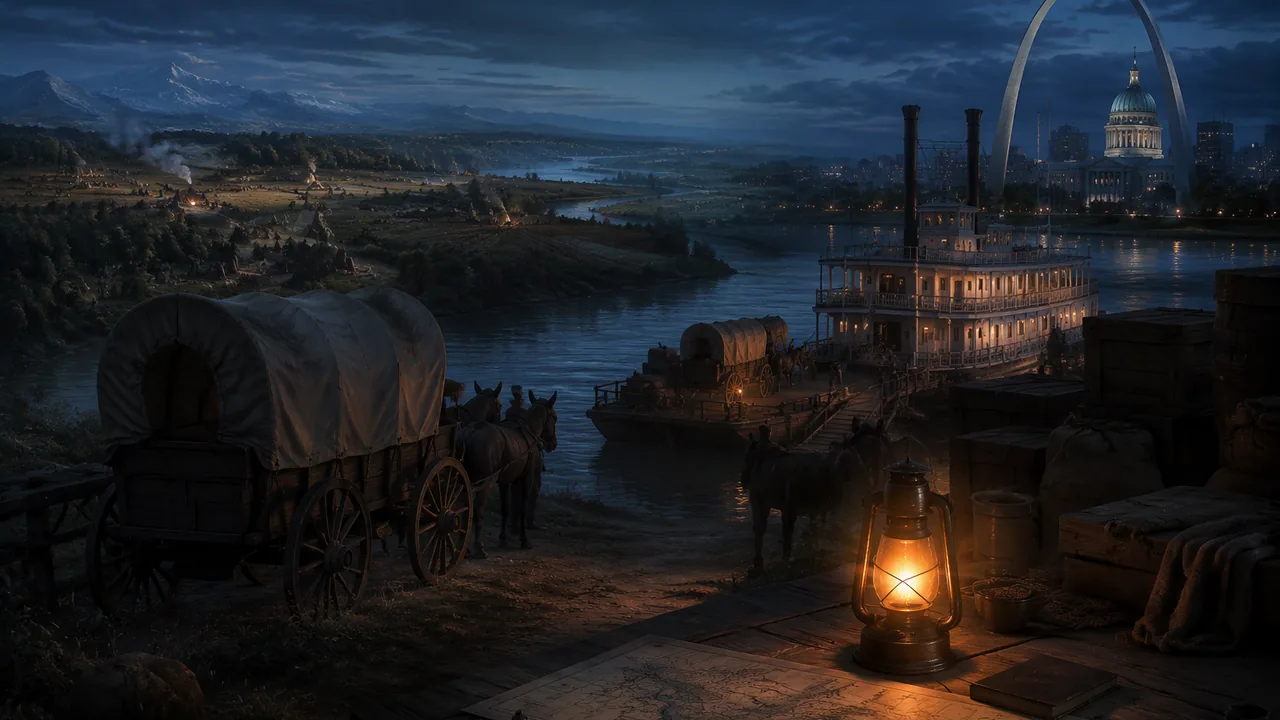
describe the purposes, challenges and economic incentives of westward expansion through Missouri’s role as a gateway, evaluate its effects on land, resources and the environment, and evaluate its short- and long-term effects on Native nations.
Instruction
In 1800 the western border of the United States reached only as far as the Mississippi River. After the Louisiana Purchase of 1803 the country nearly doubled in size and its edge moved past the Rocky Mountains, according to the National Park Service. Between the river and the mountains lay Missouri, and the city of St. Louis became the place where trade, treaties and travelers met. The Gateway Arch National Park, which includes the Old Courthouse where the first two trials of the Dred Scott case were held in 1847 and 1850, marks that role. This lesson uses Missouri’s position to answer three questions about westward movement: why people and the government wanted it, what it did to the land and its resources, and what it did to the Native nations already living there.
Purposes, challenges and incentives. The purposes were mixed. Traders wanted markets: the Santa Fe Trail was, from 1821 to 1880, mainly a commercial highway connecting Missouri and Santa Fe, pioneered by the Missouri trader William Becknell, who left Franklin, Missouri, in September 1821 and found that newly independent Mexico welcomed outside trade. Settlers and the government wanted land and a claim to it. Oregon Country belonged to the British, and many Americans were eager to settle it; the first wagons went from Missouri in 1836, and in the spring of 1843 a wagon train of nearly 1,000 people organized at Independence, Missouri, and reached Oregon. By 1846 thousands had been “drawn west by cheap land, patriotism or the promise of a better life,” and the British ceded Oregon Country that year. The challenges were distance, mountains and water. Wagons depended on South Pass, a valley 12 miles wide that was nearly the only place where they could cross the Rockies. Then the economics changed: railroads reached Santa Fe in February 1880 and the trail faded into history.
Government supplied the strongest incentive. The Homestead Act of 1862 let any adult citizen, or person who had filed to become one, who had never fought against the United States claim 160 acres of surveyed public land for a $10 payment, provided the claimant lived on and farmed it for five years; a claimant who abandoned the land for more than six months lost it. The National Archives adds a hard result. Of some 500 million acres distributed between 1862 and 1904, only 80 million went to homesteaders. That is 80 ÷ 500 = 0.16, or 16 percent. Most of the land went to speculators, cattle owners, miners, loggers and railroads.
Resources and the environment. To evaluate effects on the “production, distribution and allocation of resources,” ask who got what. Land was allocated by law, and the law’s results were uneven. Gold in the Black Hills drew miners in 1874 onto land the 1868 Fort Laramie treaty had set aside for the Sioux. The environmental cost is clearest in the bison. The National Park Service says westward settlement was the primary driver of the “Great Slaughter” from about 1820 to 1880, when railways, rifles and an international market for hides helped cut the population from an estimated 30-60 million animals to fewer than 1,000 by the 1890s. Other causes included a military directive to destroy bison to control Native peoples, cattle diseases, drought and competition from livestock.
Native nations: short and long term. The Osage treaty of June 2, 1825 was made at St. Louis. In Article 1 the Great and Little Osage ceded their claim to lands in Missouri and the Territory of Arkansas and to lands farther west; in Article 3 the United States agreed to pay $7,000 a year for twenty years. That is a short-term exchange: land for annuities. The long term was harder. In 1868 the Fort Laramie treaty created the Great Sioux Reservation, including the Black Hills, and kept hunting rights “so long as the buffalo may range thereon”; the bison were nearly gone within decades. Gold seekers followed, the government took the Black Hills in 1877, and ownership is still a legal dispute. In 1887 the Dawes Act divided reservations into individual allotments; the National Archives reports that the land often proved unsuitable for farming, that families lacked tools and seed, and that tribes lost vast acreage. The National Park Service calls the loss of the bison pivotal in the devastation of Indian people and society.
How to evaluate. Keep three columns: who wanted what and what the law offered, what changed on the land, and what changed for the people already there, now and decades later. Cite one source in every cell.
📖 Read for this lesson
The reading opens over the lesson; close it to come back to exactly where you were. The checks below draw on it.
Formative check
Work through these before moving on. They are not graded — they tell you whether the standard below has landed yet.
Missouri standard: 9-12.AH.2.CC.B
The Homestead Act of 1862 offered acres of surveyed public land to a claimant who lived on and farmed it for years.
Missouri standard: 9-12.AH.2.CC.B
Which Missouri town was the starting point for the 1843 wagon train of nearly 1,000 people bound for Oregon Country?
Missouri standard: 9-12.AH.2.G.B
The National Archives says that of some 500 million acres distributed between 1862 and 1904, only 80 million went to homesteaders. About what share is that?
Missouri standard: 9-12.AH.2.PC.B
In the 1825 treaty made at St. Louis, what did the United States agree to give the Osage in return for their cession?
Missouri standard: 9-12.AH.2.G.B, 9-12.AH.2.PC.B
The National Park Service reports that westward settlement was the main cause of a decline in bison from tens of millions to fewer than 1,000 animals by the 1890s, a loss that harmed Native nations that depended on them.
How confident are you that you can describe why people moved west through Missouri and evaluate the effects on resources, the environment and Native nations?
Practice
Work these on paper or in your notebook, then open Check your answer. Aim for all of Fluency and Application; try at least one Challenge.
Printable version: this unit’s practice workbook (PDF)
Fluency
Build speed and accuracy with the core skill.
- Who pioneered the Santa Fe Trail, and from what Missouri town did he leave in 1821?
Check your answer
Answer: William Becknell; Franklin, Missouri. - How many acres could a homesteader claim, how many years must the claimant live on the land, and what payment does section 2 require?
Check your answer
Answer: 160 acres; five years; ten dollars. - Of 500 million acres distributed between 1862 and 1904, 80 million went to homesteaders. What percent is that?
Check your answer
Answer: 16 percent.80 ÷ 500 = 0.16. - What did the 1825 Osage treaty promise each year, and for how many years?
Check your answer
Answer: $7,000 a year for twenty years. - Name the pass that let wagons cross the Rockies and give its width.
Check your answer
Answer: South Pass, a valley 12 miles wide.
Application
Use the skill in context. Show your reasoning.
- Make a three-row table with a purpose, a challenge and an economic incentive of westward movement, each with one example from the Santa Fe or Oregon trails or the Homestead Act.
Check your answer
Answer: Sample: purpose, trade with Santa Fe (Becknell, 1821); challenge, crossing the Rockies at South Pass; incentive, 160 acres of cheap land under the Homestead Act. - The bison fell from an estimated 30-60 million to fewer than 1,000. Using the lower estimate, what share of the animals survived at most?
Check your answer
Answer: At most about 0.003 percent.1,000 ÷ 30,000,000 ≈ 0.0000333, or about 0.003 percent. - The Fort Laramie treaty kept hunting rights “so long as the buffalo may range thereon.” Explain why that right lost value as the bison disappeared.
Check your answer
Answer: The right depended on the animals; when settlement, railroads and the hide trade nearly destroyed the herds by the 1890s, a legal right to hunt them no longer meant a means of living. - In one paragraph, compare a short-term and a long-term effect of land cession on a Native nation, using the 1825 Osage treaty and the Dawes Act.
Check your answer
Answer: Short term: the Osage gave up land in exchange for annuities of $7,000 a year. Long term: allotment under the Dawes Act led tribes to lose vast acreage, and the National Archives says the allotted land was often unsuitable for farming.
Challenge
Stretch problems. Expect to think before you write.
- Evaluate whether the Homestead Act achieved its purpose of settling small farmers on public land. Use the 500 million and 80 million acre figures and one other piece of evidence.
Check your answer
Answer: Model answer: only 16 percent of the land went to homesteaders; the Archives says most went to speculators, cattle owners, miners, loggers and railroads, and few laborers could afford tools, seed and livestock. The act helped some families but did not mainly serve small farmers.
Review
Keep earlier skills sharp.
- What was the effect of the Louisiana Purchase on the size of the United States?
Check your answer
Answer: It nearly doubled the country. - Which agency created on March 3, 1865 supervised labor contracts between planters and freedpeople?
Check your answer
Answer: The Freedmen’s Bureau.
The Road West from Missouri: Trails, the Homestead Act, an 1825 Osage Treaty Made in St. Louis, Fort Laramie, the Dawes Act and the Bison
National Park Service, Santa Fe National Historic Trail, Oregon National Historic Trail, Gateway Arch National Park and “People and Bison” pages; Homestead Act (12 Stat. 392) and National Archives milestone-document notes on the Homestead Act, the Treaty of Fort Laramie (1868) and the Dawes Act (1887); Treaty with the Osage, 1825 (7 Stat. 240) from the Oklahoma State University treaty collection; all retrieved 9 Nov. 2026 · Public domain (U.S. government works and treaty/statute text)
Why this reading. The lesson says the road west began in Missouri and then asks you to weigh three things at once: why people and the government wanted the land, what expansion did to the land and its resources, and what it did to the Native nations who already lived there. Here are the documents behind each: the National Park Service on the trails that started in Missouri, the Homestead Act of 1862 and the National Archives’ judgment of how it worked, an 1825 treaty made in St. Louis with the Osage, and the National Archives and Park Service on the Fort Laramie treaty, the Dawes Act and the bison. What to look for: who gains in each document, who gives something up, and what the document does not mention.
1. Missouri as the gateway (National Park Service)
Between 1821 and 1880, the Santa Fe Trail was primarily a commercial highway connecting Missouri and Santa Fe, New Mexico. The route was pioneered by Missouri trader William Becknell, who left Franklin, Missouri in September 1821.
In the spring of 1843, a wagon train of nearly 1,000 people organized at Independence, Missouri with plans to reach Oregon Country. Amidst an overwhelming chorus of naysayers who doubted their success, the so-called “Great Migration” made it safely to Oregon.
By 1846, thousands of emigrants who were drawn west by cheap land, patriotism or the promise of a better life found their way to Oregon Country. With so many Americans settling the region, it became obvious to the British that Oregon was no longer theirs. They ceded Oregon Country to the United States that year.
It was here that the first two trials of the Dred Scott case were held in 1847 and 1850.
2. The Homestead Act (1862)
The National Archives prints the act in full. Section 1 and parts of sections 2 and 5 follow, exactly.
any person who is the head of a family, or who has arrived at the age of twenty-one years, and is a citizen of the United States, or who shall have filed his declaration of intention to become such, as required by the naturalization laws of the United States, and who has never borne arms against the United States Government or given aid and comfort to its enemies, shall, from and after the first January, eighteen hundred and sixty-three, be entitled to enter one quarter section or a less quantity of unappropriated public lands, upon which said person may have filed a preemption claim, or which may, at the time the application is made, be subject to preemption at one dollar and twenty-five cents, or less, per acre; or eighty acres or less of such unappropriated lands, at two dollars and fifty cents per acre, to be located in a body, in conformity to the legal subdivisions of the public lands, and after the same shall have been surveyed:
and on payment of ten dollars, he or she shall thereupon be permitted to enter the quantity of land specified:
if, at any time after the filing of the affidavit, as required in the second section of this act, and before the expiration of the five years aforesaid, it shall be proven, after due notice to the settler, to the satisfaction of the register of the land office, that the person having filed such affidavit shall have actually changed his or her residence, or abandoned the said land for more than six months at any time, then and in that event the land so entered shall revert to the government.
The National Archives adds this assessment of how the act worked:
The act, however, proved to be no panacea for poverty. Comparatively few laborers and farmers could afford to build a farm or acquire the necessary tools, seed, and livestock. In the end, most of those who purchased land under the act came from areas quite close to their new homesteads (Iowans moved to Nebraska, Minnesotans to South Dakota, and so on). Unfortunately, the act was framed so ambiguously that it seemed to invite fraud, and early modifications by Congress only compounded the problem. Most of the land went to speculators, cattle owners, miners, loggers, and railroads.
Of some 500 million acres dispersed by the General Land Office between 1862 and 1904, only 80 million acres went to homesteaders.
3. A treaty made in St. Louis: the Osage, 1825
The treaty is printed in the collection of Indian treaties kept by Oklahoma State University. It opens with the place and the people who made it:
Articles of a treaty made and concluded at St. Louis, in the State of Missouri, between William Clark, Superintendent of Indian Affairs, Commissioner on the part of the United States, and the undersigned, Chiefs, Head-Men, and Warriors, of the Great and Little Osage Tribes of Indians, duly authorized and empowered by their respective Tribes or Nations.
The Great and Little Osage Tribes or Nations do, hereby, cede and relinquish to the United States, all their right, title, interest, and claim, to lands lying within the State of Missouri and Territory of Arkansas, and to all lands lying West of the said State of Missouri and Territory of Arkansas, North and West of the Red River, South of the Kansas River, and East of a line to be drawn from the head sources of the Kansas, Southwardly through the Rock Saline, with such reservations, for such considerations, and upon such terms as are hereinafter specified, expressed, and provided for.
In consideration of the cession and relinquishment, aforesaid, the United States do, hereby, agree to pay to the said tribes or nations, yearly, and every year, for twenty years, from the date of these presents, the sum of seven thousand dollars, at their Village, or at St. Louis
4. Fort Laramie (1868), the Dawes Act (1887) and the bison
In exchange, the U.S. Government established the Great Sioux Reservation, consisting of a large portion of the western half of what is now the state of South Dakota, including the Black Hills, which are sacred to the Sioux people.
the tribes who are parties to this agreement hereby stipulate that they will relinquish all right to occupy permanently the territory outside their reservation, as herein defined, but yet reserve the right to hunt on any lands, north of North Platte and on the Republican Fork of the Smoky Hill river, so long as the buffalo may range thereon in such numbers as to justify the chase,
Though the reservation land was set aside for exclusive use by the Sioux people, in 1874 Gen. George A. Custer led an expedition into the Black Hills, accompanied by miners who were seeking gold. Once gold was found in the Black Hills, miners were soon moving onto the Sioux hunting grounds and demanding protection from the U.S. Army. Soon, the Army was ordered to move against wandering bands of Sioux hunting on the range in accordance with their treaty rights. In 1876, Custer, leading an Army detachment, encountered an encampment of Sioux and Cheyenne at the Little Bighorn River. Custer’s detachment was annihilated, but the United States would continue its battle against the Sioux Tribe in the Black Hills until the government confiscated the land in 1877. To this day, ownership of the Black Hills remains the subject of a legal dispute between the U.S. Government and the Sioux Nation.
The land allotted to individuals included desert or near-desert lands unsuitable for farming. In addition, the techniques of self-sufficient farming were much different from their tribal way of life. Many did not want to take up agriculture, and those who did want to farm could not afford the tools, animals, seed, and other supplies necessary to get started. There were also problems with inheritance. Often young children inherited allotments that they could not farm because they had been sent away to boarding schools.
Tribes were also often underpaid for the land allotments, and when individuals did not accept the government requirements, their allotments were sold to non-Native individuals, causing American Indian communities to lose vast acreage of their tribal lands.
The westward expansion of European settlers across the continent in the 19th century was the primary driver in the rapid decline of bison in North America. Railways, rifles, and an international market for buffalo hides led to “the Great Slaughter” from about 1820 to 1880, when the bison population plummeted from 30-60 million (estimates vary) to fewer than 1,000 animals by the 1890s. Other factors including the military’s directive to destroy buffalo as a way to control American Indians, the introduction of diseases from cattle, drought, and competition from domestic livestock (horses, cattle, sheep) contributed to the reduction in bison numbers as well. At their lowest numbers, some estimated that there were only 300 bison that survived the slaughter, bringing the species to the brink of extinction.
Questions
- Using the Homestead Act and the National Archives’ figures, compute what share of the 500 million acres went to homesteaders. Which groups got the rest, and why does the Archives call the act “no panacea”?
- In the Osage treaty, what did the Osage give up, what did the United States promise, and where was the treaty signed? What does that tell you about Missouri’s place in the story?
- The Fort Laramie treaty let the tribes keep hunting rights “so long as the buffalo may range thereon.” Connect that condition to the National Park Service’s account of the bison. How does an environmental change become a change in a legal right?
- Separate the short-term from the long-term effects on Native nations in sections 3 and 4. Which are still unresolved according to the sources?
Sources: Homestead Act (1862), National Archives (archives.gov); Treaty of Fort Laramie (1868), National Archives (archives.gov); Dawes Act (1887), National Archives (archives.gov); Treaty with the Osage, 1825, Oklahoma State University treaty collection (treaties.okstate.edu); Santa Fe National Historic Trail: History & Culture, National Park Service (nps.gov); Oregon National Historic Trail: History & Culture, National Park Service (nps.gov); Gateway Arch National Park: History & Culture, National Park Service (nps.gov); People and Bison, National Park Service (nps.gov)