analyze the major New Deal programs, including the WPA, Social Security, the NLRB, farm programs and regional development projects, and evaluate the controversies over the expanded federal role in a seminar.
Instruction
Before 1933 the federal government did little that touched most Americans’ daily lives. By 1939 it insured bank deposits, regulated the stock market, paid old-age pensions, protected union organizing, set a minimum wage and employed millions directly. Americans argued then, and argue now, about whether that change was a rescue, an overreach or not enough.
Relief, recovery, reform. Historians often sort the New Deal into three aims. Relief for the unemployed: the Civilian Conservation Corps put young men to work in forests and parks; the Works Progress Administration (1935) employed about 8.5 million people over its life building roads, schools, bridges and airports, and hired artists, writers and actors. Recovery of the economy: the National Industrial Recovery Act let industries write codes setting prices and wages; the Agricultural Adjustment Act paid farmers to grow less to raise prices. Reform to prevent another collapse: the FDIC insured deposits, the Securities and Exchange Commission (1934) regulated the stock market, the Social Security Act (1935) created old-age insurance, unemployment insurance and aid to dependent children, the National Labor Relations Act (1935) protected the right to organize and created the NLRB, and the Fair Labor Standards Act (1938) set a minimum wage and banned most child labor.
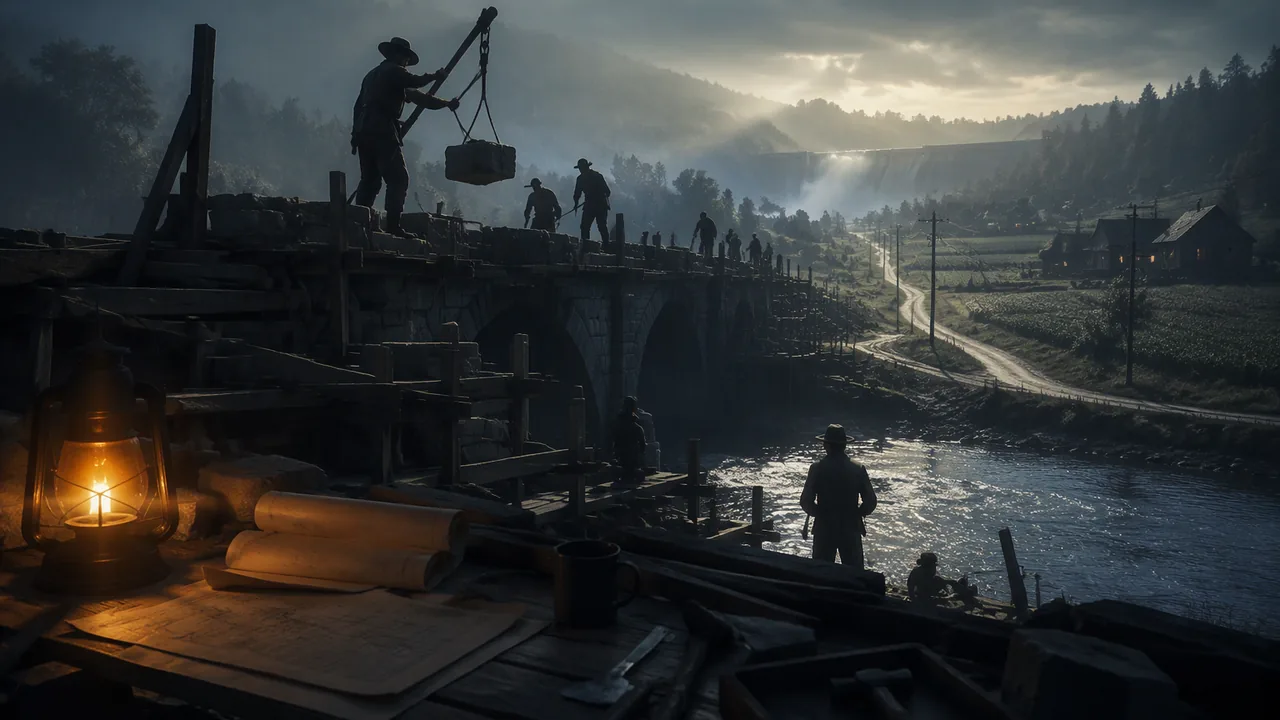
Regional development. The Tennessee Valley Authority (1933) built dams to control floods, generate cheap electricity and develop one of the poorest regions in the country. In the West, federal dams remade rivers: Bonneville Dam on the Columbia (1938). In Missouri the New Deal left its mark on the land and in the parks: by June 1933 Civilian Conservation Corps camps were operating in three Ozarks state parks — Sam A. Baker, Meramec and Roaring River — and within a year four thousand men were employed on 40,000 acres of Missouri park land, building roads, bridges, dams, trails and lodges, many still in use. The Rural Electrification Administration (1935) brought power lines to farms private utilities had ignored. These projects transformed landscapes and economies, and they flooded towns, farms and Native lands.
Too far. Conservative critics, including former President Hoover and the business-backed American Liberty League, argued that the New Deal threatened liberty and the Constitution, piled up debt and discouraged private investment. The Supreme Court agreed at first: in Schechter Poultry (1935) it struck down the NIRA, and in 1936 it struck down the AAA. After his landslide re-election in 1936, Roosevelt proposed adding up to six justices; Congress rejected the plan, but the Court began upholding New Deal laws in 1937.
Not far enough. Critics on the left — Long, Townsend, Sinclair, socialists and communists — said the New Deal saved capitalism without fixing its injustices. Others pointed to whom it left out. To win Southern votes in Congress, Social Security at first excluded agricultural and domestic workers, which left out a large share of Black and Mexican American workers. AAA payments went to landowners, not the tenants they displaced. Federal housing programs refused to insure mortgages in neighborhoods marked as risky on maps, often because Black or immigrant families lived there — a practice called redlining. Unemployment never fell below about 14 percent in the 1930s, and a recession in 1937-1938 followed spending cuts; full recovery came only with wartime spending.
A stronger presidency. The New Deal also changed the presidency (US.11.8.5). Roosevelt spoke directly to the public in radio “fireside chats,” sent Congress a flood of legislation, and in 1939 created the Executive Office of the President. He won four elections; the Twenty-second Amendment (1951) later limited presidents to two terms.
Seminar question: Did the New Deal go too far, or not far enough? A third answer is available: it did both, for different people. CST.1 asks you to compare past and present and evaluate consequences; name one New Deal institution that still exists and say what its survival suggests. SL.11-12.1.d asks you to respond to diverse perspectives and resolve contradictions where possible.
📖 Read for this lesson
The reading opens over the lesson; close it to come back to exactly where you were. The checks below draw on it.
Reading: Roosevelt at two inaugurals
Franklin D. Roosevelt, First Inaugural Address (4 March 1933) and Second Inaugural Address (20 January 1937) · Public domain (U.S. government works)
Four years apart, Roosevelt describes the crisis differently. What changed in what he claims government must do?
1933: So, first of all, let me assert my firm belief that the only thing we have to fear is fear itself—nameless, unreasoning, unjustified terror which paralyzes needed efforts to convert retreat into advance… This Nation asks for action, and action now.
1937: I see one-third of a nation ill-housed, ill-clad, ill-nourished.
Formative check
Work through these before moving on. They are not graded — they tell you whether the standard below has landed yet.
Which New Deal program is best classified as reform rather than relief?
The original Social Security Act covered agricultural and domestic workers.
Civilian Conservation Corps in Missouri
Tap to revealFrom June 1933, CCC camps in Ozarks state parks such as Sam A. Baker, Meramec and Roaring River built roads, bridges, dams, trails and lodges.
Bonneville Dam (1938)
Tap to revealFederal dam on the Columbia River supplying power to the Pacific Northwest.
Schechter Poultry (1935)
Tap to revealSupreme Court struck down the National Industrial Recovery Act.
Fair Labor Standards Act (1938)
Tap to revealSet a federal minimum wage and maximum hours and banned most child labor.
Executive Office of the President (1939)
Tap to revealCreated to give the president a professional staff — a sign of the office’s growth.
Record a 90-second seminar contribution answering the seminar question with evidence about at least two programs and one group affected differently. Then write two replies to views you do not hold — a critic from the lesson, a historian, or a study partner if you have one: in each, identify the key premise, evaluate the evidence, and propose a synthesis that accounts for both views.
How confident are you that you can explain the major New Deal programs and evaluate the controversies over the expanded federal role?
Practice
Work these on paper or in your notebook, then open Check your answer. Aim for all of Fluency and Application; try at least one Challenge.
Printable version: this unit’s practice workbook (PDF)
Fluency
Build speed and accuracy with the core skill.
- Order: Fair Labor Standards Act; Schechter Poultry; Tennessee Valley Authority created; Social Security Act; court-packing plan.
Check your answer
Answer: TVA (1933); Schechter (1935); Social Security Act (1935); court-packing plan (1937); Fair Labor Standards Act (1938).Schechter was decided in May 1935; the Social Security Act was signed in August 1935. - Classify as relief, recovery or reform: WPA; Securities and Exchange Commission; Agricultural Adjustment Act.
Check your answer
Answer: WPA — relief; SEC — reform; AAA — recovery.
Application
Use the skill in context. Show your reasoning.
- Roosevelt said in 1937: ‘I see one-third of a nation ill-housed, ill-clad, ill-nourished.’ When and to whom was he speaking, and what was he trying to achieve?
Check your answer
Answer: In his second inaugural address, January 1937, to the nation after his landslide re-election. He was using the scale of need to press for further reform against a Congress and Court that had resisted parts of the New Deal. - Compare Roosevelt’s 1933 claim that ‘the only thing we have to fear is fear itself’ with Chief Justice Hughes in Schechter (1935): ‘Extraordinary conditions do not create or enlarge constitutional power.’ How do they differ on what the emergency permitted?
Check your answer
Answer: Model answer: Roosevelt treated the emergency as demanding bold federal action; Hughes held that an emergency cannot expand the Constitution’s limits. Strong answers note each speaker’s role — president and Chief Justice — and that the Court later upheld New Deal laws from 1937. - Roosevelt’s court-packing plan failed in 1937, and the Court began upholding New Deal laws that year. Did the plan cause the change?
Check your answer
Answer: Historians disagree. Some see the justices responding to political pressure; others note that key votes preceded or did not depend on the plan. A strong answer acknowledges the debate and the evidence on each side rather than asserting cause from timing.
Review
Keep earlier skills sharp.
- Semester A review: which Progressive-era amendment made the New Deal’s larger budgets possible by allowing a federal income tax?
Check your answer
Answer: The Sixteenth Amendment (1913).
Too Far and Not Far Enough: Four Documents of 1933-1937
Franklin D. Roosevelt, First Inaugural Address (1933) and Second Inaugural Address (1937); Social Security Act, 49 Stat. 620 (1935); National Labor Relations Act, 49 Stat. 449 (1935); Schechter Poultry Corp. v. United States, 295 U.S. 495 (1935) · Public domain (U.S. government works)
Why this reading. The seminar asks whether the New Deal went too far or not far enough, and the task requires evidence about at least two programs and one group affected differently. The lesson supplies two sentences of Roosevelt and no statute at all. Here are the four documents the argument actually turns on: Roosevelt making the case for federal power in 1933 and again in 1937; the Social Security Act saying who is covered and who is not; the Wagner Act doing the same; and the Supreme Court telling Congress that an emergency is not a power. What to look for: the “not far enough” case is not an opinion you have to supply. It is written into section 210(b) of one statute and section 2(3) of the other, in the same nine words.
1. Roosevelt asks for the power — First Inaugural Address, 4 March 1933
This great Nation will endure as it has endured, will revive and will prosper. So, first of all, let me assert my firm belief that the only thing we have to fear is fear itself—nameless, unreasoning, unjustified terror which paralyzes needed efforts to convert retreat into advance.
Primarily this is because the rulers of the exchange of mankind’s goods have failed, through their own stubbornness and their own incompetence, have admitted their failure, and abdicated. Practices of the unscrupulous money changers stand indicted in the court of public opinion, rejected by the hearts and minds of men.
Restoration calls, however, not for changes in ethics alone. This Nation asks for action, and action now.
Our greatest primary task is to put people to work. This is no unsolvable problem if we face it wisely and courageously. It can be accomplished in part by direct recruiting by the Government itself, treating the task as we would treat the emergency of a war…
Finally, in our progress toward a resumption of work we require two safeguards against a return of the evils of the old order; there must be a strict supervision of all banking and credits and investments; there must be an end to speculation with other people’s money, and there must be provision for an adequate but sound currency.
It is to be hoped that the normal balance of executive and legislative authority may be wholly adequate to meet the unprecedented task before us. But it may be that an unprecedented demand and need for undelayed action may call for temporary departure from that normal balance of public procedure.
But in the event that the Congress shall fail to take one of these two courses, and in the event that the national emergency is still critical, I shall not evade the clear course of duty that will then confront me. I shall ask the Congress for the one remaining instrument to meet the crisis—broad Executive power to wage a war against the emergency, as great as the power that would be given to me if we were in fact invaded by a foreign foe.
That last paragraph is the best single piece of evidence for the “too far” side, and it was spoken in the first twenty minutes of the New Deal.
2. Roosevelt defends the power — Second Inaugural Address, 20 January 1937
We have always known that heedless self-interest was bad morals; we know now that it is bad economics.
Nearly all of us recognize that as intricacies of human relationships increase, so power to govern them also must increase—power to stop evil; power to do good. The essential democracy of our Nation and the safety of our people depend not upon the absence of power, but upon lodging it with those whom the people can change or continue at stated intervals through an honest and free system of elections. The Constitution of 1787 did not make our democracy impotent.
I see a great nation, upon a great continent, blessed with a great wealth of natural resources… But here is the challenge to our democracy: In this nation I see tens of millions of its citizens—a substantial part of its whole population—who at this very moment are denied the greater part of what the very lowest standards of today call the necessities of life.
I see millions of families trying to live on incomes so meager that the pall of family disaster hangs over them day by day.
I see millions denied education, recreation, and the opportunity to better their lot and the lot of their children.
I see one-third of a nation ill-housed, ill-clad, ill-nourished.
It is not in despair that I paint you that picture. I paint it for you in hope—because the Nation, seeing and understanding the injustice in it, proposes to paint it out… The test of our progress is not whether we add more to the abundance of those who have much; it is whether we provide enough for those who have too little.
Four years into the New Deal, the president’s own measure of the problem is one third of the country. Both sides of the seminar can use that sentence, and they should have to explain why.
3. Who was covered — Social Security Act, 14 August 1935
The Act’s own title says what it was for:
An Act To provide for the general welfare by establishing a system of Federal old-age benefits, and by enabling the several States to make more adequate provision for aged persons, blind persons, dependent and crippled children, maternal and child welfare, public health, and the administration of their unemployment compensation laws…
Old-age benefits were built on “employment.” Section 210(b) defines that word:
The term “employment” means any service, of whatever nature, performed within the United States by an employee for his employer, except—(1) Agricultural labor; (2) Domestic service in a private home; (3) Casual labor not in the course of the employer’s trade or business…
The payroll-tax title, section 811(b), and the unemployment-compensation title, section 907(c), carry the same two exclusions. Nothing in the statute mentions race. The effect did: in 1935 a very large share of Black workers in the South, and of Mexican American workers in the Southwest, worked in the fields or in other people’s homes.
4. Who could organize — National Labor Relations Act, 5 July 1935
Congress explained itself first. Section 1 is a theory of the Depression as much as a labor policy:
The inequality of bargaining power between employees who do not possess full freedom of association or actual liberty of contract, and employers who are organized in the corporate or other forms of ownership association substantially burdens and affects the flow of commerce, and tends to aggravate recurrent business depressions, by depressing wage rates and the purchasing power of wage earners in industry…
Then the right itself:
Sec. 7. Employees shall have the right to self-organization, to form, join, or assist labor organizations, to bargain collectively through representatives of their own choosing, and to engage in concerted activities, for the purpose of collective bargaining or other mutual aid or protection.
And then the definition that decides who “employees” are:
Sec. 2(3). The term “employee” shall include any employee, and shall not be limited to the employees of a particular employer… but shall not include any individual employed as an agricultural laborer, or in the domestic service of any family or person at his home, or any individual employed by his parent or spouse.
5. The Court answers — Schechter Poultry Corp. v. United States, 27 May 1935
The government argued that the National Industrial Recovery Act had to be read in the light of a national crisis. Chief Justice Hughes, for a unanimous Court:
Undoubtedly, the conditions to which power is addressed are always to be considered when the exercise of power is challenged. Extraordinary conditions may call for extraordinary remedies. But the argument necessarily stops short of an attempt to justify action which lies outside the sphere of constitutional authority. Extraordinary conditions do not create or enlarge constitutional power.
Such a delegation of legislative power is unknown to our law and is utterly inconsistent with the constitutional prerogatives and duties of Congress… Congress cannot delegate legislative power to the President to exercise an unfettered discretion to make whatever laws he thinks may be needed or advisable…
If the commerce clause were construed to reach all enterprises and transactions which could be said to have an indirect effect upon interstate commerce, the federal authority would embrace practically all the activities of the people and the authority of the State over its domestic concerns would exist only by sufferance of the federal government.
6. Building your two sides
This section is ours, not quoted. Too far has three distinct arguments in these documents, and they are not the same argument: the president asking in advance for war powers over an economy (Document 1); Congress handing lawmaking to the executive and to trade associations (Document 5); and the federal government reaching into what the Court called a State’s domestic concerns (Document 5 again). Not far enough has two: the scale Roosevelt himself names in 1937, and the identical nine-word exclusion in two 1935 statutes. The third answer — that it went too far and not far enough at once, for different people — is the one these documents support best, because an industrial worker in Flint and a cotton picker in Kern County were governed by the same Congress in the same summer and came out on opposite sides of a definition. Whichever you argue, name one institution from 1935 that still exists, as the standard asks, and say what its survival proves and what it does not.
Sources: First Inaugural Address of Franklin D. Roosevelt (1933), Avalon Project, Yale Law School (avalon.law.yale.edu); Second Inaugural Address of Franklin D. Roosevelt (1937), Avalon Project, Yale Law School (avalon.law.yale.edu); Social Security Act, 49 Stat. 620 (1935), United States Statutes at Large, govinfo.gov (govinfo.gov); National Labor Relations Act, 49 Stat. 449 (1935), United States Statutes at Large, govinfo.gov (govinfo.gov); Schechter Poultry Corp. v. United States, 295 U.S. 495 (1935), official U.S. Reports (tile.loc.gov)