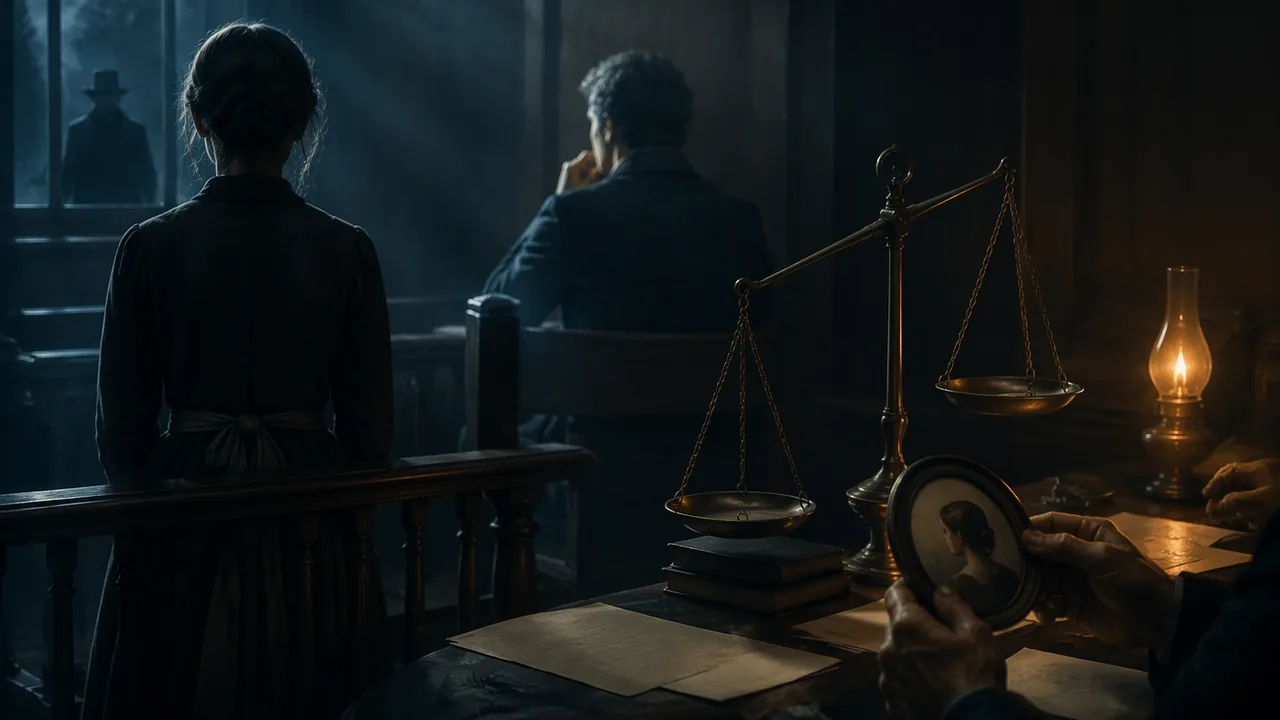
analyze how Shelley uses dramatic irony in the murder of William and the trial of Justine, and evaluate Victor’s choice to stay silent.
Instruction
Chapters 5 through 7 close Volume I with a murder, a trial and an execution, and they turn a story about science into a story about justice. The question this course keeps asking, what happens when law and conscience pull apart, arrives in Geneva in the person of a young servant who is innocent and is condemned anyway.
The news. Chapter 6 opens with Alphonse Frankenstein’s letter: “William is dead!—that sweet child, whose smiles delighted and warmed my heart, who was so gentle, yet so gay! Victor, he is murdered!” The letter also plants the evidence the plot will turn on. William had been wearing a “very valuable miniature” of Victor’s mother, and it is gone. Elizabeth, who let him wear it, cries, “O God! I have murdered my darling infant!” Hold onto that line. In the next two chapters, nearly everyone who is innocent accuses themselves, while the one person who holds the key stays silent.
Victor’s own verdict. Returning at night, Victor sees the creature in a flash of lightning near the place where William died and decides at once: “He was the murderer! I could not doubt it. The mere presence of the idea was an irresistible proof of the fact.” Look at the reasoning. Victor convicts on a feeling, as surely as the court will convict Justine on a coincidence. He happens to be right, but his method is no better than theirs. Then he chooses silence. His story, he reasons, carries “an air of delirium,” and he admits he would have taken it for “the ravings of insanity” if anyone else had told it.
Dramatic irony. At Justine’s trial in Chapter 7, the reader knows what the court does not. Every piece of evidence, from her night outside the city walls to her confused answer to a market-woman and the portrait found in her pocket, seems to point at her, and only Victor and the reader know it points nowhere. Shelley uses this dramatic irony to make the trial almost unbearable to read. When Elizabeth rises to speak for Justine, she condemns “the cowardice of her pretended friends,” and the sentence lands harder on Victor, sitting in the court, than on anyone she means. Victor calls the proceeding “this wretched mockery of justice” and himself “the cause,” and still he does not speak.
A false confession. In prison Justine tells Elizabeth, “I did confess; but I confessed a lie.” Her confessor, she says, “threatened excommunication and hell fire” until she signed. The law has its confession, and the confession is false. When Victor reports the verdict, he turns upside down a famous principle associated with the English jurist William Blackstone, that it is better for ten guilty persons to escape than for one innocent person to suffer: “all judges had rather that ten innocent should suffer, than that one guilty should escape.” His bitterness is aimed at the judges. The novel quietly aims it back at him.
Who is the murderer? The chapter ends with Victor calling himself “the true murderer.” Decide what he means. He did not strangle William, and he did not condemn Justine; but he made the being who did the first, and he withheld the truth that might have prevented the second. As you close-read Chapters 6 and 7, keep a log with two columns: each moment when Victor could act and does not, and each moment when someone innocent accepts blame that is not theirs.
📖 Before this lesson, read: Frankenstein; or, The Modern Prometheus, Volume 1, Chapters 5-7
The reading opens over the lesson; close it to come back to exactly where you were.
Formative check
Work through these before moving on. They are not graded — they tell you whether the standard below has landed yet.
During Justine’s trial the reader knows who killed William, but the court does not. What is this technique, and what effect does it create?
Victor tells the court that he knows who killed William.
In prison Justine says, “I did confess; but I confessed a .” Elizabeth calls the punishment that follows a crime by the “Hateful name” of .
Victor calls himself “the true murderer,” yet he killed no one. In five to seven sentences, explain what he means and whether you agree. Quote one moment in Chapter 6 or 7 where Victor could have acted and chose not to, and one moment where an innocent character blames herself.
How confident are you that you can explain how dramatic irony shapes the trial of Justine and use it to judge Victor’s silence?
Frankenstein; or, The Modern Prometheus, Volume 1, Chapters 5-7
Frankenstein (1818), Volume 1, Chapter 5 Bridge summary — not the primary text
This is a short recap written for this course, not Mary Shelley’s own words, so you can follow the story between close-reading lessons.
{summary}Frankenstein (1818), Volume 1, Chapter 6
Source: Mary Shelley, Frankenstein; or, The Modern Prometheus (London: Lackington, Hughes, Harding, Mavor and Jones, 1818), Project Gutenberg eBook #41445 (gutenberg.org) · Public domain
On my return, I found the following letter from my father:—
* * * * *
“To V. FRANKENSTEIN.
“MY DEAR VICTOR,
“You have probably waited impatiently for a letter to fix the date of your return to us; and I was at first tempted to write only a few lines, merely mentioning the day on which I should expect you. But that would be a cruel kindness, and I dare not do it. What would be your surprise, my son, when you expected a happy and gay welcome, to behold, on the contrary, tears and wretchedness? And how, Victor, can I relate our misfortune? Absence cannot have rendered you callous to our joys and griefs; and how shall I inflict pain on an absent child? I wish to prepare you for the woeful news, but I know it is impossible; even now your eye skims over the page, to seek the words which are to convey to you the horrible tidings.
“William is dead!—that sweet child, whose smiles delighted and warmed my heart, who was so gentle, yet so gay! Victor, he is murdered!
“I will not attempt to console you; but will simply relate the circumstances of the transaction.
“Last Thursday (May 7th) I, my niece, and your two brothers, went to walk in Plainpalais. The evening was warm and serene, and we prolonged our walk farther than usual. It was already dusk before we thought of returning; and then we discovered that William and Ernest, who had gone on before, were not to be found. We accordingly rested on a seat until they should return. Presently Ernest came, and inquired if we had seen his brother: he said, that they had been playing together, that William had run away to hide himself, and that he vainly sought for him, and afterwards waited for him a long time, but that he did not return.
“This account rather alarmed us, and we continued to search for him until night fell, when Elizabeth conjectured that he might have returned to the house. He was not there. We returned again, with torches; for I could not rest, when I thought that my sweet boy had lost himself, and was exposed to all the damps and dews of night: Elizabeth also suffered extreme anguish. About five in the morning I discovered my lovely boy, whom the night before I had seen blooming and active in health, stretched on the grass livid and motionless: the print of the murderer’s finger was on his neck.
“He was conveyed home, and the anguish that was visible in my countenance betrayed the secret to Elizabeth. She was very earnest to see the corpse. At first I attempted to prevent her; but she persisted, and entering the room where it lay, hastily examined the neck of the victim, and clasping her hands exclaimed, ‘O God! I have murdered my darling infant!’
“She fainted, and was restored with extreme difficulty. When she again lived, it was only to weep and sigh. She told me, that that same evening William had teazed her to let him wear a very valuable miniature that she possessed of your mother. This picture is gone, and was doubtless the temptation which urged the murderer to the deed. We have no trace of him at present, although our exertions to discover him are unremitted; but they will not restore my beloved William.
“Come, dearest Victor; you alone can console Elizabeth. She weeps continually, and accuses herself unjustly as the cause of his death; her words pierce my heart. We are all unhappy; but will not that be an additional motive for you, my son, to return and be our comforter? Your dear mother! Alas, Victor! I now say, Thank God she did not live to witness the cruel, miserable death of her youngest darling!
“Come, Victor; not brooding thoughts of vengeance against the assassin, but with feelings of peace and gentleness, that will heal, instead of festering the wounds of our minds. Enter the house of mourning, my friend, but with kindness and affection for those who love you, and not with hatred for your enemies.
“Your affectionate and afflicted father,
“ALPHONSE FRANKENSTEIN.
“Geneva, May 12th, 17—.”
* * * * *
Clerval, who had watched my countenance as I read this letter, was surprised to observe the despair that succeeded to the joy I at first expressed on receiving news from my friends. I threw the letter on the table, and covered my face with my hands.
“My dear Frankenstein,” exclaimed Henry, when he perceived me weep with bitterness, “are you always to be unhappy? My dear friend, what has happened?”
I motioned to him to take up the letter, while I walked up and down the room in the extremest agitation. Tears also gushed from the eyes of Clerval, as he read the account of my misfortune.
“I can offer you no consolation, my friend,” said he; “your disaster is irreparable. What do you intend to do?”
“To go instantly to Geneva: come with me, Henry, to order the horses.”
During our walk, Clerval endeavoured to raise my spirits. He did not do this by common topics of consolation, but by exhibiting the truest sympathy. “Poor William!” said he, “that dear child; he now sleeps with his angel mother. His friends mourn and weep, but he is at rest: he does not now feel the murderer’s grasp; a sod covers his gentle form, and he knows no pain. He can no longer be a fit subject for pity; the survivors are the greatest sufferers, and for them time is the only consolation. Those maxims of the Stoics, that death was no evil, and that the mind of man ought to be superior to despair on the eternal absence of a beloved object, ought not to be urged. Even Cato wept over the dead body of his brother.”
Clerval spoke thus as we hurried through the streets; the words impressed themselves on my mind, and I remembered them afterwards in solitude. But now, as soon as the horses arrived, I hurried into a cabriole, and bade farewell to my friend.
My journey was very melancholy. At first I wished to hurry on, for I longed to console and sympathize with my loved and sorrowing friends; but when I drew near my native town, I slackened my progress. I could hardly sustain the multitude of feelings that crowded into my mind. I passed through scenes familiar to my youth, but which I had not seen for nearly six years. How altered every thing might be during that time? One sudden and desolating change had taken place; but a thousand little circumstances might have by degrees worked other alterations which, although they were done more tranquilly, might not be the less decisive. Fear overcame me; I dared not advance, dreading a thousand nameless evils that made me tremble, although I was unable to define them.
I remained two days at Lausanne, in this painful state of mind. I contemplated the lake: the waters were placid; all around was calm, and the snowy mountains, “the palaces of nature,” were not changed. By degrees the calm and heavenly scene restored me, and I continued my journey towards Geneva.
The road ran by the side of the lake, which became narrower as I approached my native town. I discovered more distinctly the black sides of Jura, and the bright summit of Mont Blânc; I wept like a child: “Dear mountains! my own beautiful lake! how do you welcome your wanderer? Your summits are clear; the sky and lake are blue and placid. Is this to prognosticate peace, or to mock at my unhappiness?”
I fear, my friend, that I shall render myself tedious by dwelling on these preliminary circumstances; but they were days of comparative happiness, and I think of them with pleasure. My country, my beloved country! who but a native can tell the delight I took in again beholding thy streams, thy mountains, and, more than all, thy lovely lake.
Yet, as I drew nearer home, grief and fear again overcame me. Night also closed around; and when I could hardly see the dark mountains, I felt still more gloomily. The picture appeared a vast and dim scene of evil, and I foresaw obscurely that I was destined to become the most wretched of human beings. Alas! I prophesied truly, and failed only in one single circumstance, that in all the misery I imagined and dreaded, I did not conceive the hundredth part of the anguish I was destined to endure.
It was completely dark when I arrived in the environs of Geneva; the gates of the town were already shut; and I was obliged to pass the night at Secheron, a village half a league to the east of the city. The sky was serene; and, as I was unable to rest, I resolved to visit the spot where my poor William had been murdered. As I could not pass through the town, I was obliged to cross the lake in a boat to arrive at Plainpalais. During this short voyage I saw the lightnings playing on the summit of Mont Blânc in the most beautiful figures. The storm appeared to approach rapidly; and, on landing, I ascended a low hill, that I might observe its progress. It advanced; the heavens were clouded, and I soon felt the rain coming slowly in large drops, but its violence quickly increased.
I quitted my seat, and walked on, although the darkness and storm increased every minute, and the thunder burst with a terrific crash over my head. It was echoed from Salêve, the Juras, and the Alps of Savoy; vivid flashes of lightning dazzled my eyes, illuminating the lake, making it appear like a vast sheet of fire; then for an instant every thing seemed of a pitchy darkness, until the eye recovered itself from the preceding flash. The storm, as is often the case in Switzerland, appeared at once in various parts of the heavens. The most violent storm hung exactly north of the town, over that part of the lake which lies between the promontory of Belrive and the village of Copêt. Another storm enlightened Jura with faint flashes; and another darkened and sometimes disclosed the Môle, a peaked mountain to the east of the lake.
While I watched the storm, so beautiful yet terrific, I wandered on with a hasty step. This noble war in the sky elevated my spirits; I clasped my hands, and exclaimed aloud, “William, dear angel! this is thy funeral, this thy dirge!” As I said these words, I perceived in the gloom a figure which stole from behind a clump of trees near me; I stood fixed, gazing intently: I could not be mistaken. A flash of lightning illuminated the object, and discovered its shape plainly to me; its gigantic stature, and the deformity of its aspect, more hideous than belongs to humanity, instantly informed me that it was the wretch, the filthy dæmon to whom I had given life. What did he there? Could he be (I shuddered at the conception) the murderer of my brother? No sooner did that idea cross my imagination, than I became convinced of its truth; my teeth chattered, and I was forced to lean against a tree for support. The figure passed me quickly, and I lost it in the gloom. Nothing in human shape could have destroyed that fair child. He was the murderer! I could not doubt it. The mere presence of the idea was an irresistible proof of the fact. I thought of pursuing the devil; but it would have been in vain, for another flash discovered him to me hanging among the rocks of the nearly perpendicular ascent of Mont Salêve, a hill that bounds Plainpalais on the south. He soon reached the summit, and disappeared.
I remained motionless. The thunder ceased; but the rain still continued, and the scene was enveloped in an impenetrable darkness. I revolved in my mind the events which I had until now sought to forget: the whole train of my progress towards the creation; the appearance of the work of my own hands alive at my bed side; its departure. Two years had now nearly elapsed since the night on which he first received life; and was this his first crime? Alas! I had turned loose into the world a depraved wretch, whose delight was in carnage and misery; had he not murdered my brother?
No one can conceive the anguish I suffered during the remainder of the night, which I spent, cold and wet, in the open air. But I did not feel the inconvenience of the weather; my imagination was busy in scenes of evil and despair. I considered the being whom I had cast among mankind, and endowed with the will and power to effect purposes of horror, such as the deed which he had now done, nearly in the light of my own vampire, my own spirit let loose from the grave, and forced to destroy all that was dear to me.
Day dawned; and I directed my steps towards the town. The gates were open; and I hastened to my father’s house. My first thought was to discover what I knew of the murderer, and cause instant pursuit to be made. But I paused when I reflected on the story that I had to tell. A being whom I myself had formed, and endued with life, had met me at midnight among the precipices of an inaccessible mountain. I remembered also the nervous fever with which I had been seized just at the time that I dated my creation, and which would give an air of delirium to a tale otherwise so utterly improbable. I well knew that if any other had communicated such a relation to me, I should have looked upon it as the ravings of insanity. Besides, the strange nature of the animal would elude all pursuit, even if I were so far credited as to persuade my relatives to commence it. Besides, of what use would be pursuit? Who could arrest a creature capable of scaling the overhanging sides of Mont Salêve? These reflections determined me, and I resolved to remain silent.
It was about five in the morning when I entered my father’s house. I told the servants not to disturb the family, and went into the library to attend their usual hour of rising.
Six years had elapsed, passed as a dream but for one indelible trace, and I stood in the same place where I had last embraced my father before my departure for Ingolstadt. Beloved and respectable parent! He still remained to me. I gazed on the picture of my mother, which stood over the mantle-piece. It was an historical subject, painted at my father’s desire, and represented Caroline Beaufort in an agony of despair, kneeling by the coffin of her dead father. Her garb was rustic, and her cheek pale; but there was an air of dignity and beauty, that hardly permitted the sentiment of pity. Below this picture was a miniature of William; and my tears flowed when I looked upon it. While I was thus engaged, Ernest entered: he had heard me arrive, and hastened to welcome me. He expressed a sorrowful delight to see me: “Welcome, my dearest Victor,” said he. “Ah! I wish you had come three months ago, and then you would have found us all joyous and delighted. But we are now unhappy; and, I am afraid, tears instead of smiles will be your welcome. Our father looks so sorrowful: this dreadful event seems to have revived in his mind his grief on the death of Mamma. Poor Elizabeth also is quite inconsolable.” Ernest began to weep as he said these words.
“Do not,” said I, “welcome me thus; try to be more calm, that I may not be absolutely miserable the moment I enter my father’s house after so long an absence. But, tell me, how does my father support his misfortunes? and how is my poor Elizabeth?”
“She indeed requires consolation; she accused herself of having caused the death of my brother, and that made her very wretched. But since the murderer has been discovered——”
“The murderer discovered! Good God! how can that be? who could attempt to pursue him? It is impossible; one might as well try to overtake the winds, or confine a mountain-stream with a straw.”
“I do not know what you mean; but we were all very unhappy when she was discovered. No one would believe it at first; and even now Elizabeth will not be convinced, notwithstanding all the evidence. Indeed, who would credit that Justine Moritz, who was so amiable, and fond of all the family, could all at once become so extremely wicked?”
“Justine Moritz! Poor, poor girl, is she the accused? But it is wrongfully; every one knows that; no one believes it, surely, Ernest?”
“No one did at first; but several circumstances came out, that have almost forced conviction upon us: and her own behaviour has been so confused, as to add to the evidence of facts a weight that, I fear, leaves no hope for doubt. But she will be tried to-day, and you will then hear all.”
He related that, the morning on which the murder of poor William had been discovered, Justine had been taken ill, and confined to her bed; and, after several days, one of the servants, happening to examine the apparel she had worn on the night of the murder, had discovered in her pocket the picture of my mother, which had been judged to be the temptation of the murderer. The servant instantly shewed it to one of the others, who, without saying a word to any of the family, went to a magistrate; and, upon their deposition, Justine was apprehended. On being charged with the fact, the poor girl confirmed the suspicion in a great measure by her extreme confusion of manner.
This was a strange tale, but it did not shake my faith; and I replied earnestly, “You are all mistaken; I know the murderer. Justine, poor, good Justine, is innocent.”
At that instant my father entered. I saw unhappiness deeply impressed on his countenance, but he endeavoured to welcome me cheerfully; and, after we had exchanged our mournful greeting, would have introduced some other topic than that of our disaster, had not Ernest exclaimed, “Good God, Papa! Victor says that he knows who was the murderer of poor William.”
“We do also, unfortunately,” replied my father; “for indeed I had rather have been for ever ignorant than have discovered so much depravity and ingratitude in one I valued so highly.”
“My dear father, you are mistaken; Justine is innocent.”
“If she is, God forbid that she should suffer as guilty. She is to be tried to-day, and I hope, I sincerely hope, that she will be acquitted.”
This speech calmed me. I was firmly convinced in my own mind that Justine, and indeed every human being, was guiltless of this murder. I had no fear, therefore, that any circumstantial evidence could be brought forward strong enough to convict her; and, in this assurance, I calmed myself, expecting the trial with eagerness, but without prognosticating an evil result.
We were soon joined by Elizabeth. Time had made great alterations in her form since I had last beheld her. Six years before she had been a pretty, good-humoured girl, whom every one loved and caressed. She was now a woman in stature and expression of countenance, which was uncommonly lovely. An open and capacious forehead gave indications of a good understanding, joined to great frankness of disposition. Her eyes were hazel, and expressive of mildness, now through recent affliction allied to sadness. Her hair was of a rich, dark auburn, her complexion fair, and her figure slight and graceful. She welcomed me with the greatest affection. “Your arrival, my dear cousin,” said she, “fills me with hope. You perhaps will find some means to justify my poor guiltless Justine. Alas! who is safe, if she be convicted of crime? I rely on her innocence as certainly as I do upon my own. Our misfortune is doubly hard to us; we have not only lost that lovely darling boy, but this poor girl, whom I sincerely love, is to be torn away by even a worse fate. If she is condemned, I never shall know joy more. But she will not, I am sure she will not; and then I shall be happy again, even after the sad death of my little William.”
“She is innocent, my Elizabeth,” said I, “and that shall be proved; fear nothing, but let your spirits be cheered by the assurance of her acquittal.”
“How kind you are! every one else believes in her guilt, and that made me wretched; for I knew that it was impossible: and to see every one else prejudiced in so deadly a manner, rendered me hopeless and despairing.” She wept.
“Sweet niece,” said my father, “dry your tears. If she is, as you believe, innocent, rely on the justice of our judges, and the activity with which I shall prevent the slightest shadow of partiality.”
Frankenstein (1818), Volume 1, Chapter 7
Source: Mary Shelley, Frankenstein; or, The Modern Prometheus (London: Lackington, Hughes, Harding, Mavor and Jones, 1818), Project Gutenberg eBook #41445 (gutenberg.org) · Public domain
We passed a few sad hours, until eleven o’clock, when the trial was to commence. My father and the rest of the family being obliged to attend as witnesses, I accompanied them to the court. During the whole of this wretched mockery of justice, I suffered living torture. It was to be decided, whether the result of my curiosity and lawless devices would cause the death of two of my fellow-beings: one a smiling babe, full of innocence and joy; the other far more dreadfully murdered, with every aggravation of infamy that could make the murder memorable in horror. Justine also was a girl of merit, and possessed qualities which promised to render her life happy: now all was to be obliterated in an ignominious grave; and I the cause! A thousand times rather would I have confessed myself guilty of the crime ascribed to Justine; but I was absent when it was committed, and such a declaration would have been considered as the ravings of a madman, and would not have exculpated her who suffered through me.
The appearance of Justine was calm. She was dressed in mourning; and her countenance, always engaging, was rendered, by the solemnity of her feelings, exquisitely beautiful. Yet she appeared confident in innocence, and did not tremble, although gazed on and execrated by thousands; for all the kindness which her beauty might otherwise have excited, was obliterated in the minds of the spectators by the imagination of the enormity she was supposed to have committed. She was tranquil, yet her tranquillity was evidently constrained; and as her confusion had before been adduced as a proof of her guilt, she worked up her mind to an appearance of courage. When she entered the court, she threw her eyes round it, and quickly discovered where we were seated. A tear seemed to dim her eye when she saw us; but she quickly recovered herself, and a look of sorrowful affection seemed to attest her utter guiltlessness.
The trial began; and after the advocate against her had stated the charge, several witnesses were called. Several strange facts combined against her, which might have staggered any one who had not such proof of her innocence as I had. She had been out the whole of the night on which the murder had been committed, and towards morning had been perceived by a market-woman not far from the spot where the body of the murdered child had been afterwards found. The woman asked her what she did there; but she looked very strangely, and only returned a confused and unintelligible answer. She returned to the house about eight o’clock; and when one inquired where she had passed the night, she replied, that she had been looking for the child, and demanded earnestly, if any thing had been heard concerning him. When shewn the body, she fell into violent hysterics, and kept her bed for several days. The picture was then produced, which the servant had found in her pocket; and when Elizabeth, in a faltering voice, proved that it was the same which, an hour before the child had been missed, she had placed round his neck, a murmur of horror and indignation filled the court.
Justine was called on for her defence. As the trial had proceeded, her countenance had altered. Surprise, horror, and misery, were strongly expressed. Sometimes she struggled with her tears; but when she was desired to plead, she collected her powers, and spoke in an audible although variable voice:—
“God knows,” she said, “how entirely I am innocent. But I do not pretend that my protestations should acquit me: I rest my innocence on a plain and simple explanation of the facts which have been adduced against me; and I hope the character I have always borne will incline my judges to a favourable interpretation, where any circumstance appears doubtful or suspicious.”
She then related that, by the permission of Elizabeth, she had passed the evening of the night on which the murder had been committed, at the house of an aunt at Chêne, a village situated at about a league from Geneva. On her return, at about nine o’clock, she met a man, who asked her if she had seen any thing of the child who was lost. She was alarmed by this account, and passed several hours in looking for him, when the gates of Geneva were shut, and she was forced to remain several hours of the night in a barn belonging to a cottage, being unwilling to call up the inhabitants, to whom she was well known. Unable to rest or sleep, she quitted her asylum early, that she might again endeavour to find my brother. If she had gone near the spot where his body lay, it was without her knowledge. That she had been bewildered when questioned by the market-woman, was not surprising, since she had passed a sleepless night, and the fate of poor William was yet uncertain. Concerning the picture she could give no account.
“I know,” continued the unhappy victim, “how heavily and fatally this one circumstance weighs against me, but I have no power of explaining it; and when I have expressed my utter ignorance, I am only left to conjecture concerning the probabilities by which it might have been placed in my pocket. But here also I am checked. I believe that I have no enemy on earth, and none surely would have been so wicked as to destroy me wantonly. Did the murderer place it there? I know of no opportunity afforded him for so doing; or if I had, why should he have stolen the jewel, to part with it again so soon?
“I commit my cause to the justice of my judges, yet I see no room for hope. I beg permission to have a few witnesses examined concerning my character; and if their testimony shall not overweigh my supposed guilt, I must be condemned, although I would pledge my salvation on my innocence.”
Several witnesses were called, who had known her for many years, and they spoke well of her; but fear, and hatred of the crime of which they supposed her guilty, rendered them timorous, and unwilling to come forward. Elizabeth saw even this last resource, her excellent dispositions and irreproachable conduct, about to fail the accused, when, although violently agitated, she desired permission to address the court.
“I am,” said she, “the cousin of the unhappy child who was murdered, or rather his sister, for I was educated by and have lived with his parents ever since and even long before his birth. It may therefore be judged indecent in me to come forward on this occasion; but when I see a fellow-creature about to perish through the cowardice of her pretended friends, I wish to be allowed to speak, that I may say what I know of her character. I am well acquainted with the accused. I have lived in the same house with her, at one time for five, and at another for nearly two years. During all that period she appeared to me the most amiable and benevolent of human creatures. She nursed Madame Frankenstein, my aunt, in her last illness with the greatest affection and care; and afterwards attended her own mother during a tedious illness, in a manner that excited the admiration of all who knew her. After which she again lived in my uncle’s house, where she was beloved by all the family. She was warmly attached to the child who is now dead, and acted towards him like a most affectionate mother. For my own part, I do not hesitate to say, that, notwithstanding all the evidence produced against her, I believe and rely on her perfect innocence. She had no temptation for such an action: as to the bauble on which the chief proof rests, if she had earnestly desired it, I should have willingly given it to her; so much do I esteem and value her.”
Excellent Elizabeth! A murmur of approbation was heard; but it was excited by her generous interference, and not in favour of poor Justine, on whom the public indignation was turned with renewed violence, charging her with the blackest ingratitude. She herself wept as Elizabeth spoke, but she did not answer. My own agitation and anguish was extreme during the whole trial. I believed in her innocence; I knew it. Could the dæmon, who had (I did not for a minute doubt) murdered my brother, also in his hellish sport have betrayed the innocent to death and ignominy. I could not sustain the horror of my situation; and when I perceived that the popular voice, and the countenances of the judges, had already condemned my unhappy victim, I rushed out of the court in agony. The tortures of the accused did not equal mine; she was sustained by innocence, but the fangs of remorse tore my bosom, and would not forego their hold.
I passed a night of unmingled wretchedness. In the morning I went to the court; my lips and throat were parched. I dared not ask the fatal question; but I was known, and the officer guessed the cause of my visit. The ballots had been thrown; they were all black, and Justine was condemned.
I cannot pretend to describe what I then felt. I had before experienced sensations of horror; and I have endeavoured to bestow upon them adequate expressions, but words cannot convey an idea of the heart-sickening despair that I then endured. The person to whom I addressed myself added, that Justine had already confessed her guilt. “That evidence,” he observed, “was hardly required in so glaring a case, but I am glad of it; and, indeed, none of our judges like to condemn a criminal upon circumstantial evidence, be it ever so decisive.”
When I returned home, Elizabeth eagerly demanded the result.
“My cousin,” replied I, “it is decided as you may have expected; all judges had rather that ten innocent should suffer, than that one guilty should escape. But she has confessed.”
This was a dire blow to poor Elizabeth, who had relied with firmness upon Justine’s innocence. “Alas!” said she, “how shall I ever again believe in human benevolence? Justine, whom I loved and esteemed as my sister, how could she put on those smiles of innocence only to betray; her mild eyes seemed incapable of any severity or ill-humour, and yet she has committed a murder.”
Soon after we heard that the poor victim had expressed a wish to see my cousin. My father wished her not to go; but said, that he left it to her own judgment and feelings to decide. “Yes,” said Elizabeth, “I will go, although she is guilty; and you, Victor, shall accompany me: I cannot go alone.” The idea of this visit was torture to me, yet I could not refuse.
We entered the gloomy prison-chamber, and beheld Justine sitting on some straw at the further end; her hands were manacled, and her head rested on her knees. She rose on seeing us enter; and when we were left alone with her, she threw herself at the feet of Elizabeth, weeping bitterly. My cousin wept also.
“Oh, Justine!” said she, “why did you rob me of my last consolation. I relied on your innocence; and although I was then very wretched, I was not so miserable as I am now.”
“And do you also believe that I am so very, very wicked? Do you also join with my enemies to crush me?” Her voice was suffocated with sobs.
“Rise, my poor girl,” said Elizabeth, “why do you kneel, if you are innocent? I am not one of your enemies; I believed you guiltless, notwithstanding every evidence, until I heard that you had yourself declared your guilt. That report, you say, is false; and be assured, dear Justine, that nothing can shake my confidence in you for a moment, but your own confession.”
“I did confess; but I confessed a lie. I confessed, that I might obtain absolution; but now that falsehood lies heavier at my heart than all my other sins. The God of heaven forgive me! Ever since I was condemned, my confessor has besieged me; he threatened and menaced, until I almost began to think that I was the monster that he said I was. He threatened excommunication and hell fire in my last moments, if I continued obdurate. Dear lady, I had none to support me; all looked on me as a wretch doomed to ignominy and perdition. What could I do? In an evil hour I subscribed to a lie; and now only am I truly miserable.”
She paused, weeping, and then continued—“I thought with horror, my sweet lady, that you should believe your Justine, whom your blessed aunt had so highly honoured, and whom you loved, was a creature capable of a crime which none but the devil himself could have perpetrated. Dear William! dearest blessed child! I soon shall see you again in heaven, where we shall all be happy; and that consoles me, going as I am to suffer ignominy and death.”
“Oh, Justine! forgive me for having for one moment distrusted you. Why did you confess? But do not mourn, my dear girl; I will every where proclaim your innocence, and force belief. Yet you must die; you, my playfellow, my companion, my more than sister. I never can survive so horrible a misfortune.”
“Dear, sweet Elizabeth, do not weep. You ought to raise me with thoughts of a better life, and elevate me from the petty cares of this world of injustice and strife. Do not you, excellent friend, drive me to despair.”
“I will try to comfort you; but this, I fear, is an evil too deep and poignant to admit of consolation, for there is no hope. Yet heaven bless thee, my dearest Justine, with resignation, and a confidence elevated beyond this world. Oh! how I hate its shews and mockeries! when one creature is murdered, another is immediately deprived of life in a slow torturing manner; then the executioners, their hands yet reeking with the blood of innocence, believe that they have done a great deed. They call this retribution. Hateful name! When that word is pronounced, I know greater and more horrid punishments are going to be inflicted than the gloomiest tyrant has ever invented to satiate his utmost revenge. Yet this is not consolation for you, my Justine, unless indeed that you may glory in escaping from so miserable a den. Alas! I would I were in peace with my aunt and my lovely William, escaped from a world which is hateful to me, and the visages of men which I abhor.”
Justine smiled languidly. “This, dear lady, is despair, and not resignation. I must not learn the lesson that you would teach me. Talk of something else, something that will bring peace, and not increase of misery.”
During this conversation I had retired to a corner of the prison-room, where I could conceal the horrid anguish that possessed me. Despair! Who dared talk of that? The poor victim, who on the morrow was to pass the dreary boundary between life and death, felt not as I did, such deep and bitter agony. I gnashed my teeth, and ground them together, uttering a groan that came from my inmost soul. Justine started. When she saw who it was, she approached me, and said, “Dear Sir, you are very kind to visit me; you, I hope, do not believe that I am guilty.”
I could not answer. “No, Justine,” said Elizabeth; “he is more convinced of your innocence than I was; for even when he heard that you had confessed, he did not credit it.”
“I truly thank him. In these last moments I feel the sincerest gratitude towards those who think of me with kindness. How sweet is the affection of others to such a wretch as I am! It removes more than half my misfortune; and I feel as if I could die in peace, now that my innocence is acknowledged by you, dear lady, and your cousin.”
Thus the poor sufferer tried to comfort others and herself. She indeed gained the resignation she desired. But I, the true murderer, felt the never-dying worm alive in my bosom, which allowed of no hope or consolation. Elizabeth also wept, and was unhappy; but her’s also was the misery of innocence, which, like a cloud that passes over the fair moon, for a while hides, but cannot tarnish its brightness. Anguish and despair had penetrated into the core of my heart; I bore a hell within me, which nothing could extinguish. We staid several hours with Justine; and it was with great difficulty that Elizabeth could tear herself away. “I wish,” cried she, “that I were to die with you; I cannot live in this world of misery.”
Justine assumed an air of cheerfulness, while she with difficulty repressed her bitter tears. She embraced Elizabeth, and said, in a voice of half-suppressed emotion, “Farewell, sweet lady, dearest Elizabeth, my beloved and only friend; may heaven in its bounty bless and preserve you; may this be the last misfortune that you will ever suffer. Live, and be happy, and make others so.”
As we returned, Elizabeth said, “You know not, my dear Victor, how much I am relieved, now that I trust in the innocence of this unfortunate girl. I never could again have known peace, if I had been deceived in my reliance on her. For the moment that I did believe her guilty, I felt an anguish that I could not have long sustained. Now my heart is lightened. The innocent suffers; but she whom I thought amiable and good has not betrayed the trust I reposed in her, and I am consoled.”
Amiable cousin! such were your thoughts, mild and gentle as your own dear eyes and voice. But I—I was a wretch, and none ever conceived of the misery that I then endured.