analyze how Shelley shifts the point of view to the creature, and how his words for a world he cannot yet name shape the reader’s view of him.
Instruction
For a volume and a half, the creature has existed only in other people’s words. Walton glimpsed “a being which had the shape of a man.” Victor called him “the wretch,” “the filthy dæmon,” “the devil.” Volume II, Chapter 2 finally lets him speak, and in Chapter 3 the novel’s third narrator begins his own story. Shelley has made you wait, and the wait is a structural choice: by the time the creature tells his side, you have already heard the case against him.
The plea on the glacier. On the sea of ice, Victor greets his creation with “Devil!” and springs at him. The creature’s answer is calm, reasoned and eloquent, and it asks for the one thing Justine was given and Victor would not help her use: a hearing. “The guilty are allowed, by human laws, bloody as they may be, to speak in their own defence before they are condemned.” Whatever you decide about the creature, notice that he argues like someone who understands what a trial is for.
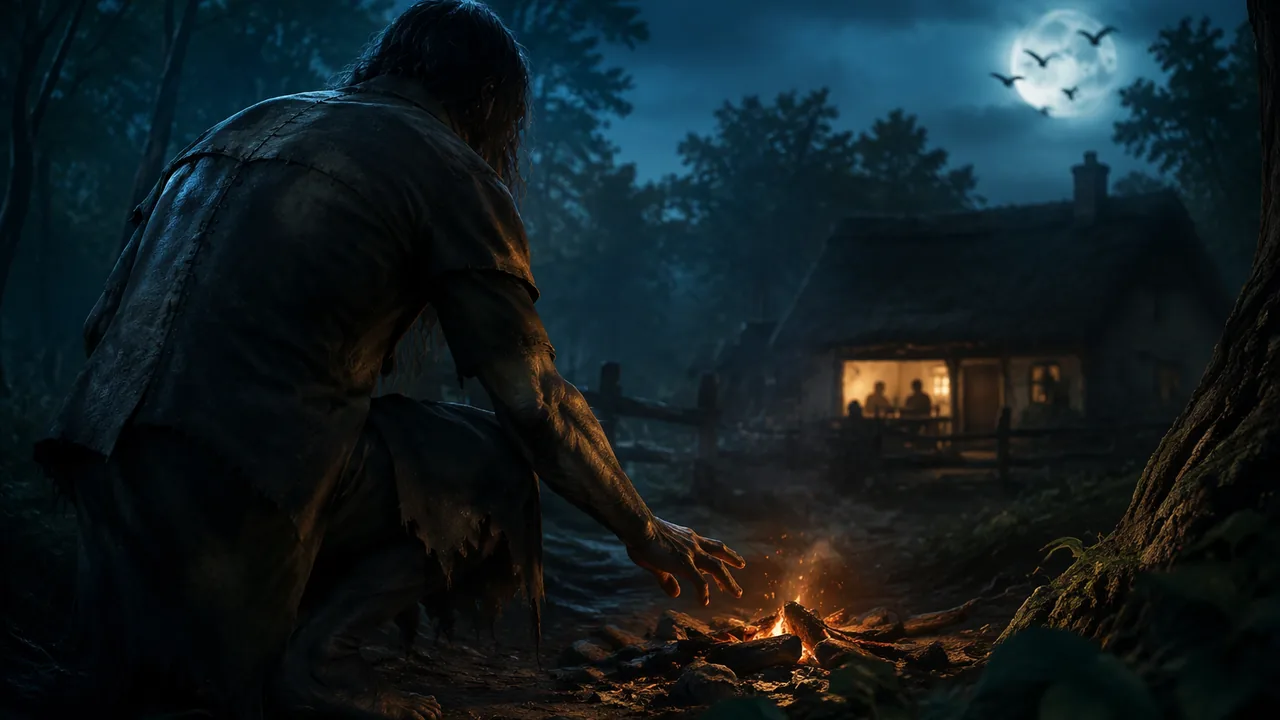
A voice without names. Chapter 3 is told by a being who, at first, has no words for anything. Shelley solves a hard problem of point of view by having him describe the world before he can name it. The moon is “a radiant form” rising from among the trees; birds are “the little winged animals who had often intercepted the light from my eyes.” This technique is called defamiliarization: ordinary things are described as if seen for the first time, so that the reader sees them freshly too. Its effect here is to put you inside a mind that is new, curious and harmless.
An experimenter, like his maker. The creature’s first discoveries mirror Victor’s. He finds a fire left by wandering beggars, thrusts his hand into the embers, and reasons like a scientist: “How strange, I thought, that the same cause should produce such opposite effects!” He learns that wet wood dries and burns, that a fan of branches revives the embers, and that the fire cooks nuts and roots but spoils berries. The creator who studied death in charnel houses has made a being who studies life by touching it.
The first human answers. Every human the creature meets in Chapter 3 answers him with terror. A shepherd shrieks and runs. In the village, “the children shrieked, and one of the women fainted,” and he escapes “grievously bruised by stones.” He takes refuge in a hovel, glad of shelter “from the inclemency of the season, and still more from the barbarity of man.” Notice who is called barbarous here, and by whom. The narrator whom others call a monster is, in this chapter, the one who describes human cruelty.
The cottagers. Through a chink in the wall he watches an old man play for a weeping girl and raise her with a smile, and he feels “a mixture of pain and pleasure, such as I had never before experienced.” The De Laceys become his school. As you close-read Chapter 3, mark the words the creature uses for things he cannot yet name, and mark each point where his feelings come from watching others rather than from his own needs. Then ask: whose account of the creature have you been reading until now, and what did it leave out?
📖 Before this lesson, read: Frankenstein; or, The Modern Prometheus, Volume 2, Chapters 1-4
The reading opens over the lesson; close it to come back to exactly where you were.
Formative check
Work through these before moving on. They are not graded — they tell you whether the standard below has landed yet.
Shelley lets the creature speak only after we have heard Victor’s account of William’s death and Justine’s trial. Before you read Chapter 3, what might that order do to a reader?
Why does the creature call the moon “a radiant form” rather than the moon?
In Chapter 3 the villagers attack the creature after he has harmed one of them.
Choose two passages from Chapter 3 in which the creature describes something he cannot yet name or understand. For each, quote his words, say what he is describing, and explain in three or four sentences how the description shapes your view of him. Then compare one of his descriptions with a name Victor used for the creature in Volume I.
How confident are you that you can explain how the creature’s point of view and word choices change the way the reader sees him?
Frankenstein; or, The Modern Prometheus, Volume 2, Chapters 1-4
Frankenstein (1818), Volume 2, Chapter 1 Bridge summary — not the primary text
This is a short recap written for this course, not Mary Shelley’s own words, so you can follow the story between close-reading lessons.
{summary}Frankenstein (1818), Volume 2, Chapter 2 Bridge summary — not the primary text
This is a short recap written for this course, not Mary Shelley’s own words, so you can follow the story between close-reading lessons.
{summary}Frankenstein (1818), Volume 2, Chapter 3
Source: Mary Shelley, Frankenstein; or, The Modern Prometheus (London: Lackington, Hughes, Harding, Mavor and Jones, 1818), Project Gutenberg eBook #41445 (gutenberg.org) · Public domain
“It is with considerable difficulty that I remember the original æra of my being: all the events of that period appear confused and indistinct. A strange multiplicity of sensations seized me, and I saw, felt, heard, and smelt, at the same time; and it was, indeed, a long time before I learned to distinguish between the operations of my various senses. By degrees, I remember, a stronger light pressed upon my nerves, so that I was obliged to shut my eyes. Darkness then came over me, and troubled me; but hardly had I felt this, when, by opening my eyes, as I now suppose, the light poured in upon me again. I walked, and, I believe, descended; but I presently found a great alteration in my sensations. Before, dark and opaque bodies had surrounded me, impervious to my touch or sight; but I now found that I could wander on at liberty, with no obstacles which I could not either surmount or avoid. The light became more and more oppressive to me; and, the heat wearying me as I walked, I sought a place where I could receive shade. This was the forest near Ingolstadt; and here I lay by the side of a brook resting from my fatigue, until I felt tormented by hunger and thirst. This roused me from my nearly dormant state, and I ate some berries which I found hanging on the trees, or lying on the ground. I slaked my thirst at the brook; and then lying down, was overcome by sleep.
“It was dark when I awoke; I felt cold also, and half-frightened as it were instinctively, finding myself so desolate. Before I had quitted your apartment, on a sensation of cold, I had covered myself with some clothes; but these were insufficient to secure me from the dews of night. I was a poor, helpless, miserable wretch; I knew, and could distinguish, nothing; but, feeling pain invade me on all sides, I sat down and wept.
“Soon a gentle light stole over the heavens, and gave me a sensation of pleasure. I started up, and beheld a radiant form rise from among the trees. I gazed with a kind of wonder. It moved slowly, but it enlightened my path; and I again went out in search of berries. I was still cold, when under one of the trees I found a huge cloak, with which I covered myself, and sat down upon the ground. No distinct ideas occupied my mind; all was confused. I felt light, and hunger, and thirst, and darkness; innumerable sounds rung in my ears, and on all sides various scents saluted me: the only object that I could distinguish was the bright moon, and I fixed my eyes on that with pleasure.
“Several changes of day and night passed, and the orb of night had greatly lessened when I began to distinguish my sensations from each other. I gradually saw plainly the clear stream that supplied me with drink, and the trees that shaded me with their foliage. I was delighted when I first discovered that a pleasant sound, which often saluted my ears, proceeded from the throats of the little winged animals who had often intercepted the light from my eyes. I began also to observe, with greater accuracy, the forms that surrounded me, and to perceive the boundaries of the radiant roof of light which canopied me. Sometimes I tried to imitate the pleasant songs of the birds, but was unable. Sometimes I wished to express my sensations in my own mode, but the uncouth and inarticulate sounds which broke from me frightened me into silence again.
“The moon had disappeared from the night, and again, with a lessened form, shewed itself, while I still remained in the forest. My sensations had, by this time, become distinct, and my mind received every day additional ideas. My eyes became accustomed to the light, and to perceive objects in their right forms; I distinguished the insect from the herb, and, by degrees, one herb from another. I found that the sparrow uttered none but harsh notes, whilst those of the blackbird and thrush were sweet and enticing.
“One day, when I was oppressed by cold, I found a fire which had been left by some wandering beggars, and was overcome with delight at the warmth I experienced from it. In my joy I thrust my hand into the live embers, but quickly drew it out again with a cry of pain. How strange, I thought, that the same cause should produce such opposite effects! I examined the materials of the fire, and to my joy found it to be composed of wood. I quickly collected some branches; but they were wet, and would not burn. I was pained at this, and sat still watching the operation of the fire. The wet wood which I had placed near the heat dried, and itself became inflamed. I reflected on this; and, by touching the various branches, I discovered the cause, and busied myself in collecting a great quantity of wood, that I might dry it, and have a plentiful supply of fire. When night came on, and brought sleep with it, I was in the greatest fear lest my fire should be extinguished. I covered it carefully with dry wood and leaves, and placed wet branches upon it; and then, spreading my cloak, I lay on the ground, and sunk into sleep.
“It was morning when I awoke, and my first care was to visit the fire. I uncovered it, and a gentle breeze quickly fanned it into a flame. I observed this also, and contrived a fan of branches, which roused the embers when they were nearly extinguished. When night came again, I found, with pleasure, that the fire gave light as well as heat; and that the discovery of this element was useful to me in my food; for I found some of the offals that the travellers had left had been roasted, and tasted much more savoury than the berries I gathered from the trees. I tried, therefore, to dress my food in the same manner, placing it on the live embers. I found that the berries were spoiled by this operation, and the nuts and roots much improved.
“Food, however, became scarce; and I often spent the whole day searching in vain for a few acorns to assuage the pangs of hunger. When I found this, I resolved to quit the place that I had hitherto inhabited, to seek for one where the few wants I experienced would be more easily satisfied. In this emigration, I exceedingly lamented the loss of the fire which I had obtained through accident, and knew not how to re-produce it. I gave several hours to the serious consideration of this difficulty; but I was obliged to relinquish all attempt to supply it; and, wrapping myself up in my cloak, I struck across the wood towards the setting sun. I passed three days in these rambles, and at length discovered the open country. A great fall of snow had taken place the night before, and the fields were of one uniform white; the appearance was disconsolate, and I found my feet chilled by the cold damp substance that covered the ground.
“It was about seven in the morning, and I longed to obtain food and shelter; at length I perceived a small hut, on a rising ground, which had doubtless been built for the convenience of some shepherd. This was a new sight to me; and I examined the structure with great curiosity. Finding the door open, I entered. An old man sat in it, near a fire, over which he was preparing his breakfast. He turned on hearing a noise; and, perceiving me, shrieked loudly, and, quitting the hut, ran across the fields with a speed of which his debilitated form hardly appeared capable. His appearance, different from any I had ever before seen, and his flight, somewhat surprised me. But I was enchanted by the appearance of the hut: here the snow and rain could not penetrate; the ground was dry; and it presented to me then as exquisite and divine a retreat as Pandæmonium appeared to the dæmons of hell after their sufferings in the lake of fire. I greedily devoured the remnants of the shepherd’s breakfast, which consisted of bread, cheese, milk, and wine; the latter, however, I did not like. Then overcome by fatigue, I lay down among some straw, and fell asleep.
“It was noon when I awoke; and, allured by the warmth of the sun, which shone brightly on the white ground, I determined to recommence my travels; and, depositing the remains of the peasant’s breakfast in a wallet I found, I proceeded across the fields for several hours, until at sunset I arrived at a village. How miraculous did this appear! the huts, the neater cottages, and stately houses, engaged my admiration by turns. The vegetables in the gardens, the milk and cheese that I saw placed at the windows of some of the cottages, allured my appetite. One of the best of these I entered; but I had hardly placed my foot within the door, before the children shrieked, and one of the women fainted. The whole village was roused; some fled, some attacked me, until, grievously bruised by stones and many other kinds of missile weapons, I escaped to the open country, and fearfully took refuge in a low hovel, quite bare, and making a wretched appearance after the palaces I had beheld in the village. This hovel, however, joined a cottage of a neat and pleasant appearance; but, after my late dearly-bought experience, I dared not enter it. My place of refuge was constructed of wood, but so low, that I could with difficulty sit upright in it. No wood, however, was placed on the earth, which formed the floor, but it was dry; and although the wind entered it by innumerable chinks, I found it an agreeable asylum from the snow and rain.
“Here then I retreated, and lay down, happy to have found a shelter, however miserable, from the inclemency of the season, and still more from the barbarity of man.
“As soon as morning dawned, I crept from my kennel, that I might view the adjacent cottage, and discover if I could remain in the habitation I had found. It was situated against the back of the cottage, and surrounded on the sides which were exposed by a pig-stye and a clear pool of water. One part was open, and by that I had crept in; but now I covered every crevice by which I might be perceived with stones and wood, yet in such a manner that I might move them on occasion to pass out: all the light I enjoyed came through the stye, and that was sufficient for me.
“Having thus arranged my dwelling, and carpeted it with clean straw, I retired; for I saw the figure of a man at a distance, and I remembered too well my treatment the night before, to trust myself in his power. I had first, however, provided for my sustenance for that day, by a loaf of coarse bread, which I purloined, and a cup with which I could drink, more conveniently than from my hand, of the pure water which flowed by my retreat. The floor was a little raised, so that it was kept perfectly dry, and by its vicinity to the chimney of the cottage it was tolerably warm.
“Being thus provided, I resolved to reside in this hovel, until something should occur which might alter my determination. It was indeed a paradise, compared to the bleak forest, my former residence, the rain-dropping branches, and dank earth. I ate my breakfast with pleasure, and was about to remove a plank to procure myself a little water, when I heard a step, and, looking through a small chink, I beheld a young creature, with a pail on her head, passing before my hovel. The girl was young and of gentle demeanour, unlike what I have since found cottagers and farm-house servants to be. Yet she was meanly dressed, a coarse blue petticoat and a linen jacket being her only garb; her fair hair was plaited, but not adorned; she looked patient, yet sad. I lost sight of her; and in about a quarter of an hour she returned, bearing the pail, which was now partly filled with milk. As she walked along, seemingly incommoded by the burden, a young man met her, whose countenance expressed a deeper despondence. Uttering a few sounds with an air of melancholy, he took the pail from her head, and bore it to the cottage himself. She followed, and they disappeared. Presently I saw the young man again, with some tools in his hand, cross the field behind the cottage; and the girl was also busied, sometimes in the house, and sometimes in the yard.
“On examining my dwelling, I found that one of the windows of the cottage had formerly occupied a part of it, but the panes had been filled up with wood. In one of these was a small and almost imperceptible chink, through which the eye could just penetrate. Through this crevice, a small room was visible, white-washed and clean, but very bare of furniture. In one corner, near a small fire, sat an old man, leaning his head on his hands in a disconsolate attitude. The young girl was occupied in arranging the cottage; but presently she took something out of a drawer, which employed her hands, and she sat down beside the old man, who, taking up an instrument, began to play, and to produce sounds, sweeter than the voice of the thrush or the nightingale. It was a lovely sight, even to me, poor wretch! who had never beheld aught beautiful before. The silver hair and benevolent countenance of the aged cottager, won my reverence; while the gentle manners of the girl enticed my love. He played a sweet mournful air, which I perceived drew tears from the eyes of his amiable companion, of which the old man took no notice, until she sobbed audibly; he then pronounced a few sounds, and the fair creature, leaving her work, knelt at his feet. He raised her, and smiled with such kindness and affection, that I felt sensations of a peculiar and over-powering nature: they were a mixture of pain and pleasure, such as I had never before experienced, either from hunger or cold, warmth or food; and I withdrew from the window, unable to bear these emotions.
“Soon after this the young man returned, bearing on his shoulders a load of wood. The girl met him at the door, helped to relieve him of his burden, and, taking some of the fuel into the cottage, placed it on the fire; then she and the youth went apart into a nook of the cottage, and he shewed her a large loaf and a piece of cheese. She seemed pleased; and went into the garden for some roots and plants, which she placed in water, and then upon the fire. She afterwards continued her work, whilst the young man went into the garden, and appeared busily employed in digging and pulling up roots. After he had been employed thus about an hour, the young woman joined him, and they entered the cottage together.
“The old man had, in the mean time, been pensive; but, on the appearance of his companions, he assumed a more cheerful air, and they sat down to eat. The meal was quickly dispatched. The young woman was again occupied in arranging the cottage; the old man walked before the cottage in the sun for a few minutes, leaning on the arm of the youth. Nothing could exceed in beauty the contrast between these two excellent creatures. One was old, with silver hairs and a countenance beaming with benevolence and love: the younger was slight and graceful in his figure, and his features were moulded with the finest symmetry; yet his eyes and attitude expressed the utmost sadness and despondency. The old man returned to the cottage; and the youth, with tools different from those he had used in the morning, directed his steps across the fields.
“Night quickly shut in; but, to my extreme wonder, I found that the cottagers had a means of prolonging light, by the use of tapers, and was delighted to find, that the setting of the sun did not put an end to the pleasure I experienced in watching my human neighbours. In the evening, the young girl and her companion were employed in various occupations which I did not understand; and the old man again took up the instrument, which produced the divine sounds that had enchanted me in the morning. So soon as he had finished, the youth began, not to play, but to utter sounds that were monotonous, and neither resembling the harmony of the old man’s instrument or the songs of the birds; I since found that he read aloud, but at that time I knew nothing of the science of words or letters.
“The family, after having been thus occupied for a short time, extinguished their lights, and retired, as I conjectured, to rest.”
Frankenstein (1818), Volume 2, Chapter 4 Bridge summary — not the primary text
This is a short recap written for this course, not Mary Shelley’s own words, so you can follow the story between close-reading lessons.
{summary}