analyze Victor’s decision to destroy the second creature, weigh the reasons he gives, and explain how the broken promise drives the plot toward Clerval’s death.
Instruction
At the end of Volume II Victor promised to make a companion for the creature. Volume III, Chapters 1 through 4 show what that promise costs. Victor delays, travels to Britain with Clerval to gather what he needs, and finally sets up a laboratory in a hut on one of the remotest of the Orkney Islands. Chapter 3 is a turning point of the book: the moment the creator decides, for the second time, what kind of maker he will be.
Working “in cold blood.” Victor tells Walton that his first creation was driven by “a kind of enthusiastic frenzy,” but that this time he works “in cold blood.” That difference matters in Chapter 3. Alone one evening, he thinks for the first time about the being he is making as someone with a will of her own: “she might become ten thousand times more malignant than her mate,” and she “might refuse to comply with a compact made before her creation.” The creature swore to leave Europe; she has sworn nothing. Victor sees, in other words, the problem he never considered the first time: a made being is not bound by what its maker intended.
The argument from the future. Victor then widens the frame from two beings to all humanity. If the pair have children, “a race of devils would be propagated upon the earth.” He asks, “Had I a right, for my own benefit, to inflict this curse upon everlasting generations?” and imagines future ages cursing him as one “whose selfishness had not hesitated to buy its own peace at the price perhaps of the existence of the whole human race.” This is a serious moral argument: it weighs a promise to one being against possible harm to millions. Notice, though, how much of it is speculation, built on might and would.
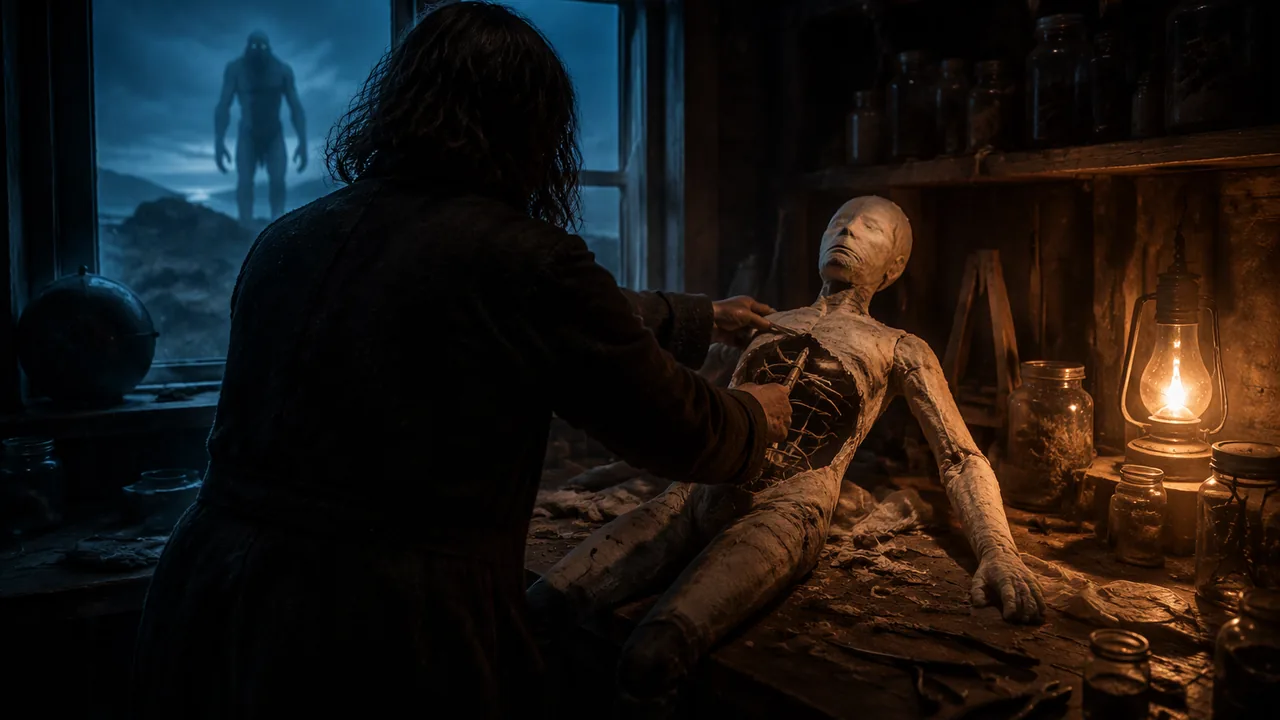
The act. Looking up, Victor sees the creature at the window, “a ghastly grin” on his lips, and, “trembling with passion,” tears the half-made female to pieces while her intended mate watches. Decide whether the decision and the act are the same thing. The reasoning may be sound; the destruction happens in a rage, in front of the one being it will hurt most, with no word of explanation.
Master and slave. When the creature confronts him, the language of power reverses: “You are my creator, but I am your master;—obey!” Victor answers that threats only “confirm me in a resolution of not creating you a companion in vice.” The creature’s parting words, “I shall be with you on your wedding-night,” are a threat whose meaning Victor settles at once: he assumes it means his own death. Notice that he never considers any other meaning.
Structure and suspense. Shelley follows this scene with a calm night at sea, a storm, and a landing on the Irish coast, where a hostile crowd tells Victor that “it is the custom of the Irish to hate villains.” He is being accused of a murder before he knows who has died, and the chapter breaks off with Victor refusing to go on: “I must pause here.” As you close-read Chapter 3, list every reason Victor gives for breaking his promise, rank them from strongest to weakest, and decide whether he was right to break it, whatever came of it.
📖 Before this lesson, read: Frankenstein; or, The Modern Prometheus, Volume 3, Chapters 1-4
The reading opens over the lesson; close it to come back to exactly where you were.
Formative check
Work through these before moving on. They are not graded — they tell you whether the standard below has landed yet.
The creature leaves with the words “I shall be with you on your wedding-night.” Victor is sure he knows what they mean. Before you read on, what could they mean?
Which reason does Victor give in Chapter 3 for destroying the female creature?
Victor destroys the half-finished female while the creature is far away in Switzerland.
Was Victor right to break his promise? In a paragraph of six to eight sentences, state your judgment, quote two of Victor’s reasons from Chapter 3, and weigh them against the promise he made at the end of Volume II. Address whether the way he destroys the female matters, and not only the fact that he does.
How confident are you that you can weigh Victor’s reasons for breaking his promise and explain how that choice drives the plot?
Frankenstein; or, The Modern Prometheus, Volume 3, Chapters 1-4
Frankenstein (1818), Volume 3, Chapter 1 Bridge summary — not the primary text
This is a short recap written for this course, not Mary Shelley’s own words, so you can follow the story between close-reading lessons.
{summary}Frankenstein (1818), Volume 3, Chapter 2 Bridge summary — not the primary text
This is a short recap written for this course, not Mary Shelley’s own words, so you can follow the story between close-reading lessons.
{summary}Frankenstein (1818), Volume 3, Chapter 3
Source: Mary Shelley, Frankenstein; or, The Modern Prometheus (London: Lackington, Hughes, Harding, Mavor and Jones, 1818), Project Gutenberg eBook #41445 (gutenberg.org) · Public domain
I sat one evening in my laboratory; the sun had set, and the moon was just rising from the sea; I had not sufficient light for my employment, and I remained idle, in a pause of consideration of whether I should leave my labour for the night, or hasten its conclusion by an unremitting attention to it. As I sat, a train of reflection occurred to me, which led me to consider the effects of what I was now doing. Three years before I was engaged in the same manner, and had created a fiend whose unparalleled barbarity had desolated my heart, and filled it for ever with the bitterest remorse. I was now about to form another being, of whose dispositions I was alike ignorant; she might become ten thousand times more malignant than her mate, and delight, for its own sake, in murder and wretchedness. He had sworn to quit the neighbourhood of man, and hide himself in deserts; but she had not; and she, who in all probability was to become a thinking and reasoning animal, might refuse to comply with a compact made before her creation. They might even hate each other; the creature who already lived loathed his own deformity, and might he not conceive a greater abhorrence for it when it came before his eyes in the female form? She also might turn with disgust from him to the superior beauty of man; she might quit him, and he be again alone, exasperated by the fresh provocation of being deserted by one of his own species.
Even if they were to leave Europe, and inhabit the deserts of the new world, yet one of the first results of those sympathies for which the dæmon thirsted would be children, and a race of devils would be propagated upon the earth, who might make the very existence of the species of man a condition precarious and full of terror. Had I a right, for my own benefit, to inflict this curse upon everlasting generations? I had before been moved by the sophisms of the being I had created; I had been struck senseless by his fiendish threats: but now, for the first time, the wickedness of my promise burst upon me; I shuddered to think that future ages might curse me as their pest, whose selfishness had not hesitated to buy its own peace at the price perhaps of the existence of the whole human race.
I trembled, and my heart failed within me; when, on looking up, I saw, by the light of the moon, the dæmon at the casement. A ghastly grin wrinkled his lips as he gazed on me, where I sat fulfilling the task which he had allotted to me. Yes, he had followed me in my travels; he had loitered in forests, hid himself in caves, or taken refuge in wide and desert heaths; and he now came to mark my progress, and claim the fulfilment of my promise.
As I looked on him, his countenance expressed the utmost extent of malice and treachery. I thought with a sensation of madness on my promise of creating another like to him, and, trembling with passion, tore to pieces the thing on which I was engaged. The wretch saw me destroy the creature on whose future existence he depended for happiness, and, with a howl of devilish despair and revenge, withdrew.
I left the room, and, locking the door, made a solemn vow in my own heart never to resume my labours; and then, with trembling steps, I sought my own apartment. I was alone; none were near me to dissipate the gloom, and relieve me from the sickening oppression of the most terrible reveries.
Several hours past, and I remained near my window gazing on the sea; it was almost motionless, for the winds were hushed, and all nature reposed under the eye of the quiet moon. A few fishing vessels alone specked the water, and now and then the gentle breeze wafted the sound of voices, as the fishermen called to one another. I felt the silence, although I was hardly conscious of its extreme profundity until my ear was suddenly arrested by the paddling of oars near the shore, and a person landed close to my house.
In a few minutes after, I heard the creaking of my door, as if some one endeavoured to open it softly. I trembled from head to foot; I felt a presentiment of who it was, and wished to rouse one of the peasants who dwelt in a cottage not far from mine; but I was overcome by the sensation of helplessness, so often felt in frightful dreams, when you in vain endeavour to fly from an impending danger, and was rooted to the spot.
Presently I heard the sound of footsteps along the passage; the door opened, and the wretch whom I dreaded appeared. Shutting the door, he approached me, and said, in a smothered voice—
“You have destroyed the work which you began; what is it that you intend? Do you dare to break your promise? I have endured toil and misery: I left Switzerland with you; I crept along the shores of the Rhine, among its willow islands, and over the summits of its hills. I have dwelt many months in the heaths of England, and among the deserts of Scotland. I have endured incalculable fatigue, and cold, and hunger; do you dare destroy my hopes?”
“Begone! I do break my promise; never will I create another like yourself, equal in deformity and wickedness.”
“Slave, I before reasoned with you, but you have proved yourself unworthy of my condescension. Remember that I have power; you believe yourself miserable, but I can make you so wretched that the light of day will be hateful to you. You are my creator, but I am your master;—obey!”
“The hour of my weakness is past, and the period of your power is arrived. Your threats cannot move me to do an act of wickedness; but they confirm me in a resolution of not creating you a companion in vice. Shall I, in cool blood, set loose upon the earth a dæmon, whose delight is in death and wretchedness. Begone! I am firm, and your words will only exasperate my rage.”
The monster saw my determination in my face, and gnashed his teeth in the impotence of anger. “Shall each man,” cried he, “find a wife for his bosom, and each beast have his mate, and I be alone? I had feelings of affection, and they were requited by detestation and scorn. Man, you may hate; but beware! Your hours will pass in dread and misery, and soon the bolt will fall which must ravish from you your happiness for ever. Are you to be happy, while I grovel in the intensity of my wretchedness? You can blast my other passions; but revenge remains—revenge, henceforth dearer than light or food! I may die; but first you, my tyrant and tormentor, shall curse the sun that gazes on your misery. Beware; for I am fearless, and therefore powerful. I will watch with the wiliness of a snake, that I may sting with its venom. Man, you shall repent of the injuries you inflict.”
“Devil, cease; and do not poison the air with these sounds of malice. I have declared my resolution to you, and I am no coward to bend beneath words. Leave me; I am inexorable.”
“It is well. I go; but remember, I shall be with you on your wedding-night.”
I started forward, and exclaimed, “Villain! before you sign my death-warrant, be sure that you are yourself safe.”
I would have seized him; but he eluded me, and quitted the house with precipitation: in a few moments I saw him in his boat, which shot across the waters with an arrowy swiftness, and was soon lost amidst the waves.
All was again silent; but his words rung in my ears. I burned with rage to pursue the murderer of my peace, and precipitate him into the ocean. I walked up and down my room hastily and perturbed, while my imagination conjured up a thousand images to torment and sting me. Why had I not followed him, and closed with him in mortal strife? But I had suffered him to depart, and he had directed his course towards the main land. I shuddered to think who might be the next victim sacrificed to his insatiate revenge. And then I thought again of his words—“I will be with you on your wedding-night.” That then was the period fixed for the fulfilment of my destiny. In that hour I should die, and at once satisfy and extinguish his malice. The prospect did not move me to fear; yet when I thought of my beloved Elizabeth,—of her tears and endless sorrow, when she should find her lover so barbarously snatched from her,—tears, the first I had shed for many months, streamed from my eyes, and I resolved not to fall before my enemy without a bitter struggle.
The night passed away, and the sun rose from the ocean; my feelings became calmer, if it may be called calmness, when the violence of rage sinks into the depths of despair. I left the house, the horrid scene of the last night’s contention, and walked on the beach of the sea, which I almost regarded as an insuperable barrier between me and my fellow-creatures; nay, a wish that such should prove the fact stole across me. I desired that I might pass my life on that barren rock, wearily it is true, but uninterrupted by any sudden shock of misery. If I returned, it was to be sacrificed, or to see those whom I most loved die under the grasp of a dæmon whom I had myself created.
I walked about the isle like a restless spectre, separated from all it loved, and miserable in the separation. When it became noon, and the sun rose higher, I lay down on the grass, and was overpowered by a deep sleep. I had been awake the whole of the preceding night, my nerves were agitated, and my eyes inflamed by watching and misery. The sleep into which I now sunk refreshed me; and when I awoke, I again felt as if I belonged to a race of human beings like myself, and I began to reflect upon what had passed with greater composure; yet still the words of the fiend rung in my ears like a death-knell, they appeared like a dream, yet distinct and oppressive as a reality.
The sun had far descended, and I still sat on the shore, satisfying my appetite, which had become ravenous, with an oaten cake, when I saw a fishing-boat land close to me, and one of the men brought me a packet; it contained letters from Geneva, and one from Clerval, entreating me to join him. He said that nearly a year had elapsed since we had quitted Switzerland, and France was yet unvisited. He entreated me, therefore, to leave my solitary isle, and meet him at Perth, in a week from that time, when we might arrange the plan of our future proceedings. This letter in a degree recalled me to life, and I determined to quit my island at the expiration of two days.
Yet, before I departed, there was a task to perform, on which I shuddered to reflect: I must pack my chemical instruments; and for that purpose I must enter the room which had been the scene of my odious work, and I must handle those utensils, the sight of which was sickening to me. The next morning, at day-break, I summoned sufficient courage, and unlocked the door of my laboratory. The remains of the half-finished creature, whom I had destroyed, lay scattered on the floor, and I almost felt as if I had mangled the living flesh of a human being. I paused to collect myself, and then entered the chamber. With trembling hand I conveyed the instruments out of the room; but I reflected that I ought not to leave the relics of my work to excite the horror and suspicion of the peasants, and I accordingly put them into a basket, with a great quantity of stones, and laying them up, determined to throw them into the sea that very night; and in the mean time I sat upon the beach, employed in cleaning and arranging my chemical apparatus.
Nothing could be more complete than the alteration that had taken place in my feelings since the night of the appearance of the dæmon. I had before regarded my promise with a gloomy despair, as a thing that, with whatever consequences, must be fulfilled; but I now felt as if a film had been taken from before my eyes, and that I, for the first time, saw clearly. The idea of renewing my labours did not for one instant occur to me; the threat I had heard weighed on my thoughts, but I did not reflect that a voluntary act of mine could avert it. I had resolved in my own mind, that to create another like the fiend I had first made would be an act of the basest and most atrocious selfishness; and I banished from my mind every thought that could lead to a different conclusion.
Between two and three in the morning the moon rose; and I then, putting my basket aboard a little skiff, sailed out about four miles from the shore. The scene was perfectly solitary: a few boats were returning towards land, but I sailed away from them. I felt as if I was about the commission of a dreadful crime, and avoided with shuddering anxiety any encounter with my fellow-creatures. At one time the moon, which had before been clear, was suddenly overspread by a thick cloud, and I took advantage of the moment of darkness, and cast my basket into the sea; I listened to the gurgling sound as it sunk, and then sailed away from the spot. The sky became clouded; but the air was pure, although chilled by the north-east breeze that was then rising. But it refreshed me, and filled me with such agreeable sensations, that I resolved to prolong my stay on the water, and fixing the rudder in a direct position, stretched myself at the bottom of the boat. Clouds hid the moon, every thing was obscure, and I heard only the sound of the boat, as its keel cut through the waves; the murmur lulled me, and in a short time I slept soundly.
I do not know how long I remained in this situation, but when I awoke I found that the sun had already mounted considerably. The wind was high, and the waves continually threatened the safety of my little skiff. I found that the wind was north-east, and must have driven me far from the coast from which I had embarked. I endeavoured to change my course, but quickly found that if I again made the attempt the boat would be instantly filled with water. Thus situated, my only resource was to drive before the wind. I confess that I felt a few sensations of terror. I had no compass with me, and was so little acquainted with the geography of this part of the world that the sun was of little benefit to me. I might be driven into the wide Atlantic, and feel all the tortures of starvation, or be swallowed up in the immeasurable waters that roared and buffeted around me. I had already been out many hours, and felt the torment of a burning thirst, a prelude to my other sufferings. I looked on the heavens, which were covered by clouds that flew before the wind only to be replaced by others: I looked upon the sea, it was to be my grave. “Fiend,” I exclaimed, “your task is already fulfilled!” I thought of Elizabeth, of my father, and of Clerval; and sunk into a reverie, so despairing and frightful, that even now, when the scene is on the point of closing before me for ever, I shudder to reflect on it.
Some hours passed thus; but by degrees, as the sun declined towards the horizon, the wind died away into a gentle breeze, and the sea became free from breakers. But these gave place to a heavy swell; I felt sick, and hardly able to hold the rudder, when suddenly I saw a line of high land towards the south.
Almost spent, as I was, by fatigue, and the dreadful suspense I endured for several hours, this sudden certainty of life rushed like a flood of warm joy to my heart, and tears gushed from my eyes.
How mutable are our feelings, and how strange is that clinging love we have of life even in the excess of misery! I constructed another sail with a part of my dress, and eagerly steered my course towards the land. It had a wild and rocky appearance; but as I approached nearer, I easily perceived the traces of cultivation. I saw vessels near the shore, and found myself suddenly transported back to the neighbourhood of civilized man. I eagerly traced the windings of the land, and hailed a steeple which I at length saw issuing from behind a small promontory. As I was in a state of extreme debility, I resolved to sail directly towards the town as a place where I could most easily procure nourishment. Fortunately I had money with me. As I turned the promontory, I perceived a small neat town and a good harbour, which I entered, my heart bounding with joy at my unexpected escape.
As I was occupied in fixing the boat and arranging the sails, several people crowded towards the spot. They seemed very much surprised at my appearance; but, instead of offering me any assistance, whispered together with gestures that at any other time might have produced in me a slight sensation of alarm. As it was, I merely remarked that they spoke English; and I therefore addressed them in that language: “My good friends,” said I, “will you be so kind as to tell me the name of this town, and inform me where I am?”
“You will know that soon enough,” replied a man with a gruff voice. “May be you are come to a place that will not prove much to your taste; but you will not be consulted as to your quarters, I promise you.”
I was exceedingly surprised on receiving so rude an answer from a stranger; and I was also disconcerted on perceiving the frowning and angry countenances of his companions. “Why do you answer me so roughly?” I replied: “surely it is not the custom of Englishmen to receive strangers so inhospitably.”
“I do not know,” said the man, “what the custom of the English may be; but it is the custom of the Irish to hate villains.”
While this strange dialogue continued, I perceived the crowd rapidly increase. Their faces expressed a mixture of curiosity and anger, which annoyed, and in some degree alarmed me. I inquired the way to the inn; but no one replied. I then moved forward, and a murmuring sound arose from the crowd as they followed and surrounded me; when an ill-looking man approaching, tapped me on the shoulder, and said, “Come, Sir, you must follow me to Mr. Kirwin’s, to give an account of yourself.”
“Who is Mr. Kirwin? Why am I to give an account of myself? Is not this a free country?”
“Aye, Sir, free enough for honest folks. Mr. Kirwin is a magistrate; and you are to give an account of the death of a gentleman who was found murdered here last night.”
This answer startled me; but I presently recovered myself. I was innocent; that could easily be proved: accordingly I followed my conductor in silence, and was led to one of the best houses in the town. I was ready to sink from fatigue and hunger; but, being surrounded by a crowd, I thought it politic to rouse all my strength, that no physical debility might be construed into apprehension or conscious guilt. Little did I then expect the calamity that was in a few moments to overwhelm me, and extinguish in horror and despair all fear of ignominy or death.
I must pause here; for it requires all my fortitude to recall the memory of the frightful events which I am about to relate, in proper detail, to my recollection.
Frankenstein (1818), Volume 3, Chapter 4 Bridge summary — not the primary text
This is a short recap written for this course, not Mary Shelley’s own words, so you can follow the story between close-reading lessons.
{summary}