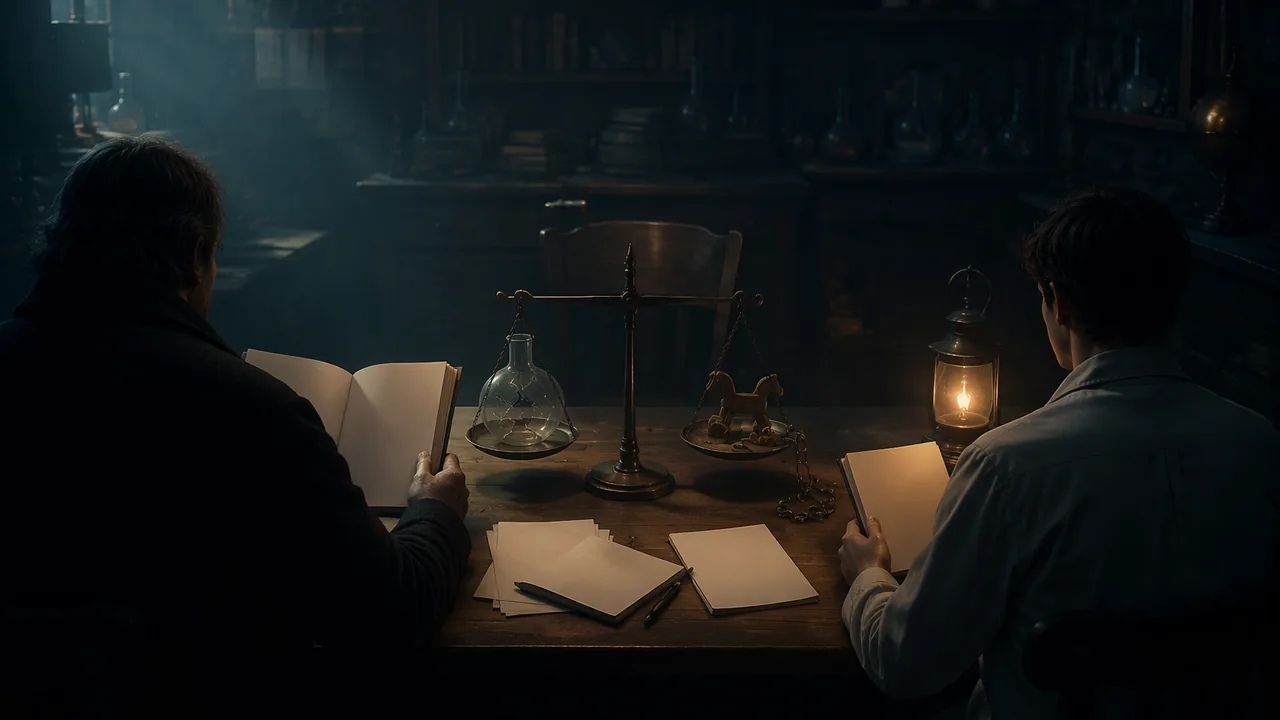
respond thoughtfully to diverse perspectives on who bears responsibility for the deaths so far in Frankenstein, using the creature’s education and plea as evidence, summarize points of agreement and disagreement, and qualify my own view in light of the evidence.
Instruction
By the end of Volume II two people are dead. William has been strangled, and Justine has been executed for it. The creature has told his story, admitted the killing, and demanded a companion, with the warning that if he cannot inspire love he “will cause fear.” Who is responsible so far? The novel offers evidence for several answers, and this structured disagreement asks you to argue one while taking the others seriously.
The creature’s education as evidence. Chapters 5 through 9 are the creature’s case. He learns speech and letters by listening to Felix teach Safie; he reads Paradise Lost, Plutarch’s Lives and the Sorrows of Werter; and in Victor’s journal, found in the clothes he took from the laboratory, he reads the story of his own making, told “in language which painted your own horrors.” He approaches the blind De Lacey and is welcomed, until Felix “dashed me to the ground, and struck me violently with a stick.” His conclusion, spoken to Victor, is the sentence this lesson turns on: “I am malicious because I am miserable.”
Position 1: Victor. He creates a living being and abandons it within hours, fleeing in horror. He never teaches, names or protects it. When he could have tried to prevent Justine’s execution by telling the truth, he stays silent. On the glacier he greets his creation with curses, and he grants the companion only after first refusing it. Every death so far follows from his choices.
Position 2: the creature. Whatever his suffering, he chooses to kill. He strangles a child because the boy’s father is a Frankenstein, then plants the portrait on a passing young woman, knowing what the law will do to her. He tells Victor that over William’s body his heart “swelled with exultation and hellish triumph.” Suffering can explain violence without excusing it.
Position 3: society. Everyone the creature meets — villagers, the De Lacey family he has secretly helped, the companion of a girl he rescues from drowning — responds to his appearance with violence or terror. Godwin argued that human dispositions are “the offspring of circumstances.” The creature learns hatred from how he is treated.
Most strong answers combine positions, and 9-10.SL.1.C asks you to do exactly that kind of thinking: respond to diverse perspectives, summarize where people agree and disagree, and qualify or justify your view in light of the evidence. Qualifying is not weakness. “Victor bears primary responsibility, but the creature’s murder of William is a free choice the novel does not excuse” is a stronger claim than either half alone.
Using nonfiction (9-10.RI.1.D, 9-10.RI.2.A). The two short readings are not about the novel, but they state positions Shelley knew intimately — her father’s and her mother’s. Determine each text’s central idea, and analyze how the author develops it. Then use them as lenses: how would Godwin judge Victor? How would Wollstonecraft, who blamed “neglected education” for human misery, judge a creator who left his creature to educate himself through a chink in a wall?
Information in diverse formats (9-10.SL.1.C). Before recording, compile a simple chart: each death so far, who caused it directly, what choices led to it, and which narrator reports it. The novel is not over; keep the chart, because you will extend it when you finish the book in Lesson 2.9.
The disagreement. Record 90 seconds: your position, two quotations (one from the narrator you trust least), and one qualification. Reply to two classmates who hold different positions. Each reply must begin by summarizing their argument and naming what you agree with, before stating where you differ and why.
📖 Before this lesson, read: Frankenstein; or, The Modern Prometheus, Volume 2, Chapters 5-9
The reading opens over the lesson; close it to come back to exactly where you were.
Reading: Seminar packet: three positions, three outside voices, and the chart
Mary Shelley, Frankenstein; or, The Modern Prometheus (London: Lackington, Hughes, Harding, Mavor and Jones, 1818, three volumes), Project Gutenberg eBook 41445 (text from a photo-reprint of the 1818 edition), retrieved 2026-09-26; Mary Wollstonecraft, A Vindication of the Rights of Woman (1792), Project Gutenberg eBook 3420 (https://www.gutenberg.org/ebooks/3420); William Godwin, Enquiry Concerning Political Justice, 4th ed. (London: J. Watson, 1843), vol. 1, Internet Archive https://archive.org/stream/enquiryconcernin01godwuoft/enquiryconcernin01godwuoft_djvu.txt; John Milton, Paradise Lost (1667), Project Gutenberg eBook 26 (https://www.gutenberg.org/ebooks/26), cross-checked against the 1851 Baker and Scribner edition https://archive.org/stream/paradiselost00milt/paradiselost00milt_djvu.txt · SLS original framing, tables, models and keys; quoted passages are public domain (Shelley, 1818; Wollstonecraft, 1792; Milton, 1667)
Every claim you make must point to a passage here or in the chapters you have read (the Letters through Volume II).
What is hosted. The evidence for each of the three positions in the lesson (Victor, the creature, society), three attributed outside positions, a table of the deaths so far with where each is reported, the protocol, question stems and a model contribution. Sources: Mary Shelley, Frankenstein; or, The Modern Prometheus (London: Lackington, Hughes, Harding, Mavor and Jones, 1818, three volumes), Project Gutenberg eBook 41445 (text from a photo-reprint of the 1818 edition), retrieved 2026-09-26; Mary Wollstonecraft, A Vindication of the Rights of Woman (1792), Introduction, Project Gutenberg eBook 3420; William Godwin, Enquiry Concerning Political Justice, 4th edition (London: J. Watson, 1843), vol. 1, Internet Archive item enquiryconcernin01godwuoft; John Milton, Paradise Lost (1667), Books III and X, Project Gutenberg eBook 26 (lines counted from the start of each book in that text). All retrieved 2026-09-26.
Edition and references. Every passage from Frankenstein is from the 1818 first edition, in three volumes, and keeps its spelling and punctuation (for example “dæmon” and “Werter”). Passages are located by volume and chapter of that edition. The 1818 chapters restart in each volume (Vol. I has Chapters I–VII, Vol. II has I–IX, Vol. III has I–VII), so a Vol. II, Ch. II passage is not the same as Ch. II of a modern one-volume edition. Later editions (1831 and after) renumber chapters 1–24 and change some wording; if your copy differs, use the volume and chapter here to find the passage.
1. Position 1: Victor. He abandons what he made and keeps silent at Justine’s trial
The abandonment (Vol. I, Ch. IV)
I beheld the wretch—the miserable monster whom I had created. He held up the curtain of the bed; and his eyes, if eyes they may be called, were fixed on me. His jaws opened, and he muttered some inarticulate sounds, while a grin wrinkled his cheeks. He might have spoken, but I did not hear; one hand was stretched out, seemingly to detain me, but I escaped, and rushed down stairs.
Justine’s trial, Victor as narrator (Vol. I, Ch. VII)
During the whole of this wretched mockery of justice, I suffered living torture. It was to be decided, whether the result of my curiosity and lawless devices would cause the death of two of my fellow-beings: one a smiling babe, full of innocence and joy; the other far more dreadfully murdered, with every aggravation of infamy that could make the murder memorable in horror. Justine also was a girl of merit, and possessed qualities which promised to render her life happy: now all was to be obliterated in an ignominious grave; and I the cause! A thousand times rather would I have confessed myself guilty of the crime ascribed to Justine; but I was absent when it was committed, and such a declaration would have been considered as the ravings of a madman, and would not have exculpated her who suffered through me.
2. Position 2: the creature. He chooses to kill, and says so
William’s death, told by the creature (Vol. II, Ch. VIII)
Frankenstein! you belong then to my enemy—to him towards whom I have sworn eternal revenge; you shall be my first victim.’ “The child still struggled, and loaded me with epithets which carried despair to my heart: I grasped his throat to silence him, and in a moment he lay dead at my feet. “I gazed on my victim, and my heart swelled with exultation and hellish triumph: clapping my hands, I exclaimed, ‘I, too, can create desolation; my enemy is not impregnable; this death will carry despair to him, and a thousand other miseries shall torment and destroy him.
The creature frames Justine (Vol. II, Ch. VIII)
Here, I thought, is one of those whose smiles are bestowed on all but me; she shall not escape: thanks to the lessons of Felix, and the sanguinary laws of man, I have learned how to work mischief. I approached her unperceived, and placed the portrait securely in one of the folds of her dress.
The creature to Victor, after Victor first refuses him a companion (Vol. II, Ch. IX)
I will revenge my injuries: if I cannot inspire love, I will cause fear; and chiefly towards you my arch-enemy, because my creator, do I swear inextinguishable hatred.
3. Position 3: society. He is met with violence before he has done anything
The creature’s claim (Vol. II, Ch. II)
I was benevolent and good; misery made me a fiend. Make me happy, and I shall again be virtuous.
The creature at the cottage (Vol. II, Ch. VII)
Felix darted forward, and with supernatural force tore me from his father, to whose knees I clung: in a transport of fury, he dashed me to the ground, and struck me violently with a stick. I could have torn him limb from limb, as the lion rends the antelope. But my heart sunk within me as with bitter sickness, and I refrained.
The creature after saving a drowning girl (Vol. II, Ch. VIII)
This was then the reward of my benevolence! I had saved a human being from destruction, and, as a recompense, I now writhed under the miserable pain of a wound, which shattered the flesh and bone.
4. Three outside positions, attributed
None is about Frankenstein. Each states in its own words a view about who is answerable for what a made or raised being does. Decide how each would judge Victor, and which of the three positions above it comes closest to.
William Godwin, Enquiry Concerning Political Justice, Book I, Ch. IV (in the 3rd ed., 1798, and the 4th ed., 1843): character is made by circumstances
first, that the actions and dispositions of mankind are the offspring of circumstances and events, and not of any original determination that they bring into the world
Mary Wollstonecraft, A Vindication of the Rights of Woman (1792), Introduction: neglected education is the source of misery
I have turned over various books written on the subject of education, and patiently observed the conduct of parents and the management of schools; but what has been the result? a profound conviction, that the neglected education of my fellow creatures is the grand source of the misery I deplore
John Milton, Paradise Lost (1667), Book III, lines 97–100 and 113–120: God says the maker is not to blame for a free being’s fall
He and his faithless progeny: Whose fault?
Whose but his own? ingrate, he had of me
All he could have; I made him just and right,
Sufficient to have stood, though free to fall.
So were created, nor can justly accuse
Their Maker, or their making, or their fate,
As if predestination over-rul’d
Their will dispos’d by absolute decree
Or high foreknowledge they themselves decreed
Their own revolt, not I; if I foreknew,
Foreknowledge had no influence on their fault,
Which had no less proved certain unforeknown.
John Milton, Paradise Lost (1667), Book X, lines 743–745: Adam, in reply, asks whether he asked to be made (the lines Shelley printed on her title page)
Did I request thee, Maker, from my clay
To mould me Man? did I solicit thee
From darkness to promote me, or here place
5. Responsibility chart: the deaths so far, and where each is reported (SLS original; locations checked against the 1818 text)
| Person | Event | Where | Direct cause | Choices that led to it | Narrator |
|---|---|---|---|---|---|
| William Frankenstein | William is found dead; the creature later describes the killing | Vol. I, Ch. VI (Victor, reading his father’s letter); Vol. II, Ch. VIII (the creature’s account) | |||
| Justine Moritz | Justine’s trial and condemnation; her execution | Vol. I, Ch. VII; execution reported at the opening of Vol. II, Ch. I |
Fill the last three columns from the passages above and the novel. Write the narrator who reports it and whether that narrator has a stake in the answer. The novel is not over: keep this chart, because you will add rows when you finish the book in Lesson 2.9.
6. Protocol (SLS original)
- State your position in one sentence, and one qualification: “Victor bears primary responsibility, but…”
- Two quotations, one from the narrator you trust least.
- Name how one outside position (Wollstonecraft or Milton) would judge yours.
- Record 90 seconds. Reply to two classmates who hold different positions. Begin each reply by summarizing their argument and naming what you agree with, before you say where you differ and why.
7. Question stems (SLS original)
- Which narrator is telling us this, and what does that narrator gain by telling it this way?
- If Milton’s God is right that a free being cannot blame its maker, does the creature count as free?
- Where does the text show Victor acting on a choice, and where merely suffering a consequence?
- Can suffering explain a killing without excusing it? Which passage tests that best?
8. A model contribution (SLS original)
“I hold that Victor bears primary responsibility, but the creature’s murder of William is a free choice the novel does not excuse. Victor himself says of Justine’s trial, ‘I the cause!’ and that a confession ‘would have been considered as the ravings of a madman’; that is a reason, not an excuse, for staying silent. The creature, for his part, tells Victor that over the child’s body his heart ‘swelled with exultation and hellish triumph.’ I would want a classmate who blames society to answer this: Milton’s God says a being made free cannot ‘justly accuse / Their Maker, or their making, or their fate.’ If that is true, is the creature answerable for his choices even though Victor left him to be shunned?”
Formative check
Work through these before moving on. They are not graded — they tell you whether the standard below has landed yet.
Which reply best meets 9-10.SL.1.C?
Godwin’s central idea is that people’s actions are determined mainly by circumstances rather than inborn nature.
Complete the responsibility chart (each death, direct cause, prior choices, narrator). Then draft your 90-second position with two quotations and one qualification, and name how Godwin or Wollstonecraft would judge your position.
How confident are you that you can respond to opposing views fairly and qualify my own claim with evidence?
Frankenstein; or, The Modern Prometheus, Volume 2, Chapters 5-9
Frankenstein (1818), Volume 2, Chapter 5 Bridge summary — not the primary text
This is a short recap written for this course, not Mary Shelley’s own words, so you can follow the story between close-reading lessons.
{summary}Frankenstein (1818), Volume 2, Chapter 6 Bridge summary — not the primary text
This is a short recap written for this course, not Mary Shelley’s own words, so you can follow the story between close-reading lessons.
{summary}Frankenstein (1818), Volume 2, Chapter 7
Source: Mary Shelley, Frankenstein; or, The Modern Prometheus (London: Lackington, Hughes, Harding, Mavor and Jones, 1818), Project Gutenberg eBook #41445 (gutenberg.org) · Public domain
“Such was the history of my beloved cottagers. It impressed me deeply. I learned, from the views of social life which it developed, to admire their virtues, and to deprecate the vices of mankind.
“As yet I looked upon crime as a distant evil; benevolence and generosity were ever present before me, inciting within me a desire to become an actor in the busy scene where so many admirable qualities were called forth and displayed. But, in giving an account of the progress of my intellect, I must not omit a circumstance which occurred in the beginning of the month of August of the same year.
“One night, during my accustomed visit to the neighbouring wood, where I collected my own food, and brought home firing for my protectors, I found on the ground a leathern portmanteau, containing several articles of dress and some books. I eagerly seized the prize, and returned with it to my hovel. Fortunately the books were written in the language the elements of which I had acquired at the cottage; they consisted of Paradise Lost, a volume of Plutarch’s Lives, and the Sorrows of Werter. The possession of these treasures gave me extreme delight; I now continually studied and exercised my mind upon these histories, whilst my friends were employed in their ordinary occupations.
“I can hardly describe to you the effect of these books. They produced in me an infinity of new images and feelings, that sometimes raised me to ecstacy, but more frequently sunk me into the lowest dejection. In the Sorrows of Werter, besides the interest of its simple and affecting story, so many opinions are canvassed, and so many lights thrown upon what had hitherto been to me obscure subjects, that I found in it a never-ending source of speculation and astonishment. The gentle and domestic manners it described, combined with lofty sentiments and feelings, which had for their object something out of self, accorded well with my experience among my protectors, and with the wants which were for ever alive in my own bosom. But I thought Werter himself a more divine being than I had ever beheld or imagined; his character contained no pretension, but it sunk deep. The disquisitions upon death and suicide were calculated to fill me with wonder. I did not pretend to enter into the merits of the case, yet I inclined towards the opinions of the hero, whose extinction I wept, without precisely understanding it.
“As I read, however, I applied much personally to my own feelings and condition. I found myself similar, yet at the same time strangely unlike the beings concerning whom I read, and to whose conversation I was a listener. I sympathized with, and partly understood them, but I was unformed in mind; I was dependent on none, and related to none. ‘The path of my departure was free;’ and there was none to lament my annihilation. My person was hideous, and my stature gigantic: what did this mean? Who was I? What was I? Whence did I come? What was my destination? These questions continually recurred, but I was unable to solve them.
“The volume of Plutarch’s Lives which I possessed, contained the histories of the first founders of the ancient republics. This book had a far different effect upon me from the Sorrows of Werter. I learned from Werter’s imaginations despondency and gloom: but Plutarch taught me high thoughts; he elevated me above the wretched sphere of my own reflections, to admire and love the heroes of past ages. Many things I read surpassed my understanding and experience. I had a very confused knowledge of kingdoms, wide extents of country, mighty rivers, and boundless seas. But I was perfectly unacquainted with towns, and large assemblages of men. The cottage of my protectors had been the only school in which I had studied human nature; but this book developed new and mightier scenes of action. I read of men concerned in public affairs governing or massacring their species. I felt the greatest ardour for virtue rise within me, and abhorrence for vice, as far as I understood the signification of those terms, relative as they were, as I applied them, to pleasure and pain alone. Induced by these feelings, I was of course led to admire peaceable law-givers, Numa, Solon, and Lycurgus, in preference to Romulus and Theseus. The patriarchal lives of my protectors caused these impressions to take a firm hold on my mind; perhaps, if my first introduction to humanity had been made by a young soldier, burning for glory and slaughter, I should have been imbued with different sensations.
“But Paradise Lost excited different and far deeper emotions. I read it, as I had read the other volumes which had fallen into my hands, as a true history. It moved every feeling of wonder and awe, that the picture of an omnipotent God warring with his creatures was capable of exciting. I often referred the several situations, as their similarity struck me, to my own. Like Adam, I was created apparently united by no link to any other being in existence; but his state was far different from mine in every other respect. He had come forth from the hands of God a perfect creature, happy and prosperous, guarded by the especial care of his Creator; he was allowed to converse with, and acquire knowledge from beings of a superior nature: but I was wretched, helpless, and alone. Many times I considered Satan as the fitter emblem of my condition; for often, like him, when I viewed the bliss of my protectors, the bitter gall of envy rose within me.
“Another circumstance strengthened and confirmed these feelings. Soon after my arrival in the hovel, I discovered some papers in the pocket of the dress which I had taken from your laboratory. At first I had neglected them; but now that I was able to decypher the characters in which they were written, I began to study them with diligence. It was your journal of the four months that preceded my creation. You minutely described in these papers every step you took in the progress of your work; this history was mingled with accounts of domestic occurrences. You, doubtless, recollect these papers. Here they are. Every thing is related in them which bears reference to my accursed origin; the whole detail of that series of disgusting circumstances which produced it is set in view; the minutest description of my odious and loathsome person is given, in language which painted your own horrors, and rendered mine ineffaceable. I sickened as I read. ‘Hateful day when I received life!’ I exclaimed in agony. ‘Cursed creator! Why did you form a monster so hideous that even you turned from me in disgust? God in pity made man beautiful and alluring, after his own image; but my form is a filthy type of your’s, more horrid from its very resemblance. Satan had his companions, fellow-devils, to admire and encourage him; but I am solitary and detested.’
“These were the reflections of my hours of despondency and solitude; but when I contemplated the virtues of the cottagers, their amiable and benevolent dispositions, I persuaded myself that when they should become acquainted with my admiration of their virtues, they would compassionate me, and overlook my personal deformity. Could they turn from their door one, however monstrous, who solicited their compassion and friendship? I resolved, at least, not to despair, but in every way to fit myself for an interview with them which would decide my fate. I postponed this attempt for some months longer; for the importance attached to its success inspired me with a dread lest I should fail. Besides, I found that my understanding improved so much with every day’s experience, that I was unwilling to commence this undertaking until a few more months should have added to my wisdom.
“Several changes, in the mean time, took place in the cottage. The presence of Safie diffused happiness among its inhabitants; and I also found that a greater degree of plenty reigned there. Felix and Agatha spent more time in amusement and conversation, and were assisted in their labours by servants. They did not appear rich, but they were contented and happy; their feelings were serene and peaceful, while mine became every day more tumultuous. Increase of knowledge only discovered to me more clearly what a wretched outcast I was. I cherished hope, it is true; but it vanished, when I beheld my person reflected in water, or my shadow in the moon-shine, even as that frail image and that inconstant shade.
“I endeavoured to crush these fears, and to fortify myself for the trial which in a few months I resolved to undergo; and sometimes I allowed my thoughts, unchecked by reason, to ramble in the fields of Paradise, and dared to fancy amiable and lovely creatures sympathizing with my feelings and cheering my gloom; their angelic countenances breathed smiles of consolation. But it was all a dream: no Eve soothed my sorrows, or shared my thoughts; I was alone. I remembered Adam’s supplication to his Creator; but where was mine? he had abandoned me, and, in the bitterness of my heart, I cursed him.
“Autumn passed thus. I saw, with surprise and grief, the leaves decay and fall, and nature again assume the barren and bleak appearance it had worn when I first beheld the woods and the lovely moon. Yet I did not heed the bleakness of the weather; I was better fitted by my conformation for the endurance of cold than heat. But my chief delights were the sight of the flowers, the birds, and all the gay apparel of summer; when those deserted me, I turned with more attention towards the cottagers. Their happiness was not decreased by the absence of summer. They loved, and sympathized with one another; and their joys, depending on each other, were not interrupted by the casualties that took place around them. The more I saw of them, the greater became my desire to claim their protection and kindness; my heart yearned to be known and loved by these amiable creatures: to see their sweet looks turned towards me with affection, was the utmost limit of my ambition. I dared not think that they would turn them from me with disdain and horror. The poor that stopped at their door were never driven away. I asked, it is true, for greater treasures than a little food or rest; I required kindness and sympathy; but I did not believe myself utterly unworthy of it.
“The winter advanced, and an entire revolution of the seasons had taken place since I awoke into life. My attention, at this time, was solely directed towards my plan of introducing myself into the cottage of my protectors. I revolved many projects; but that on which I finally fixed was, to enter the dwelling when the blind old man should be alone. I had sagacity enough to discover, that the unnatural hideousness of my person was the chief object of horror with those who had formerly beheld me. My voice, although harsh, had nothing terrible in it; I thought, therefore, that if, in the absence of his children, I could gain the good-will and mediation of the old De Lacy, I might, by his means, be tolerated by my younger protectors.
“One day, when the sun shone on the red leaves that strewed the ground, and diffused cheerfulness, although it denied warmth, Safie, Agatha, and Felix, departed on a long country walk, and the old man, at his own desire, was left alone in the cottage. When his children had departed, he took up his guitar, and played several mournful, but sweet airs, more sweet and mournful than I had ever heard him play before. At first his countenance was illuminated with pleasure, but, as he continued, thoughtfulness and sadness succeeded; at length, laying aside the instrument, he sat absorbed in reflection.
“My heart beat quick; this was the hour and moment of trial, which would decide my hopes, or realize my fears. The servants were gone to a neighbouring fair. All was silent in and around the cottage: it was an excellent opportunity; yet, when I proceeded to execute my plan, my limbs failed me, and I sunk to the ground. Again I rose; and, exerting all the firmness of which I was master, removed the planks which I had placed before my hovel to conceal my retreat. The fresh air revived me, and, with renewed determination, I approached the door of their cottage.
“I knocked. ‘Who is there?’ said the old man—‘Come in.’
“I entered; ‘Pardon this intrusion,’ said I, ‘I am a traveller in want of a little rest; you would greatly oblige me, if you would allow me to remain a few minutes before the fire.’
“‘Enter,’ said De Lacy; ‘and I will try in what manner I can relieve your wants; but, unfortunately, my children are from home, and, as I am blind, I am afraid I shall find it difficult to procure food for you.’
“‘Do not trouble yourself, my kind host, I have food; it is warmth and rest only that I need.’
“I sat down, and a silence ensued. I knew that every minute was precious to me, yet I remained irresolute in what manner to commence the interview; when the old man addressed me—
“‘By your language, stranger, I suppose you are my countryman;—are you French?’
“‘No; but I was educated by a French family, and understand that language only. I am now going to claim the protection of some friends, whom I sincerely love, and of whose favour I have some hopes.’
“‘Are these Germans?’
“‘No, they are French. But let us change the subject. I am an unfortunate and deserted creature; I look around, and I have no relation or friend upon earth. These amiable people to whom I go have never seen me, and know little of me. I am full of fears; for if I fail there, I am an outcast in the world for ever.’
“‘Do not despair. To be friendless is indeed to be unfortunate; but the hearts of men, when unprejudiced by any obvious self-interest, are full of brotherly love and charity. Rely, therefore, on your hopes; and if these friends are good and amiable, do not despair.’
“‘They are kind—they are the most excellent creatures in the world; but, unfortunately, they are prejudiced against me. I have good dispositions; my life has been hitherto harmless, and, in some degree, beneficial; but a fatal prejudice clouds their eyes, and where they ought to see a feeling and kind friend, they behold only a detestable monster.’
“‘That is indeed unfortunate; but if you are really blameless, cannot you undeceive them?’
“‘I am about to undertake that task; and it is on that account that I feel so many overwhelming terrors. I tenderly love these friends; I have, unknown to them, been for many months in the habits of daily kindness towards them; but they believe that I wish to injure them, and it is that prejudice which I wish to overcome.’
“‘Where do these friends reside?’
“‘Near this spot.’
“The old man paused, and then continued, ‘If you will unreservedly confide to me the particulars of your tale, I perhaps may be of use in undeceiving them. I am blind, and cannot judge of your countenance, but there is something in your words which persuades me that you are sincere. I am poor, and an exile; but it will afford me true pleasure to be in any way serviceable to a human creature.’
“‘Excellent man! I thank you, and accept your generous offer. You raise me from the dust by this kindness; and I trust that, by your aid, I shall not be driven from the society and sympathy of your fellow-creatures.’
“‘Heaven forbid! even if you were really criminal; for that can only drive you to desperation, and not instigate you to virtue. I also am unfortunate; I and my family have been condemned, although innocent: judge, therefore, if I do not feel for your misfortunes.’
“‘How can I thank you, my best and only benefactor? from your lips first have I heard the voice of kindness directed towards me; I shall be for ever grateful; and your present humanity assures me of success with those friends whom I am on the point of meeting.’
“‘May I know the names and residence of those friends?’
“I paused. This, I thought, was the moment of decision, which was to rob me of, or bestow happiness on me for ever. I struggled vainly for firmness sufficient to answer him, but the effort destroyed all my remaining strength; I sank on the chair, and sobbed aloud. At that moment I heard the steps of my younger protectors. I had not a moment to lose; but, seizing the hand of the old man, I cried, ‘Now is the time!—save and protect me! You and your family are the friends whom I seek. Do not you desert me in the hour of trial!’
“‘Great God!’ exclaimed the old man, ‘who are you?’
“At that instant the cottage door was opened, and Felix, Safie, and Agatha entered. Who can describe their horror and consternation on beholding me? Agatha fainted; and Safie, unable to attend to her friend, rushed out of the cottage. Felix darted forward, and with supernatural force tore me from his father, to whose knees I clung: in a transport of fury, he dashed me to the ground, and struck me violently with a stick. I could have torn him limb from limb, as the lion rends the antelope. But my heart sunk within me as with bitter sickness, and I refrained. I saw him on the point of repeating his blow, when, overcome by pain and anguish, I quitted the cottage, and in the general tumult escaped unperceived to my hovel.”
Frankenstein (1818), Volume 2, Chapter 8 Bridge summary — not the primary text
This is a short recap written for this course, not Mary Shelley’s own words, so you can follow the story between close-reading lessons.
{summary}Frankenstein (1818), Volume 2, Chapter 9
Source: Mary Shelley, Frankenstein; or, The Modern Prometheus (London: Lackington, Hughes, Harding, Mavor and Jones, 1818), Project Gutenberg eBook #41445 (gutenberg.org) · Public domain
The being finished speaking, and fixed his looks upon me in expectation of a reply. But I was bewildered, perplexed, and unable to arrange my ideas sufficiently to understand the full extent of his proposition. He continued—
“You must create a female for me, with whom I can live in the interchange of those sympathies necessary for my being. This you alone can do; and I demand it of you as a right which you must not refuse.”
The latter part of his tale had kindled anew in me the anger that had died away while he narrated his peaceful life among the cottagers, and, as he said this, I could no longer suppress the rage that burned within me.
“I do refuse it,” I replied; “and no torture shall ever extort a consent from me. You may render me the most miserable of men, but you shall never make me base in my own eyes. Shall I create another like yourself, whose joint wickedness might desolate the world. Begone! I have answered you; you may torture me, but I will never consent.”
“You are in the wrong,” replied the fiend; “and, instead of threatening, I am content to reason with you. I am malicious because I am miserable; am I not shunned and hated by all mankind? You, my creator, would tear me to pieces, and triumph; remember that, and tell me why I should pity man more than he pities me? You would not call it murder, if you could precipitate me into one of those ice-rifts, and destroy my frame, the work of your own hands. Shall I respect man, when he contemns me? Let him live with me in the interchange of kindness, and, instead of injury, I would bestow every benefit upon him with tears of gratitude at his acceptance. But that cannot be; the human senses are insurmountable barriers to our union. Yet mine shall not be the submission of abject slavery. I will revenge my injuries: if I cannot inspire love, I will cause fear; and chiefly towards you my arch-enemy, because my creator, do I swear inextinguishable hatred. Have a care: I will work at your destruction, nor finish until I desolate your heart, so that you curse the hour of your birth.”
A fiendish rage animated him as he said this; his face was wrinkled into contortions too horrible for human eyes to behold; but presently he calmed himself, and proceeded—
“I intended to reason. This passion is detrimental to me; for you do not reflect that you are the cause of its excess. If any being felt emotions of benevolence towards me, I should return them an hundred and an hundred fold; for that one creature’s sake, I would make peace with the whole kind! But I now indulge in dreams of bliss that cannot be realized. What I ask of you is reasonable and moderate; I demand a creature of another sex, but as hideous as myself: the gratification is small, but it is all that I can receive, and it shall content me. It is true, we shall be monsters, cut off from all the world; but on that account we shall be more attached to one another. Our lives will not be happy, but they will be harmless, and free from the misery I now feel. Oh! my creator, make me happy; let me feel gratitude towards you for one benefit! Let me see that I excite the sympathy of some existing thing; do not deny me my request!”
I was moved. I shuddered when I thought of the possible consequences of my consent; but I felt that there was some justice in his argument. His tale, and the feelings he now expressed, proved him to be a creature of fine sensations; and did I not, as his maker, owe him all the portion of happiness that it was in my power to bestow? He saw my change of feeling, and continued—
“If you consent, neither you nor any other human being shall ever see us again: I will go to the vast wilds of South America. My food is not that of man; I do not destroy the lamb and the kid, to glut my appetite; acorns and berries afford me sufficient nourishment. My companion will be of the same nature as myself, and will be content with the same fare. We shall make our bed of dried leaves; the sun will shine on us as on man, and will ripen our food. The picture I present to you is peaceful and human, and you must feel that you could deny it only in the wantonness of power and cruelty. Pitiless as you have been towards me, I now see compassion in your eyes: let me seize the favourable moment, and persuade you to promise what I so ardently desire.”
“You propose,” replied I, “to fly from the habitations of man, to dwell in those wilds where the beasts of the field will be your only companions. How can you, who long for the love and sympathy of man, persevere in this exile? You will return, and again seek their kindness, and you will meet with their detestation; your evil passions will be renewed, and you will then have a companion to aid you in the task of destruction. This may not be; cease to argue the point, for I cannot consent.”
“How inconstant are your feelings! but a moment ago you were moved by my representations, and why do you again harden yourself to my complaints? I swear to you, by the earth which I inhabit, and by you that made me, that, with the companion you bestow, I will quit the neighbourhood of man, and dwell, as it may chance, in the most savage of places. My evil passions will have fled, for I shall meet with sympathy; my life will flow quietly away, and, in my dying moments, I shall not curse my maker.”
His words had a strange effect upon me. I compassionated him, and sometimes felt a wish to console him; but when I looked upon him, when I saw the filthy mass that moved and talked, my heart sickened, and my feelings were altered to those of horror and hatred. I tried to stifle these sensations; I thought, that as I could not sympathize with him, I had no right to withhold from him the small portion of happiness which was yet in my power to bestow.
“You swear,” I said, “to be harmless; but have you not already shewn a degree of malice that should reasonably make me distrust you? May not even this be a feint that will increase your triumph by affording a wider scope for your revenge?”
“How is this? I thought I had moved your compassion, and yet you still refuse to bestow on me the only benefit that can soften my heart, and render me harmless. If I have no ties and no affections, hatred and vice must be my portion; the love of another will destroy the cause of my crimes, and I shall become a thing, of whose existence every one will be ignorant. My vices are the children of a forced solitude that I abhor; and my virtues will necessarily arise when I live in communion with an equal. I shall feel the affections of a sensitive being, and become linked to the chain of existence and events, from which I am now excluded.”
I paused some time to reflect on all he had related, and the various arguments which he had employed. I thought of the promise of virtues which he had displayed on the opening of his existence, and the subsequent blight of all kindly feeling by the loathing and scorn which his protectors had manifested towards him. His power and threats were not omitted in my calculations: a creature who could exist in the ice caves of the glaciers, and hide himself from pursuit among the ridges of inaccessible precipices, was a being possessing faculties it would be vain to cope with. After a long pause of reflection, I concluded, that the justice due both to him and my fellow-creatures demanded of me that I should comply with his request. Turning to him, therefore, I said—
“I consent to your demand, on your solemn oath to quit Europe for ever, and every other place in the neighbourhood of man, as soon as I shall deliver into your hands a female who will accompany you in your exile.”
“I swear,” he cried, “by the sun, and by the blue sky of heaven, that if you grant my prayer, while they exist you shall never behold me again. Depart to your home, and commence your labours: I shall watch their progress with unutterable anxiety; and fear not but that when you are ready I shall appear.”
Saying this, he suddenly quitted me, fearful, perhaps, of any change in my sentiments. I saw him descend the mountain with greater speed than the flight of an eagle, and quickly lost him among the undulations of the sea of ice.
His tale had occupied the whole day; and the sun was upon the verge of the horizon when he departed. I knew that I ought to hasten my descent towards the valley, as I should soon be encompassed in darkness; but my heart was heavy, and my steps slow. The labour of winding among the little paths of the mountains, and fixing my feet firmly as I advanced, perplexed me, occupied as I was by the emotions which the occurrences of the day had produced. Night was far advanced, when I came to the half-way resting-place, and seated myself beside the fountain. The stars shone at intervals, as the clouds passed from over them; the dark pines rose before me, and every here and there a broken tree lay on the ground: it was a scene of wonderful solemnity, and stirred strange thoughts within me. I wept bitterly; and, clasping my hands in agony, I exclaimed, “Oh! stars, and clouds, and winds, ye are all about to mock me: if ye really pity me, crush sensation and memory; let me become as nought; but if not, depart, depart and leave me in darkness.”
These were wild and miserable thoughts; but I cannot describe to you how the eternal twinkling of the stars weighed upon me, and how I listened to every blast of wind, as if it were a dull ugly siroc on its way to consume me.
Morning dawned before I arrived at the village of Chamounix; but my presence, so haggard and strange, hardly calmed the fears of my family, who had waited the whole night in anxious expectation of my return.
The following day we returned to Geneva. The intention of my father in coming had been to divert my mind, and to restore me to my lost tranquillity; but the medicine had been fatal. And, unable to account for the excess of misery I appeared to suffer, he hastened to return home, hoping the quiet and monotony of a domestic life would by degrees alleviate my sufferings from whatsoever cause they might spring.
For myself, I was passive in all their arrangements; and the gentle affection of my beloved Elizabeth was inadequate to draw me from the depth of my despair. The promise I had made to the dæmon weighed upon my mind, like Dante’s iron cowl on the heads of the hellish hypocrites. All pleasures of earth and sky passed before me like a dream, and that thought only had to me the reality of life. Can you wonder, that sometimes a kind of insanity possessed me, or that I saw continually about me a multitude of filthy animals inflicting on me incessant torture, that often extorted screams and bitter groans?
By degrees, however, these feelings became calmed. I entered again into the every-day scene of life, if not with interest, at least with some degree of tranquillity.