analyze various accounts of the Frankenstein story told in different mediums, determining which details each emphasizes and what each adds or omits.
Instruction
Most people know Frankenstein from films, not from the novel. The first film adaptation was made by Thomas Edison’s studio in 1910 — about thirteen minutes long, silent, and now in the public domain. Comparing it with the novel shows how much a medium changes a story (9-10.RI.3.A / 9-10.RI.1.C asks you to analyze various accounts of a subject told in different mediums and determine which details are emphasized in each; 9-10.RL.3.A / 9-10.RL.1.C asks you to analyze how a key scene of a literary work is represented in two different artistic mediums, including what is emphasized or absent in each treatment).
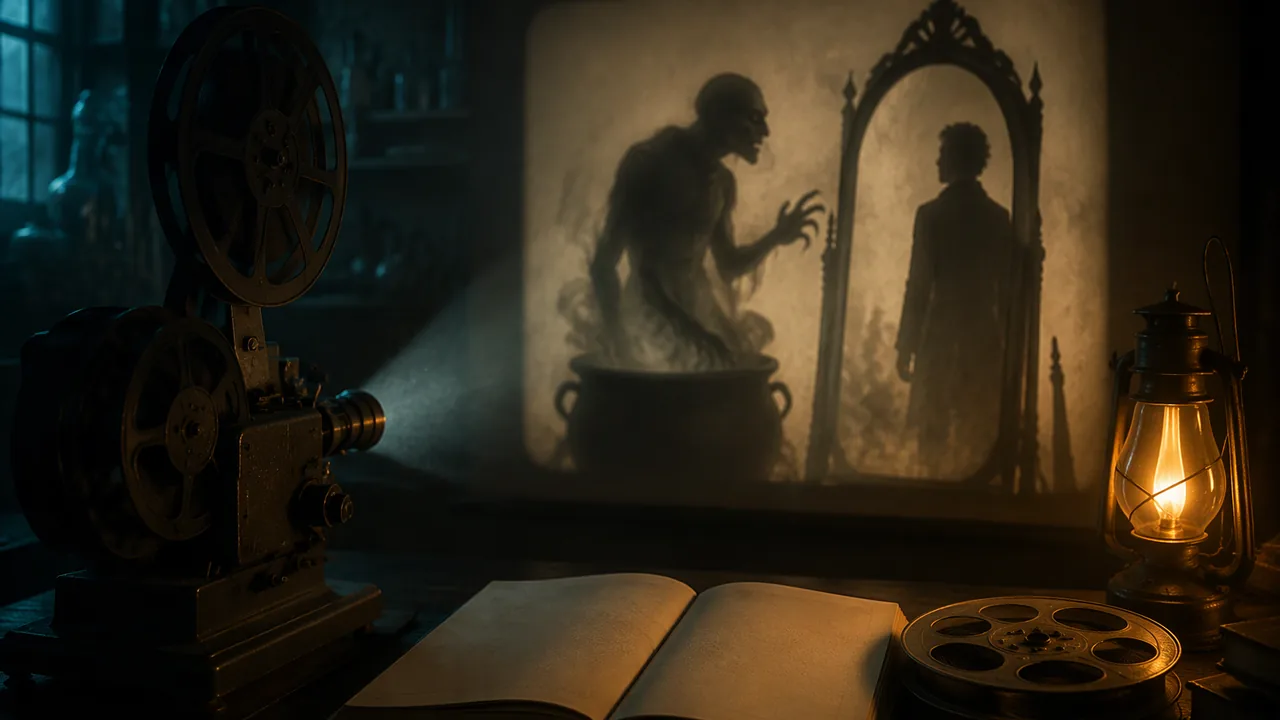
What the 1910 film does. Victor, a young student, goes to college, discovers the secret of life, and creates a being in a cauldron of chemicals — not from bodies. The creation is presented as a result of Victor’s evil and unnatural thoughts. On Victor’s wedding night the creature appears; in the film’s climax the creature sees himself in a mirror, and then fades away as Victor’s love for his bride grows stronger, leaving only Victor’s reflection.
Emphasis. The film emphasizes the creature as a projection of Victor’s own dark mind — almost a double — and resolves the story by love overcoming evil. Special effects (the creature forming in the cauldron, played in reverse footage of a burning dummy) were its selling point.
What it adds. The cauldron, the mirror, the happy ending, and a moral reading in which evil thoughts create evil.
What it omits. Walton and the frame narrative; the creature’s own account, education and voice; William, Justine, Clerval and Elizabeth’s deaths; the Arctic; and above all the creature’s argument about responsibility. The creature cannot speak in a silent film in which he is pure menace.
Why the medium matters. A silent film of about thirteen minutes cannot sustain a nested frame narrative or long speeches. It must show, not tell, and it favors visual spectacle. The creature’s eloquence — the heart of Shelley’s argument — is precisely what the early film cannot carry. Later films inherited this: the creature of popular culture groans rather than argues.
Your analysis. Watch the film (it is short; watch twice) and complete a chart for each medium: what it emphasizes, what it adds, what it omits, and what it makes the audience feel about the creature. 9-10.SL.1.C asks you to integrate information from diverse media and evaluate its credibility and accuracy — note what the film gets wrong about the novel and why that might have been a deliberate choice.
The finding. Record 90 seconds naming the single most consequential difference between the two and what it changes about the story’s meaning (9-10.RL.1.D). In replies, respond to a classmate who chose a different difference and qualify your view (9-10.SL.1.C).
Reading: The novel and the 1910 film: cards, passages, chart and model
Frankenstein (Edison Manufacturing Company, 1910, directed by J. Searle Dawley), title cards as transcribed on Wikisource https://en.wikisource.org/w/index.php?title=Frankenstein_%281910_film%29&action=render; Mary Shelley, Frankenstein; or, The Modern Prometheus (1818 text), Project Gutenberg eBook 41445 (https://www.gutenberg.org/ebooks/41445). Retrieved 2026-09-26. · SLS original framing, chart and model; quoted passages are public domain (Edison title cards, 1910; Shelley, 1818)
Fill the chart from the cards and the passages; the film’s pictures are not needed for the chart.
What is hosted. The complete title cards of the 1910 film, in order, with the time each card appears; four passages of the novel the film could be set against; a comparison chart with worked rows; a protocol; and a model 90-second finding. Sources: Frankenstein (Edison Manufacturing Company, 1910, directed by J. Searle Dawley), title cards as transcribed on Wikisource https://en.wikisource.org/w/index.php?title=Frankenstein_%281910_film%29&action=render; Mary Shelley, Frankenstein; or, The Modern Prometheus (1818 text), Project Gutenberg eBook 41445 (https://www.gutenberg.org/ebooks/41445). Retrieved 2026-09-26. The film is silent, so its cards are the only words it carries; the moving pictures are not reproduced here, and the chart asks only for what the cards and the novel passages show. The 1818 chapters restart in each volume (Vol. I has Chapters I–VII, Vol. II has I–IX, Vol. III has I–VII), so a Vol. II, Ch. VII passage is not Chapter 7 of a modern one-volume edition.
1. The film’s cards, in order
Each card is quoted exactly as the transcription gives it. The time is when the card appears in a print that ends at 12:04.
A LIBERAL ADAPTATION FROM MRS. SHELLEY’S FAMOUS STORY FOR EDISON PRODUCTION
— card at 00:00
FRANKENSTEIN DEPARTS FOR COLLEGE
— card at 00:09
TWO YEARS LATER FRANKENSTEIN HAS DISCOVERED THE MYSTERY OF LIFE
— card at 00:27
JUST BEFORE THE EXPERIMENT
— card at 01:13
Sweetheart, Tonight my ambition will be accomplished. I have discovered the secret of life and death and in a few hours I shall create into life the most perfect human being that the world has yet known. When this marvelous work is accomplished I shall then return to claim you for my bride. Your devoted,
— letter card at 01:37
INSTEAD OF A PERFECT HUMAN BEING, THE EVIL IN FRANKENSTEIN’S MIND CREATES A MONSTER
— card at 02:09
FRANKENSTEIN APPALLED AT THE SIGHT OF HIS EVIL CREATION
— card at 05:04
THE RETURN HOME
— card at 06:12
HAUNTING HIS CREATOR AND JEALOUS OF HIS SWEETHEART.
FOR THE FIRST TIME THE MONSTER SEES HIMSELF
— card at 06:47 (two lines)
ON THE BRIDAL NIGHT.
FRANKENSTEIN’S BETTER NATURE ASSERTING ITSELF
— card at 08:58 (two lines)
THE CREATION OF AN EVIL MIND IS OVERCOME BY LOVE AND DISAPPEARS
— card at 11:03
The first card, at 00:00, is the title card; it also names Edison and the 1910 copyright. The last card, at 12:04, is the Edison trade mark.
2. Four passages of the novel to set against it
The different accidents of life are not so changeable as the feelings of human nature. I had worked hard for nearly two years, for the sole purpose of infusing life into an inanimate body. For this I had deprived myself of rest and health. I had desired it with an ardour that far exceeded moderation; but now that I had finished, the beauty of the dream vanished, and breathless horror and disgust filled my heart. Unable to endure the aspect of the being I had created, I rushed out of the room, and continued a long time traversing my bed-chamber, unable to compose my mind to sleep. At length lassitude succeeded to the tumult I had before endured; and I threw myself on the bed in my clothes, endeavouring to seek a few moments of forgetfulness. But it was in vain: I slept indeed, but I was disturbed by the wildest dreams. I thought I saw Elizabeth, in the bloom of health, walking in the streets of Ingolstadt. Delighted and surprised, I embraced her; but as I imprinted the first kiss on her lips, they became livid with the hue of death; her features appeared to change, and I thought that I held the corpse of my dead mother in my arms; a shroud enveloped her form, and I saw the grave-worms crawling in the folds of the flannel. I started from my sleep with horror; a cold dew covered my forehead, my teeth chattered, and every limb became convulsed; when, by the dim and yellow light of the moon, as it forced its way through the window-shutters, I beheld the wretch—the miserable monster whom I had created. He held up the curtain of the bed; and his eyes, if eyes they may be called, were fixed on me. His jaws opened, and he muttered some inarticulate sounds, while a grin wrinkled his cheeks. He might have spoken, but I did not hear; one hand was stretched out, seemingly to detain me, but I escaped, and rushed down stairs. I took refuge in the court-yard belonging to the house which I inhabited; where I remained during the rest of the night, walking up and down in the greatest agitation, listening attentively, catching and fearing each sound as if it were to announce the approach of the demoniacal corpse to which I had so miserably given life.
— Victor, the creation, Vol. I, Ch. IV
I had admired the perfect forms of my cottagers—their grace, beauty, and delicate complexions: but how was I terrified, when I viewed myself in a transparent pool! At first I started back, unable to believe that it was indeed I who was reflected in the mirror; and when I became fully convinced that I was in reality the monster that I am, I was filled with the bitterest sensations of despondence and mortification. Alas! I did not yet entirely know
— The creature, quoted by Victor, sees himself in a pool, Vol. II, Ch. IV
Am I to be thought the only criminal, when all human kind sinned against me? Why do you not hate Felix, who drove his friend from his door with contumely? Why do you not execrate the rustic who sought to destroy the saviour of his child? Nay, these are virtuous and immaculate beings! I, the miserable and the abandoned, am an abortion, to be spurned at, and kicked, and trampled on. Even now my blood boils at the recollection of this injustice. “But it is true that I am a wretch.
— The creature to Walton, Vol. III, Ch. VII
I shall quit your vessel on the ice-raft which brought me hither, and shall seek the most northern extremity of the globe; I shall collect my funeral pile, and consume to ashes this miserable frame, that its remains may afford no light to any curious and unhallowed wretch, who would create such another as I have been. I shall die. I shall no longer feel the agonies which now consume me, or be the prey of feelings unsatisfied, yet unquenched. He is dead who called me into being; and when I shall be no more, the very remembrance of us both will speedily vanish. I shall no longer see the sun or stars, or feel the winds play on my cheeks. Light, feeling, and sense, will pass away; and in this condition must I find my happiness. Some years ago, when the images which this world affords first opened upon me, when I felt the cheering warmth of summer, and heard the rustling of the leaves and the chirping of the birds, and these were all to me, I should have wept to die; now it is my only consolation. Polluted by crimes, and torn by the bitterest remorse, where can I find rest but in death?
— The creature, the end of the novel, Vol. III, Ch. VII
3. Two-medium chart with worked rows (SLS original)
| Novel | 1910 film | |
|---|---|---|
| How the creature comes to be | Victor works for “nearly two years” and the creature opens his eyes at night; Victor’s horror comes after. | The card at 02:09: “THE EVIL IN FRANKENSTEIN’S MIND CREATES A MONSTER.” The creation is caused by an evil mind, not by a plan. |
| Seeing himself | The creature sees his reflection in a pool and is “terrified” at what he is; the discovery is his. | The card at 06:47: “FOR THE FIRST TIME THE MONSTER SEES HIMSELF.” The card pairs the moment with “HAUNTING HIS CREATOR AND JEALOUS OF HIS SWEETHEART.” |
| What is added | — | A sweetheart’s letter; a return home; a wedding night; a moral ending. |
| What is omitted | — | (You fill this row from the cards: which characters and events in the novel never appear on a card?) |
| Ending | The creature says he will burn on a funeral pile and Victor is dead. | The card at 11:03: “THE CREATION OF AN EVIL MIND IS OVERCOME BY LOVE AND DISAPPEARS.” |
| What we are made to feel about the creature | You fill this row. | You fill this row. |
4. Protocol (SLS original)
- Read the cards in order and the four passages twice.
- Fill the chart, then choose the one difference that changes the meaning most.
- Record 90 seconds: name the difference, what each medium does with it, and what it changes about who is responsible.
- Reply to a classmate who chose a different difference and qualify your view.
5. Question stems (SLS original)
- What can a silent film say with only a few cards, and what does it have to leave out?
- Whose point of view does each medium give us?
- What does the film’s ending assume about where evil comes from?
6. A model finding (SLS original)
“The most consequential difference is where the cards put the cause. In the novel the creature says, ‘Am I to be thought the only criminal, when all human kind sinned against me?’ and asks who else is to blame. On the card at 02:09 the cause is ‘THE EVIL IN FRANKENSTEIN’S MIND.’ That moves the fault inside one man and removes the argument about responsibility. A silent film with a few cards has no room for the creature’s speech, so the medium itself produces the change.”
Formative check
Work through these before moving on. They are not graded — they tell you whether the standard below has landed yet.
What is the most consequential omission in the 1910 film?
In the 1910 film, Victor builds the creature from parts of dead bodies, as in the novel.
Complete the two-medium chart (emphasizes, adds, omits, audience feeling about the creature). Then draft your 90-second finding: the single most consequential difference and what it changes about meaning.
How confident are you that you can compare how two mediums tell the same story and explain what each emphasizes and omits?