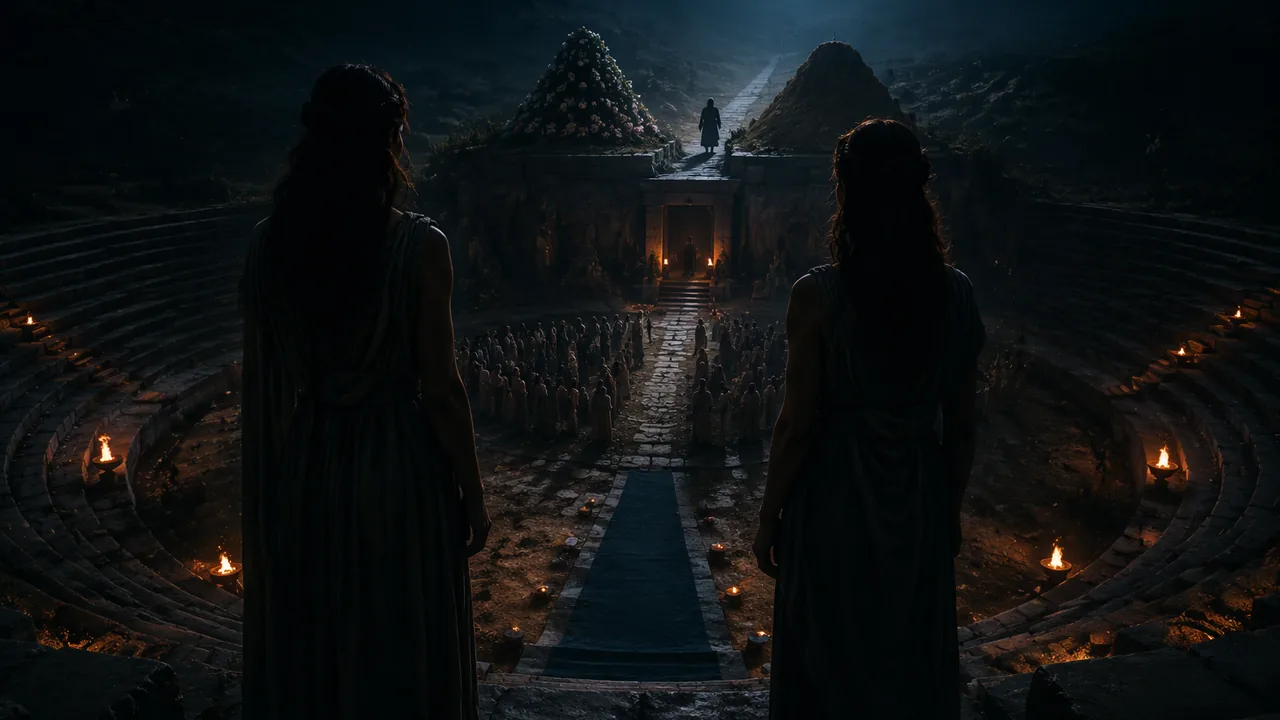
explain how the structure of Greek tragedy — prologue, choral odes, episodes, reversal and recognition — organizes Antigone and shapes what the audience knows and feels.
Instruction
Antigone was first performed in Athens around 441 BCE, at a festival where citizens watched tragedies as a civic duty. It is short — a single sitting — and built with a precision that repays study. This lesson maps the structure, because in tragedy the order in which you learn things is the argument. Sophocles’ audience already knew the outline of the myth; the suspense lay in how it would unfold. You begin today with the prologue and the parodos, and the map you start now will be filled in as you read the play in order across the unit.
The situation. Two brothers, Eteocles and Polyneices, have killed each other fighting for the throne of Thebes. Their uncle Creon, now king, orders that Eteocles be buried with honor and that Polyneices, who attacked the city, be left unburied for dogs and birds — a terrible punishment for Greeks, who believed the unburied dead could not rest. Their sister Antigone decides to bury Polyneices anyway.
The parts. The prologue sets up the conflict: Antigone asks her sister Ismene to help, and Ismene refuses. The parodos, the chorus’s entrance song, celebrates the city’s victory. Then the play alternates episodes — scenes of dialogue — with stasima, choral odes in which the chorus of Theban elders reflects on what has happened. The chorus is not a narrator; it is a group of citizens trying to understand, and it often gets things wrong.
Reversal and recognition. Aristotle, writing a century later, said the best tragedies turn on a peripeteia — a reversal of fortune — and an anagnorisis — a moment of recognition. In Antigone, Creon is warned by the blind prophet Teiresias that the gods are offended. He finally gives way and rushes to undo his orders — too late. His recognition comes after the deaths of Antigone, his son Haemon and his wife Eurydice. The play ends not with Antigone, who dies offstage, but with Creon holding his son’s body.
Why structure matters. Notice how Sophocles arranges things. We hear Antigone’s reasons before Creon’s decree is tested. Creon’s speeches grow longer and more rigid as those around him — Ismene, the guard, Haemon, Teiresias — each give him a chance to reconsider. The chorus’s most famous ode, which begins “Wonders are many, and none is more wonderful than man,” praises human skill just after the burial has been discovered, and ends with a warning that cleverness without justice leads to ruin. Every placement is a choice.
Two laws. The play’s central conflict is between two kinds of law: Creon’s decree, the law of the city, and what Antigone calls “the unwritten and unfailing statutes of heaven” — duties to family and the gods that she believes no ruler can override. Neither is simply wrong. A city cannot survive if everyone disobeys laws they dislike; a person cannot live with herself if she obeys a law she believes is monstrous. That tension is why the play still matters.
Vocabulary in translation. Jebb’s prose translation uses words that may be unfamiliar: edict, statutes, deemed. Use context first, then a dictionary (9-10.RL.1.B / 9-10.RI.1.B), and notice word parts — edict shares a root with dictate (9-10.RL.1.B / 9-10.RI.1.B).
📖 Before this lesson, read: Antigone, Prologue and Parodos (lines 1-161)
The reading opens over the lesson; close it to come back to exactly where you were.
Reading: Antigone: the parts of the play and the passages the structure map needs
Sophocles, Antigone, translated by R. C. Jebb (Cambridge University Press; translation first published 1888, text here from the 1917 edition, The Tragedies of Sophocles), Wikisource https://en.wikisource.org/wiki/Antigone_%28Jebb%29, retrieved 2026-09-26 · SLS original framing, tables, models and keys; quoted passages are public domain (Sophocles, tr. Jebb, 1888/1917)
Read the table first, then the passages. Which part of the play does each passage belong to, and what does it do there?
What is hosted. The prologue complete, the first choral ode complete, Antigone’s defense before Creon, Teiresias’s warning and Creon’s turn, Creon’s recognition, and the closing lines, together with a table of the parts of the play and a bank of short quotations for the parts not hosted whole, so that every row of your structure map has evidence. Edition: Sophocles, Antigone, translated by R. C. Jebb (Cambridge University Press; translation first published 1888, text here from the 1917 edition, The Tragedies of Sophocles), via Wikisource, retrieved 2026-09-26. The play itself is read complete and in order across this unit, beginning with the prologue and parodos assigned above; the later passages are hosted here only as a preview, and you will read each of them in full in its own lesson.
How the text is marked. Speakers are named as Jebb prints them: An. (Antigone), Is. (Ismene), Cr. (Creon), Ch. (the Chorus), Gu. (the Guard), Hae. (Haemon), Te. (Teiresias), Me. (the Messenger). Jebb translates into prose. The numbers in square brackets, such as [450], are the Greek line numbers Jebb prints in the margin at every tenth line; each sits at the place in the prose where that Greek line falls, so a passage can be located to within a few lines but not exactly. Cite the ten-line stretch it falls in. Spelling and wording are Jebb’s. Stage directions are in his brackets.
1. The parts of the play
Greek tragedy has a fixed frame. The line ranges below are the Greek line numbers of the thirteen parts, the same ranges your reading assignments use; Jebb prints only every tenth line number, so treat each boundary as accurate to within a few lines. (SLS original table.)
| Part | Greek lines | What happens | What it does |
|---|---|---|---|
| Prologue | 1–99 | Antigone tells Ismene of Creon’s edict and asks for help; Ismene refuses. | Sets the conflict and the two sisters’ characters before Creon speaks. |
| Parodos | 100–161 | The Chorus of Theban elders enters singing of the city’s victory over the Argive army. | Gives the city’s point of view and its confidence, which the play will test. |
| Episode 1 | 162–331 | Creon announces his edict; the Guard reports that someone has buried Polyneices. | Shows Creon’s principles, then the first breach of them. |
| Stasimon 1 | 332–375 | The ode beginning “Wonders are many.” | Praises human skill, then warns that skill without justice ruins a city. |
| Episode 2 | 376–581 | Antigone is brought in and defends her act; Creon condemns her and Ismene. | The two laws meet face to face. |
| Stasimon 2 | 582–625 | The Chorus reflects on the curse on Oedipus’s house. | Widens the conflict into fate and hope. |
| Episode 3 | 626–780 | Haemon argues with his father and leaves in anger. | The first person to test Creon’s certainty is his own son. |
| Stasimon 3 | 781–800 | An ode on the power of love. | Points at Haemon and Antigone, and at what Creon has not counted. |
| Episode 4, with Antigone’s lament (kommos) | 801–943 | Antigone is led toward the tomb and laments; Creon hurries her. | Shows the cost of Creon’s order from Antigone’s side. |
| Stasimon 4 | 944–987 | The Chorus recalls others who were shut away. | Compares Antigone with figures of myth. |
| Episode 5 | 988–1114 | Teiresias warns Creon; Creon at last yields. | The reversal (peripeteia). |
| Stasimon 5 | 1115–1154 | A hymn to Bacchus, hoping for the city’s rescue. | A breath of hope just before the catastrophe. |
| Exodos | 1155–1353 | Messengers report the deaths of Haemon and Eurydice; Creon returns carrying his son. | The recognition (anagnorisis) and the play’s closing moral. |
2. One quotation for every part (for the structure map)
Each is complete as printed here and comes straight from Jebb. Parts hosted whole appear in section 3.
Parodos [about 127]
For Zeus utterly abhors the boasts of a proud tongue; and when he beheld them coming on in a great stream, in the haughty pride of clanging gold
Episode 1 [about 200]
Such are the rules by which I guard this city’s greatness. And in accord with them is the edict which I have now published to the folk touching the sons of Oedipus;
Stasimon 2 [about 590]
Blest are they whose days have not tasted of evil.
Episode 3 [about 735]
Hae. That is no city, which belongs to one man. Cr. Is not the city held to be the ruler’s? Hae. Thou wouldst make a good monarch of a desert.
Stasimon 3 [about 790]
Love, unconquered in the fight, Love, who makest havoc of wealth, who keepest thy vigil on the soft cheek of a maiden; thou roamest over the sea, and among the homes of dwellers in the wilds; no immortal can escape thee, [790] nor any among men whose life is for a day; and he to whom thou hast come is mad.
Lament [about 900]
Tomb, bridal-chamber, eternal prison in the caverned rock, whither I go to find mine own, those many who have perished, and whom Persephone hath received among the dead! Last of all shall I pass thither, and far most miserably of all, before the term of my life is spent.
Stasimon 4 [about 950]
Even thus endured Danaë in her beauty to change the light of day for brass-bound walls;
3. Passages hosted whole
The prologue (complete)
Antigone. Ismene, sister, mine own dear sister, knowest thou what ill there is, of all bequeathed by Oedipus, that Zeus fulfils not for us twain while we live? Nothing painful is there, nothing fraught with ruin, no shame, no dishonour, that I have not seen in thy woes and mine. And now what new edict is this of which they tell, that our Captain hath just published to all Thebes? Knowest thou aught? Hast thou heard? Or is it hidden from thee that our friends are threatened with the doom of our foes? [10]
Ismene. No word of friends, Antigone, gladsome or painful, hath come to me, since we two sisters were bereft of brothers twain, killed in one day by a twofold blow; and since in this last night the Argive host hath fled, I know no more, whether my fortune be brighter, or more grievous.
An. I knew it well, and therefore sought to bring thee beyond the gates of the court, that thou mightest hear alone.
Is. What is it? ‘Tis plain that thou art brooding [20] on some dark tidings.
An. What, hath not Creon destined our brothers, the one to honoured burial, the other to unburied shame? Eteocles, they say, with due observance of right and custom, he hath laid in the earth, for his honour among the dead below. But the hapless corpse of Polyneices—as rumour saith, it hath been published to the town that none shall entomb him or mourn, but leave unwept, unsepulchred, [30] a welcome store for the birds, as they espy him, to feast on at will. Such, ’tis said, is the edict that the good Creon hath set forth for thee and for me,—yes, for me,—and is coming hither to proclaim it clearly to those who know it not; nor counts the matter light, but, whoso disobeys in aught, his doom is death by stoning before all the folk. Thou knowest it now; and thou wilt soon show whether thou art nobly bred, or the base daughter of a noble line.
Is. Poor sister,—and if things stand thus, what could I help to do or undo? [40]
An. Consider if thou wilt share the toil and the deed.
Is. In what venture? What can be thy meaning?
An. Wilt thou aid this hand to lift the dead?
Is. Thou wouldst bury him,—when ’tis forbidden to Thebes?
An. I will do my part,—and thine, if thou wilt not,—to a brother. False to him will I never be found.
Is. Ah, over-bold! when Creon hath forbidden?
An. Nay, he hath no right to keep me from mine own.
Is. Ah me! [50] think, sister, how our father perished, amid hate and scorn, when sins bared by his own search had moved him to strike both eyes with self-blinding hand; then the mother wife, two names in one, with twisted noose did despite unto her life; and last, our two brothers in one day,—each shedding, hapless one, a kinsman’s blood,—wrought out with mutual hands their common doom. And now we in turn—we two left all alone—think how we shall perish, more miserably than all the rest, if, in defiance of the law, [60] we brave a king’s decree or his powers. Nay, we must remember, first, that we were born women, as who should not strive with men; next, that we are ruled of the stronger, so that we must obey in these things, and in things yet sorer. I, therefore, asking the Spirits Infernal to pardon, seeing that force is put on me herein, will hearken to our rulers; for ’tis witless to be over busy.
An. I will not urge thee,—no, nor, if thou yet shouldst have the mind, [70] wouldst thou be welcome as a worker with me. Nay, be what thou wilt; but I will bury him: well for me to die in doing that. I shall rest, a loved one with him whom I have loved, sinless in my crime; for I owe a longer allegiance to the dead than to the living: in that world I shall abide for ever. But if thou wilt, be guilty of dishonouring laws which the gods have stablished in honour.
Is. I do them no dishonour; but to defy the State,—I have no strength for that.
An. Such be thy plea:—I, then, [80] will go to heap the earth above the brother whom I love.
Is. Alas, unhappy one! How I fear for thee!
An. Fear not for me: guide thine own fate aright.
Is. At least, then, disclose this plan to none, but hide it closely,—and so, too, will I.
An. Oh, denounce it! Thou wilt be far more hateful for thy silence, if thou proclaim not these things to all.
Is. Thou hast a hot heart for chilling deeds.
An. I know that I please where I am most bound to please.
Is. Aye, if thou canst; [90] but thou wouldst what thou canst not.
An. Why, then, when my strength fails, I shall have done.
Is. A hopeless quest should not be made at all.
An. If thus thou speakest, thou wilt have hatred from me, and will justly be subject to the lasting hatred of the dead. But leave me, and the folly that is mine alone, to suffer this dread thing; for I shall not suffer aught so dreadful as an ignoble death.
Is. Go, then, if thou must; and of this be sure,—that, though thine errand is foolish, to thy dear ones thou art truly dear.
The first ode (Stasimon 1, complete)
str. 1. Wonders are many, and none is more wonderful than man; the power that crosses the white sea, driven by the stormy south-wind, making a path under surges that threaten to engulf him; and Earth, the eldest of the gods, the immortal, the unwearied, doth he wear, turning the soil with the offspring of horses, [340] as the ploughs go to and fro from year to year. ant. 1. And the light-hearted race of birds, and the tribes of savage beasts, and the sea-brood of the deep, he snares in the meshes of his woven toils, he leads captive, man excellent in wit. And he masters by his arts the beast whose lair is in the wilds, who roams the hills; he tames the horse of shaggy mane, [350] he puts the yoke upon its neck, he tames the tireless mountain bull. str. 2. And speech, and wind-swift thought, and all the moods that mould a state, hath he taught himself; and how to flee the arrows of the frost, when ’tis hard lodging under the clear sky, and the arrows of the rushing rain; yea, he hath resource for all; [360] without resource he meets nothing that must come: only against Death shall he call for aid in vain; but from baffling maladies he hath devised escapes. ant. 2. Cunning beyond fancy’s dream is the fertile skill which brings him, now to evil, now to good. When he honours the laws of the land, and that justice which he hath sworn by the gods to uphold, proudly stands his city: no city hath he who, for his rashness, [370] dwells with sin. Never may he share my hearth, never think my thoughts, who doth these things!
Antigone before Creon (Episode 2, the exchange that states the two laws)
Cr. (To Guard.) Thou canst betake thee whither thou wilt, free and clear of a grave charge. [Exit Guard.]
(To Antigone.) Now, tell me thou—not in many words, but briefly—knewest thou that an edict had forbidden this?
An. I knew it: could I help it? It was public.
Cr. And thou didst indeed dare to transgress that law?
An. Yes; for it was not Zeus that had published [450] me that edict; not such are the laws set among men by the Justice who dwells with the gods below; nor deemed I that thy decrees were of such force, that a mortal could override the unwritten and unfailing statutes of heaven. For their life is not of to-day or yesterday, but from all time, and no man knows when they were first put forth. Not through dread of any human pride could I answer to the gods for breaking these. [460] Die I must,—I knew that well (how should I not?)—even without thy edicts. But if I am to die before my time, I count that a gain: for when any one lives, as I do, compassed about with evils, can such an one find aught but gain in death? So for me to meet this doom is trifling grief; but if I had suffered my mother’s son to lie in death an unburied corpse, that would have grieved me; for this, I am not grieved. And if my present deeds are foolish in thy sight, [470] it may be that a foolish judge arraigns my folly.
The reversal (Episode 5)
Te. Then know thou—aye, know it well—that thou shalt not live through many more courses of the sun’s swift chariot, ere one begotten of thine own loins shall have been given by thee, a corpse for corpses; because thou hast thrust children of the sunlight to the shades, and ruthlessly lodged a living soul in the grave; [1070] but keepest in this world one who belongs to the gods infernal, a corpse unburied, unhonoured, all unhallowed. In such thou hast no part, nor have the gods above, but this is a violence done to them by thee. Therefore the avenging destroyers lie in wait for thee, the Furies of Hades and of the gods, that thou mayest be taken in these same ills. And mark well if I speak these things as a hireling. A time not long to be delayed shall awaken the wailing of men and of women in thy house. And a tumult of hatred against thee stirs all the cities whose mangled [1080] sons had the burial-rite from dogs, or from wild beasts, or from some winged bird that bore a polluting breath to each city that contains the hearths of the dead. Such arrows for thy heart—since thou provokest me—have I launched at thee, archer-like, in my anger,—sure arrows, of which thou shalt not escape the smart.—Boy, lead me home, that he may spend his rage on younger men, and learn to keep a tongue more temperate, and to bear within his breast a better mind than now he bears. [1090] [Exit Teiresias.
Ch. The man hath gone, O king, with dread prophecies. And, since the hair on this head, once dark, hath been white, I know that he hath never been a false prophet to our city.
Cr. I, too, know it well, and am troubled in soul. ‘Tis dire to yield; but, by resistance, to smite my pride with ruin—this, too, is a dire choice.
Ch. Son of Menoeceus, it behoves thee to take wise counsel.
Cr. What should I do, then? Speak, and I will obey.
Ch. Go thou, and free the maiden from her rocky [1100] chamber, and make a tomb for the unburied dead.
Cr. And this is thy counsel? Thou wouldst have me yield?
Ch. Yea, King, and with all speed; for swift harms from the gods cut short the folly of men.
Cr. Ah me, ’tis hard, but I resign my cherished resolve,—I obey. We must not wage a vain war with destiny.
Ch. Go, thou, and do these things; leave them not to others.
Cr. Even as I am I’ll go
Recognition and close (Exodos)
Cr. Ah me, this guilt can never be fixed on any other of mortal kind, for my acquittal! I, even I, was thy slayer, wretched that I am—I own the truth. [1320] Lead me away, O my servants, lead me hence with all speed, whose life is but as death!
Ch. Thy counsels are good, if there can be good with ills; briefest is best, when trouble is in our path. ant. 3.
Cr. Oh, let it come, let it appear, that fairest of fates for me, that brings my last day,—aye, [1330] best fate of all! Oh, let it come, that I may never look upon to-morrow’s light.
Ch. These things are in the future; present tasks claim our care: the ordering of the future rests where it should rest.
Cr. All my desires, at least, were summed in that prayer.
Ch. Pray thou no more; for mortals have no escape from destined woe. ant. 4.
Cr. Lead me away, I pray you; a rash, foolish man; [1340] who have slain thee, ah my son, unwittingly, and thee, too, my wife—unhappy that I am! I know not which way I should bend my gaze, or where I should seek support; for all is amiss with that which is in my hands,—and yonder, again, a crushing fate hath leapt upon my head. [As Creon is being conducted into the house, the Coryphaeus speaks the closing verses.
Ch. Wisdom is the supreme part of happiness; and reverence towards the gods must be inviolate. Great words of prideful men [1350] are ever punished with great blows, and, in old age, teach the chastened to be wise.
4. A worked row of the structure map (SLS original)
Part: prologue. What it adds: the audience learns the edict, the two sisters’ opposite temperaments and Antigone’s resolve before Creon says a word, so when Creon speaks his decree is already being tested against a person. Quotation: “Nay, he hath no right to keep me from mine own” (Antigone, about line 48). Why here: the play opens on a refusal, not an argument; the argument comes later.
Finding the reversal (a preview: you will read these scenes in full in Lessons 1.7 and 1.8). A reversal (peripeteia) is the moment the action turns against the person driving it. Ask where Creon first gives way. In section 3 he says “Ah me, ’tis hard, but I resign my cherished resolve,—I obey.” That is the reversal, in Episode 5, roughly lines 1095–1105. Ask next where he sees what he has done. That is the recognition (anagnorisis), and it comes later, in the Exodos: “I, even I, was thy slayer, wretched that I am—I own the truth.” The gap between the two moments is the play’s point: reversal and recognition are separated by the deaths.
Formative check
Work through these before moving on. They are not graded — they tell you whether the standard below has landed yet.
The play is named for Antigone, but she dies before the end. Before reading on — who do you expect is on stage in the final scene?
What is the function of the choral odes in Antigone?
The play presents Creon’s position as obviously wrong from the start.
A reversal of fortune is a ; a moment of recognition is an ; the chorus’s songs are called .
Start your structure map. List every part of the play in order, using the table in the supplemental reading. Fill in the prologue and parodos rows completely from today’s reading: one sentence on what each part adds and one quotation. For every other row, write a one-line prediction of what that part will do, to check and revise as you read. Then use the preview passages from Episode 5 and the Exodos to locate the reversal and the recognition, and write a short paragraph on why Sophocles might separate them.
How confident are you that you can explain how the order of scenes and odes in Antigone shapes the audience’s judgment?
Printable: Unit 1 Student Workbook
Every organizer for this unit in one booklet — the reading schedule, the vocabulary pages, all five lesson organizers, the peer review sheet and the scoring rubric. Print it before the unit starts and bring the page to each lesson.
Read the complete work: Antigone
This unit only close-reads part of the text in any one lesson. The complete, unabridged public-domain text of Antigone is also here as a single printable PDF, for anyone who wants to read ahead or read it straight through.
Antigone, Prologue and Parodos (lines 1-161)
Antigone, Prologue (lines 1-99)
Source: Sophocles, Antigone, translated by R. C. Jebb (The Tragedies of Sophocles, Cambridge University Press, 1917), Wikisource (en.wikisource.org) · Public domain
Antigone.
Ismene, sister, mine own dear sister, knowest thou what ill there is, of all bequeathed by Oedipus, that Zeus fulfils not for us twain while we live? Nothing painful is there, nothing fraught with ruin, no shame, no dishonour, that I have not seen in thy woes and mine.
And now what new edict is this of which they tell, that our Captain hath just published to all Thebes? Knowest thou aught? Hast thou heard? Or is it hidden from thee that our friends are threatened with the doom of our foes?
Ismene.
No word of friends, Antigone, gladsome or painful, hath come to me, since we two sisters were bereft of brothers twain, killed in one day by a twofold blow; and since in this last night the Argive host hath fled, I know no more, whether my fortune be brighter, or more grievous.
An. I knew it well, and therefore sought to bring thee beyond the gates of the court, that thou mightest hear alone.
Is. What is it? ‘Tis plain that thou art brooding on some dark tidings.
An. What, hath not Creon destined our brothers, the one to honoured burial, the other to unburied shame? Eteocles, they say, with due observance of right and custom, he hath laid in the earth, for his honour among the dead below. But the hapless corpse of Polyneices—as rumour saith, it hath been published to the town that none shall entomb him or mourn, but leave unwept, unsepulchred, a welcome store for the birds, as they espy him, to feast on at will.
Such, ’tis said, is the edict that the good Creon hath set forth for thee and for me,—yes, for me,—and is coming hither to proclaim it clearly to those who know it not; nor counts the matter light, but, whoso disobeys in aught, his doom is death by stoning before all the folk. Thou knowest it now; and thou wilt soon show whether thou art nobly bred, or the base daughter of a noble line.
Is. Poor sister,—and if things stand thus, what could I help to do or undo?
An. Consider if thou wilt share the toil and the deed.
Is. In what venture? What can be thy meaning?
An. Wilt thou aid this hand to lift the dead?
Is. Thou wouldst bury him,—when ’tis forbidden to Thebes?
An. I will do my part,—and thine, if thou wilt not,—to a brother. False to him will I never be found.
Is. Ah, over-bold! when Creon hath forbidden?
An. Nay, he hath no right to keep me from mine own.
Is. Ah me! think, sister, how our father perished, amid hate and scorn, when sins bared by his own search had moved him to strike both eyes with self-blinding hand; then the mother wife, two names in one, with twisted noose did despite unto her life; and last, our two brothers in one day,—each shedding, hapless one, a kinsman’s blood,—wrought out with mutual hands their common doom. And now we in turn—we two left all alone—think how we shall perish, more miserably than all the rest, if, in defiance of the law, we brave a king’s decree or his powers. Nay, we must remember, first, that we were born women, as who should not strive with men; next, that we are ruled of the stronger, so that we must obey in these things, and in things yet sorer. I, therefore, asking the Spirits Infernal to pardon, seeing that force is put on me herein, will hearken to our rulers; for ’tis witless to be over busy.
An. I will not urge thee,—no, nor, if thou yet shouldst have the mind, wouldst thou be welcome as a worker with me. Nay, be what thou wilt; but I will bury him: well for me to die in doing that. I shall rest, a loved one with him whom I have loved, sinless in my crime; for I owe a longer allegiance to the dead than to the living: in that world I shall abide for ever. But if thou wilt, be guilty of dishonouring laws which the gods have stablished in honour.
Is. I do them no dishonour; but to defy the State,—I have no strength for that.
An. Such be thy plea:—I, then, will go to heap the earth above the brother whom I love.
Is. Alas, unhappy one! How I fear for thee!
An. Fear not for me: guide thine own fate aright.
Is. At least, then, disclose this plan to none, but hide it closely,—and so, too, will I.
An. Oh, denounce it! Thou wilt be far more hateful for thy silence, if thou proclaim not these things to all.
Is. Thou hast a hot heart for chilling deeds.
An. I know that I please where I am most bound to please.
Is. Aye, if thou canst; but thou wouldst what thou canst not.
An. Why, then, when my strength fails, I shall have done.
Is. A hopeless quest should not be made at all.
An. If thus thou speakest, thou wilt have hatred from me, and will justly be subject to the lasting hatred of the dead. But leave me, and the folly that is mine alone, to suffer this dread thing; for I shall not suffer aught so dreadful as an ignoble death.
Is. Go, then, if thou must; and of this be sure,—that, though thine errand is foolish, to thy dear ones thou art truly dear.
Exit Antigone on the spectators’ left. Ismene retires into the palace by one of the two side-doors.
Antigone, Parodos (First Choral Song) (lines 100-161) Bridge summary — not the primary text
This is a short recap written for this course, not Sophocles’s own words, so you can follow the story between close-reading lessons.
{summary}