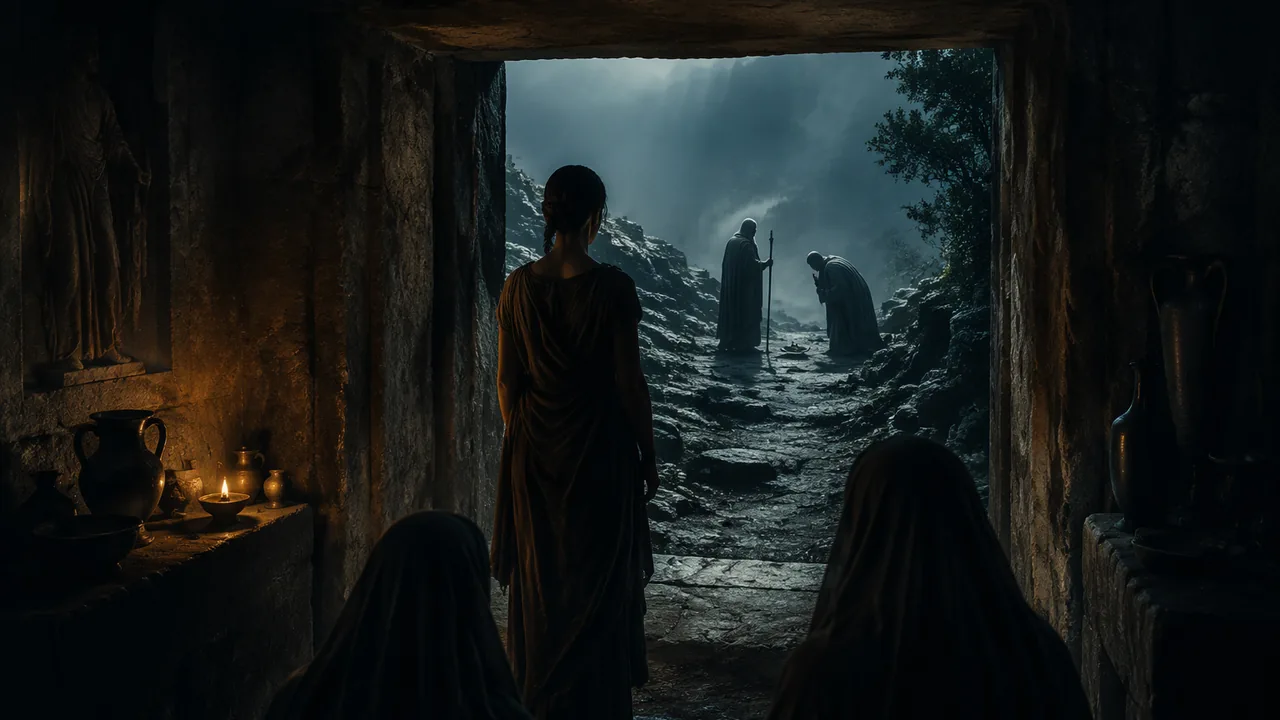
trace how Antigone’s farewell and Teiresias’s warning bring the play to its turning point, explain how Sophocles orders these scenes to build the reversal, and compare how a sung original and a modern staging would represent Antigone’s last exit.
Instruction
This reading carries the play through its turn. Antigone is led to her tomb, the Chorus sings of others who were shut away, and the blind prophet Teiresias tells Creon what his decree has done. By the end Creon has given way. Read it as one movement, from the last time we see Antigone to the first time Creon bends.
From speech to song. The fourth episode opens with a kommos, a lament sung in alternation by an actor and the Chorus. Until now Antigone has argued; here she sings. Her first words are a farewell to the light: “See me, citizens of my fatherland, setting forth on my last way, looking my last on the sunlight that is for me no more.” Her central image is the one the Chorus has just used: death as a wedding. She has had “no portion in the chant that brings the bride,” and instead “the lord of the Dark Lake shall wed” her. She compares herself to Niobe, “the daughter of Tantalus,” whom “the growth of stone subdued” on a mountainside, where her tears still run down as rain and snow.
The Chorus as audience. The elders’ answers are mixed. They call her “mistress of thine own fate,” but when they remind her that Niobe was a goddess, she cries, “Ah, I am mocked!” They grant that “Reverent action claims a certain praise for reverence,” then give the verdict a city would give: “Thy self-willed temper hath wrought thy ruin.” Her sharpest line names exactly where Creon’s sentence has put her: she has “no home with the living or with the dead.”
The last speech. Creon cuts the song short (“Know ye not that songs and wailings before death would never cease, if it profited to utter them?”) and insists, “Our hands are clean as touching this maiden,” because she will be walled in with food rather than killed outright. Antigone’s final speech begins, “Tomb, bridal-chamber, eternal prison in the caverned rock.” In its middle comes a strange argument: she would not have defied the city for a husband or a child, since “The husband lost, another might have been found,” but with her parents dead “no brother’s life could ever bloom for me again.” Many readers, Jebb among them, have doubted that Sophocles wrote this passage; others hear a woman reaching for any reason she can still hold. Her closing claim is a conditional, not a certainty: if the gods approve her punishment, “I shall come to know my sin; but if the sin is with my judges,” may they suffer what they inflict. She is led away “because I feared to cast away the fear of Heaven!” The audience never sees her again.
Teiresias. After the fourth stasimon (summarized in the reading card), Teiresias enters, blind, led by a boy: “thus, by a guide’s help, the blind must walk.” The image is a lesson for a king who will not be guided. He reports birds tearing at each other and a sacrifice that would not burn, and he explains why: the altars are fouled “by birds and dogs, with carrion from the hapless corpse.” He offers Creon a way out, not a sentence: “All men are liable to err; but when an error hath been made, that man is no longer witless or unblest who heals the ill into which he hath fallen, and remains not stubborn.”
The pattern repeats. Creon answers as he answered the guards: “the seer-tribe hath long trafficked in me.” The charge of taking money has now been aimed at the guards and at the city’s own prophet. Only then does Teiresias prophesy that Creon will give “one begotten of thine own loins” as “a corpse for corpses,” because he has turned the order of the world upside down: he has “ruthlessly lodged a living soul in the grave” while keeping “in this world one who belongs to the gods infernal, a corpse unburied.” The living are below ground and the dead above it.
The reversal. When Teiresias leaves, Creon gives way within a few lines: “‘Tis dire to yield; but, by resistance, to smite my pride with ruin—this, too, is a dire choice.” Told to “free the maiden from her rocky chamber, and make a tomb for the unburied dead,” he obeys: “Ah me, ’tis hard, but I resign my cherished resolve,—I obey.” This is the peripeteia, the turn of the action against the man driving it. Notice two things for the next reading. The Chorus names the maiden first and the corpse second. And Creon’s last words before he goes sound almost like Antigone’s: “’tis best to keep the established laws, even to life’s end.”
On stage. In Sophocles’ theater the kommos was sung and danced, and the actor’s mask never changed expression; in many modern productions it is spoken, and on film a close-up can do the work the music once did. As you read, decide what is lost and what is gained when Antigone’s farewell is spoken rather than sung, and how a staging should handle her exit, since it is the last time the audience sees her alive.
📖 Before this lesson, read: Antigone, Fourth Episode to Fifth Episode (lines 801-1114)
The reading opens over the lesson; close it to come back to exactly where you were.
Formative check
Work through these before moving on. They are not graded — they tell you whether the standard below has landed yet.
The Chorus tells Creon to free Antigone and to bury Polyneices, naming the living girl first. Before you read the Exodos: which will Creon do first?
How does Creon first respond to Teiresias’s warning?
In her final speech, Antigone declares with complete certainty that the gods approve of what she did.
Part 1: Choose three lines from Antigone’s farewell (the kommos and her final speech) and three from the Teiresias scene, and arrange them in a before-and-after chart: what Antigone holds on to as she leaves, and what Creon lets go of. Part 2: In a paragraph, compare how Sophocles’ original theater (a sung, danced lament by a masked actor and the Chorus) and a modern spoken staging or film would represent Antigone’s last exit: what each can emphasize and what each loses. Part 3: In two or three sentences, explain why Sophocles places the fourth stasimon and Teiresias’s arrival between Antigone’s exit and Creon’s reversal.
How confident are you that you can explain how Sophocles orders Antigone’s farewell, the fourth stasimon and Teiresias’s warning to build the play’s reversal?
Antigone, Fourth Episode to Fifth Episode (lines 801-1114)
Antigone, Fourth Episode (lines 801-943)
Source: Sophocles, Antigone, translated by R. C. Jebb (The Tragedies of Sophocles, Cambridge University Press, 1917), Wikisource (en.wikisource.org) · Public domain
str. 1. An. See me, citizens of my fatherland, setting forth on my last way, looking my last on the sunlight that is for me no more; no, Hades who gives sleep to all leads me living to Acheron’s shore; who have had no portion in the chant that brings the bride, nor hath any song been mine for the crowning of bridals; whom the lord of the Dark Lake shall wed.
syst. 1. Ch. Glorious, therefore, and with praise, thou departest to that deep place of the dead: wasting sickness hath not smitten thee; thou hast not found the wages of the sword; no, mistress of thine own fate, and still alive, thou shalt pass to Hades, as no other of mortal kind hath passed.
ant. 1. An. I have heard in other days how dread a doom befell our Phrygian guest, the daughter of Tantalus, on the Sipylian heights; how, like clinging ivy, the growth of stone subdued her; and the rains fail not, as men tell, from her wasting form, nor fails the snow, while beneath her weeping lids the tears bedew her bosom; and most like to hers is the fate that brings me to my rest.
syst. 2. Ch. Yet she was a goddess, thou knowest, and born of gods; we are mortals, and of mortal race. But ’tis great renown for a woman who hath perished that she should have shared the doom of the godlike, in her life, and afterward in death.
str. 2. An. Ah, I am mocked! In the name of our fathers’ gods, can ye not wait till I am gone,—must ye taunt me to my face, O my city, and ye, her wealthy sons? Ah, fount of Dircè, and thou holy ground of Thebè whose chariots are many; ye, at least, will bear me witness, in what sort, unwept of friends, and by what laws I pass to the rock-closed prison of my strange tomb, ah me unhappy! who have no home on the earth or in the shades, no home with the living or with the dead.
str. 3. Ch. Thou hast rushed forward to the utmost verge of daring; and against that throne where Justice sits on high thou hast fallen, my daughter, with a grievous fall. But in this ordeal thou art paying, haply, for thy father’s sin.
ant. 2. An. Thou hast touched on my bitterest thought,—awaking the ever-new lament for my sire and for all the doom given to us, the famed house of Labdacus. Alas for the horrors of the mother’s bed! alas for the wretched mother’s slumber at the side of her own son,—and my sire! From what manner of parents did I take my miserable being! And to them I go thus, accursed, unwed, to share their home. Alas, my brother, ill-starred in thy marriage, in thy death thou hast undone my life!
ant. 3. Ch. Reverent action claims a certain praise for reverence; but an offence against power cannot be brooked by him who hath power in his keeping. Thy self-willed temper hath wrought thy ruin.
ep. An. Unwept, unfriended, without marriage-song, I am led forth in my sorrow on this journey that can be delayed no more. No longer, hapless one, may I behold yon day-star’s sacred eye; but for my fate no tear is shed, no friend makes moan.
Cr. Know ye not that songs and wailings before death would never cease, if it profited to utter them? Away with her—away! And when ye have enclosed her, according to my word, in her vaulted grave, leave her alone, forlorn—whether she wishes to die, or to live a buried life in such a home. Our hands are clean as touching this maiden. But this is certain—she shall be deprived of her sojourn in the light.
An. Tomb, bridal-chamber, eternal prison in the caverned rock, whither I go to find mine own, those many who have perished, and whom Persephone hath received among the dead! Last of all shall I pass thither, and far most miserably of all, before the term of my life is spent. But I cherish good hope that my coming will be welcome to my father, and pleasant to thee, my mother, and welcome, brother, to thee; for, when ye died, with mine own hands I washed and dressed you, and poured drink-offerings at your graves; and now, Polyneices, ’tis for tending thy corpse that I win such recompense as this.
And yet I honoured thee, as the wise will deem, rightly. Never, had I been a mother of children, or if a husband had been mouldering in death, would I have taken this task upon me in the city’s despite. What law, ye ask, is my warrant for that word? The husband lost, another might have been found, and child from another, to replace the first-born; but, father and mother hidden with Hades, no brother’s life could ever bloom for me again. Such was the law whereby I held thee first in honour; but Creon deemed me guilty of error therein, and of outrage, ah brother mine! And now he leads me thus, a captive in his hands; no bridal bed, no bridal song hath been mine, no joy of marriage, no portion in the nurture of children; but thus, forlorn of friends, unhappy one, I go living to the vaults of death.
And what law of heaven have I transgressed? Why, hapless one, should I look to the gods any more,—what ally should I invoke,—when by piety I have earned the name of impious? Nay, then, if these things are pleasing to the gods, when I have suffered my doom, I shall come to know my sin; but if the sin is with my judges, I could wish them no fuller measure of evil than they, on their part, mete wrongfully to me.
Ch. Still the same tempest of the soul vexes this maiden with the same fierce gusts.
Cr. Then for this shall her guards have cause to rue their slowness.
An. Ah me! that word hath come very near to death.
Cr. I can cheer thee with no hope that this doom is not thus to be fulfilled.
An. O city of my fathers in the land of Thebè! O ye gods, eldest of our race!—they lead me hence—now, now—they tarry not! Behold me, princes of Thebes, the last daughter of the house of your kings,—see what I suffer, and from whom, because I feared to cast away the fear of Heaven!
Antigone is led away by the guards.
Antigone, Fourth Stasimon (lines 944-987) Bridge summary — not the primary text
This is a short recap written for this course, not Sophocles’s own words, so you can follow the story between close-reading lessons.
{summary}Antigone, Fifth Episode (lines 988-1114)
Source: Sophocles, Antigone, translated by R. C. Jebb (The Tragedies of Sophocles, Cambridge University Press, 1917), Wikisource (en.wikisource.org) · Public domain
Enter Teiresias, led by a Boy, on the spectators’ right.
Te. Princes of Thebes, we have come with linked steps, both served by the eyes of one; for thus, by a guide’s help, the blind must walk.
Cr. And what, aged Teiresias, are thy tidings?
Te. I will tell thee; and do thou hearken to the seer.
Cr. Indeed, it has not been my wont to slight thy counsel.
Te. Therefore didst thou steer our city’s course aright.
Cr. I have felt, and can attest, thy benefits.
Te. Mark that now, once more, thou standest on fate’s fine edge.
Cr. What means this? How I shudder at thy message!
Te. Thou wilt learn, when thou hearest the warnings of mine art. As I took my place on mine old seat of augury, where all birds have been wont to gather within my ken, I heard a strange voice among them; they were screaming with dire, feverish rage, that drowned their language in a jargon; and I knew that they were rending each other with their talons, murderously; the whirr of wings told no doubtful tale.
Forthwith, in fear, I essayed burnt-sacrifice on a duly kindled altar: but from my offerings the Fire-god showed no flame; a dank moisture, oozing from the thigh-flesh, trickled forth upon the embers, and smoked, and sputtered; the gall was scattered to the air; and the streaming thighs lay bared of the fat that had been wrapped round them.
Such was the failure of the rites by which I vainly asked a sign, as from this boy I learned; for he is my guide, as I am guide to others. And ’tis thy counsel that hath brought this sickness on our State. For the altars of our city and of our hearths have been tainted, one and all, by birds and dogs, with carrion from the hapless corpse, the son of Oedipus: and therefore the gods no more accept prayer and sacrifice at our hands, or the flame of meat-offering; nor doth any bird give a clear sign by its shrill cry, for they have tasted the fatness of a slain man’s blood.
Think, then, on these things, my son. All men are liable to err; but when an error hath been made, that man is no longer witless or unblest who heals the ill into which he hath fallen, and remains not stubborn.
Self-will, we know, incurs the charge of folly. Nay, allow the claim of the dead; stab not the fallen; what prowess is it to slay the slain anew? I have sought thy good, and for thy good I speak: and never is it sweeter to learn from a good counsellor than when he counsels for thine own gain.
Cr. Old man, ye all shoot your shafts at me, as archers at the butts;—ye must needs practise on me with seer-craft also;—aye, the seer-tribe hath long trafficked in me, and made me their merchandise. Gain your gains, drive your trade, if ye list, in the silver-gold of Sardis and the gold of India; but ye shall not hide that man in the grave,—no, though the eagles of Zeus should bear the carrion morsels to their Master’s throne—no, not for dread of that defilement will I suffer his burial:—for well I know that no mortal can defile the gods.—But, aged Teiresias, the wisest fall with a shameful fall, when they clothe shameful thoughts in fair words, for lucre’s sake.
Te. Alas! Doth any man know, doth any consider…
Cr. Whereof? What general truth dost thou announce?
Te. How precious, above all wealth, is good counsel.
Cr. As folly, I think, is the worst mischief.
Te. Yet thou art tainted with that distemper.
Cr. I would not answer the seer with a taunt.
Te. But thou dost, in saying that I prophesy falsely.
Cr. Well, the prophet-tribe was ever fond of money.
Te. And the race bred of tyrants loves base gain.
Cr. Knowest thou that thy speech is spoken of thy king?
Te. I know it; for through me thou hast saved Thebes.
Cr. Thou art a wise seer; but thou lovest evil deeds.
Te. Thou wilt rouse me to utter the dread secret in my soul.
Cr. Out with it!—Only speak it not for gain.
Te. Indeed, methinks, I shall not,—as touching thee.
Cr. Know that thou shalt not trade on my resolve.
Te. Then know thou—aye, know it well—that thou shalt not live through many more courses of the sun’s swift chariot, ere one begotten of thine own loins shall have been given by thee, a corpse for corpses; because thou hast thrust children of the sunlight to the shades, and ruthlessly lodged a living soul in the grave; but keepest in this world one who belongs to the gods infernal, a corpse unburied, unhonoured, all unhallowed. In such thou hast no part, nor have the gods above, but this is a violence done to them by thee. Therefore the avenging destroyers lie in wait for thee, the Furies of Hades and of the gods, that thou mayest be taken in these same ills.
And mark well if I speak these things as a hireling. A time not long to be delayed shall awaken the wailing of men and of women in thy house. And a tumult of hatred against thee stirs all the cities whose mangled sons had the burial-rite from dogs, or from wild beasts, or from some winged bird that bore a polluting breath to each city that contains the hearths of the dead.
Such arrows for thy heart—since thou provokest me—have I launched at thee, archer-like, in my anger,—sure arrows, of which thou shalt not escape the smart.—Boy, lead me home, that he may spend his rage on younger men, and learn to keep a tongue more temperate, and to bear within his breast a better mind than now he bears.
Exit Teiresias.
Ch. The man hath gone, O king, with dread prophecies. And, since the hair on this head, once dark, hath been white, I know that he hath never been a false prophet to our city.
Cr. I, too, know it well, and am troubled in soul. ‘Tis dire to yield; but, by resistance, to smite my pride with ruin—this, too, is a dire choice.
Ch. Son of Menoeceus, it behoves thee to take wise counsel.
Cr. What should I do, then? Speak, and I will obey.
Ch. Go thou, and free the maiden from her rocky chamber, and make a tomb for the unburied dead.
Cr. And this is thy counsel? Thou wouldst have me yield?
Ch. Yea, King, and with all speed; for swift harms from the gods cut short the folly of men.
Cr. Ah me, ’tis hard, but I resign my cherished resolve,—I obey. We must not wage a vain war with destiny.
Ch. Go, thou, and do these things; leave them not to others.
Cr. Even as I am I’ll go:—on, on, my servants, each and all of you,—take axes in your hands, and hasten to the ground that ye see yonder! Since our judgment hath taken this turn, I will be present to unloose her, as I myself bound her. My heart misgives me, ’tis best to keep the established laws, even to life’s end.