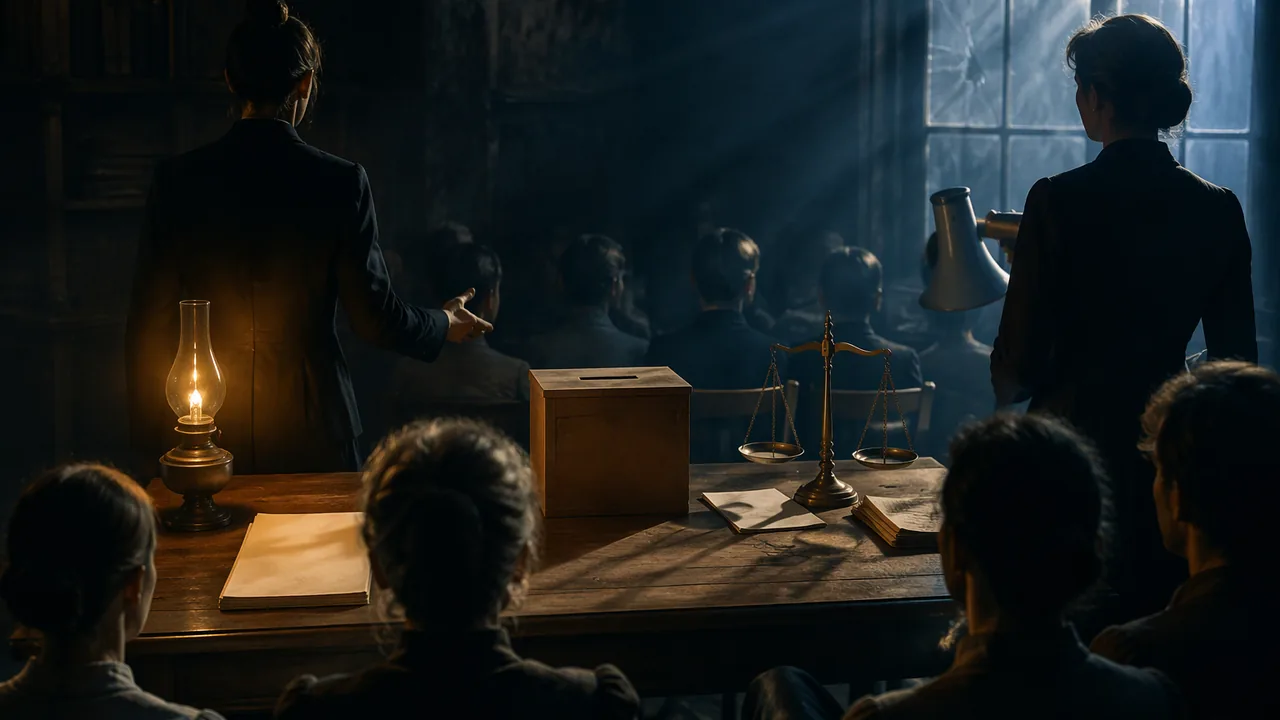
evaluate each speaker’s point of view, reasoning and use of evidence and rhetoric, identifying any fallacious reasoning or exaggerated or distorted evidence.
Instruction
Susan B. Anthony voted in the 1872 presidential election in Rochester, New York, and was arrested. Before her trial she toured the county delivering a speech arguing that she had committed no crime. Forty years later, Emmeline Pankhurst, leader of the militant British suffragettes, toured the United States to raise support. Her movement broke windows, set fire to empty buildings and went on hunger strike in prison. Both were breaking laws to win the vote. They argued very differently.
Anthony’s argument is legal. Her claim is that she already had the right to vote. Her reasoning: the Constitution’s preamble says “We, the people” formed the Union, not “we, the male citizens”; women are citizens and “persons”; the Fourteenth Amendment protects the privileges of citizens; voting is such a privilege; therefore a state that denies women the vote violates the Constitution. Her evidence is the text of founding documents and amendments. Her appeal is primarily logos — reasoning from shared authority. (The court disagreed; she was convicted and fined $100, which she refused to pay.)
Pankhurst’s argument is moral and strategic. Her claim is that women were justified in using militant, even destructive, tactics. Her reasoning: men have always used violence to win political rights — Americans in the Revolution among them; peaceful methods had failed for decades; therefore women were entitled to do the same. Her evidence is historical analogy and the experience of her movement. Her appeals mix logos, pathos (hunger strikes, force-feeding) and a bold ethos: she presents herself as a soldier.
Evaluating reasoning (9-10.SL.1.B, 9-10.RI.2.D). Evaluation is not agreement. For each speaker, ask four things. Claim: what exactly is being argued? Evidence: is it relevant and sufficient? Reasoning: does the conclusion follow, or is there a gap or fallacy? Rhetoric: how do word choice, emphasis and tone serve the argument? Look for fallacies: a false analogy (is women’s militancy really like the American Revolution?), hasty generalization, or evidence that is exaggerated or distorted.
Anthony’s weak point is that the court and most legal experts of her day read “citizen” and “privileges” more narrowly — her reading was a real argument, but not the settled law. Pankhurst’s weak point is that her analogy to war may prove too much: if violence is justified whenever peaceful methods fail, where does it stop?
The listening lab. Listen to or read both speeches aloud. Complete the four-part evaluation for each. Then record a 90-second comparative evaluation and pose one question to the class that relates the comparison to a broader theme (9-10.SL.1.B) — for example, what makes law-breaking justified, or whether means can undermine ends.
Reading: Anthony and Pankhurst: the passages, the evaluation frame and a model
Susan B. Anthony, Is It a Crime for a Citizen of the United States to Vote? (1873), as printed in History of Woman Suffrage, vol. 2 (1882), ch. 25, Wikisource https://en.wikisource.org/w/index.php?title=History_of_Woman_Suffrage/Volume_2/Chapter_25&action=render; Emmeline Pankhurst, Freedom or Death (Hartford, Connecticut, 13 November 1913), Wikisource https://en.wikisource.org/wiki/Freedom_or_death. Retrieved 2026-09-26. · SLS original framing, frame and model; quoted passages are public domain (Anthony, 1873; Pankhurst, 1913)
Complete the four-part frame for each speaker before you compare them.
What is hosted. The parts of both speeches the evaluation works from, complete as printed; a four-part evaluation frame with a worked example for each speaker; definitions of the fallacies to look for; a protocol and question stems; and a model 90-second evaluation. Sources: Susan B. Anthony, Is It a Crime for a Citizen of the United States to Vote? (1873), as printed in History of Woman Suffrage, vol. 2 (1882), ch. 25, Wikisource https://en.wikisource.org/w/index.php?title=History_of_Woman_Suffrage/Volume_2/Chapter_25&action=render; Emmeline Pankhurst, Freedom or Death (Hartford, Connecticut, 13 November 1913), Wikisource https://en.wikisource.org/wiki/Freedom_or_death. Retrieved 2026-09-26.
1. Susan B. Anthony, 1873
Anthony gave this speech in the weeks before her trial for voting in the 1872 election. The version below is the one the editors of History of Woman Suffrage printed.
Friends and Fellow Citizens:—I stand before you to-night, under indictment for the alleged crime of having voted illegally at the last Presidential election. I shall endeavor this evening to prove to you that in voting, I not only committed no crime, but simply exercised my “citizen’s right,” guaranteed to me and all United States citizens by the National Constitution, beyond the power of any State to deny.
— Anthony, opening
It was we, the people, not we, the white male citizens, nor yet we, the male citizens, but we, the whole people, who formed this Union. And we formed it, not to give the blessings of liberty, but to secure them; not to the half of ourselves and the half of our posterity, but to the whole people—women as well as men. And it is downright mockery to talk to women of their enjoyment of the blessings of liberty while they are denied the use of the only means of securing them provided by this democratic republican government—the ballot.
— Anthony, on the Preamble
For any State to make sex a qualification that must ever result in the disfranchisement of one entire half of the people, is to pass a bill of attainder, or an ex post facto law, and is therefore a violation of the supreme law of the land. By it, the blessings of liberty are forever withheld from women and their female posterity. To them, this government has no just powers derived from the consent of the governed. To them this government is not a democracy. It is not a republic. It is an odious aristocracy; a hateful oligarchy; the most hateful ever established on the face of the globe. An oligarchy of wealth, where the rich govern the poor; an oligarchy of learning, where the educated govern the ignorant; or even an oligarchy of race, where the Saxon rules the African, might be endured; but surely this oligarchy of sex, which makes the men of every household sovereigns, masters; the women subjects, slaves; carrying dissension, rebellion into every home of the Nation, can not be endured.
— Anthony, on the “oligarchy of sex”
The only question left to be settled now, is: Are women persons? And I hardly believe any of our opponents will have the hardihood to say they are not. Being persons, then, women are citizens, and no State has a right to make any new law, or to enforce any old law, that shall abridge their privileges or immunities. Hence, every discrimination against women in the constitutions and laws of the several States, is to-day null and void, precisely as is every one against negroes.
— Anthony, the argument from citizenship
2. Emmeline Pankhurst, 1913
Pankhurst gave this speech in Hartford, Connecticut, on a tour to raise support. In the speech she describes herself as a soldier under sentence of penal servitude.
I am here as a soldier who has temporarily left the field of battle in order to explain – it seems strange it should have to be explained – what civil war is like when civil war is waged by women. I am not only here as a soldier temporarily absent from the field at battle; I am here – and that, I think, is the strangest part of my coming – I am here as a person who, according to the law courts of my country, it has been decided, is of no value to the community at all: and I am adjudged because of my life to be a dangerous person, under sentence of penal servitude in a convict prison. So you see there is some special interest in hearing so unusual a person address you. I dare say, in the minds of many of you – you will perhaps forgive me this personal touch – that I do not look either very like a soldier or very like a convict, and yet I am both.
— Pankhurst, opening
Suppose the men of Hartford had a grievance, and they laid that grievance before their legislature, and the legislature obstinately refused to listen to them, or to remove their grievance, what would be the proper and the constitutional and the practical way of getting their grievance removed? Well, it is perfectly obvious at the next general election, when the legislature is elected, the men of Hartford in sufficient numbers would turn out that legislature and elect a new one: entirely change the personnel of an obstinate legislature which would not remove their grievance. It is perfectly simple and perfectly easy for voting communities to get their grievances removed if they act in combination and make an example of the legislature by changing the composition of the legislature and sending better people to take the place of those who have failed to do justice. But let the men of Hartford imagine that they were not in the position of being voters at all, that they were governed without their consent being obtained, that the legislature turned an absolutely deaf ear to their demands, what would the men of Hartford do then? They couldn’t vote the legislature out. They would have to choose; they would have to make a choice of two evils: they would either have to submit indefinitely to an unjust state of affairs, or they would have to rise up and adopt some of the antiquated means by which men in the past got their grievances remedied. We know what happened when your forefathers decided that they must have representation for taxation, many, many years ago. When they felt they couldn’t wait any longer, when they laid all the arguments before an obstinate British government that they could think of, and when their arguments were absolutely disregarded, when every other means had failed, they began by the tea party at Boston, and they went on until they had won the independence of the United States of America. That is what happened in the old days.
— Pankhurst, the Hartford analogy
Very well, then when you have warfare things happen; people suffer; the noncombatants suffer as well as the combatants. And so it happens in civil war. When your forefathers threw the tea into Boston harbour, a good many women had to go without their tea. It has always seemed to me an extraordinary thing that you did not follow it up by throwing the whiskey overboard; you sacrificed the women; and there is a good deal of warfare for which men take a great deal of glorification which has involved more practical sacrifice on women than it has on any man. It always has been so. The grievances of those who have got power, the influence of those who have got power commands a great deal of attention; but the wrongs and the grievances of those people who have no power at all are apt to be absolutely ignored. That is the history of humanity right from the beginning.
— Pankhurst, on suffering in civil war
Well, in our civil war people have suffered, but you cannot make omelettes without breaking eggs; you cannot have civil war without damage to something. The great thing is to see that no more damage is done than is absolutely necessary, that you do just as much as will arouse enough feeling to bring about peace, to bring about an honourable peace for the combatants, and that is what we have been doing. Within the last few days you have read – I don’t know how accurate the news cables are to America. I always take them with a grain of salt – but you have read within the last few days that some more empty houses have been burned, that a cactus house has been destroyed and some valuable plants have suffered in that house, that some pavilion at a pleasure ground has also been burned. Well, it is quite possible that it has happened.
— Pankhurst, on damage
You won your freedom in America when you had the revolution, by bloodshed, by sacrificing human life. You won the civil war by the sacrifice of human life when you decided to emancipate the negro. You have left it to women in your land, the men of all civilised countries have left it to women, to work out their own salvation. That is the way in which we women of England are doing. Human life for us is sacred, but we say if any life is to be sacrificed it shall be ours; we won’t do it ourselves, but we will put the enemy in the position where they will have to choose between giving us freedom or giving us death.
— Pankhurst, closing appeal
3. Four-part evaluation frame (SLS original)
| Anthony | Pankhurst | |
|---|---|---|
| Claim | Women already have the right to vote under the Constitution, so voting was no crime. | Women are justified in using militant, even destructive, tactics. |
| Evidence | The Preamble’s “we, the people”; the definition of citizen; the Fourteenth Amendment’s protection of the “privileges or immunities” of citizens. | The American Revolution and the Civil War; the failure of peaceful petitions; the sacrifice of her own movement. |
| Reasoning | If women are persons, and persons are citizens, and citizens hold the vote as a privilege, then a state that denies it breaks the Constitution. | Men have used force when they could not vote; women cannot vote; therefore women may do the same. |
| Rhetoric | A lawyer’s tone; a list of authorities; a striking image (“an odious aristocracy”). | A soldier’s ethos; a story told to the audience’s own history; a warning at the end. |
| Weak point to test | Her reading of “citizen” and “privileges” was an argument, not settled law; a court convicted her. | The analogy to war may prove too much: if violence is justified whenever peaceful methods fail, where does it stop? |
4. Terms for evaluating reasoning (SLS original)
- False analogy: comparing two cases that are alike in one way and unlike in a way that matters.
- Hasty generalization: drawing a broad conclusion from too few examples.
- Exaggerated or distorted evidence: a fact stretched beyond what it shows.
- Relevant and sufficient evidence: evidence that bears on the claim, and enough of it.
5. Protocol and question stems (SLS original)
- Read or listen to each passage twice. The first time, note the claim; the second, mark each appeal to reason, emotion or credibility.
- Fill the four-part frame for each speaker in your own words.
- Record 90 seconds comparing the two: which reasoning is stronger and why.
- End with one question for the class that connects the comparison to a larger theme.
- What would Anthony need to prove for her claim to stand?
- Is Pankhurst’s comparison to the Revolution a fair one? What is the same, and what is different?
- Which speaker is more careful about what her evidence can and cannot show?
6. A model 90-second evaluation (SLS original)
“Anthony argues from the text of the Constitution: women are persons, persons are citizens, and citizens hold the vote as a privilege. Her evidence is relevant and her reasoning follows, but it depends on reading ‘privileges or immunities’ to include voting, which the court that tried her did not accept. Pankhurst argues from history: men used force when they could not vote, so women may. Her evidence is vivid, but the analogy between an armed revolution and breaking windows is not exact, and her argument does not say where the limit lies. My question for the class: if a group has no vote, what makes a protest go too far?”
Formative check
Work through these before moving on. They are not graded — they tell you whether the standard below has landed yet.
What kind of evidence is central to Anthony’s argument?
Evaluating a speaker’s reasoning means deciding whether you agree with their conclusion.
Complete the four-part evaluation (claim, evidence, reasoning, rhetoric) for both speeches, naming any fallacy. Then record your 90-second comparative evaluation and end with a question for the class that connects the comparison to a broader theme.
How confident are you that you can evaluate a speaker’s reasoning and evidence separately from whether I agree?