write, publish and present a 1,300-1,600 word researched argument answering the semester’s essential question, synthesizing semester texts and vetted secondary sources.
Instruction
The semester’s question is now yours to answer: when, if ever, is it right to defy an authority or to refuse a responsibility?
Take a position. A research paper is an argument, not a report. Surveying views and concluding that “it depends” is not a position. “It is right to defy an authority when obedience would require an active wrong, but not merely when the law is unwise — a line Antigone and Thoreau draw differently” is a position you can defend.
Evidence requirements. At least two semester texts, including one full-length work (Antigone or Frankenstein); at least three vetted secondary sources from your annotated bibliography; one paragraph that represents a secondary source fairly and disagrees with it; and one paragraph analyzing how a text transforms its source material (from Lesson 4.1).
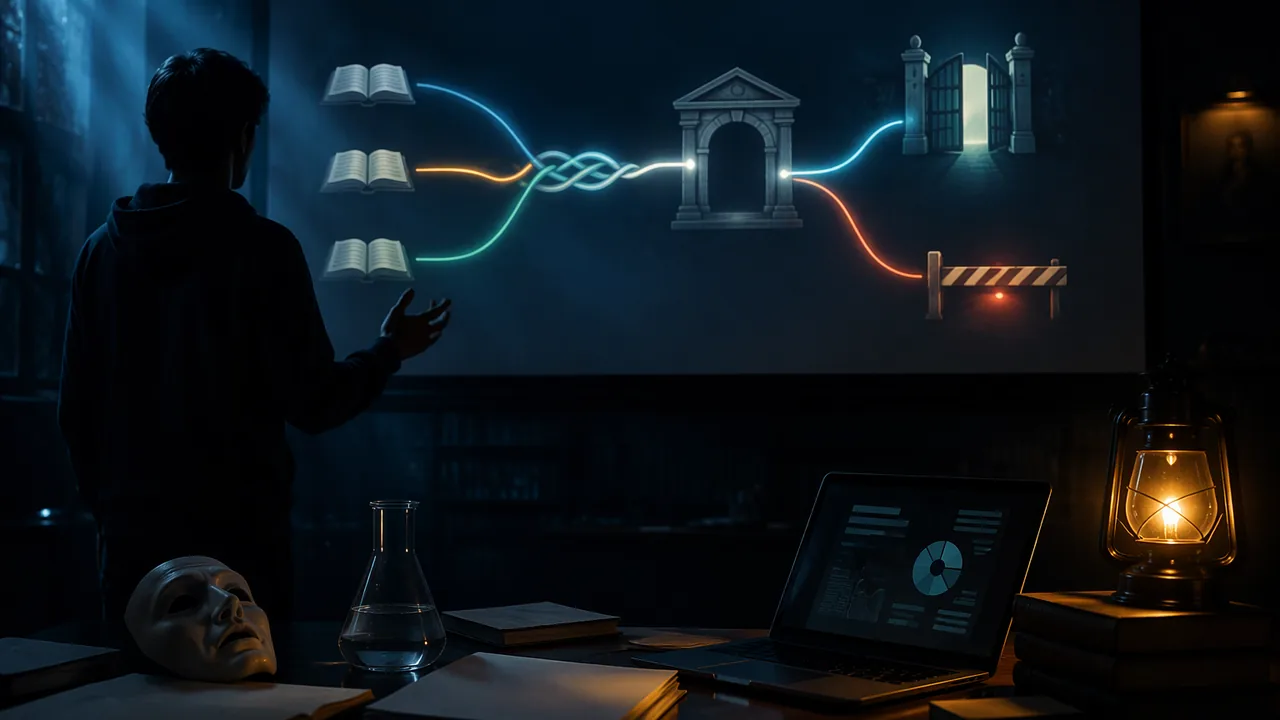
Synthesis. Every body paragraph is braided (Lesson 4.4): your claim governs, sources serve. Run the highlighter test on your full draft.
Informative clarity (9-10.W.2.A). Define your key terms — authority, responsibility, conscience — so readers know exactly what you are arguing. Use transitions that name relationships between sections, not just sequence.
Digital publication (9-10.W.3.A.e). Publish the final paper to your course portfolio page in a clean, readable format with working links to any online sources. Digital publication means readers can check your sources — a reason to cite carefully.
The presentation (9-10.SL.2.A, 9-10.SL.2.B, 9-10.SL.2.C). Four to five minutes. Present your claim early, your strongest evidence, and your answer to the strongest objection. Include at least one visual that carries information your narration does not repeat — a timeline of the texts, a comparison chart, a still from the 1910 film set against a passage from the novel. Provide captions or a transcript. A live presentation in a scheduled session is an equal-credit alternative to recording.
Vocabulary (9-10.RI.1.B). Use the semester’s academic vocabulary precisely: conscience, complicity, civil disobedience, transformation, synthesis.
Integrity. Your proposal, bibliography and drafts are part of the grade because they make your thinking visible. A final paper whose sources do not match the bibliography, or whose argument does not grow from the drafts, will be discussed with you.
Reading: Key assignment packet: prompt, passages, rubric and models
Sophocles, Antigone, translated by R. C. Jebb, Wikisource https://en.wikisource.org/wiki/Antigone_%28Jebb%29; Mary Shelley, Frankenstein; or, The Modern Prometheus (1818 text), Project Gutenberg eBook 41445 (https://www.gutenberg.org/ebooks/41445); Henry David Thoreau, Resistance to Civil Government (1849), Wikisource https://en.wikisource.org/wiki/Resistance_to_Civil_Government; [Walter Scott, attributed], Remarks on Frankenstein, Blackwood’s Edinburgh Magazine, vol. 2, no. 12 (March 1818), Wikisource https://en.wikisource.org/w/index.php?title=Blackwood%27s_Magazine/Volume_2/Issue_12/Remarks_on_Frankenstein&action=render. Retrieved 2026-09-26. · SLS original framing, rubric, models and checklists; quoted passages are public domain (Sophocles, tr. Jebb, 1888; Shelley, 1818; Thoreau, 1849; review in Blackwood’s Edinburgh Magazine, 1818)
Take your position before you read the model.
What is hosted. The full prompt, key passages from the semester texts located by line or by volume and chapter, a four-level rubric, a model position and outline, an exemplar paragraph, a Works Cited model and a presentation checklist. Sources: Sophocles, Antigone, translated by R. C. Jebb, Wikisource https://en.wikisource.org/wiki/Antigone_%28Jebb%29 (line numbers in square brackets are Jebb’s Greek line numbers, printed every tenth line); Mary Shelley, Frankenstein; or, The Modern Prometheus (1818 text), Project Gutenberg eBook 41445 (https://www.gutenberg.org/ebooks/41445); Henry David Thoreau, Resistance to Civil Government (1849), Wikisource https://en.wikisource.org/wiki/Resistance_to_Civil_Government; [Walter Scott, attributed], Remarks on Frankenstein, Blackwood’s Edinburgh Magazine, vol. 2, no. 12 (March 1818), Wikisource https://en.wikisource.org/w/index.php?title=Blackwood%27s_Magazine/Volume_2/Issue_12/Remarks_on_Frankenstein&action=render. Retrieved 2026-09-26. The prompt, rubric, models and checklists are SLS original.
1. The prompt
Answer the semester’s question: when, if ever, is it right to defy an authority or to refuse a responsibility? Write a 1,300–1,600 word researched argument. It must take a position (not “it depends”), define your key terms, and use at least two semester texts including one full-length work (Antigone or Frankenstein), at least three vetted secondary sources from your annotated bibliography, one paragraph that represents a secondary source fairly and disagrees with it, and one paragraph analyzing how a text transforms its source material (Lesson 4.1). Publish it to your portfolio page, then present it in 4–5 minutes with a visual that carries information your narration does not repeat, and captions or a transcript.
2. Key passages, located
Antigone answers Creon (about Greek lines 450–60)
Yes; for it was not Zeus that had published [450] me that edict; not such are the laws set among men by the Justice who dwells with the gods below; nor deemed I that thy decrees were of such force, that a mortal could override the unwritten and unfailing statutes of heaven. For their life is not of to-day or yesterday, but from all time, and no man knows when they were first put forth. Not through dread of any human pride could I answer to the gods for breaking these
No, whomsoever the city may appoint, that man must be obeyed, in little things and great, in just things and unjust
— Creon, Sophocles, Antigone, tr. Jebb, about lines 666–68
I think that we should be men first, and subjects afterward. It is not desirable to cultivate a respect for the law, so much as for the right.
— Thoreau, Resistance to Civil Government (1849)
Had I a right, for my own benefit, to inflict this curse upon everlasting generations? I had before been moved by the sophisms of the being I had created; I had been struck senseless by his fiendish threats: but now, for the first time, the wickedness of my promise burst upon me; I shuddered to think that future ages might curse me as their pest, whose selfishness had not hesitated to buy its own peace at the price perhaps of the existence of the whole human race.
— Victor, Vol. III, Ch. III
I have murdered the lovely and the helpless; I have strangled the innocent as they slept, and grasped to death his throat who never injured me or any other living thing. I have devoted my creator, the select specimen of all that is worthy of love and admiration among men, to misery; I have pursued him even to that irremediable ruin.
— The creature, Vol. III, Ch. VII
The result is, this monster, who was at first, according to his own account, but a harmless monster, becomes ferocious and malignant, in consequence of finding all his approaches to human society repelled with injurious violence and offensive marks of disgust.
— The 1818 review in Blackwood’s Edinburgh Magazine (a secondary source)
3. Rubric (SLS original, four levels)
| Criterion | 4 Exemplary | 3 Proficient | 2 Developing | 1 Beginning |
|---|---|---|---|---|
| Position (9-10.W.2.A) | A defensible answer with defined key terms and a precise limit. | A clear answer with terms defined. | An answer that says “it depends.” | No position. |
| Synthesis (9-10.W.1.A) | Sources braided; your analysis outweighs borrowed material in every paragraph. | Mostly braided. | Sources reported one after another. | Little analysis. |
| Evidence (9-10.W.1.A.b, 9-10.RL.3.B) | Two semester texts, three vetted sources, a disagreement paragraph and a source-transformation paragraph. | All present, one thin. | One requirement missing. | Two or more missing. |
| Integrity and citation (9-10.W.1.A.b, 9-10.W.3.A.b) | Accurate MLA; bibliography matches the paper. | Minor MLA slips. | Sources not matched to the bibliography. | Uncited or copied text. |
| Publication (9-10.W.3.A.e) | Readable format, working links. | Readable. | Hard to read. | Not published. |
| Presentation (9-10.SL.2.A, 9-10.SL.2.B, 9-10.SL.2.C) | Claim early, strongest evidence and the objection; the visual carries information; captions supplied. | Clear structure; visual decorative. | Uneven. | Not presented. |
4. A model position and outline (SLS original)
Position. It is right to defy an authority when obedience would require an active wrong, but not merely when the law is unwise. Antigone and Thoreau draw that line differently: Antigone appeals to laws that “no man knows when they were first put forth,” while Thoreau appeals to individual conscience.
- Introduction: the question, key terms (authority, responsibility, conscience), the position.
- Antigone: her appeal to unwritten laws and its cost.
- Thoreau: the “men first, and subjects afterward” passage and the risk of his individualism.
- Frankenstein: refusing a responsibility: Victor’s reasoning about the companion and the creature’s confession.
- Source transformation: how Shelley turns Prometheus into a warning (Lesson 4.1).
- Disagreement paragraph: the 1818 reviewer’s reading, represented fairly and tested.
- Conclusion: what the semester’s texts make visible about who owes what to whom.
5. An exemplar paragraph (SLS original)
Antigone and Thoreau both appeal beyond the law, but they defend the appeal differently. Antigone says the edict cannot override “the unwritten and unfailing statutes of heaven,” a claim about duties older than any city. Thoreau, by contrast, says “we should be men first, and subjects afterward,” a claim about the individual. The difference matters for the question I am answering, because a duty to the dead cannot be settled by a vote, while a claim of individual conscience can be tested by asking what it costs the person who makes it.
6. Works Cited model (SLS original)
- Shelley, Mary Wollstonecraft. Frankenstein; or, The Modern Prometheus. Lackington, Hughes, Harding, Mavor and Jones, 1818. Project Gutenberg, www.gutenberg.org/ebooks/41445.
- Sophocles. Antigone. Translated by R. C. Jebb, Cambridge UP, 1917. Wikisource, en.wikisource.org/wiki/Antigone_(Jebb).
- Thoreau, Henry David. “Resistance to Civil Government.” 1849. Wikisource, en.wikisource.org/wiki/Resistance_to_Civil_Government.
- [Scott, Walter, attributed.] “Remarks on Frankenstein.” Blackwood’s Edinburgh Magazine, vol. 2, no. 12, Mar. 1818, pp. [page range from the source]. Wikisource.
7. Presentation checklist (SLS original)
- Claim in the first 30 seconds.
- One piece of evidence, one objection, one answer.
- One visual that adds information (a timeline of the texts, a chart, a title card from the 1910 film set against a passage of the novel).
- Captions or a transcript.
- A live presentation is an equal-credit alternative to recording.
Formative check
Work through these before moving on. They are not graded — they tell you whether the standard below has landed yet.
synthesis
Tap to revealSources combined under the writer’s own claim.
source transformation
Tap to revealHow an author changes what they inherit.
primary vs secondary source
Tap to revealOriginal material versus later interpretation.
adaptation
Tap to revealA version in a new medium.
complicity
Tap to revealSupporting a wrong by going along with it.
Your presentation slide lists the same three points you say aloud. What should you change?
How confident are you that you can write, publish and present a researched argument that answers a real question?
Submit: Semester Research Paper (1,300-1,600 words, published) + 4-5 minute presentation
Task: Answer the semester’s question — when is it right to defy an authority or refuse a responsibility? — with a researched argument synthesizing semester texts and secondary sources.
Submission workflow
- Stage 1 — Proposal and annotated bibliography (from Lesson 4.2), with revised research question (Lesson 4.4).
- Stage 2 — Peer-reviewed draft. A partner runs the highlighter test and checks the disagreement paragraph; submit a revision note.
- Stage 3 — Final paper, 1,300-1,600 words, MLA, published to the portfolio page.
- Stage 4 — Presentation, 4-5 minutes with an information-carrying visual and captions or transcript.
How it is scored
| Criterion | What proficient looks like |
|---|---|
| Position (9-10.W.2.A) | A clear, defensible answer to the semester question, with key terms defined. |
| Synthesis (9-10.W.1.A) | Sources braided; the writer’s analysis outweighs borrowed material. |
| Evidence (9-10.W.1.A.b, 9-10.RL.3.B) | Two semester texts including a full-length work, three vetted sources, a disagreement paragraph, and a source-transformation paragraph. |
| Integrity and citation (9-10.W.1.A.b, 9-10.W.3.A.b) | Accurate MLA; bibliography matches the paper. |
| Publication (9-10.W.3.A.e) | Published in a readable format with working links. |
| Presentation (9-10.SL.2.A, 9-10.SL.2.B, 9-10.SL.2.C) | Claim early, strongest evidence and objection addressed; visual carries information; captions or transcript supplied. |