explain how Creon’s first speech presents his principles as the ground of his edict, show what his reaction to the Guard’s report reveals about him, and argue whom the ode “Wonders are many” judges by the standard in its final stanza.
Instruction
The first episode belongs to Creon. He enters as a new king, speaks for the first time, and within a few minutes of stage time he has been defied. Then the Chorus sings the most famous ode in Greek tragedy. Read the two together, because Sophocles placed them side by side on purpose.
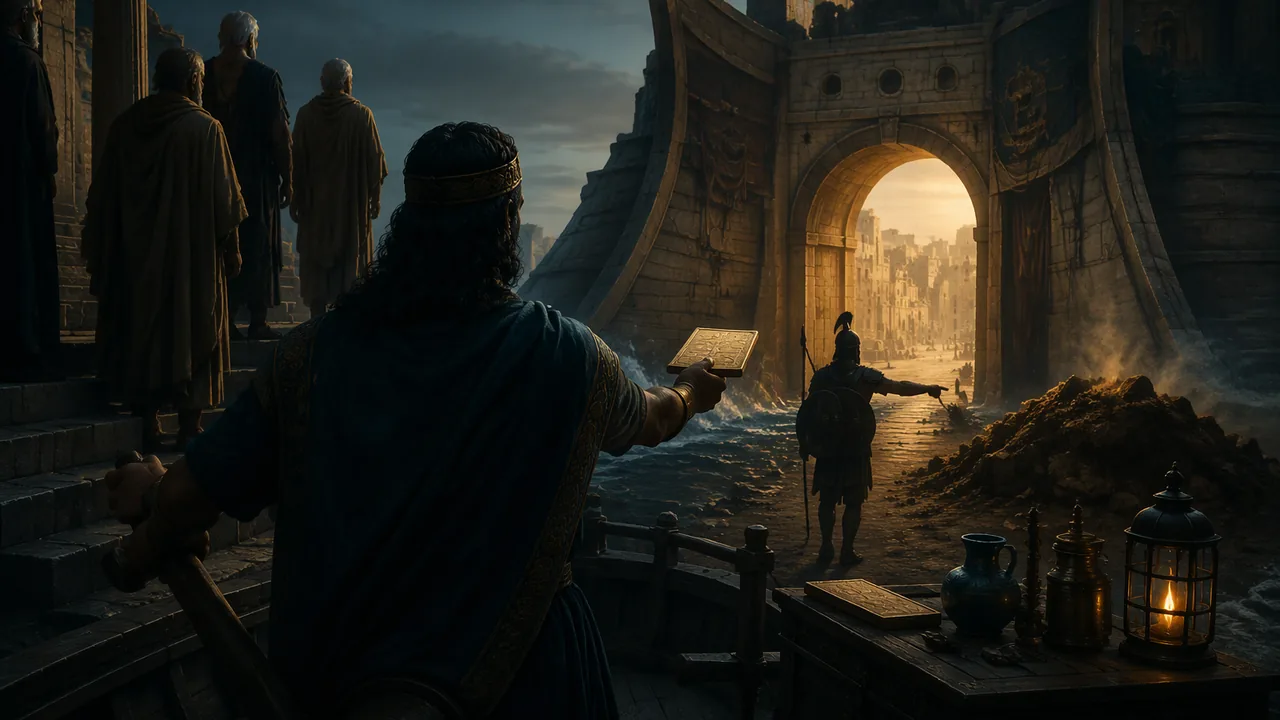
A speech built like a law. Creon does not begin with the edict. He begins with the city: “the vessel of our State, after being tossed on wild waves, hath once more been safely steadied by the gods.” The ship of state is an old Greek metaphor, and he returns to it to close his principles: “our country is the ship that bears us safe, and that only while she prospers in our voyage can we make true friends.” Only then does the edict arrive, introduced as a conclusion: “Such are the rules by which I guard this city’s greatness.” The order is the argument. If you accept the principles, the decree seems to follow. Notice what one principle demands: “if any makes a friend of more account than his fatherland, that man hath no place in my regard.” In the prologue Antigone has already chosen a brother over the city. The audience can see the collision coming; Creon cannot.
The test he sets himself. Creon also says, “No man can be fully known, in soul and spirit and mind, until he hath been seen versed in rule and law-giving.” This is dramatic irony: a character announces a test without knowing that the play is about to apply it to him. He adds that a ruler who, “through some fear, keeps his lips locked” is “most base.” Hold on to that sentence. Later, ask who in Thebes is keeping silent out of fear, and of whom.
The Chorus does not quite agree. The elders answer, “Such is thy pleasure, Creon,” and add only that “thou hast power, I ween, to take what order thou wilt.” That acknowledges his power without praising his judgment. When he asks them to stand guard over the decree, they ask him to give the job to “some younger man.”
The Guard and the first burial. The Guard is the play’s one comic voice, and his comedy is self-protection: his own dithering meant that “a short road was made long,” and before he will say what happened he insists, “I did not do the deed—I did not see the doer.” His report still matters. The corpse was “not shut within a tomb, but lightly strewn with dust, as by the hand of one who shunned a curse,” and there was no track, no tool mark, no sign of animals. A ritual covering of dust was enough, in Greek belief, to give the dead their due. When the Chorus wonders whether “this deed, perchance, be e’en the work of gods,” Creon explodes: “Cease, ere thy words fill me utterly with wrath, lest thou be found at once an old man and foolish.” He decides that his political enemies have bribed the guards: “Nothing so evil as money ever grew to be current among men.” Watch for this explanation to return. A ruler who sees every disagreement as bought has stopped listening.
“Wonders are many.” The ode is built in matched pairs of stanzas: a strophe and an antistrophe share the same meter, so that the second answers the first in sound and in the Chorus’s dance. The first three stanzas are a catalog of human mastery. Man crosses “the white sea,” wears down Earth, “the eldest of the gods,” snares birds and fish, yokes the horse and “the tireless mountain bull,” and teaches himself “speech, and wind-swift thought, and all the moods that mould a state.” One limit is named: “only against Death shall he call for aid in vain.” Then the last stanza turns: “Cunning beyond fancy’s dream is the fertile skill which brings him, now to evil, now to good.”
One word, two meanings. The Greek word Jebb translates as “wonders” (deina) also means “terrible.” Sophocles’ audience heard both at once: human beings are the most wonderful thing on earth and the most dangerous. Jebb’s English has to choose one meaning, so read the ode with the other in your ear.
Whom does the ode judge? The final stanza names the condition for a city’s survival: “When he honours the laws of the land, and that justice which he hath sworn by the gods to uphold, proudly stands his city.” The elders mean the unknown burier, the lawbreaker who “for his rashness, dwells with sin.” But the sentence joins two things the play is about to pull apart: the laws of the land and the justice of the gods. Creon claims the first; Antigone has already claimed the second. Placed between the report of the burial and the arrest that follows, the ode becomes a measure for everyone on stage, the king included.
As you read, keep two lists. In one, copy every sentence in which Creon explains his own motives. In the other, note what his words and actions suggest about motives he does not name. The gap between the two lists is where his character begins.
📖 Before this lesson, read: Antigone, First Episode and First Stasimon (lines 162-375)
The reading opens over the lesson; close it to come back to exactly where you were.
Formative check
Work through these before moving on. They are not graded — they tell you whether the standard below has landed yet.
Creon states his principles before he announces the edict. What is the effect of that order?
When the Chorus suggests that the gods may have buried Polyneices, Creon considers the idea before rejecting it.
Creon pictures the city as a that carries its citizens safely. The ode names one limit on human skill: only against does man call for aid in vain. Its last stanza says that skill brings him “now to evil, now to .”
Copy the sentence from the last stanza of the ode that begins “When he honours the laws of the land.” Then write a paragraph arguing whom the sentence fits best at this point in the play: the unknown burier, Creon, or both. Support your answer with one quotation from Creon’s first speech or his reply to the Guard and one from the ode, and explain each. End with one sentence on why Sophocles placed this ode between the report of the burial and the scene that follows it.
How confident are you that you can explain how Creon’s first speech and the ode “Wonders are many” set up the play’s conflict between two kinds of law?
Antigone, First Episode and First Stasimon (lines 162-375)
Antigone, First Episode (lines 162-331)
Source: Sophocles, Antigone, translated by R. C. Jebb (The Tragedies of Sophocles, Cambridge University Press, 1917), Wikisource (en.wikisource.org) · Public domain
Enter Creon, from the central doors of the palace, in the garb of king; with two attendants.
Cr. Sirs, the vessel of our State, after being tossed on wild waves, hath once more been safely steadied by the gods: and ye, out of all the folk, have been called apart by my summons, because I knew, first of all, how true and constant was your reverence for the royal power of Laïus; how, again, when Oedipus was ruler of our land, and when he had perished, your steadfast loyalty still upheld their children. Since, then, his sons have fallen in one day by a twofold doom,—each smitten by the other, each stained with a brother’s blood,—I now possess the throne and all its powers, by nearness of kinship to the dead.
No man can be fully known, in soul and spirit and mind, until he hath been seen versed in rule and law-giving. For if any, being supreme guide of the State, cleaves not to the best counsels, but, through some fear, keeps his lips locked, I hold, and have ever held, him most base; and if any makes a friend of more account than his fatherland, that man hath no place in my regard. For I—be Zeus my witness, who sees all things always—would not be silent if I saw ruin, instead of safety, coming to the citizens; nor would I ever deem the country’s foe a friend to myself; remembering this, that our country is the ship that bears us safe, and that only while she prospers in our voyage can we make true friends.
Such are the rules by which I guard this city’s greatness. And in accord with them is the edict which I have now published to the folk touching the sons of Oedipus;—that Eteocles, who hath fallen fighting for our city, in all renown of arms, shall be entombed, and crowned with every rite that follows the noblest dead to their rest. But for his brother, Polyneices,—who came back from exile, and sought to consume utterly with fire the city of his fathers and the shrines of his fathers’ gods,—sought to taste of kindred blood, and to lead the remnant into slavery;—touching this man, it hath been proclaimed to our people that none shall grace him with sepulture or lament, but leave him unburied, a corpse for birds and dogs to eat, a ghastly sight of shame.
Such the spirit of my dealing; and never, by deed of mine, shall the wicked stand in honour before the just; but whoso hath good will to Thebes, he shall be honoured of me, in his life and in his death.
Ch. Such is thy pleasure, Creon, son of Menoeceus, touching this city’s foe, and its friend; and thou hast power, I ween, to take what order thou wilt, both for the dead, and for all us who live.
Cr. See, then, that ye be guardians of the mandate.
Ch. Lay the burden of this task on some younger man.
Cr. Nay, watchers of the corpse have been found.
Ch. What, then, is this further charge that thou wouldst give?
Cr. That ye side not with the breakers of these commands.
Ch. No man is so foolish that he is enamoured of death.
Cr. In sooth, that is the meed; yet lucre hath oft ruined men through their hopes.
Enter Guard.
Gu. My liege, I will not say that I come breathless from speed, or that I have plied a nimble foot; for often did my thoughts make me pause, and wheel round in my path, to return. My mind was holding large discourse with me; ‘Fool, why goest thou to thy certain doom?’ ‘Wretch, tarrying again? And if Creon hears this from another, must not thou smart for it?’ So debating, I went on my way with lagging steps, and thus a short road was made long. At last, however, it carried the day that I should come hither—to thee; and, though my tale be nought, yet will I tell it; for I come with a good grip on one hope,—that I can suffer nothing but what is my fate.
Cr. And what is it that disquiets thee thus?
Gu. I wish to tell thee first about myself—I did not do the deed—I did not see the doer—it were not right that I should come to any harm.
Cr. Thou hast a shrewd eye for thy mark; well dost thou fence thyself round against the blame:—clearly thou hast some strange thing to tell.
Gu. Aye, truly; dread news makes one pause long.
Cr. Then tell it, wilt thou, and so get thee gone?
Gu. Well, this is it.—The corpse—some one hath just given it burial, and gone away,—after sprinkling thirsty dust on the flesh, with such other rites as piety enjoins.
Cr. What sayest thou? What living man hath dared this deed?
Gu. I know not; no stroke of pickaxe was seen there, no earth thrown up by mattock; the ground was hard and dry, unbroken, without track of wheels; the doer was one who had left no trace. And when the first day-watchman showed it to us, sore wonder fell on all. The dead man was veiled from us; not shut within a tomb, but lightly strewn with dust, as by the hand of one who shunned a curse. And no sign met the eye as though any beast of prey or any dog had come nigh to him, or torn him.
Then evil words flew fast and loud among us, guard accusing guard; and it would e’en have come to blows at last, nor was there any to hinder. Every man was the culprit, and no one was convicted, but all disclaimed knowledge of the deed. And we were ready to take red-hot iron in our hands;—to walk through fire;—to make oath by the gods that we had not done the deed,—that we were not privy to the planning or the doing.
At last, when all our searching was fruitless, one spake, who made us all bend our faces on the earth in fear; for we saw not how we could gainsay him, or escape mischance if we obeyed. His counsel was that this deed must be reported to thee, and not hidden. And this seemed best; and the lot doomed my hapless self to win this prize. So here I stand,—as unwelcome as unwilling, well I wot; for no man delights in the bearer of bad news.
Ch. O king, my thoughts have long been whispering, can this deed, perchance, be e’en the work of gods?
Cr. Cease, ere thy words fill me utterly with wrath, lest thou be found at once an old man and foolish. For thou sayest what is not to be borne, in saying that the gods have care for this corpse. Was it for high reward of trusty service that they sought to hide his nakedness, who came to burn their pillared shrines and sacred treasures, to burn their land, and scatter its laws to the winds? Or dost thou behold the gods honouring the wicked? It cannot be. No! From the first there were certain in the town that muttered against me, chafing at this edict, wagging their heads in secret; and kept not their necks duly under the yoke, like men contented with my sway.
‘Tis by them, well I know, that these have been beguiled and bribed to do this deed. Nothing so evil as money ever grew to be current among men. This lays cities low, this drives men from their homes, this trains and warps honest souls till they set themselves to works of shame; this still teaches folk to practise villanies, and to know every godless deed.
But all the men who wrought this thing for hire have made it sure that, soon or late, they shall pay the price. Now, as Zeus still hath my reverence, know this—I tell it thee on my oath:—If ye find not the very author of this burial, and produce him before mine eyes, death alone shall not be enough for you, till first, hung up alive, ye have revealed this outrage,—that henceforth ye may thieve with better knowledge whence lucre should be won, and learn that it is not well to love gain from every source. For thou wilt find that ill-gotten pelf brings more men to ruin than to weal.
Gu. May I speak? Or shall I just turn and go?
Cr. Knowest thou not that even now thy voice offends?
Gu. Is thy smart in the ears, or in the soul?
Cr. And why wouldst thou define the seat of my pain?
Gu. The doer vexes thy mind, but I, thine ears.
Cr. Ah, thou art a born babbler, ’tis well seen.
Gu. May be, but never the doer of this deed.
Cr. Yea, and more,—the seller of thy life for silver.
Gu. Alas! ‘Tis sad, truly, that he who judges should misjudge.
Cr. Let thy fancy play with ‘judgment’ as it will;—but, if ye show me not the doers of these things, ye shall avow that dastardly gains work sorrows.
Exit.
Gu. Well, may he be found! so ’twere best. But, be he caught or be he not—fortune must settle that—truly thou wilt not see me here again. Saved, even now, beyond hope and thought, I owe the gods great thanks.
Exit.
Antigone, First Stasimon (“Wonders are many”) (lines 332-375)
Source: Sophocles, Antigone, translated by R. C. Jebb (The Tragedies of Sophocles, Cambridge University Press, 1917), Wikisource (en.wikisource.org) · Public domain
Chorus.
str. 1. Wonders are many, and none is more wonderful than man; the power that crosses the white sea, driven by the stormy south-wind, making a path under surges that threaten to engulf him; and Earth, the eldest of the gods, the immortal, the unwearied, doth he wear, turning the soil with the offspring of horses, as the ploughs go to and fro from year to year.
ant. 1. And the light-hearted race of birds, and the tribes of savage beasts, and the sea-brood of the deep, he snares in the meshes of his woven toils, he leads captive, man excellent in wit. And he masters by his arts the beast whose lair is in the wilds, who roams the hills; he tames the horse of shaggy mane, he puts the yoke upon its neck, he tames the tireless mountain bull.
str. 2. And speech, and wind-swift thought, and all the moods that mould a state, hath he taught himself; and how to flee the arrows of the frost, when ’tis hard lodging under the clear sky, and the arrows of the rushing rain; yea, he hath resource for all; without resource he meets nothing that must come: only against Death shall he call for aid in vain; but from baffling maladies he hath devised escapes.
ant. 2. Cunning beyond fancy’s dream is the fertile skill which brings him, now to evil, now to good. When he honours the laws of the land, and that justice which he hath sworn by the gods to uphold, proudly stands his city: no city hath he who, for his rashness, dwells with sin. Never may he share my hearth, never think my thoughts, who doth these things!