analyze how Antigone and Creon argue in the second episode, what each claims and what each fears, explain how the rapid exchange of single lines sharpens the conflict, and compare how the scene would be represented in the original masked theater and in a modern staging.
Instruction
The second episode is the center of the play’s argument: the two laws meet face to face. It is also a scene about evidence. Notice how much of it is report, how much is open confession, and how little of it is persuasion.
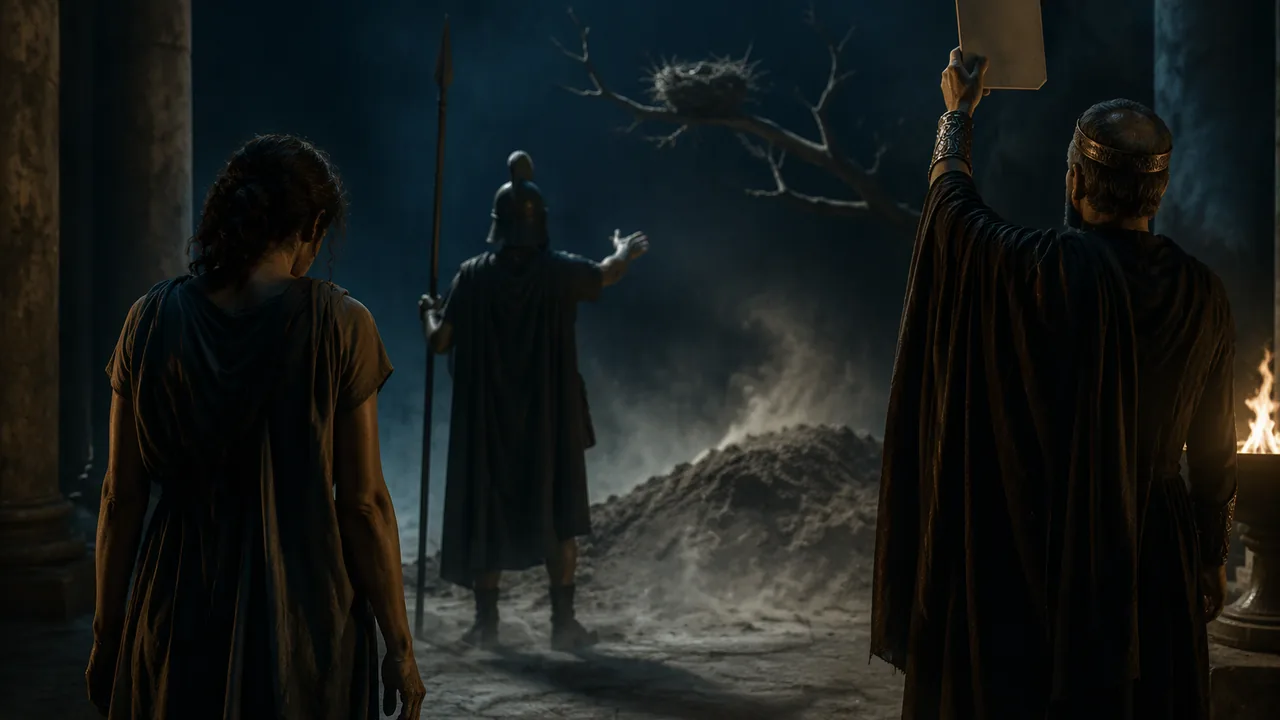
The burial we never see. The Guard returns, though he had sworn he would not, and he opens with a joke against himself: “against nothing should men pledge their word.” Then he narrates the arrest. The guards had swept the dust off the corpse and sat upwind of the smell; at noon a whirlwind filled the plain with dust; when it passed, Antigone was there, and “she cried aloud with the sharp cry of a bird in its bitterness,—even as when, within the empty nest, it sees the bed stripped of its nestlings.” The simile turns a lawbreaker into a grieving mother bird and her brother’s bared body into a robbed nest. Greek tragedy kept such actions offstage and brought them to the audience through a speaker’s report, so this simile is the only picture of the burial the audience ever receives. Sophocles chose what that picture would be.
“I avow it.” Creon turns to the silent figure: “Thou—thou whose face is bent to earth—dost thou avow, or disavow, this deed?” The line works as a stage direction. Antigone has entered with her head down and has said nothing. Her answer is brief: “I avow it; I make no denial.” She will offer no defense of the facts, only of her right to have done it.
The speech on the two laws. Antigone’s reply makes three moves. The first concerns authority: “it was not Zeus that had published me that edict.” The second ranks the laws: Creon’s decrees are not “of such force, that a mortal could override the unwritten and unfailing statutes of heaven,” statutes whose life “is not of to-day or yesterday, but from all time.” The third weighs costs: to die is “trifling grief,” but to leave “my mother’s son” unburied would have grieved her. She does not argue that Polyneices was innocent or that the edict is poor policy. She argues that it lies outside any king’s authority. And she ends with a sting: “it may be that a foolish judge arraigns my folly.”
Creon’s reply. Creon answers with images of things that break and things that are broken in: “’tis the stiffest iron, baked to hardness in the fire, that thou shalt oftenest see snapped and shivered,” and horses “brought to order by a little curb.” The images are aimed at Antigone, but they describe any rigid will, his own included. Then the deeper fear surfaces: “Now verily I am no man, she is the man, if this victory shall rest with her.” The quarrel is now about authority and about gender, not only about law. And with no evidence he accuses Ismene, whom he saw “raving” indoors, the same habit of suspicion he showed toward the guards.
Stichomythia. The debate then speeds up into stichomythia, single lines traded back and forth like blows, each speaker seizing the other’s word and turning it. Creon: “A foe is never a friend—not even in death.” Antigone: “‘Tis not my nature to join in hating, but in loving.” In two lines the whole conflict is stated. For Creon, loyalty is set by the city’s wars; for Antigone, by blood and love.
Ismene returns. Ismene, who refused to help in the prologue, now claims a share of the guilt. Antigone turns her away: “a friend in words is not the friend that I love,” and “Thy choice was to live; mine, to die.” Is this cruelty, or a sister keeping Ismene alive? The text supports both readings. Ismene’s question to Creon then points to the next episode: “But wilt thou slay the betrothed of thine own son?” Creon answers, “Nay, there are other fields for him to plough.”
The scene in performance. Sophocles wrote for an open-air theater of masked actors, no more than three of them speaking in any scene, with the Chorus of elders watching from the dancing floor below. Look at the exits: the Guard leaves before Ismene enters, so three actors can play the whole episode. For Sophocles’ audience, leaving a body unburied was an offense against the gods below, so Antigone’s claim would have sounded less private than it may to you. A modern stage or film version can show Antigone’s face in close-up while she speaks; the original could not, and put the whole weight on voice, posture and words. As you read, decide what a production must choose that the script leaves open. Does Antigone ever raise her head, and when?
📖 Before this lesson, read: Antigone, Second Episode and Second Stasimon (lines 376-625)
The reading opens over the lesson; close it to come back to exactly where you were.
Formative check
Work through these before moving on. They are not graded — they tell you whether the standard below has landed yet.
Which statement best describes the argument Antigone makes to Creon?
Antigone accepts Ismene’s offer to share the blame for the burial.
Single lines traded rapidly between two speakers are called . Creon says, “A foe is never a —not even in death.” Antigone answers that it is not her nature to join in hating, but in .
Compare the scene on the page with the scene in performance. First, list three decisions the script leaves to a production (for example, when Antigone raises her head, where Ismene stands, how Creon delivers the iron and horse images). Then write a paragraph comparing how Sophocles’ original theater, with masks, no close-ups and at most three actors, and a modern stage or film version would each present Antigone’s speech on the unwritten laws: what each medium can emphasize, and what each must leave out. Quote at least two lines from the episode.
How confident are you that you can explain what Antigone and Creon each claim and fear in the second episode, using quoted lines rather than plot summary?
Antigone, Second Episode and Second Stasimon (lines 376-625)
Antigone, Second Episode (lines 376-581)
Source: Sophocles, Antigone, translated by R. C. Jebb (The Tragedies of Sophocles, Cambridge University Press, 1917), Wikisource (en.wikisource.org) · Public domain
Enter the Guard on the spectators’ left, leading in Antigone.
What portent from the gods is this?—my soul is amazed. I know her—how can I deny that yon maiden is Antigone?
O hapless, and child of hapless sire,—of Oedipus! What means this? Thou brought a prisoner?—thou, disloyal to the king’s laws, and taken in folly?
Guard.
Here she is, the doer of the deed:—we caught this girl burying him:—but where is Creon?
Ch. Lo, he comes forth again from the house, at our need.
Cr. What is it? What hath chanced, that makes my coming timely?
Gu. O king, against nothing should men pledge their word; for the after-thought belies the first intent. I could have vowed that I should not soon be here again,—scared by thy threats, with which I had just been lashed: but,—since the joy that surprises and transcends our hopes is like in fulness to no other pleasure,—I have come, though ’tis in breach of my sworn oath, bringing this maid; who was taken showing grace to the dead. This time there was no casting of lots; no, this luck hath fallen to me, and to none else. And now, sire, take her thyself, question her, examine her, as thou wilt; but I have a right to free and final quittance of this trouble.
Cr. And thy prisoner here — how and whence hast thou taken her?
Gu. She was burying the man; thou knowest all.
Cr. Dost thou mean what thou sayest? Dost thou speak aright?
Gu. I saw her burying the corpse that thou hadst forbidden to bury. Is that plain and clear?
Cr. And how was she seen? how taken in the act?
Gu. It befell on this wise. When we had come to the place,—with those dread menaces of thine upon us,—we swept away all the dust that covered the corpse, and bared the dank body well; and then sat us down on the brow of the hill, to windward, heedful that the smell from him should not strike us; every man was wide awake, and kept his neighbour alert with torrents of threats, if any one should be careless of this task.
So went it, until the sun’s bright orb stood in mid heaven, and the heat began to burn: and then suddenly a whirlwind lifted from the earth a storm of dust, a trouble in the sky, and filled the plain, marring all the leafage of its woods; and the wide air was choked therewith: we closed our eyes, and bore the plague from the gods.
And when, after a long while, this storm had passed, the maid was seen; and she cried aloud with the sharp cry of a bird in its bitterness,—even as when, within the empty nest, it sees the bed stripped of its nestlings. So she also, when she saw the corpse bare, lifted up a voice of wailing, and called down curses on the doers of that deed. And straightway she brought thirsty dust in her hands; and from a shapely ewer of bronze, held high, with thrice-poured drink-offering she crowned the dead.
We rushed forward when we saw it, and at once closed upon our quarry, who was in no wise dismayed. Then we taxed her with her past and present doings; and she stood not on denial of aught,—at once to my joy and to my pain. To have escaped from ills one’s self is a great joy; but ’tis painful to bring friends to ill. Howbeit, all such things are of less account to me than mine own safety.
Cr. Thou—thou whose face is bent to earth—dost thou avow, or disavow, this deed?
An. I avow it; I make no denial.
Cr. (To Guard.) Thou canst betake thee whither thou wilt, free and clear of a grave charge.
Exit Guard.
(To Antigone.) Now, tell me thou—not in many words, but briefly—knewest thou that an edict had forbidden this?
An. I knew it: could I help it? It was public.
Cr. And thou didst indeed dare to transgress that law?
An. Yes; for it was not Zeus that had published me that edict; not such are the laws set among men by the Justice who dwells with the gods below; nor deemed I that thy decrees were of such force, that a mortal could override the unwritten and unfailing statutes of heaven. For their life is not of to-day or yesterday, but from all time, and no man knows when they were first put forth.
Not through dread of any human pride could I answer to the gods for breaking these. Die I must,—I knew that well (how should I not?)—even without thy edicts. But if I am to die before my time, I count that a gain: for when any one lives, as I do, compassed about with evils, can such an one find aught but gain in death?
So for me to meet this doom is trifling grief; but if I had suffered my mother’s son to lie in death an unburied corpse, that would have grieved me; for this, I am not grieved. And if my present deeds are foolish in thy sight, it may be that a foolish judge arraigns my folly.
Ch. The maid shows herself passionate child of passionate sire, and knows not how to bend before troubles.
Cr. Yet I would have thee know that o’er-stubborn spirits are most often humbled; ’tis the stiffest iron, baked to hardness in the fire, that thou shalt oftenest see snapped and shivered; and I have known horses that show temper brought to order by a little curb; there is no room for pride, when thou art thy neighbour’s slave.—This girl was already versed in insolence when she transgressed the laws that had been set forth; and, that done, lo, a second insult,—to vaunt of this, and exult in her deed.
Now verily I am no man, she is the man, if this victory shall rest with her, and bring no penalty. No! be she sister’s child, or nearer to me in blood than any that worships Zeus at the altar of our house,—she and her kinsfolk shall not avoid a doom most dire; for indeed I charge that other with a like share in the plotting of this burial.
And summon her—for I saw her e’en now within,—raving, and not mistress of her wits. So oft, before the deed, the mind stands self-convicted in its treason, when folks are plotting mischief in the dark. But verily this, too, is hateful,—when one who hath been caught in wickedness then seeks to make the crime a glory.
An. Wouldst thou do more than take and slay me?
Cr. No more, indeed; having that, I have all.
An. Why then dost thou delay? In thy discourse there is nought that pleases me,—never may there be!—and so my words must needs be unpleasing to thee. And yet, for glory—whence could I have won a nobler, than by giving burial to mine own brother? All here would own that they thought it well, were not their lips sealed by fear. But royalty, blest in so much besides, hath the power to do and say what it will.
Cr. Thou differest from all these Thebans in that view.
An. These also share it; but they curb their tongues for thee.
Cr. And art thou not ashamed to act apart from them?
An. No; there is nothing shameful in piety to a brother.
Cr. Was it not a brother, too, that died in the opposite cause?
An. Brother by the same mother and the same sire.
Cr. Why, then, dost thou render a grace that is impious in his sight?
An. The dead man will not say that he so deems it.
Cr. Yea, if thou makest him but equal in honour with the wicked.
An. It was his brother, not his slave, that perished.
Cr. Wasting this land; while he fell as its champion.
An. Nevertheless, Hades desires these rites.
Cr. But the good desires not a like portion with the evil.
An. Who knows but this seems blameless in the world below?
Cr. A foe is never a friend—not even in death.
An. ‘Tis not my nature to join in hating, but in loving.
Cr. Pass, then, to the world of the dead, and, if thou must needs love, love them. While I live, no woman shall rule me.
Enter Ismene from the house, led in by two attendants.
Ch. Lo, yonder Ismene comes forth, shedding such tears as fond sisters weep; a cloud upon her brow casts its shadow over her darkly-flushing face, and breaks in rain on her fair cheek.
Cr. And thou, who, lurking like a viper in my house, wast secretly draining my life-blood, while I knew not that I was nurturing two pests, to rise against my throne—come, tell me now, wilt thou also confess thy part in this burial, or wilt thou forswear all knowledge of it?
Is. I have done the deed,—if she allows my claim,—and share the burden of the charge.
An. Nay, justice will not suffer thee to do that: thou didst not consent to the deed, nor did I give thee part in it.
Is. But, now that ills beset thee, I am not ashamed to sail the sea of trouble at thy side.
An. Whose was the deed, Hades and the dead are witnesses: a friend in words is not the friend that I love.
Is. Nay, sister, reject me not, but let me die with thee, and duly honour the dead.
An. Share not thou my death, nor claim deeds to which thou hast not put thy hand: my death will suffice.
Is. And what life is dear to me, bereft of thee?
An. Ask Creon; all thy care is for him.
Is. Why vex me thus, when it avails thee nought?
An. Indeed, if I mock, ’tis with pain that I mock thee.
Is. Tell me,—how can I serve thee, even now?
An. Save thyself: I grudge not thy escape.
Is. Ah, woe is me! And shall I have no share in thy fate?
An. Thy choice was to live; mine, to die.
Is. At least thy choice was not made without my protest.
An. One world approved thy wisdom; another, mine.
Is. Howbeit, the offence is the same for both of us.
An. Be of good cheer; thou livest; but my life hath long been given to death, that so I might serve the dead.
Cr. Lo, one of these maidens hath newly shown herself foolish, as the other hath been since her life began.
Is. Yea, O king, such reason as nature may have given abides not with the unfortunate, but goes astray.
Cr. Thine did, when thou chosest vile deeds with the vile.
Is. What life could I endure, without her presence?
Cr. Nay, speak not of her ‘presence’; she lives no more.
Is. But wilt thou slay the betrothed of thine own son?
Cr. Nay, there are other fields for him to plough.
Is. But there can never be such love as bound him to her.
Cr. I like not an evil wife for my son.
An. Haemon, beloved! How thy father wrongs thee!
Cr. Enough, enough of thee and of thy marriage!
Ch. Wilt thou indeed rob thy son of this maiden?
Cr. ‘Tis Death that shall stay these bridals for me.
Ch. ‘Tis determined, it seems, that she shall die.
Cr. Determined, yes, for thee and for me.—(To the two attendants.) No more delay—servants, take them within! Henceforth they must be women, and not range at large; for verily even the bold seek to fly, when they see Death now closing on their life.
Exeunt attendants, guarding Antigone and Ismene.—Creon remains.
Antigone, Second Stasimon (lines 582-625) Bridge summary — not the primary text
This is a short recap written for this course, not Sophocles’s own words, so you can follow the story between close-reading lessons.
{summary}