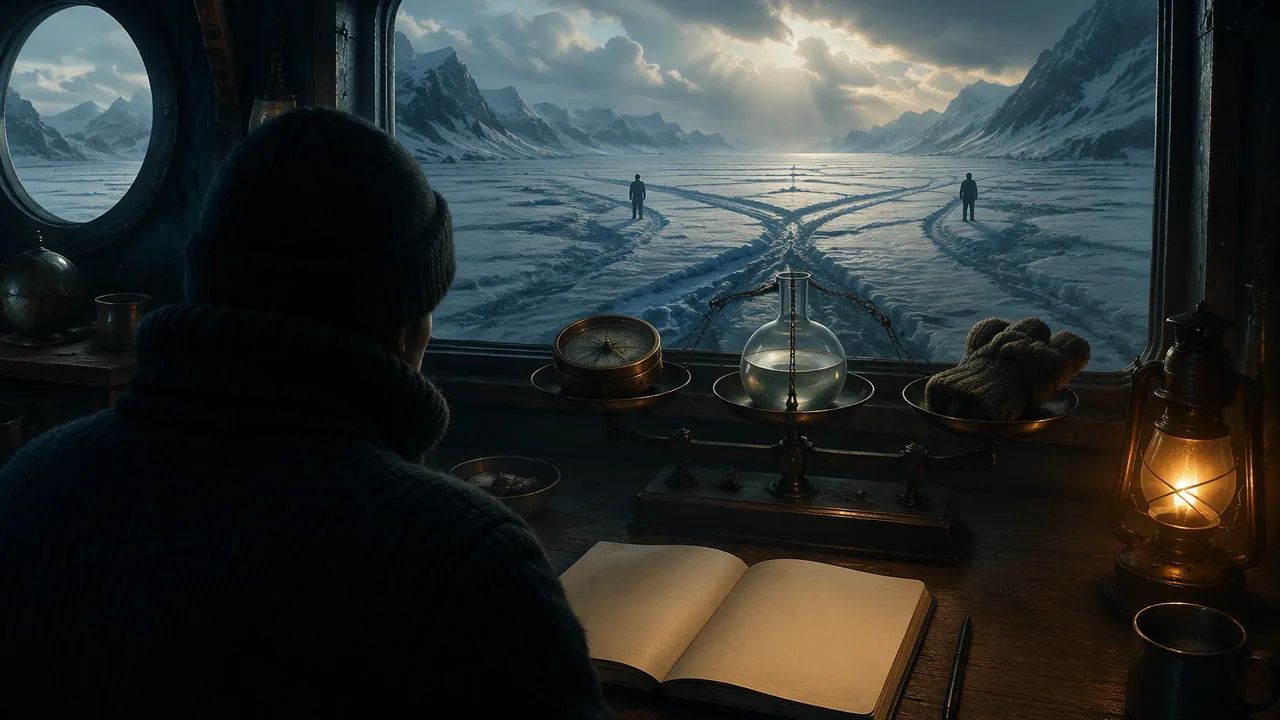
write a 1,000-1,200 word argument about responsibility in Frankenstein that develops claim and counterclaim with evidence from all three narrators, and defend it orally.
Instruction
Before you write, finish the novel: Volume III, Chapters 5 through 7, including Walton’s closing letters. Add the last deaths to the responsibility chart you began in Lesson 2.6, and notice that the final word on the creature belongs neither to Victor nor to the creature but to Walton, who must decide what to make of them both. This essay is the fullest argument you have written in this course so far: 1,000-1,200 words, a precise claim, a counterclaim with its own evidence, and evidence from all three narrators.
The question. Who or what bears the greater responsibility for the deaths in Frankenstein — Victor, the creature, the society that rejects the creature, or some combination you define precisely? Your claim must be contestable: a thoughtful classmate should be able to disagree using the same novel.
Structure. An introduction that states your claim and distinguishes it from alternate claims. Body paragraphs that develop your reasons in a logical order, each opening with a topic sentence that advances the argument. A counterclaim section that states the opposing view at full strength with its evidence and answers it, with transitions that tell the reader where the opposing view ends and your answer begins (Lesson 2.8). A conclusion (9-10.W.3.A.a) that follows from the argument and says what your reading makes visible — about responsibility, creation, or the danger of knowledge without care — rather than repeating your introduction.
Narrators and reliability. Use evidence from Walton, Victor and the creature. At least once, analyze how a narrator’s position affects the evidence: when Victor reports the creature’s words, or when the creature describes his own innocence, what might each leave out?
Theme (9-10.RL.1.D). Your argument should connect to a central idea the novel develops — the responsibility of creators, the effects of rejection, the pursuit of knowledge — and show how Shelley develops it across the book.
Conventions. Use colons and semicolons purposefully (9-10.W.3.A.c), cite page numbers in MLA from the 1818 text, and spell names correctly.
The defense (9-10.SL.1.C). Record 90 seconds: your claim, your strongest evidence, and how your view changed during drafting. Then record replies to two classmates who argued differently, summarizing their claim and qualifying or justifying your own in response.
Integrity. Frankenstein is one of the most written-about novels in English. Your stages must show your own developing argument; a final that appears from nowhere will be discussed with you.
📖 Before this lesson, read: Frankenstein; or, The Modern Prometheus, Volume 3, Chapters 5-7
The reading opens over the lesson; close it to come back to exactly where you were.
Reading: Key assignment packet: prompt, passages, rubric and model
Mary Shelley, Frankenstein; or, The Modern Prometheus (London: Lackington, Hughes, Harding, Mavor and Jones, 1818, three volumes), Project Gutenberg eBook 41445 (text from a photo-reprint of the 1818 edition), retrieved 2026-09-26 · SLS original framing, tables, models and keys; quoted passages are public domain (Shelley, 1818; Milton, 1667)
Choose your claim before you read the rubric.
What is hosted. The full prompt, key passages not hosted in Lessons 2.1, 2.6 and 2.8 (including the creature’s last speech to Walton, from the chapters you read for this lesson), a four-level rubric, a model thesis and outline and a short exemplar. Source: Mary Shelley, Frankenstein; or, The Modern Prometheus (London: Lackington, Hughes, Harding, Mavor and Jones, 1818, three volumes), Project Gutenberg eBook 41445 (text from a photo-reprint of the 1818 edition), retrieved 2026-09-26. Retrieved 2026-09-26. Passages hosted in the earlier readings of this unit (the creation, the creature’s plea, Justine’s trial, William’s death, the creature’s threats in Volumes II and III) remain available there.
Edition and references. Every passage from Frankenstein is from the 1818 first edition, in three volumes, and keeps its spelling and punctuation (for example “dæmon” and “Werter”). Passages are located by volume and chapter of that edition. The 1818 chapters restart in each volume (Vol. I has Chapters I–VII, Vol. II has I–IX, Vol. III has I–VII), so a Vol. II, Ch. II passage is not the same as Ch. II of a modern one-volume edition. Later editions (1831 and after) renumber chapters 1–24 and change some wording; if your copy differs, use the volume and chapter here to find the passage.
1. The prompt
Write a 1,000–1,200 word argument on this question: who or what bears the greater responsibility for the deaths in Frankenstein: Victor, the creature, the society that rejects the creature, or a combination you define precisely? Your claim must be contestable. Introduce it and distinguish it from alternate claims; develop your reasons in a logical order; state the strongest counterclaim at full strength with its own evidence and answer it; and end with a conclusion that follows from your argument and says what your reading makes visible. Use evidence from all three narrators (Walton, Victor and the creature) and at least once analyze how a narrator’s position affects the evidence. Cite volume and chapter (or page, if your edition has them) in MLA. Then record a 90-second defense and two replies.
2. Key passages not hosted elsewhere
Victor refuses a companion; the creature threatens (Vol. III, Ch. III)
Slave, I before reasoned with you, but you have proved yourself unworthy of my condescension. Remember that I have power; you believe yourself miserable, but I can make you so wretched that the light of day will be hateful to you. You are my creator, but I am your master;—obey!” “The hour of my weakness is past, and the period of your power is arrived. Your threats cannot move me to do an act of wickedness; but they confirm me in a resolution of not creating you a companion in vice. Shall I, in cool blood, set loose upon the earth a dæmon, whose delight is in death and wretchedness. Begone! I am firm, and your words will only exasperate my rage.” The monster saw my determination in my face, and gnashed his teeth in the impotence of anger. “Shall each man,” cried he, “find a wife for his bosom, and each beast have his mate, and I be alone? I had feelings of affection, and they were requited by detestation and scorn. Man, you may hate; but beware! Your hours will pass in dread and misery, and soon the bolt will fall which must ravish from you your happiness for ever. Are you to be happy, while I grovel in the intensity of my wretchedness? You can blast my other passions; but revenge remains—revenge, henceforth dearer than light or food! I may die; but first you, my tyrant and tormentor, shall curse the sun that gazes on your misery. Beware; for I am fearless, and therefore powerful. I will watch with the wiliness of a snake, that I may sting with its venom. Man, you shall repent of the injuries you inflict.” “Devil, cease; and do not poison the air with these sounds of malice. I have declared my resolution to you, and I am no coward to bend beneath words. Leave me; I am inexorable.” “It is well. I go; but remember, I shall be with you on your wedding-night.
The creature to Walton, at Victor’s body (Vol. III, Ch. VII)
Once my fancy was soothed with dreams of virtue, of fame, and of enjoyment. Once I falsely hoped to meet with beings, who, pardoning my outward form, would love me for the excellent qualities which I was capable of bringing forth. I was nourished with high thoughts of honour and devotion. But now vice has degraded me beneath the meanest animal. No crime, no mischief, no malignity, no misery, can be found comparable to mine. When I call over the frightful catalogue of my deeds, I cannot believe that I am he whose thoughts were once filled with sublime and transcendant visions of the beauty and the majesty of goodness. But it is even so; the fallen angel becomes a malignant devil. Yet even that enemy of God and man had friends and associates in his desolation; I am quite alone. “You, who call Frankenstein your friend, seem to have a knowledge of my crimes and his misfortunes. But, in the detail which he gave you of them, he could not sum up the hours and months of misery which I endured, wasting in impotent passions. For whilst I destroyed his hopes, I did not satisfy my own desires. They were for ever ardent and craving; still I desired love and fellowship, and I was still spurned. Was there no injustice in this? Am I to be thought the only criminal, when all human kind sinned against me? Why do you not hate Felix, who drove his friend from his door with contumely? Why do you not execrate the rustic who sought to destroy the saviour of his child? Nay, these are virtuous and immaculate beings! I, the miserable and the abandoned, am an abortion, to be spurned at, and kicked, and trampled on. Even now my blood boils at the recollection of this injustice. “But it is true that I am a wretch. I have murdered the lovely and the helpless; I have strangled the innocent as they slept, and grasped to death his throat who never injured me or any other living thing. I have devoted my creator, the select specimen of all that is worthy of love and admiration among men, to misery; I have pursued him even to that irremediable ruin. There he lies, white and cold in death. You hate me; but your abhorrence cannot equal that with which I regard myself. I look on the hands which executed the deed; I think on the heart in which the imagination of it was conceived, and long for the moment when they will meet my eyes, when it will haunt my thoughts, no more. “Fear not that I shall be the instrument of future mischief. My work is nearly complete. Neither your’s nor any man’s death is needed to consummate the series of my being, and accomplish that which must be done; but it requires my own. Do not think that I shall be slow to perform this sacrifice.
Victor’s last advice, reported by Walton (Vol. III, Ch. VII)
Farewell, Walton! Seek happiness in tranquillity, and avoid ambition, even if it be only the apparently innocent one of distinguishing yourself in science and discoveries. Yet why do I say this? I have myself been blasted in these hopes, yet another may succeed.” His voice became fainter as he spoke; and at length, exhausted by his effort, he sunk into silence.
3. Rubric (SLS original, four levels)
| Criterion | 4 Exemplary | 3 Proficient | 2 Developing | 1 Beginning |
|---|---|---|---|---|
| Claim (9-10.W.2.A) | Precise and contestable; names a mechanism of responsibility; distinguished from two alternate claims. | Contestable and distinguished from alternates. | Broad (“Victor is responsible”) or not distinguished. | No arguable claim. |
| Counterclaim (9-10.W.2.A) | Stated in words its holder would sign, with its own quotation; answered by refutation, concession or qualification; strengths and limits of both named. | Stated fairly with evidence and answered. | Mentioned without evidence, or dismissed. | Absent. |
| Evidence and narrators (9-10.RL.1.A) | Evidence from Walton, Victor and the creature; reliability analyzed at least once with specific words. | Evidence from all three; reliability mentioned. | Evidence from one or two narrators. | Little or no quotation. |
| Theme (9-10.RL.1.D) | Connected to a central idea and its development across the novel. | Connected to a central idea. | Theme named but not developed. | No theme. |
| Conclusion (9-10.W.3.A.a) | Follows from the argument and states what the reading makes visible. | Follows from the argument. | Repeats the introduction. | Missing or unrelated. |
| Defense (9-10.SL.1.C) | Replies summarize others’ claims fairly and qualify or justify the writer’s view with evidence. | Replies summarize and respond. | Replies disagree without summarizing. | No replies. |
4. Model thesis and outline (SLS original)
Thesis. Victor bears the greater responsibility, not because he made the creature but because at three points, the night of creation, Justine’s trial and the broken promise of a companion, he chose to protect himself over anyone he had made or wronged; the creature’s killings are free choices, but they are choices made inside conditions Victor built and refused to repair.
- Introduction: the question, the alternate claims (the creature’s free choice; a rejecting society), the claim.
- Body 1, abandonment: Victor’s own narration of the night of creation and his word choice (“the wretch,” “the miserable monster”).
- Body 2, silence: Victor at Justine’s trial; how the narrator’s stake shapes what we are told.
- Body 3, the broken promise: Vol. III, Ch. III, and the wedding-night threat.
- Counterclaim: the creature’s confession to Walton; answer by concession and qualification.
- Conclusion: what the novel makes visible about making something you will not care for.
5. A short exemplar paragraph on narrator reliability (SLS original)
We hear about Justine’s trial only from Victor, and he has a reason to make his silence look forced. He says a confession “would have been considered as the ravings of a madman” (Vol. I, Ch. VII), but the sentence is written by the man who benefits from believing it. The evidence that his silence was a choice is in the same paragraph: he calls the trial a “wretched mockery of justice” and himself “the cause,” and still does not speak. Walton, who reports Victor’s story, adds no correction, and the creature, who might, is not present. What we can trust is not Victor’s excuse but the fact that he offers one.
Formative check
Work through these before moving on. They are not graded — they tell you whether the standard below has landed yet.
frame narrative
Tap to revealA story within a story.
connotation
Tap to revealThe associations a word carries.
allusion
Tap to revealA reference to another text or event.
concession
Tap to revealGranting part of an opposing argument.
qualify
Tap to revealRefine a claim to fit the evidence.
Which conclusion best meets 9-10.W.3.A.a?
How confident are you that you can argue a contested claim about a novel with a fully supported counterclaim and evidence from multiple narrators?
Submit: Responsibility Argument Essay (1,000-1,200 words) + defense and two replies
Task: Argue who or what bears the greater responsibility for the deaths in Frankenstein, with a counterclaim supported by its own evidence and evidence from all three narrators.
Submission workflow
- Stage 1 — Organizer. Claim, alternate claims, supported counterclaim and answer, with transitions marked (from Lesson 2.8).
- Stage 2 — Peer-reviewed draft. A classmate who holds the counterclaim checks that it is stated fairly; submit a revision note.
- Stage 3 — Final essay. 1,000-1,200 words, MLA, page citations from the 1818 text.
- Stage 4 — Recorded defense and two replies. Live defense in a scheduled session is an equal-credit alternative.
How it is scored
| Criterion | What proficient looks like |
|---|---|
| Claim (9-10.W.2.A) | Precise, contestable, distinguished from alternate claims. |
| Counterclaim (9-10.W.2.A) | Stated fairly with its own evidence; answered by refutation, concession or qualification. |
| Evidence and narrators (9-10.RL.1.A) | Evidence from all three narrators; reliability analyzed at least once. |
| Theme (9-10.RL.1.D) | Argument connected to a central idea and its development across the novel. |
| Conclusion (9-10.W.3.A.a) | Follows from the argument and states what the reading makes visible. |
| Defense (9-10.SL.1.C) | Replies summarize others’ claims and qualify or justify the writer’s view. |
Frankenstein; or, The Modern Prometheus, Volume 3, Chapters 5-7
Frankenstein (1818), Volume 3, Chapter 5 Bridge summary — not the primary text
This is a short recap written for this course, not Mary Shelley’s own words, so you can follow the story between close-reading lessons.
{summary}Frankenstein (1818), Volume 3, Chapter 6 Bridge summary — not the primary text
This is a short recap written for this course, not Mary Shelley’s own words, so you can follow the story between close-reading lessons.
{summary}Frankenstein (1818), Volume 3, Chapter 7
Source: Mary Shelley, Frankenstein; or, The Modern Prometheus (London: Lackington, Hughes, Harding, Mavor and Jones, 1818), Project Gutenberg eBook #41445 (gutenberg.org) · Public domain
My present situation was one in which all voluntary thought was swallowed up and lost. I was hurried away by fury; revenge alone endowed me with strength and composure; it modelled my feelings, and allowed me to be calculating and calm, at periods when otherwise delirium or death would have been my portion.
My first resolution was to quit Geneva for ever; my country, which, when I was happy and beloved, was dear to me, now, in my adversity, became hateful. I provided myself with a sum of money, together with a few jewels which had belonged to my mother, and departed.
And now my wanderings began, which are to cease but with life. I have traversed a vast portion of the earth, and have endured all the hardships which travellers, in deserts and barbarous countries, are wont to meet. How I have lived I hardly know; many times have I stretched my failing limbs upon the sandy plain, and prayed for death. But revenge kept me alive; I dared not die, and leave my adversary in being.
When I quitted Geneva, my first labour was to gain some clue by which I might trace the steps of my fiendish enemy. But my plan was unsettled; and I wandered many hours around the confines of the town, uncertain what path I should pursue. As night approached, I found myself at the entrance of the cemetery where William, Elizabeth, and my father, reposed. I entered it, and approached the tomb which marked their graves. Every thing was silent, except the leaves of the trees, which were gently agitated by the wind; the night was nearly dark; and the scene would have been solemn and affecting even to an uninterested observer. The spirits of the departed seemed to flit around, and to cast a shadow, which was felt but seen not, around the head of the mourner.
The deep grief which this scene had at first excited quickly gave way to rage and despair. They were dead, and I lived; their murderer also lived, and to destroy him I must drag out my weary existence. I knelt on the grass, and kissed the earth, and with quivering lips exclaimed, “By the sacred earth on which I kneel, by the shades that wander near me, by the deep and eternal grief that I feel, I swear; and by thee, O Night, and by the spirits that preside over thee, I swear to pursue the dæmon, who caused this misery, until he or I shall perish in mortal conflict. For this purpose I will preserve my life: to execute this dear revenge, will I again behold the sun, and tread the green herbage of earth, which otherwise should vanish from my eyes for ever. And I call on you, spirits of the dead; and on you, wandering ministers of vengeance, to aid and conduct me in my work. Let the cursed and hellish monster drink deep of agony; let him feel the despair that now torments me.”
I had begun my adjuration with solemnity, and an awe which almost assured me that the shades of my murdered friends heard and approved my devotion; but the furies possessed me as I concluded, and rage choaked my utterance.
I was answered through the stillness of night by a loud and fiendish laugh. It rung on my ears long and heavily; the mountains re-echoed it, and I felt as if all hell surrounded me with mockery and laughter. Surely in that moment I should have been possessed by phrenzy, and have destroyed my miserable existence, but that my vow was heard, and that I was reserved for vengeance. The laughter died away: when a well-known and abhorred voice, apparently close to my ear, addressed me in an audible whisper—“I am satisfied: miserable wretch! you have determined to live, and I am satisfied.”
I darted towards the spot from which the sound proceeded; but the devil eluded my grasp. Suddenly the broad disk of the moon arose, and shone full upon his ghastly and distorted shape, as he fled with more than mortal speed.
I pursued him; and for many months this has been my task. Guided by a slight clue, I followed the windings of the Rhone, but vainly. The blue Mediterranean appeared; and, by a strange chance, I saw the fiend enter by night, and hide himself in a vessel bound for the Black Sea. I took my passage in the same ship; but he escaped, I know not how.
Amidst the wilds of Tartary and Russia, although he still evaded me, I have ever followed in his track. Sometimes the peasants, scared by this horrid apparition, informed me of his path; sometimes he himself, who feared that if I lost all trace I should despair and die, often left some mark to guide me. The snows descended on my head, and I saw the print of his huge step on the white plain. To you first entering on life, to whom care is new, and agony unknown, how can you understand what I have felt, and still feel? Cold, want, and fatigue, were the least pains which I was destined to endure; I was cursed by some devil, and carried about with me my eternal hell; yet still a spirit of good followed and directed my steps, and, when I most murmured, would suddenly extricate me from seemingly insurmountable difficulties. Sometimes, when nature, overcome by hunger, sunk under the exhaustion, a repast was prepared for me in the desert, that restored and inspirited me. The fare was indeed coarse, such as the peasants of the country ate; but I may not doubt that it was set there by the spirits that I had invoked to aid me. Often, when all was dry, the heavens cloudless, and I was parched by thirst, a slight cloud would bedim the sky, shed the few drops that revived me, and vanish.
I followed, when I could, the courses of the rivers; but the dæmon generally avoided these, as it was here that the population of the country chiefly collected. In other places human beings were seldom seen; and I generally subsisted on the wild animals that crossed my path. I had money with me, and gained the friendship of the villagers by distributing it, or bringing with me some food that I had killed, which, after taking a small part, I always presented to those who had provided me with fire and utensils for cooking.
My life, as it passed thus, was indeed hateful to me, and it was during sleep alone that I could taste joy. O blessed sleep! often, when most miserable, I sank to repose, and my dreams lulled me even to rapture. The spirits that guarded me had provided these moments, or rather hours, of happiness, that I might retain strength to fulfil my pilgrimage. Deprived of this respite, I should have sunk under my hardships. During the day I was sustained and inspirited by the hope of night: for in sleep I saw my friends, my wife, and my beloved country; again I saw the benevolent countenance of my father, heard the silver tones of my Elizabeth’s voice, and beheld Clerval enjoying health and youth. Often, when wearied by a toilsome march, I persuaded myself that I was dreaming until night should come, and that I should then enjoy reality in the arms of my dearest friends. What agonizing fondness did I feel for them! how did I cling to their dear forms, as sometimes they haunted even my waking hours, and persuade myself that they still lived! At such moments vengeance, that burned within me, died in my heart, and I pursued my path towards the destruction of the dæmon, more as a task enjoined by heaven, as the mechanical impulse of some power of which I was unconscious, than as the ardent desire of my soul.
What his feelings were whom I pursued, I cannot know. Sometimes, indeed, he left marks in writing on the barks of the trees, or cut in stone, that guided me, and instigated my fury. “My reign is not yet over,” (these words were legible in one of these inscriptions); “you live, and my power is complete. Follow me; I seek the everlasting ices of the north, where you will feel the misery of cold and frost, to which I am impassive. You will find near this place, if you follow not too tardily, a dead hare; eat, and be refreshed. Come on, my enemy; we have yet to wrestle for our lives; but many hard and miserable hours must you endure, until that period shall arrive.”
Scoffing devil! Again do I vow vengeance; again do I devote thee, miserable fiend, to torture and death. Never will I omit my search, until he or I perish; and then with what ecstacy shall I join my Elizabeth, and those who even now prepare for me the reward of my tedious toil and horrible pilgrimage.
As I still pursued my journey to the northward, the snows thickened, and the cold increased in a degree almost too severe to support. The peasants were shut up in their hovels, and only a few of the most hardy ventured forth to seize the animals whom starvation had forced from their hiding places to seek for prey. The rivers were covered with ice, and no fish could be procured; and thus I was cut off from my chief article of maintenance.
The triumph of my enemy increased with the difficulty of my labours. One inscription that he left was in these words: “Prepare! your toils only begin: wrap yourself in furs, and provide food, for we shall soon enter upon a journey where your sufferings will satisfy my everlasting hatred.”
My courage and perseverance were invigorated by these scoffing words; I resolved not to fail in my purpose; and, calling on heaven to support me, I continued with unabated fervour to traverse immense deserts, until the ocean appeared at a distance, and formed the utmost boundary of the horizon. Oh! how unlike it was to the blue seas of the south! Covered with ice, it was only to be distinguished from land by its superior wildness and ruggedness. The Greeks wept for joy when they beheld the Mediterranean from the hills of Asia, and hailed with rapture the boundary of their toils. I did not weep; but I knelt down, and, with a full heart, thanked my guiding spirit for conducting me in safety to the place where I hoped, notwithstanding my adversary’s gibe, to meet and grapple with him.
Some weeks before this period I had procured a sledge and dogs, and thus traversed the snows with inconceivable speed. I know not whether the fiend possessed the same advantages; but I found that, as before I had daily lost ground in the pursuit, I now gained on him; so much so, that when I first saw the ocean, he was but one day’s journey in advance, and I hoped to intercept him before he should reach the beach. With new courage, therefore, I pressed on, and in two days arrived at a wretched hamlet on the seashore. I inquired of the inhabitants concerning the fiend, and gained accurate information. A gigantic monster, they said, had arrived the night before, armed with a gun and many pistols; putting to flight the inhabitants of a solitary cottage, through fear of his terrific appearance. He had carried off their store of winter food, and, placing it in a sledge, to draw which he had seized on a numerous drove of trained dogs, he had harnessed them, and the same night, to the joy of the horror-struck villagers, had pursued his journey across the sea in a direction that led to no land; and they conjectured that he must speedily be destroyed by the breaking of the ice, or frozen by the eternal frosts.
On hearing this information, I suffered a temporary access of despair. He had escaped me; and I must commence a destructive and almost endless journey across the mountainous ices of the ocean,—amidst cold that few of the inhabitants could long endure, and which I, the native of a genial and sunny climate, could not hope to survive. Yet at the idea that the fiend should live and be triumphant, my rage and vengeance returned, and, like a mighty tide, overwhelmed every other feeling. After a slight repose, during which the spirits of the dead hovered round, and instigated me to toil and revenge, I prepared for my journey.
I exchanged my land sledge for one fashioned for the inequalities of the frozen ocean; and, purchasing a plentiful stock of provisions, I departed from land.
I cannot guess how many days have passed since then; but I have endured misery, which nothing but the eternal sentiment of a just retribution burning within my heart could have enabled me to support. Immense and rugged mountains of ice often barred up my passage, and I often heard the thunder of the ground sea, which threatened my destruction. But again the frost came, and made the paths of the sea secure.
By the quantity of provision which I had consumed I should guess that I had passed three weeks in this journey; and the continual protraction of hope, returning back upon the heart, often wrung bitter drops of despondency and grief from my eyes. Despair had indeed almost secured her prey, and I should soon have sunk beneath this misery; when once, after the poor animals that carried me had with incredible toil gained the summit of a sloping ice mountain, and one sinking under his fatigue died, I viewed the expanse before me with anguish, when suddenly my eye caught a dark speck upon the dusky plain. I strained my sight to discover what it could be, and uttered a wild cry of ecstacy when I distinguished a sledge, and the distorted proportions of a well-known form within. Oh! with what a burning gush did hope revisit my heart! warm tears filled my eyes, which I hastily wiped away, that they might not intercept the view I had of the dæmon; but still my sight was dimmed by the burning drops, until, giving way to the emotions that oppressed me, I wept aloud.
But this was not the time for delay; I disencumbered the dogs of their dead companion, gave them a plentiful portion of food; and, after an hour’s rest, which was absolutely necessary, and yet which was bitterly irksome to me, I continued my route. The sledge was still visible; nor did I again lose sight of it, except at the moments when for a short time some ice rock concealed it with its intervening crags. I indeed perceptibly gained on it; and when, after nearly two days’ journey, I beheld my enemy at no more than a mile distant, my heart bounded within me.
But now, when I appeared almost within grasp of my enemy, my hopes were suddenly extinguished, and I lost all trace of him more utterly than I had ever done before. A ground sea was heard; the thunder of its progress, as the waters rolled and swelled beneath me, became every moment more ominous and terrific. I pressed on, but in vain. The wind arose; the sea roared; and, as with the mighty shock of an earthquake, it split, and cracked with a tremendous and overwhelming sound. The work was soon finished: in a few minutes a tumultuous sea rolled between me and my enemy, and I was left drifting on a scattered piece of ice, that was continually lessening, and thus preparing for me a hideous death.
In this manner many appalling hours passed; several of my dogs died; and I myself was about to sink under the accumulation of distress, when I saw your vessel riding at anchor, and holding forth to me hopes of succour and life. I had no conception that vessels ever came so far north, and was astounded at the sight. I quickly destroyed part of my sledge to construct oars; and by these means was enabled, with infinite fatigue, to move my ice-raft in the direction of your ship. I had determined, if you were going southward, still to trust myself to the mercy of the seas, rather than abandon my purpose. I hoped to induce you to grant me a boat with which I could still pursue my enemy. But your direction was northward. You took me on board when my vigour was exhausted, and I should soon have sunk under my multiplied hardships into a death, which I still dread,—for my task is unfulfilled.
Oh! when will my guiding spirit, in conducting me to the dæmon, allow me the rest I so much desire; or must I die, and he yet live? If I do, swear to me, Walton, that he shall not escape; that you will seek him, and satisfy my vengeance in his death. Yet, do I dare ask you to undertake my pilgrimage, to endure the hardships that I have undergone? No; I am not so selfish. Yet, when I am dead, if he should appear; if the ministers of vengeance should conduct him to you, swear that he shall not live—swear that he shall not triumph over my accumulated woes, and live to make another such a wretch as I am. He is eloquent and persuasive; and once his words had even power over my heart: but trust him not. His soul is as hellish as his form, full of treachery and fiend-like malice. Hear him not; call on the manes of William, Justine, Clerval, Elizabeth, my father, and of the wretched Victor, and thrust your sword into his heart. I will hover near, and direct the steel aright.
* * * * *
WALTON, in continuation.
August 26th, 17—.
You have read this strange and terrific story, Margaret; and do you not feel your blood congealed with horror, like that which even now curdles mine? Sometimes, seized with sudden agony, he could not continue his tale; at others, his voice broken, yet piercing, uttered with difficulty the words so replete with agony. His fine and lovely eyes were now lighted up with indignation, now subdued to downcast sorrow, and quenched in infinite wretchedness. Sometimes he commanded his countenance and tones, and related the most horrible incidents with a tranquil voice, suppressing every mark of agitation; then, like a volcano bursting forth, his face would suddenly change to an expression of the wildest rage, as he shrieked out imprecations on his persecutor.
His tale is connected, and told with an appearance of the simplest truth; yet I own to you that the letters of Felix and Safie, which he shewed me, and the apparition of the monster, seen from our ship, brought to me a greater conviction of the truth of his narrative than his asseverations, however earnest and connected. Such a monster has then really existence; I cannot doubt it; yet I am lost in surprise and admiration. Sometimes I endeavoured to gain from Frankenstein the particulars of his creature’s formation; but on this point he was impenetrable.
“Are you mad, my friend?” said he, “or whither does your senseless curiosity lead you? Would you also create for yourself and the world a demoniacal enemy? Or to what do your questions tend? Peace, peace! learn my miseries, and do not seek to increase your own.”
Frankenstein discovered that I made notes concerning his history: he asked to see them, and then himself corrected and augmented them in many places; but principally in giving the life and spirit to the conversations he held with his enemy. “Since you have preserved my narration,” said he, “I would not that a mutilated one should go down to posterity.”
Thus has a week passed away, while I have listened to the strangest tale that ever imagination formed. My thoughts, and every feeling of my soul, have been drunk up by the interest for my guest, which this tale, and his own elevated and gentle manners have created. I wish to soothe him; yet can I counsel one so infinitely miserable, so destitute of every hope of consolation, to live? Oh, no! the only joy that he can now know will be when he composes his shattered feelings to peace and death. Yet he enjoys one comfort, the offspring of solitude and delirium: he believes, that, when in dreams he holds converse with his friends, and derives from that communion consolation for his miseries, or excitements to his vengeance, that they are not the creations of his fancy, but the real beings who visit him from the regions of a remote world. This faith gives a solemnity to his reveries that render them to me almost as imposing and interesting as truth.
Our conversations are not always confined to his own history and misfortunes. On every point of general literature he displays unbounded knowledge, and a quick and piercing apprehension. His eloquence is forcible and touching; nor can I hear him, when he relates a pathetic incident, or endeavours to move the passions of pity or love, without tears. What a glorious creature must he have been in the days of his prosperity, when he is thus noble and godlike in ruin. He seems to feel his own worth, and the greatness of his fall.
“When younger,” said he, “I felt as if I were destined for some great enterprise. My feelings are profound; but I possessed a coolness of judgment that fitted me for illustrious achievements. This sentiment of the worth of my nature supported me, when others would have been oppressed; for I deemed it criminal to throw away in useless grief those talents that might be useful to my fellow-creatures. When I reflected on the work I had completed, no less a one than the creation of a sensitive and rational animal, I could not rank myself with the herd of common projectors. But this feeling, which supported me in the commencement of my career, now serves only to plunge me lower in the dust. All my speculations and hopes are as nothing; and, like the archangel who aspired to omnipotence, I am chained in an eternal hell. My imagination was vivid, yet my powers of analysis and application were intense; by the union of these qualities I conceived the idea, and executed the creation of a man. Even now I cannot recollect, without passion, my reveries while the work was incomplete. I trod heaven in my thoughts, now exulting in my powers, now burning with the idea of their effects. From my infancy I was imbued with high hopes and a lofty ambition; but how am I sunk! Oh! my friend, if you had known me as I once was, you would not recognize me in this state of degradation. Despondency rarely visited my heart; a high destiny seemed to bear me on, until I fell, never, never again to rise.”
Must I then lose this admirable being? I have longed for a friend; I have sought one who would sympathize with and love me. Behold, on these desert seas I have found such a one; but, I fear, I have gained him only to know his value, and lose him. I would reconcile him to life, but he repulses the idea.
“I thank you, Walton,” he said, “for your kind intentions towards so miserable a wretch; but when you speak of new ties, and fresh affections, think you that any can replace those who are gone? Can any man be to me as Clerval was; or any woman another Elizabeth? Even where the affections are not strongly moved by any superior excellence, the companions of our childhood always possess a certain power over our minds, which hardly any later friend can obtain. They know our infantine dispositions, which, however they may be afterwards modified, are never eradicated; and they can judge of our actions with more certain conclusions as to the integrity of our motives. A sister or a brother can never, unless indeed such symptoms have been shewn early, suspect the other of fraud or false dealing, when another friend, however strongly he may be attached, may, in spite of himself, be invaded with suspicion. But I enjoyed friends, dear not only through habit and association, but from their own merits; and, wherever I am, the soothing voice of my Elizabeth, and the conversation of Clerval, will be ever whispered in my ear. They are dead; and but one feeling in such a solitude can persuade me to preserve my life. If I were engaged in any high undertaking or design, fraught with extensive utility to my fellow-creatures, then could I live to fulfil it. But such is not my destiny; I must pursue and destroy the being to whom I gave existence; then my lot on earth will be fulfilled, and I may die.”
* * * * *
September 2d.
MY BELOVED SISTER,
I write to you, encompassed by peril, and ignorant whether I am ever doomed to see again dear England, and the dearer friends that inhabit it. I am surrounded by mountains of ice, which admit of no escape, and threaten every moment to crush my vessel. The brave fellows, whom I have persuaded to be my companions, look towards me for aid; but I have none to bestow. There is something terribly appalling in our situation, yet my courage and hopes do not desert me. We may survive; and if we do not, I will repeat the lessons of my Seneca, and die with a good heart.
Yet what, Margaret, will be the state of your mind? You will not hear of my destruction, and you will anxiously await my return. Years will pass, and you will have visitings of despair, and yet be tortured by hope. Oh! my beloved sister, the sickening failings of your heart-felt expectations are, in prospect, more terrible to me than my own death. But you have a husband, and lovely children; you may be happy: heaven bless you, and make you so!
My unfortunate guest regards me with the tenderest compassion. He endeavours to fill me with hope; and talks as if life were a possession which he valued. He reminds me how often the same accidents have happened to other navigators, who have attempted this sea, and, in spite of myself, he fills me with cheerful auguries. Even the sailors feel the power of his eloquence: when he speaks, they no longer despair: he rouses their energies, and, while they hear his voice, they believe these vast mountains of ice are mole-hills, which will vanish before the resolutions of man. These feelings are transitory; each day’s expectation delayed fills them with fear, and I almost dread a mutiny caused by this despair.
* * * * *
September 5th.
A scene has just passed of such uncommon interest, that although it is highly probable that these papers may never reach you, yet I cannot forbear recording it.
We are still surrounded by mountains of ice, still in imminent danger of being crushed in their conflict. The cold is excessive, and many of my unfortunate comrades have already found a grave amidst this scene of desolation. Frankenstein has daily declined in health: a feverish fire still glimmers in his eyes; but he is exhausted, and, when suddenly roused to any exertion, he speedily sinks again into apparent lifelessness.
I mentioned in my last letter the fears I entertained of a mutiny. This morning, as I sat watching the wan countenance of my friend—his eyes half closed, and his limbs hanging listlessly,—I was roused by half a dozen of the sailors, who desired admission into the cabin. They entered; and their leader addressed me. He told me that he and his companions had been chosen by the other sailors to come in deputation to me, to make me a demand, which, in justice, I could not refuse. We were immured in ice, and should probably never escape; but they feared that if, as was possible, the ice should dissipate, and a free passage be opened, I should be rash enough to continue my voyage, and lead them into fresh dangers, after they might happily have surmounted this. They desired, therefore, that I should engage with a solemn promise, that if the vessel should be freed, I would instantly direct my coarse southward.
This speech troubled me. I had not despaired; nor had I yet conceived the idea of returning, if set free. Yet could I, in justice, or even in possibility, refuse this demand? I hesitated before I answered; when Frankenstein, who had at first been silent, and, indeed, appeared hardly to have force enough to attend, now roused himself; his eyes sparkled, and his cheeks flushed with momentary vigour. Turning towards the men, he said—
“What do you mean? What do you demand of your captain? Are you then so easily turned from your design? Did you not call this a glorious expedition? and wherefore was it glorious? Not because the way was smooth and placid as a southern sea, but because it was full of dangers and terror; because, at every new incident, your fortitude was to be called forth, and your courage exhibited; because danger and death surrounded, and these dangers you were to brave and overcome. For this was it a glorious, for this was it an honourable undertaking. You were hereafter to be hailed as the benefactors of your species; your name adored, as belonging to brave men who encountered death for honour and the benefit of mankind. And now, behold, with the first imagination of danger, or, if you will, the first mighty and terrific trial of your courage, you shrink away, and are content to be handed down as men who had not strength enough to endure cold and peril; and so, poor souls, they were chilly, and returned to their warm fire-sides. Why, that requires not this preparation; ye need not have come thus far, and dragged your captain to the shame of a defeat, merely to prove yourselves cowards. Oh! be men, or be more than men. Be steady to your purposes, and firm as a rock. This ice is not made of such stuff as your hearts might be; it is mutable, cannot withstand you, if you say that it shall not. Do not return to your families with the stigma of disgrace marked on your brows. Return as heroes who have fought and conquered, and who know not what it is to turn their backs on the foe.”
He spoke this with a voice so modulated to the different feelings expressed in his speech, with an eye so full of lofty design and heroism, that can you wonder that these men were moved. They looked at one another, and were unable to reply. I spoke; I told them to retire, and consider of what had been said: that I would not lead them further north, if they strenuously desired the contrary; but that I hoped that, with reflection, their courage would return.
They retired, and I turned towards my friend; but he was sunk in languor, and almost deprived of life.
How all this will terminate, I know not; but I had rather die, than return shamefully,—my purpose unfulfilled. Yet I fear such will be my fate; the men, unsupported by ideas of glory and honour, can never willingly continue to endure their present hardships.
* * * * *
September 7th.
The die is cast; I have consented to return, if we are not destroyed. Thus are my hopes blasted by cowardice and indecision; I come back ignorant and disappointed. It requires more philosophy than I possess, to bear this injustice with patience.
* * * * *
September 12th.
It is past; I am returning to England. I have lost my hopes of utility and glory;—I have lost my friend. But I will endeavour to detail these bitter circumstances to you, my dear sister; and, while I am wafted towards England, and towards you, I will not despond.
September 19th, the ice began to move, and roarings like thunder were heard at a distance, as the islands split and cracked in every direction. We were in the most imminent peril; but, as we could only remain passive, my chief attention was occupied by my unfortunate guest, whose illness increased in such a degree, that he was entirely confined to his bed. The ice cracked behind us, and was driven with force towards the north; a breeze sprung from the west, and on the 11th the passage towards the south became perfectly free. When the sailors saw this, and that their return to their native country was apparently assured, a shout of tumultuous joy broke from them, loud and long-continued. Frankenstein, who was dozing, awoke, and asked the cause of the tumult. “They shout,” I said, “because they will soon return to England.”
“Do you then really return?”
“Alas! yes; I cannot withstand their demands. I cannot lead them unwillingly to danger, and I must return.”
“Do so, if you will; but I will not. You may give up your purpose; but mine is assigned to me by heaven, and I dare not. I am weak; but surely the spirits who assist my vengeance will endow me with sufficient strength.” Saying this, he endeavoured to spring from the bed, but the exertion was too great for him; he fell back, and fainted.
It was long before he was restored; and I often thought that life was entirely extinct. At length he opened his eyes, but he breathed with difficulty, and was unable to speak. The surgeon gave him a composing draught, and ordered us to leave him undisturbed. In the mean time he told me, that my friend had certainly not many hours to live.
His sentence was pronounced; and I could only grieve, and be patient. I sat by his bed watching him; his eyes were closed, and I thought he slept; but presently he called to me in a feeble voice, and, bidding me come near, said—“Alas! the strength I relied on is gone; I feel that I shall soon die, and he, my enemy and persecutor, may still be in being. Think not, Walton, that in the last moments of my existence I feel that burning hatred, and ardent desire of revenge, I once expressed, but I feel myself justified in desiring the death of my adversary. During these last days I have been occupied in examining my past conduct; nor do I find it blameable. In a fit of enthusiastic madness I created a rational creature, and was bound towards him, to assure, as far as was in my power, his happiness and well-being. This was my duty; but there was another still paramount to that. My duties towards my fellow-creatures had greater claims to my attention, because they included a greater proportion of happiness or misery. Urged by this view, I refused, and I did right in refusing, to create a companion for the first creature. He shewed unparalleled malignity and selfishness, in evil: he destroyed my friends; he devoted to destruction beings who possessed exquisite sensations, happiness, and wisdom; nor do I know where this thirst for vengeance may end. Miserable himself, that he may render no other wretched, he ought to die. The task of his destruction was mine, but I have failed. When actuated by selfish and vicious motives, I asked you to undertake my unfinished work; and I renew this request now, when I am only induced by reason and virtue.
“Yet I cannot ask you to renounce your country and friends, to fulfil this task; and now, that you are returning to England, you will have little chance of meeting with him. But the consideration of these points, and the well-balancing of what you may esteem your duties, I leave to you; my judgment and ideas are already disturbed by the near approach of death. I dare not ask you to do what I think right, for I may still be misled by passion.
“That he should live to be an instrument of mischief disturbs me; in other respects this hour, when I momentarily expect my release, is the only happy one which I have enjoyed for several years. The forms of the beloved dead flit before me, and I hasten to their arms. Farewell, Walton! Seek happiness in tranquillity, and avoid ambition, even if it be only the apparently innocent one of distinguishing yourself in science and discoveries. Yet why do I say this? I have myself been blasted in these hopes, yet another may succeed.”
His voice became fainter as he spoke; and at length, exhausted by his effort, he sunk into silence. About half an hour afterwards he attempted again to speak, but was unable; he pressed my hand feebly, and his eyes closed for ever, while the irradiation of a gentle smile passed away from his lips.
Margaret, what comment can I make on the untimely extinction of this glorious spirit? What can I say, that will enable you to understand the depth of my sorrow? All that I should express would be inadequate and feeble. My tears flow; my mind is overshadowed by a cloud of disappointment. But I journey towards England, and I may there find consolation.
I am interrupted. What do these sounds portend? It is midnight; the breeze blows fairly, and the watch on deck scarcely stir. Again; there is a sound as of a human voice, but hoarser; it comes from the cabin where the remains of Frankenstein still lie. I must arise, and examine. Good night, my sister.
Great God! what a scene has just taken place! I am yet dizzy with the remembrance of it. I hardly know whether I shall have the power to detail it; yet the tale which I have recorded would be incomplete without this final and wonderful catastrophe.
I entered the cabin, where lay the remains of my ill-fated and admirable friend. Over him hung a form which I cannot find words to describe; gigantic in stature, yet uncouth and distorted in its proportions. As he hung over the coffin, his face was concealed by long locks of ragged hair; but one vast hand was extended, in colour and apparent texture like that of a mummy. When he heard the sound of my approach, he ceased to utter exclamations of grief and horror, and sprung towards the window. Never did I behold a vision so horrible as his face, of such loathsome, yet appalling hideousness. I shut my eyes involuntarily, and endeavoured to recollect what were my duties with regard to this destroyer. I called on him to stay.
He paused, looking on me with wonder; and, again turning towards the lifeless form of his creator, he seemed to forget my presence, and every feature and gesture seemed instigated by the wildest rage of some uncontrollable passion.
“That is also my victim!” he exclaimed; “in his murder my crimes are consummated; the miserable series of my being is wound to its close! Oh, Frankenstein! generous and self-devoted being! what does it avail that I now ask thee to pardon me? I, who irretrievably destroyed thee by destroying all thou lovedst. Alas! he is cold; he may not answer me.”
His voice seemed suffocated; and my first impulses, which had suggested to me the duty of obeying the dying request of my friend, in destroying his enemy, were now suspended by a mixture of curiosity and compassion. I approached this tremendous being; I dared not again raise my looks upon his face, there was something so scaring and unearthly in his ugliness. I attempted to speak, but the words died away on my lips. The monster continued to utter wild and incoherent self-reproaches. At length I gathered resolution to address him, in a pause of the tempest of his passion: “Your repentance,” I said, “is now superfluous. If you had listened to the voice of conscience, and heeded the stings of remorse, before you had urged your diabolical vengeance to this extremity, Frankenstein would yet have lived.”
“And do you dream?” said the dæmon; “do you think that I was then dead to agony and remorse?—He,” he continued, pointing to the corpse, “he suffered not more in the consummation of the deed;—oh! not the ten-thousandth portion of the anguish that was mine during the lingering detail of its execution. A frightful selfishness hurried me on, while my heart was poisoned with remorse. Think ye that the groans of Clerval were music to my ears? My heart was fashioned to be susceptible of love and sympathy; and, when wrenched by misery to vice and hatred, it did not endure the violence of the change without torture such as you cannot even imagine.
“After the murder of Clerval, I returned to Switzerland, heart-broken and overcome. I pitied Frankenstein; my pity amounted to horror: I abhorred myself. But when I discovered that he, the author at once of my existence and of its unspeakable torments, dared to hope for happiness; that while he accumulated wretchedness and despair upon me, he sought his own enjoyment in feelings and passions from the indulgence of which I was for ever barred, then impotent envy and bitter indignation filled me with an insatiable thirst for vengeance. I recollected my threat, and resolved that it should be accomplished. I knew that I was preparing for myself a deadly torture; but I was the slave, not the master of an impulse, which I detested, yet could not disobey. Yet when she died!—nay, then I was not miserable. I had cast off all feeling, subdued all anguish to riot in the excess of my despair. Evil thenceforth became my good. Urged thus far, I had no choice but to adapt my nature to an element which I had willingly chosen. The completion of my demoniacal design became an insatiable passion. And now it is ended; there is my last victim!”
I was at first touched by the expressions of his misery; yet when I called to mind what Frankenstein had said of his powers of eloquence and persuasion, and when I again cast my eyes on the lifeless form of my friend, indignation was re-kindled within me. “Wretch!” I said, “it is well that you come here to whine over the desolation that you have made. You throw a torch into a pile of buildings, and when they are consumed you sit among the ruins, and lament the fall. Hypocritical fiend! if he whom you mourn still lived, still would he be the object, again would he become the prey of your accursed vengeance. It is not pity that you feel; you lament only because the victim of your malignity is withdrawn from your power.”
“Oh, it is not thus—not thus,” interrupted the being; “yet such must be the impression conveyed to you by what appears to be the purport of my actions. Yet I seek not a fellow-feeling in my misery. No sympathy may I ever find. When I first sought it, it was the love of virtue, the feelings of happiness and affection with which my whole being overflowed, that I wished to be participated. But now, that virtue has become to me a shadow, and that happiness and affection are turned into bitter and loathing despair, in what should I seek for sympathy? I am content to suffer alone, while my sufferings shall endure: when I die, I am well satisfied that abhorrence and opprobrium should load my memory. Once my fancy was soothed with dreams of virtue, of fame, and of enjoyment. Once I falsely hoped to meet with beings, who, pardoning my outward form, would love me for the excellent qualities which I was capable of bringing forth. I was nourished with high thoughts of honour and devotion. But now vice has degraded me beneath the meanest animal. No crime, no mischief, no malignity, no misery, can be found comparable to mine. When I call over the frightful catalogue of my deeds, I cannot believe that I am he whose thoughts were once filled with sublime and transcendant visions of the beauty and the majesty of goodness. But it is even so; the fallen angel becomes a malignant devil. Yet even that enemy of God and man had friends and associates in his desolation; I am quite alone.
“You, who call Frankenstein your friend, seem to have a knowledge of my crimes and his misfortunes. But, in the detail which he gave you of them, he could not sum up the hours and months of misery which I endured, wasting in impotent passions. For whilst I destroyed his hopes, I did not satisfy my own desires. They were for ever ardent and craving; still I desired love and fellowship, and I was still spurned. Was there no injustice in this? Am I to be thought the only criminal, when all human kind sinned against me? Why do you not hate Felix, who drove his friend from his door with contumely? Why do you not execrate the rustic who sought to destroy the saviour of his child? Nay, these are virtuous and immaculate beings! I, the miserable and the abandoned, am an abortion, to be spurned at, and kicked, and trampled on. Even now my blood boils at the recollection of this injustice.
“But it is true that I am a wretch. I have murdered the lovely and the helpless; I have strangled the innocent as they slept, and grasped to death his throat who never injured me or any other living thing. I have devoted my creator, the select specimen of all that is worthy of love and admiration among men, to misery; I have pursued him even to that irremediable ruin. There he lies, white and cold in death. You hate me; but your abhorrence cannot equal that with which I regard myself. I look on the hands which executed the deed; I think on the heart in which the imagination of it was conceived, and long for the moment when they will meet my eyes, when it will haunt my thoughts, no more.
“Fear not that I shall be the instrument of future mischief. My work is nearly complete. Neither your’s nor any man’s death is needed to consummate the series of my being, and accomplish that which must be done; but it requires my own. Do not think that I shall be slow to perform this sacrifice. I shall quit your vessel on the ice-raft which brought me hither, and shall seek the most northern extremity of the globe; I shall collect my funeral pile, and consume to ashes this miserable frame, that its remains may afford no light to any curious and unhallowed wretch, who would create such another as I have been. I shall die. I shall no longer feel the agonies which now consume me, or be the prey of feelings unsatisfied, yet unquenched. He is dead who called me into being; and when I shall be no more, the very remembrance of us both will speedily vanish. I shall no longer see the sun or stars, or feel the winds play on my cheeks. Light, feeling, and sense, will pass away; and in this condition must I find my happiness. Some years ago, when the images which this world affords first opened upon me, when I felt the cheering warmth of summer, and heard the rustling of the leaves and the chirping of the birds, and these were all to me, I should have wept to die; now it is my only consolation. Polluted by crimes, and torn by the bitterest remorse, where can I find rest but in death?
“Farewell! I leave you, and in you the last of human kind whom these eyes will ever behold. Farewell, Frankenstein! If thou wert yet alive, and yet cherished a desire of revenge against me, it would be better satiated in my life than in my destruction. But it was not so; thou didst seek my extinction, that I might not cause greater wretchedness; and if yet, in some mode unknown to me, thou hast not yet ceased to think and feel, thou desirest not my life for my own misery. Blasted as thou wert, my agony was still superior to thine; for the bitter sting of remorse may not cease to rankle in my wounds until death shall close them for ever.
“But soon,” he cried, with sad and solemn enthusiasm, “I shall die, and what I now feel be no longer felt. Soon these burning miseries will be extinct. I shall ascend my funeral pile triumphantly, and exult in the agony of the torturing flames. The light of that conflagration will fade away; my ashes will be swept into the sea by the winds. My spirit will sleep in peace; or if it thinks, it will not surely think thus. Farewell.”
He sprung from the cabin-window, as he said this, upon the ice-raft which lay close to the vessel. He was soon borne away by the waves, and lost in darkness and distance.