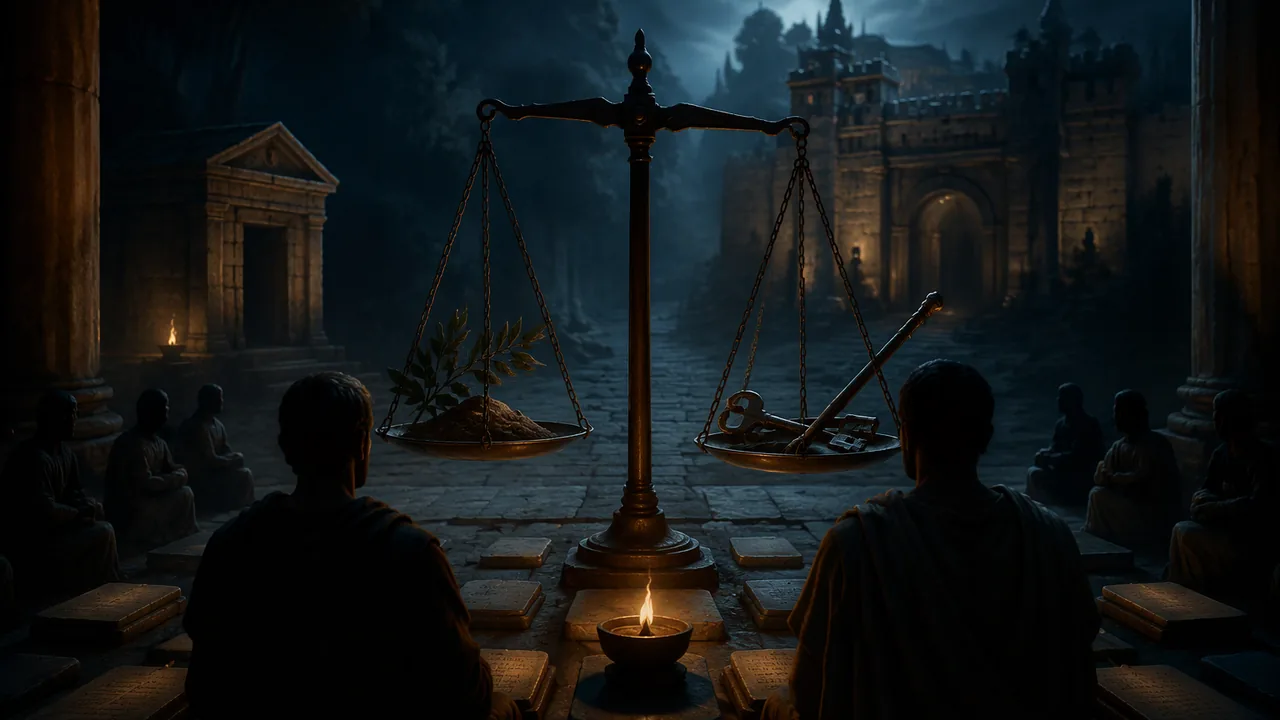
take and defend a position on whether Antigone or Creon has the stronger claim, citing the text, and build on classmates’ ideas in a recorded seminar.
Instruction
The German philosopher Hegel argued that Antigone is great tragedy because both sides are right: the family’s duty and the state’s authority are each legitimate, and the tragedy is their collision. You do not have to agree with Hegel — but you do have to take both sides seriously before you choose one. That is what this seminar is for.
Antigone’s case. Some duties are older and higher than any government. The dead must be honored; a sister owes her brother burial whatever he did. A law that commands a person to do evil — or to leave undone a sacred obligation — has no claim on her. She acts openly, accepts the penalty and does not pretend otherwise. Later writers on civil disobedience, including Thoreau in Unit 3, found in her a model.
Creon’s case. Thebes has just survived a civil war in which Polyneices led a foreign army against his own city. A ruler who lets a traitor be honored invites the next attack. Law means nothing if each person decides privately which laws to obey; “disobedience is the worst of evils.” And Creon applies the rule to his own family — Antigone is his niece and his son’s fiancée — which could be read as integrity rather than tyranny.
What complicates both. Antigone is harsh to Ismene, who wants to share her fate, and seems to seek death. Creon’s language slides from the city’s good to his own authority — “Is not the city held to be the ruler’s?” is how he answers Haemon — and so far he has met every challenge, from the Chorus, from Ismene and now from his own son, with anger. The play does not hand you an answer; it hands you evidence.
How characters develop (9-10.RL.2.D). Watch how each character changes — or refuses to change — across the play, and how their encounters with others drive the plot. Through the third episode, Creon’s development is a hardening: compare the king who promised never to keep silent about a danger to the city with the father who ends the scene ordering Antigone sealed in a rock vault. Antigone’s is steadier so far; the next reading will show whether it stays that way. A strong seminar claim uses change over time as evidence.
The scene at the center. Today’s reading, the third episode, is the middle of the play, and Sophocles gives the strongest case against Creon to the person with the most reason to side with him. Haemon opens with obedience (“Father, I am thine”), and Creon answers with his fullest statement of principle. Haemon’s reply is careful. He reports what the city says in secret, that “none ever was to die so shamefully for deeds so glorious as hers,” and argues from nature: “the trees that yield to it save every twig, while the stiff-necked perish root and branch.” When Creon refuses to bend, the debate collapses into single-line exchanges, and each of his lines moves further from the city’s good toward his own authority. The episode ends with Haemon’s furious exit, Creon sparing Ismene, and a new sentence for Antigone: to be hidden “living, in a rocky vault.” The short ode to Love that follows (summarized in the reading card) blames Love for the quarrel, and the elders weep as Antigone is led out.
The seminar. Record a 90-second claim: which character has the stronger claim, and why, quoting two passages — one of which makes your position harder to hold. End with a question you genuinely want a classmate to answer. Then reply to two classmates. 9-10.SL.1.B asks you to propel the conversation: relate the discussion to broader themes, ask questions that probe reasoning, and bring in voices who have not yet spoken. Before disagreeing, restate the other person’s point in a sentence they would accept.
A rule for this seminar. Every claim is about the text. “I would have buried him too” is a feeling; “Antigone’s appeal to ‘the unwritten and unfailing statutes of heaven’ makes her claim independent of Creon’s authority, because…” is an argument.
📖 Before this lesson, read: Antigone, Third Episode and Third Stasimon (lines 626-800)
The reading opens over the lesson; close it to come back to exactly where you were.
Reading: Seminar packet: Antigone, Creon and two outside voices
Sophocles, Antigone, translated by R. C. Jebb (Cambridge University Press; translation first published 1888, text here from the 1917 edition, The Tragedies of Sophocles), Wikisource https://en.wikisource.org/wiki/Antigone_%28Jebb%29; Henry David Thoreau, Resistance to Civil Government (1849), Wikisource https://en.wikisource.org/wiki/Resistance_to_Civil_Government (the same text is Project Gutenberg eBook 71); Plato, Crito, translated by B. Jowett (1892), Project Gutenberg eBook 1657 (https://www.gutenberg.org/ebooks/1657); retrieved 2026-09-26 · SLS original framing, protocol and models; quoted passages are public domain (Sophocles, tr. Jebb, 1888; Thoreau, 1849; Plato, tr. Jowett, 1892)
Every claim you make must point to a passage on this page or in the play.
What is hosted. The passages the seminar argues from, two outside voices that state the two positions in their own words, the protocol, a bank of question stems, a table for tracking change in the two characters, and a model contribution. Sources: Sophocles, Antigone, tr. R. C. Jebb (Wikisource, 1917 edition of the 1888 translation); Henry David Thoreau, Resistance to Civil Government (1849), Project Gutenberg eBook 71; Plato, Crito, tr. Benjamin Jowett (3rd ed., 1892), Project Gutenberg eBook 1657. All retrieved 2026-09-26.
How the text is marked. Speakers are named as Jebb prints them: An. (Antigone), Is. (Ismene), Cr. (Creon), Ch. (the Chorus), Gu. (the Guard), Hae. (Haemon), Te. (Teiresias), Me. (the Messenger). Jebb translates into prose. The numbers in square brackets, such as [450], are the Greek line numbers Jebb prints in the margin at every tenth line; each sits at the place in the prose where that Greek line falls, so a passage can be located to within a few lines but not exactly. Cite the ten-line stretch it falls in. Spelling and wording are Jebb’s. Stage directions are in his brackets.
1. Antigone’s case
An. I knew it: could I help it? It was public.
Cr. And thou didst indeed dare to transgress that law?
An. Yes; for it was not Zeus that had published [450] me that edict; not such are the laws set among men by the Justice who dwells with the gods below; nor deemed I that thy decrees were of such force, that a mortal could override the unwritten and unfailing statutes of heaven. For their life is not of to-day or yesterday, but from all time, and no man knows when they were first put forth. Not through dread of any human pride could I answer to the gods for breaking these. [460] Die I must,—I knew that well (how should I not?)—even without thy edicts. But if I am to die before my time, I count that a gain: for when any one lives, as I do, compassed about with evils, can such an one find aught but gain in death? So for me to meet this doom is trifling grief; but if I had suffered my mother’s son to lie in death an unburied corpse, that would have grieved me; for this, I am not grieved. And if my present deeds are foolish in thy sight, [470] it may be that a foolish judge arraigns my folly.
2. Creon’s case
Cr. Yea, this, my son, should be thy heart’s fixed law,—in all things to obey thy father’s will. [640] ‘Tis for this that men pray to see dutiful children grow up around them in their homes,—that such may requite their father’s foe with evil, and honour, as their father doth, his friend. But he who begets unprofitable children—what shall we say that he hath sown, but troubles for himself, and much triumph for his foes? Then do not thou, my son, at pleasure’s beck, dethrone thy reason for a woman’s sake; knowing that this is a joy that soon grows cold in clasping arms,—an evil [650] woman to share thy bed and thy home. For what wound could strike deeper than a false friend? Nay, with loathing, and as if she were thine enemy, let this girl go to find a husband in the house of Hades. For since I have taken her, alone of all the city, in open disobedience, I will not make myself a liar to my people—I will slay her. So let her appeal as she will to the majesty of kindred blood. If I am to nurture mine own kindred in naughtiness, needs must I bear with it in aliens. [660] He who does his duty in his own household will be found righteous in the State also. But if any one transgresses, and does violence to the laws, or thinks to dictate to his rulers, such an one can win no praise from me. No, whomsoever the city may appoint, that man must be obeyed, in little things and great, in just things and unjust; and I should feel sure that one who thus obeys would be a good ruler no less than a good subject, and in the storm of spears would stand his ground where he [670] was set, loyal and dauntless at his comrade’s side. But disobedience is the worst of evils. This it is that ruins cities; this makes homes desolate; by this, the ranks of allies are broken into headlong rout; but, of the lives whose course is fair, the greater part owes safety to obedience. Therefore we must support the cause of order, and in no wise suffer a woman to worst us. Better to fall from power, if we must, by a man’s hand; [680] then we should not be called weaker than a woman.
3. Haemon tests it
Hae. Father, the gods implant reason in men, the highest of all things that we call our own. Not mine the skill—far from me be the quest!—to say wherein thou speakest not aright; and yet another man, too, might have some useful thought. At least, it is my natural office to watch, on thy behalf, all that men say, or do, or find to blame. [690] For the dread of thy frown forbids the citizen to speak such words as would offend thine ear; but I can hear these murmurs in the dark, these moanings of the city for this maiden; ‘no woman,’ they say, ‘ever merited her doom less,—none ever was to die so shamefully for deeds so glorious as hers; who, when her own brother had fallen in bloody strife, would not leave him unburied, to be devoured by carrion dogs, or by any bird:—deserves not she the meed of golden honour?’ Such is the darkling rumour that spreads in secret. [700] For me, my father, no treasure is so precious as thy welfare. What, indeed, is a nobler ornament for children than a prospering sire’s fair fame, or for sire than son’s? Wear not, then, one mood only in thyself; think not that thy word, and thine alone, must be right. For if any man thinks that he alone is wise,—that in speech, or in mind, he hath no peer,—such a soul, when laid open, is ever found empty. No, though a man be wise, [710] ’tis no shame for him to learn many things, and to bend in season. Seest thou, beside the wintry torrent’s course, how the trees that yield to it save every twig, while the stiff-necked perish root and branch? And even thus he who keeps the sheet of his sail taut, and never slackens it, upsets his boat, and finishes his voyage with keel uppermost. Nay, forego thy wrath ; permit thyself to change. For if I, a younger man, may offer my thought, it were far best, I ween, that men should be all-wise by nature; [720] but, otherwise—and oft the scale inclines not so—’tis good also to learn from those who speak aright.
Ch. Sire, ’tis meet that thou shouldest profit by his words, if he speaks aught in season, and thou, Haemon, by thy father’s; for on both parts there hath been wise speech.
Cr. Men of my age—are we indeed to be schooled, then, by men of his?
Hae. In nothing that is not right; but if I am young, thou shouldest look to my merits, not to my years.
Cr. Is it a merit to honour the unruly? [730]
Hae. I could wish no one to show respect for evil-doers.
Cr. Then is not she tainted with that malady?
Hae. Our Theban folk, with one voice, denies it.
Cr. Shall Thebes prescribe to me how I must rule?
Hae. See, there thou hast spoken like a youth indeed.
Cr. Am I to rule this land by other judgment than mine own?
Hae. That is no city, which belongs to one man.
Cr. Is not the city held to be the ruler’s?
Hae. Thou wouldst make a good monarch of a desert.
Cr. This boy, it seems, is the woman’s champion. [740]
Hae. If thou art a woman; indeed, my care is for thee.
Cr. Shameless, at open feud with thy father!
Hae. Nay, I see thee offending against justice.
Cr. Do I offend, when I respect mine own prerogatives?
Hae. Thou dost not respect them, when thou tramplest on the gods’ honours.
Cr. O dastard nature, yielding place to woman!
Hae. Thou wilt never find me yield to baseness.
Cr. All thy words, at least, plead for that girl.
Hae. And for thee, and for me, and for the gods below.
Cr. Thou canst never marry her, on this side the grave. [750]
Hae. Then she must die, and in death destroy another.
Cr. How! doth thy boldness run to open threats?
Hae. What threat is it, to combat vain resolves?
Cr. Thou shalt rue thy witless teaching of wisdom.
Hae. Wert thou not my father, I would have called thee unwise.
Cr. Thou woman’s slave, use not wheedling speech with me.
Hae. Thou wouldest speak, and then hear no reply?
4. Two outside voices on the same question
Neither is about Antigone. Each states in its own words one of the positions the play stages. Decide which character each would side with, and where it would part company with that character.
Thoreau, 1849: conscience over law
I think that we should be men first, and subjects afterward. It is not desirable to cultivate a respect for the law, so much as for the right. The only obligation which I have a right to assume, is to do at any time what I think right. It is truly enough said that a corporation has no conscience; but a corporation of conscientious men is a corporation with a conscience.
Socrates in Plato’s Crito (Jowett): the country and the laws come first
Has a philosopher like you failed to discover that our country is more to be valued and higher and holier far than mother or father or any ancestor, and more to be regarded in the eyes of the gods and of men of understanding? also to be soothed, and gently and reverently entreated when angry, even more than a father, and either to be persuaded, or if not persuaded, to be obeyed?
5. Tracking change (9-10.RL.2.D)
So far you have read from the prologue to the end of the third episode. Each row pairs an early quotation with a later one. Add a quotation of your own to each row: for Creon, from the third episode; for Antigone, who does not appear in it, from the second episode or from what Haemon reports the city says of her. Keep the table: after you read the fourth episode and the Exodos you will add a final column.
| Character | Early | Middle | Your quotation |
|---|---|---|---|
| Creon | “No man can be fully known, in soul and spirit and mind, until he hath been seen versed in rule and law-giving” (First Episode, about lines 170–80) | “Is not the city held to be the ruler’s?” (Third Episode, about line 738) | |
| Antigone | “Nay, he hath no right to keep me from mine own” (Prologue, about line 48) | “Not through dread of any human pride could I answer to the gods for breaking these” (Second Episode, about line 459) |
6. Protocol (SLS original)
- Prepare. Choose your claim in one sentence: “Antigone (or Creon) has the stronger claim because…”
- Two quotations. One supports you. One makes your position harder to hold, and you say how you answer it.
- End with a real question for a classmate, one you cannot answer yourself.
- Record 90 seconds. Then reply to two classmates. Each reply starts by restating their point in a sentence they would accept, then agrees, challenges or extends.
- Every claim is about the text. “I would have done the same” is a reaction; “her appeal to the ‘unwritten and unfailing statutes of heaven’ makes her claim independent of Creon’s authority, because…” is an argument.
7. Question stems (SLS original)
- You say Creon is inflexible. Where in the passage does he answer a warning with something other than anger?
- What would Antigone say to the claim that a city cannot survive if each person chooses which laws to obey?
- If Thoreau (1849) were in this room, which speech would he quote, and what would he cut?
- Socrates says the punishment is to be endured in silence. Antigone does not keep silent. Does that difference matter to whose claim is stronger?
- Who has not spoken yet? What would Ismene or the Chorus add?
8. A model contribution (SLS original, about 90 seconds)
“I think Creon has the stronger claim, though it costs me something to say it. Antigone says she is bound by ‘the unwritten and unfailing statutes of heaven,’ and that is a real appeal, but she has no way to show anyone else what those statutes require. Creon’s argument is one anyone can check: ‘disobedience is the worst of evils. This it is that ruins cities.’ Thebes has just come through a civil war. But here is the passage that makes my position hard: when Haemon says the city does not belong to one man, Creon answers, ‘Is not the city held to be the ruler’s?’ That is no longer the city’s good; it is his own authority. So my claim is narrower than I first thought: Creon’s principle is strong, and Creon is the wrong person to apply it. My question for you: is a good principle enough if the man who holds it cannot hear a warning?”
A model reply. “You argue Antigone is stronger because she acts openly and accepts the penalty. I agree that she never hides what she did: she says ‘I avow it; I make no denial.’ Where I differ is on whether openness answers Creon’s point about the city. I’d like to hear what you make of Ismene, who says she has ‘no strength’ to defy the State.”
Formative check
Work through these before moving on. They are not graded — they tell you whether the standard below has landed yet.
Which is the strongest textual evidence that Creon’s motive shifts from the city’s good to his own authority?
In this seminar, “I would have done the same thing as Antigone” counts as a text-based claim.
Draft your 90-second claim: which character has the stronger claim, two quotations (one complicating), and a genuine question for classmates. Paste the draft here before recording.
How confident are you that you can take a position on Antigone and Creon, defend it from the text, and build on others’ ideas?
Antigone, Third Episode and Third Stasimon (lines 626-800)
Antigone, Third Episode (lines 626-780)
Source: Sophocles, Antigone, translated by R. C. Jebb (The Tragedies of Sophocles, Cambridge University Press, 1917), Wikisource (en.wikisource.org) · Public domain
But lo, Haemon, the last of thy sons;—comes he grieving for the doom of his promised bride, Antigone, and bitter for the baffled hope of his marriage?
Enter Haemon.
Cr. We shall know soon, better than seers could tell us.—My son, hearing the fixed doom of thy betrothed, art thou come in rage against thy father? Or have I thy good will, act how I may?
Hae. Father, I am thine; and thou, in thy wisdom, tracest for me rules which I shall follow. No marriage shall be deemed by me a greater gain than thy good guidance.
Cr. Yea, this, my son, should be thy heart’s fixed law,—in all things to obey thy father’s will. ‘Tis for this that men pray to see dutiful children grow up around them in their homes,—that such may requite their father’s foe with evil, and honour, as their father doth, his friend. But he who begets unprofitable children—what shall we say that he hath sown, but troubles for himself, and much triumph for his foes? Then do not thou, my son, at pleasure’s beck, dethrone thy reason for a woman’s sake; knowing that this is a joy that soon grows cold in clasping arms,—an evil woman to share thy bed and thy home. For what wound could strike deeper than a false friend? Nay, with loathing, and as if she were thine enemy, let this girl go to find a husband in the house of Hades. For since I have taken her, alone of all the city, in open disobedience, I will not make myself a liar to my people—I will slay her.
So let her appeal as she will to the majesty of kindred blood. If I am to nurture mine own kindred in naughtiness, needs must I bear with it in aliens. He who does his duty in his own household will be found righteous in the State also. But if any one transgresses, and does violence to the laws, or thinks to dictate to his rulers, such an one can win no praise from me. No, whomsoever the city may appoint, that man must be obeyed, in little things and great, in just things and unjust; and I should feel sure that one who thus obeys would be a good ruler no less than a good subject, and in the storm of spears would stand his ground where he was set, loyal and dauntless at his comrade’s side.
But disobedience is the worst of evils. This it is that ruins cities; this makes homes desolate; by this, the ranks of allies are broken into headlong rout; but, of the lives whose course is fair, the greater part owes safety to obedience. Therefore we must support the cause of order, and in no wise suffer a woman to worst us. Better to fall from power, if we must, by a man’s hand; then we should not be called weaker than a woman.
Ch. To us, unless our years have stolen our wit, thou seemest to say wisely what thou sayest.
Hae. Father, the gods implant reason in men, the highest of all things that we call our own. Not mine the skill—far from me be the quest!—to say wherein thou speakest not aright; and yet another man, too, might have some useful thought. At least, it is my natural office to watch, on thy behalf, all that men say, or do, or find to blame. For the dread of thy frown forbids the citizen to speak such words as would offend thine ear; but I can hear these murmurs in the dark, these moanings of the city for this maiden; ‘no woman,’ they say, ‘ever merited her doom less,—none ever was to die so shamefully for deeds so glorious as hers; who, when her own brother had fallen in bloody strife, would not leave him unburied, to be devoured by carrion dogs, or by any bird:—deserves not she the meed of golden honour?’
Such is the darkling rumour that spreads in secret. For me, my father, no treasure is so precious as thy welfare. What, indeed, is a nobler ornament for children than a prospering sire’s fair fame, or for sire than son’s? Wear not, then, one mood only in thyself; think not that thy word, and thine alone, must be right. For if any man thinks that he alone is wise,—that in speech, or in mind, he hath no peer,—such a soul, when laid open, is ever found empty.
No, though a man be wise, ’tis no shame for him to learn many things, and to bend in season. Seest thou, beside the wintry torrent’s course, how the trees that yield to it save every twig, while the stiff-necked perish root and branch? And even thus he who keeps the sheet of his sail taut, and never slackens it, upsets his boat, and finishes his voyage with keel uppermost.
Nay, forego thy wrath ; permit thyself to change. For if I, a younger man, may offer my thought, it were far best, I ween, that men should be all-wise by nature; but, otherwise—and oft the scale inclines not so—’tis good also to learn from those who speak aright.
Ch. Sire, ’tis meet that thou shouldest profit by his words, if he speaks aught in season, and thou, Haemon, by thy father’s; for on both parts there hath been wise speech.
Cr. Men of my age—are we indeed to be schooled, then, by men of his?
Hae. In nothing that is not right; but if I am young, thou shouldest look to my merits, not to my years.
Cr. Is it a merit to honour the unruly?
Hae. I could wish no one to show respect for evil-doers.
Cr. Then is not she tainted with that malady?
Hae. Our Theban folk, with one voice, denies it.
Cr. Shall Thebes prescribe to me how I must rule?
Hae. See, there thou hast spoken like a youth indeed.
Cr. Am I to rule this land by other judgment than mine own?
Hae. That is no city, which belongs to one man.
Cr. Is not the city held to be the ruler’s?
Hae. Thou wouldst make a good monarch of a desert.
Cr. This boy, it seems, is the woman’s champion.
Hae. If thou art a woman; indeed, my care is for thee.
Cr. Shameless, at open feud with thy father!
Hae. Nay, I see thee offending against justice.
Cr. Do I offend, when I respect mine own prerogatives?
Hae. Thou dost not respect them, when thou tramplest on the gods’ honours.
Cr. O dastard nature, yielding place to woman!
Hae. Thou wilt never find me yield to baseness.
Cr. All thy words, at least, plead for that girl.
Hae. And for thee, and for me, and for the gods below.
Cr. Thou canst never marry her, on this side the grave.
Hae. Then she must die, and in death destroy another.
Cr. How! doth thy boldness run to open threats?
Hae. What threat is it, to combat vain resolves?
Cr. Thou shalt rue thy witless teaching of wisdom.
Hae. Wert thou not my father, I would have called thee unwise.
Cr. Thou woman’s slave, use not wheedling speech with me.
Hae. Thou wouldest speak, and then hear no reply?
Cr. Sayest thou so? Now, by the heaven above us—be sure of it—thou shalt smart for taunting me in this opprobrious strain. Bring forth that hated thing, that she may die forthwith in his presence—before his eyes—at her bridegroom’s side!
Hae. No, not at my side—never think it—shall she perish; nor shalt thou ever set eyes more upon my face:—rave, then, with such friends as can endure thee.
Exit Haemon.
Ch. The man is gone, O king, in angry haste; a youthful mind, when stung, is fierce.
Cr. Let him do, or dream, more than man—good speed to him!—But he shall not save these two girls from their doom.
Ch. Dost thou indeed purpose to slay both?
Cr. Not her whose hands are pure: thou sayest well.
Ch. And by what doom mean’st thou to slay the other?
Cr. I will take her where the path is loneliest, and hide her, living, in a rocky vault, with so much food set forth as piety prescribes, that the city may avoid a public stain. And there, praying to Hades, the only god whom she worships, perchance she will obtain release from death; or else will learn, at last, though late, that it is lost labour to revere the dead.
Exit Creon.
Antigone, Third Stasimon (lines 781-800) Bridge summary — not the primary text
This is a short recap written for this course, not Sophocles’s own words, so you can follow the story between close-reading lessons.
{summary}