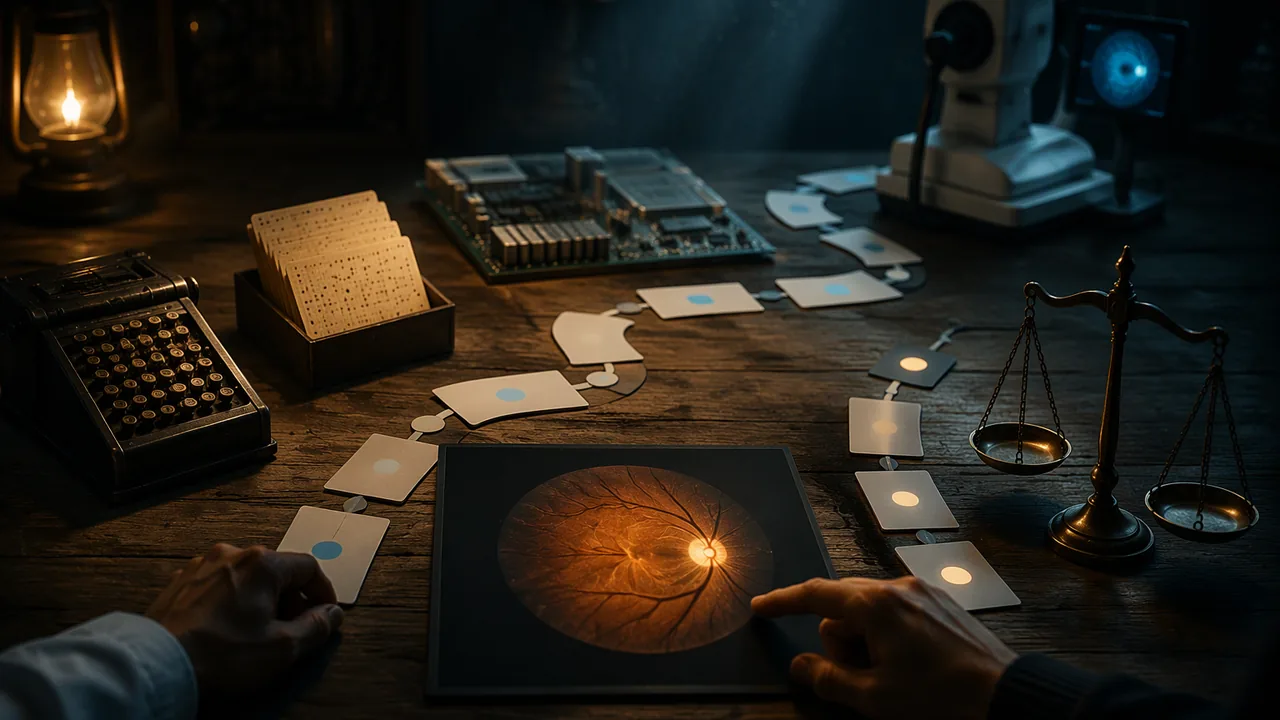
produce and present a narrated multimedia presentation that traces a healthcare AI innovation from its inventions to current use, and evaluates one ethical question it raises.
Instruction
This task asks you to tell the true story of one AI innovation in healthcare, and to tell it well. It combines everything in the unit: a verified timeline, the difference between invention and innovation, an ethical question seen from more than one side, and a presentation designed as a unified media work.
Choosing a topic. Choose an innovation you can document with at least four reliable sources, including at least one federal source. Good options include autonomous screening for diabetic retinopathy (FDA’s 2018 De Novo authorization), AI-assisted reading of medical images such as mammograms or CT scans (check the FDA AI-enabled device list for real examples), AI protein-structure prediction and its use in drug research, and speech recognition for clinical notes. If you choose something else, first confirm that you can find at least four reliable sources for it, including one federal source, before you build anything. Do not claim a device is approved or cleared unless you have found it in an FDA database or decision summary.
What the presentation must do. Trace the innovation from the earlier inventions it grew out of to its current use, with every date verified. Identify the turning point where invention became innovation, and explain what made it possible (data, computing, regulation, clinical workflow). Evaluate one ethical question it raises, such as bias, privacy, over-reliance, access or who is accountable for errors, from at least two stakeholders’ points of view. Close with an open question for the audience.
Making it a media work. A unified work has one visual system (palette, type, image style) and a narrative arc (a beginning that raises a question, a middle that builds, a turning point, and a resolution). Narration and image should do different jobs: the image shows, the voice explains. Consider pace: a 4-6 minute piece has room for about ten ideas, not thirty.
Disclosure and credits. Your final slide or end card lists every source and every image with its license, and your AI-use disclosure. Your presentation is judged partly on how clearly your own authorship shows through.
The four stages. Stage 1 is the research plan: topic, sources, timeline photograph and storyboard. Stage 2 is a full draft that you set aside for at least a day and then critique yourself with the self-critique sheet in this lesson’s reading (a family member or other adult may watch it and tell you what they understood; this is optional); you record the two most useful notes and your planned changes. Stage 3 is the revised final. Stage 4 is the recorded presentation, followed on the same recording by about three minutes of answers to the three published questions: (1) “Which card is your turning point, and which two sources confirm its date?” (2) “What does your innovation not do, according to its federal source?” (3) “Which stakeholder would disagree most with your evaluation, and what is the strongest fact on their side?”
📖 Read for this lesson
The reading opens over the lesson; close it to come back to exactly where you were. The checks below draw on it.
Formative check
Work through these before moving on. They are not graded — they tell you whether the standard below has landed yet.
Your draft says a named AI imaging product is ‘FDA approved’. You have only a company press release. What should you do?
In a unified presentation, the narration should mostly repeat the text on each slide word for word.
How confident are you that you can produce and present an accurate, unified multimedia history of a healthcare AI innovation?
Unit 2 checkpoint
Do this before you start the task. It covers the whole unit and tells you what to review first.
Which event is usually taken as the founding of AI as a field?
A period of reduced funding and interest after expectations were not met is called an AI .
A timeline drawn to scale shows long gaps and sudden bursts that even spacing hides.
In 2018 the FDA authorized IDx-DR. What did it describe as new about it?
Which is an innovation rather than an invention?
If 60 years run along a 120 cm string, each decade takes cm.
Wikipedia is a good source to cite on an event card.
In the 2019 Science study, what was the algorithm’s label?
For an algorithm to be biased, someone must have intended it to harm a group.
Under the Copyright Office’s position, an image produced entirely by an AI tool from a short prompt is:
A slide headline should be a full that states the point, not a topic label.
Submit: narrated multimedia presentation on a healthcare AI innovation + credits and AI disclosure + recorded presentation with answers to published questions
Task: Trace one healthcare AI innovation from the inventions it grew out of to its current use, with every date verified in reliable sources (at least four, including one federal source). Show where invention became innovation, evaluate one ethical question from at least two stakeholders’ views, and design the whole as a unified media work with credits and an AI-use disclosure.
Submission workflow
- Stage 1 — Research plan. Topic, source log with at least four sources, photograph of the verified timeline and a slide storyboard.
- Stage 2 — Self-critiqued draft. Full draft set aside for at least a day, then reviewed by you against the unit criteria with the self-critique sheet (an optional family member or other adult viewer may add notes); submit the two most useful notes and your revision plan.
- Stage 3 — Revised final. 10-14 narrated slides or a 4-6 minute video, with the credits list and AI-use disclosure.
- Stage 4 — Presentation. Recorded presentation, then about three minutes of recorded answers to the three published questions.
How it is scored
| Criterion | What proficient looks like |
|---|---|
| Unified media production (MA:Pr4A.I) | Images, narration, text and sequence form one coherent work with a consistent visual system and a clear narrative arc. |
| Aesthetic and technical choices (MA:Cr3A.I) | Deliberate choices in layout, type, color and sound, executed with care. |
| Historical accuracy and research (WHST.11-12.8) | Every date and claim verified in named reliable sources; invention and innovation clearly distinguished. |
| Ethical evaluation (MA:Re9A.I) | One ethical question evaluated from at least two stakeholders’ views with evidence. |
| Presentation (SL.11-12.4, SL.11-12.5, MA:Pr6A.I) | Clear, well-paced delivery designed for the audience; the published questions answered accurately. |
Portfolio Brief: The Healthcare AI Innovation, with Checked Options, an FDA Reading Model, an Ethics Frame and a Self-Critique Sheet
SLS original brief; anchors from FDA De Novo database and summary DEN180001, FDA AI-Enabled Medical Devices page, Crossref records (doi 10.1037/h0042519, 10.1038/323533a0, 10.1001/jama.2016.17216, 10.1038/s41586-021-03819-2) and the 2024 Nobel Prize in Chemistry announcement (Oct. 9, 2024, as reported by NobelPrize.org and university press pages); retrieved Sept. 26, 2026 · SLS original, citing public-domain U.S. government documents; Jumper et al. (2021) is CC BY 4.0
Why this reading. The task tells you to choose an innovation you can document with at least four sources including one federal source, and to check the FDA device list, but gives you neither a list of choices nor a model of what a documented, evaluated story looks like. This is the whole brief: three ready-to-document options with checked anchors, how to read an FDA decision summary, an ethical-evaluation frame with a worked example, what each rubric level looks like, the self-critique sheet and the three published questions. The exemplar outline is an SLS original and is not any student’s work.
Three options with checked anchors (you still need at least four sources of your own)
Option A: autonomous screening for diabetic retinopathy. Anchors, all retrieved 26 September 2026: FDA De Novo request DEN180001 for IDx-DR, request received January 12, 2018, decision date April 11, 2018 (FDA De Novo database), and the FDA’s decision summary, which names the device’s purpose (detect more than mild diabetic retinopathy in adults with diabetes not previously diagnosed with it), the study (900 participants, 10 primary care sites; sensitivity 87.4%, specificity 89.5%) and the new regulation, 21 CFR 886.1100. Earlier inventions you can document with bibliographic records: Rosenblatt’s perceptron (Psychological Review 65(6), 1958), backpropagation (Nature 323, October 1986), and Gulshan et al. (JAMA 316(22), December 13, 2016).
Option B: AI protein-structure prediction and drug research. Anchors: Jumper et al., “Highly accurate protein structure prediction with AlphaFold,” Nature 596, 583–589, issued 15 July 2021 (open access, CC BY 4.0); the 2024 Nobel Prize in Chemistry, announced October 9, 2024, half to David Baker “for computational protein design” and half jointly to Demis Hassabis and John Jumper “for protein structure prediction.” You would need a federal source (for example an NIH page on protein structure or drug discovery) and evidence for how the predictions are used in drug research; do not claim a drug exists because of AlphaFold unless a source says so.
Option C: an AI-assisted image-reading device of your choice. The FDA publishes a list of AI-enabled medical devices. Its own page says it lists devices that have met the FDA’s applicable premarket requirements, that devices are identified “primarily based on the use of AI-related terms” in their summaries, and that “the list is not a comprehensive resource of AI-enabled medical devices.” Choose one entry, then open its decision document and read it as below. Do not describe a device as “approved” unless its own record says approved; most are “cleared” or “granted De Novo classification.”
How to read an FDA decision summary (model: DEN180001)
| Look for | In the IDx-DR summary | Why it matters for your story |
|---|---|---|
| Regulatory pathway and dates | De Novo classification; received Jan. 12, 2018; decision April 11, 2018 | Sets the turning point and the exact word to use (“granted De Novo”, not “approved”) |
| Indications for use | Adults with diabetes, no prior diabetic retinopathy diagnosis, with a specified camera | Who the tool is for, and who it is not for |
| Limitations and warnings | Only designed to detect diabetic retinopathy; prescription use only | What it cannot do |
| Study design | 900 participants, 10 primary care sites; grading by a reading center, three readers, majority vote | What the numbers are counted against |
| Results | Sensitivity 87.4%, specificity 89.5%; 173 of 198 with disease flagged; 65 of 621 without it flagged | What kinds of mistakes it makes, and how often |
| Who could not be analyzed | 73 of 892 participants who completed procedures could not be analyzed | A design choice with consequences for access |
Evaluating one ethical question from two stakeholders’ views: a worked example
Frame: state the question; name two stakeholders; give each one the strongest version of its concern, with a fact; then say what you would ask of the maker. Worked example (SLS original, Option A): Question: Who is accountable when an autonomous screening tool misses disease? Stakeholder 1, a patient with diabetes: in the pivotal study 25 of the 198 people with more-than-mild disease were not flagged, so a “negative” result is not a guarantee, and no clinician looked at the image. Stakeholder 2, a primary care clinic: the FDA summary lists potential increased access to screening in primary care as the benefit, and the clinic can accept a tool with known limits only if it can rely on clear instructions and camera training (the study gave operators a four-hour training program). My evaluation: the summary reports both rates, so the maker has told the clinic what to expect; accountability then depends on whether the clinic tells patients the same thing. What I would ask of the maker: plain-language result cards that state what a negative result does not rule out. Notice that every factual claim points to a source, and that neither stakeholder is made a villain.
Media work: narrative arc and time budget (SLS original)
For a 5 minute piece (300 seconds), a workable budget is: 30 seconds the question that opens it; 90 seconds the earlier inventions (three or four events); 60 seconds the turning point and what made it possible (data, computing, regulation, clinical workflow); 75 seconds the ethical question from two views; 30 seconds a question left open for the audience; 15 seconds credits. That adds to 300. An open question is not a summary; a good one cannot be answered with the facts on your slides, for example “Should a screening tool have to say what a negative result does not rule out?”
What each level looks like
| Criterion | Not yet | Proficient | Advanced |
|---|---|---|---|
| Unified media production | Slides differ in style; narration reads the slide | One visual system and a narrative arc; narration adds what the image cannot | The design carries an idea (for example, the timeline itself is drawn to scale) |
| Aesthetic and technical choices | Small or low-contrast text; unlabeled images | Readable type, credited images, careful timing | Choices explained in the statement, each tied to the audience |
| Historical accuracy and research | Dates without sources; “approved” used for anything | At least four sources including one federal; every date checked in two; invention and innovation separated | Notes where sources disagree and how it was resolved |
| Ethical evaluation | One view, or a slogan | One question, two stakeholders, each with a fact | Ends with a request that follows from the evidence |
| Presentation | Reads notes; cannot answer | Clear delivery; answers the three published questions accurately | Uses the evidence in the work to answer a challenge |
The three published questions
Answer all three on your recording, after the presentation, in about three minutes in total: (1) “Which card is your turning point, and which two sources confirm its date?” (2) “What does your innovation not do, according to its federal source?” (3) “Which stakeholder would disagree most with your evaluation, and what is the strongest fact on their side?”
Self-critique sheet (fill it in after at least a day away from the draft)
Watch or page through your draft as if you had never seen it. A family member or other adult may watch it with you and answer steps 1 and 5 aloud; this is optional.
- Describe: the title, the innovation, the number of events on the timeline, and the number of sources on the credits slide.
- Check two facts: pick two dates or claims; write where in the credits each is sourced. Mark any date with only one source.
- Invention or innovation: point to the slide where the turning point is shown. If you cannot find it, say so.
- Ethics: name the two stakeholders you found and a fact each one is given.
- Media: name one thing the image does that the narration does not, and one moment where the narration repeats the slide.
- Two changes you will make: what to change, where, why. Rank them.
Revision plan. Three columns: critique note (from your sheet or a viewer), change made or reason not, slide number where it appears in the final.
Sources: FDA De Novo decision summary DEN180001 (IDx-DR) (accessdata.fda.gov); FDA, List of Artificial Intelligence-Enabled Medical Devices (fda.gov); Jumper et al. (2021), Highly accurate protein structure prediction with AlphaFold, Nature 596 (CC BY 4.0) (doi.org); The Nobel Prize in Chemistry 2024, NobelPrize.org (nobelprize.org)