RLP AI Design A — Machine Learning, Media and the Human Body is one semester of a full-year media arts course aligned to the Missouri Learning Standards for Fine Arts — Media Arts (2019; high school Proficient, Accomplished and Advanced). It earns 0.5 unit of credit toward Missouri’s 1-unit Fine Arts graduation requirement.
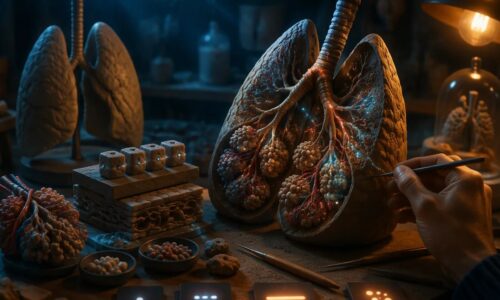
RLP AI Design is a full-year, college-preparatory interdisciplinary arts course in which students make media artworks that explain, question and imagine artificial intelligence in healthcare. Semester A builds the knowledge and the craft the rest of the year depends on. Students learn how machine-learning systems are built and trained (narrow AI versus the hypothetical general and superintelligent systems, supervised and unsupervised learning, classification and regression) and turn that understanding into an explanatory infographic and motion storyboard. They study the documented history of AI and of AI in medicine, the ethics of human-centered design, bias in health algorithms and the U.S. Copyright Office’s position on AI-generated material, and produce a multimedia presentation on the history and evolution of one healthcare AI innovation. They then draw, sculpt and diagram the eleven organ systems of the human body from OpenStax Anatomy and Physiology 2e, and build an illustrated system atlas. The semester closes with vital signs, diagnostic tools, medical imaging and health data privacy, where students code an interactive data visualization in p5.js and design a patient-facing brochure. Every unit pairs an artist or designer study with a hands-on studio exercise, a structured critique and a portfolio task that moves through planning, a self-critiqued draft (checked against the rubric after a day away; a family member may respond), a revised final and a recorded presentation, all assessed against the Missouri Learning Standards for Media Arts.
Privacy and safety: no student creates an account on any AI service; classifiers and data visualizations use provided data sets, and any personal pulse count is optional and stays private. Health topics are for design and communication only — no diagnosis or medical advice. Critique and testing happen alone or with family members the student knows, talks and interviews are recorded, and exhibitions are at home or online, shared publicly only with a parent’s permission. Mental-health topics list the 988 Suicide and Crisis Lifeline.
Sources: DESE Media Arts standards; U.S. FDA, NIH, MedlinePlus, HHS, USPTO and BLS public information; OpenStax Anatomy and Physiology 2e (referenced); SLS-written lessons, studio briefs and rubrics.
Sejal Learning Systems · Royal Legacy Preparatory School
Curriculum
- 4 Sections
- 20 Lessons
- Lifetime
- Unit 1: How Machines Learn: Making AI Visible5
- 1.1Explaining the Invisible: Designers Who Made Data Visible50 mins
- 1.2Sorting by Features: Training a Classifier by Hand100 mins
- 1.3Critiquing AI Explainers: Accuracy, Clarity and Hype50 mins
- 1.4Designing the Explainer: Hierarchy, Sequence and Storyboard100 mins
- 1.5Portfolio Task — How a Machine Learns: Explainer and Storyboard200 mins
- Unit 2: Human-Centered AI: History, Ethics and Authorship5
- 2.1Drawing Time: Timeline Design and the History of AI50 mins
- 2.2Verified Event Cards: Building a Physical Timeline Storyboard100 mins
- 2.3Who Is Responsible? Bias and Human-Centered AI in Medicine100 mins
- 2.4Authorship and AI Imagery: Making the Presentation Yours150 mins
- 2.5Portfolio Task — The Evolution of a Healthcare AI Innovation200 mins
- Unit 3: Drawing the Body: The Eleven Organ Systems5
- 3.1Art and Anatomy: Five Centuries of Seeing Inside the Body50 mins
- 3.2Sculpting a System: Modeling Structure and Function100 mins
- 3.3Clinician and Patient: Role-Play and the Critique of Health Communication100 mins
- 3.4Illustrating a Condition: Panels for One Body System150 mins
- 3.5Portfolio Task — The Body Atlas Exhibition200 mins
- Unit 4: Signals and Diagnosis: Visualizing Vital Signs and Medical Data5
- 4.1Data Portraits: Du Bois, Einthoven and the Art of the Signal50 mins
- 4.2Pulse to Pixels: Coding a Heart-Rate Visualization100 mins
- 4.3Who Sees Your Data? Medical Records, Genetics and HIPAA50 mins
- 4.4Imaging the Invisible: Designing a Patient Brochure150 mins
- 4.5Portfolio Task — Reading the Body’s Signals200 mins
Instructor

Authentic Video Stories Promote Equity and Collaboration
Our online supplemental learning experiences transport students through all instructional disciplines with Authentic Video Stories and Engaging Interactive Courses. Our resources are available in multiple languages, enrich your curriculum and foster collaborative learning.


Leave a Reply