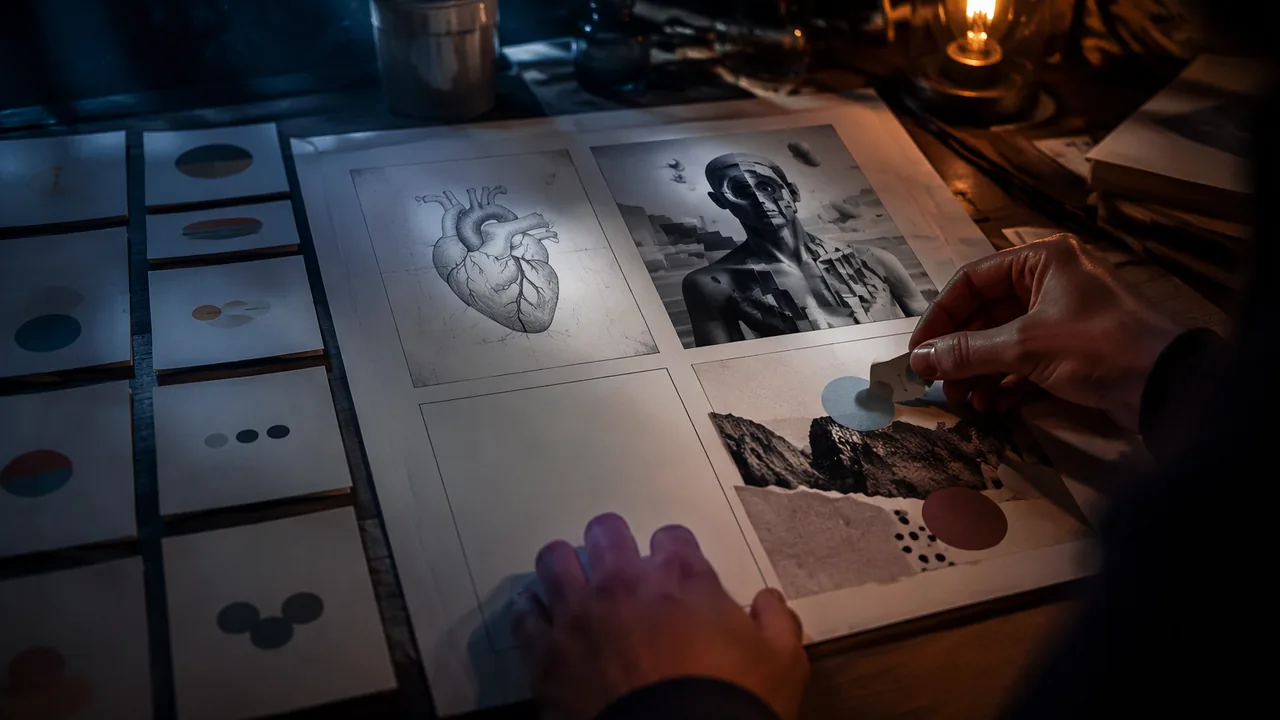
produce a draft multimedia presentation using openly licensed and original images, and explain the U.S. Copyright Office’s position on AI-generated material and how to disclose AI use.
Instruction
Your presentation will combine images, words, narration and perhaps sound. Each element has an author and a license. This workshop covers how to build the presentation well and how to be honest about where its parts came from.
Where images can come from. Your own drawings, photographs and diagrams are best: they are yours, and they fit your visual system. Public-domain material is free to use: U.S. federal government works such as FDA, NIH and NASA images are generally in the public domain (check each page, because some contain third-party material). Museums including the Art Institute of Chicago, the Cleveland Museum of Art, the Metropolitan Museum of Art, the National Gallery of Art, the Rijksmuseum and the Smithsonian release public-domain works as CC0 through their open-access programs. OpenStax figures are CC BY 4.0: you may use them if you credit them. Images found through a general web search are usually copyrighted; do not use them.
What the Copyright Office says about AI. U.S. copyright protects works of human authorship. The U.S. Copyright Office has applied this to AI in several decisions. In 2023 it registered the comic book Zarya of the Dawn for its human-written text and the human selection and arrangement of images, but not for the individual images generated with Midjourney. In its 2023 registration guidance it told applicants to disclose AI-generated content that is more than minimal. In its 2025 report on copyrightability it concluded that prompts alone do not generally give a user enough control to be the author of the output, while human expressive contributions, creative selection and arrangement, and modifications of AI output can be protected. Federal courts have also upheld the human-authorship requirement. In short, purely AI-generated material is not copyrightable; your human choices can be. The Office’s guidance is still developing, so check its website for the current position.
Ethics beyond the law. Many image generators were trained on artists’ work without their consent, and artists have raised serious objections; others argue that training is a lawful and transformative use. Courts are still deciding cases. You do not have to resolve this, but you must be transparent. Any AI-generated element in your work must be disclosed in the credits, with what it produced and what you did to it.
How AI imagery appears in this course. AI imagery is never required, and you never create an account on an AI service. If you want an AI-generated element, you need a parent’s or guardian’s permission and a tool that needs no account and allows your age; you then select, crop, combine and paint over the result. Your disclosure says so: “Background texture: generated with [tool], with a parent’s permission, prompt written by me; cropped, recolored and combined with my own drawing.”
Building the slides. One idea per slide. Put the headline as a full sentence that states the point (“Screening moved from specialists to primary-care clinics”), not a topic label. Use your timeline’s colors consistently. Limit text to what you will not say aloud. Record narration in a quiet room, close to the microphone, one slide per take, so mistakes are easy to redo. A free editor such as Audacity can trim and level the audio.
📖 Read for this lesson
The reading opens over the lesson; close it to come back to exactly where you were. The checks below draw on it.
Formative check
Work through these before moving on. They are not graded — they tell you whether the standard below has landed yet.
According to the U.S. Copyright Office, which part of a student’s presentation could be protected by copyright?
An image found through a general web search can be used in the presentation as long as you credit the website.
OpenStax figures are licensed , so you may use them if you give credit.
Paste your media credits list and your AI-use disclosure (write ‘No AI-generated elements’ if none). Then rewrite two slide headlines as full sentences that state the point.
How confident are you that you can produce a presentation from licensed and original media, and explain and disclose AI authorship correctly?
Practice
Work these on paper or in your notebook, then open Check your answer. Aim for all of Fluency and Application; try at least one Challenge.
Printable version: this unit’s practice workbook (PDF)
Fluency
Build speed and accuracy with the core skill.
- Define public domain, CC0 and CC BY.
Check your answer
Answer: Public domain: works not protected by copyright, which anyone may use (includes most U.S. federal government works). CC0: a Creative Commons tool that waives all rights. CC BY: a Creative Commons license that allows use with credit to the creator.Museum open-access programs release public-domain works as CC0; OpenStax figures are CC BY 4.0. - For each image source, say whether you may use it and what you must do: (a) an NIH image; (b) a Rijksmuseum open-access painting; (c) an OpenStax figure; (d) an image from a general web search.
Check your answer
Answer: (a) Generally public domain; check the page for third-party material. (b) Yes, CC0. (c) Yes, with credit (CC BY 4.0). (d) No; it is usually copyrighted.Your own drawings and photographs are best because they are yours and fit your visual system. - In 2023 the Copyright Office registered Zarya of the Dawn. What parts did it protect and what parts did it not?
Check your answer
Answer: It protected the human-written text and the human selection and arrangement of images, but not the individual images generated with Midjourney.U.S. copyright protects works of human authorship.
Application
Use the skill in context. Show your reasoning.
- Rewrite these topic-label headlines as full sentences that state a point: (a) ‘Screening’; (b) ‘The 1956 workshop’.
Check your answer
Answer: Models: (a) ‘Screening moved from specialists to primary-care clinics.’ (b) ‘A 1956 summer workshop at Dartmouth gave the field its name.’One idea per slide, with the headline stating the point. Any accurate claim from the lessons works. - A student used a no-account image tool, with a parent’s permission, to make a background texture, then cropped it and painted over it. Write the AI-use disclosure line for the credits.
Check your answer
Answer: ‘Background texture: generated with [tool name], with a parent’s permission, prompt written by me; cropped, recolored and painted over by me, and combined with my own drawing.’A disclosure names what the AI produced and what the human did with it. - According to the Copyright Office’s 2025 report, which of these could be protected: (a) the output of a single prompt; (b) a student’s hand-painted modifications to AI output; (c) the student’s selection and arrangement of slides; (d) the student’s recorded narration?
Check your answer
Answer: (b), (c) and (d). Not (a): prompts alone do not generally give enough control to make the user the author.Human expressive contributions, creative selection and arrangement, and modifications can be protected. The guidance is still developing. - A presentation has 9 slides and you record one take per slide. If each slide’s narration is 35 seconds, how long is the narration in minutes and seconds? Why does the lesson recommend one slide per take?
Check your answer
Answer: 315 seconds = 5 minutes 15 seconds. One slide per take makes mistakes easy to redo without re-recording everything.9 x 35 = 315; 315 = 5 x 60 + 15.
Challenge
Stretch problems. Expect to think before you write.
- Write a 4-sentence paragraph for your presentation’s credits page that states the ethical debate about image generators fairly, without taking a side.
Check your answer
Answer: Model: ‘Many image generators were trained on artists’ work without their consent, and artists have raised serious objections. Others argue that training is a lawful and transformative use. Courts are still deciding these cases. This presentation discloses every AI-generated element so viewers can judge for themselves.’A strong answer states both positions accurately, notes the question is unresolved, and connects to transparency.
Review
Keep earlier skills sharp.
- Review 2.2: Your presentation uses one color for inventions and another for innovations. Which lesson-1.4 rule about palette does this follow?
Check your answer
Answer: Give each color one consistent meaning; do not reuse the invention color for headings or anything else.The pattern of the story becomes visible before anyone reads a word.
What the Copyright Office Has Said About AI, and How to Credit and Disclose Your Media
U.S. Copyright Office, letter re Zarya of the Dawn (VAu001480196), Feb. 21, 2023; Copyright Registration Guidance: Works Containing Material Generated by Artificial Intelligence, 88 Fed. Reg. 16190 (Mar. 16, 2023); Copyright and Artificial Intelligence, Part 2: Copyrightability (Jan. 2025); retrieved Sept. 26, 2026 · Public domain (U.S. government works), with SLS original formats, worked examples and specifications
Why this reading. The workshop asks you to explain the Copyright Office’s position, write a media credits list and an AI-use disclosure, and turn headlines into sentences. This reading quotes the Office’s own documents, gives the credit and disclosure formats with worked examples, and the slide and video specifications with the arithmetic. Worked examples are SLS originals; they are not any student’s or any company’s statements. This is a description of what the Office has said, not legal advice.
1. What the U.S. Copyright Office has said
The decision on Zarya of the Dawn, February 21, 2023. In a letter to the author’s attorney about registration VAu001480196, the Office concluded that the author “is the author of the Work’s text as well as the selection, coordination, and arrangement of the Work’s written and visual elements,” and that this authorship is protected. But “the images in the Work that were generated by the Midjourney technology are not the product of human authorship.” The original certificate did not disclaim the AI-generated images, so the Office said it would cancel it and issue a narrower one covering only what the author created, with the same effective date, September 15, 2022. (Letter retrieved from copyright.gov, 26 September 2026.)
The registration guidance, 88 Federal Register 16190, March 16, 2023. “Applicants have a duty to disclose the inclusion of AI-generated content in a work submitted for registration and to provide a brief explanation of the human author’s contributions to the work.” AI-generated content “that is more than de minimis should be explicitly excluded from the application.” An applicant who arranges human and AI content is told to claim “selection, coordination, and arrangement of” the human-authored content and to describe the AI content as generated by artificial intelligence. The guidance also says applicants should not list an AI technology, or the company that provided it, as an author or co-author simply because they used it. (Retrieved from federalregister.gov, 26 September 2026.)
The Copyrightability report (Part 2), January 29, 2025. Its summary lists these conclusions, among others: using AI tools to assist rather than stand in for human creativity does not affect whether the output can be protected; copyright protects original human expression in a work that also includes AI-generated material; copyright does not extend to purely AI-generated material, or material where there is insufficient human control over the expressive elements; whether human contributions are enough must be decided case by case; “based on the functioning of current generally available technology, prompts do not alone provide sufficient control”; and human authors are entitled to copyright in the works they contribute that are perceptible in the outputs, plus the creative selection, coordination or arrangement of material, and creative modifications. (Retrieved from copyright.gov, 26 September 2026.)
Sort your presentation with this. Protectable when you make it: your narration, your drawings, your photographs, your layout, the order and pairing of images and text, and creative changes you make to an AI image. Not protectable on the Office’s reasoning: an image that an AI tool produced from your prompt, unchanged. Your prompt is not authorship of the image.
2. Where images can come from
| Source | What you may do | What to record |
|---|---|---|
| Your own drawings, photographs, diagrams | Anything, once you are the maker | “Original, [your name]” |
| U.S. federal government works (FDA, NIH, NASA, NIST) | Generally free to use; check each page, because a page can contain third-party material | Agency, page title, date retrieved |
| Museum open-access images of public-domain works: the Art Institute of Chicago, the Metropolitan Museum of Art, the Smithsonian, the National Gallery of Art | Released under CC0 (a public-domain dedication); no permission or credit is required, but credit anyway (news reports of each program, retrieved 26 September 2026; check the museum’s own page for a given image, since only images marked public domain or open access are covered) | Museum, accession number, date retrieved |
| Other museums that publish open-access programs (for example the Rijksmuseum and the Cleveland Museum of Art) | Check the specific image’s license label on the museum’s page (not verified by SLS here) | Museum, accession number, license label |
| CC BY material | Use it if you credit the creator, give the license name and say if you changed it | Creator, title, license, link |
| An image found by a general web search | Assume it is copyrighted; do not use it | Do not use |
3. The media credits list: format and a worked example
One line per item, in the order items appear: what it is, creator, where it came from, the license or status, date retrieved. Worked example (SLS original list using real public-domain sources from this course):
- Slide 3, polar-area diagram: F. Nightingale, “Diagram of the Causes of Mortality in the Army in the East,” 1858; David Rumsey Map Collection 10563.002 (via the Internet Archive); public domain (work of 1858); retrieved 26 Sept. 2026.
- Slide 5, definition of an AI system: NIST, AI Risk Management Framework 1.0 (NIST AI 100-1), January 2023; public domain (U.S. government work); retrieved 26 Sept. 2026.
- Slide 8, device facts: FDA, De Novo Classification Request for IDx-DR (DEN180001); public domain (U.S. government work); retrieved 26 Sept. 2026.
- Slides 1, 2, 4, 6, 7, 9–12: original drawings and narration by [maker].
4. The AI-use disclosure: format and two worked examples
A disclosure answers four questions: which tool, which parts of the piece, what you gave it, and what you did with the result (selected, arranged, changed, rejected). If you used none, write “No AI-generated elements.”
Worked example A (SLS original): “An image tool made the background texture on slides 2 and 7 from the prompt ‘soft blue paper.’ I chose one of four results and used it unchanged as a background; it carries no information. I claim no authorship of that texture. All other images, all text and the narration are mine, and the order and layout are mine.”
Worked example B (SLS original): “No AI-generated elements.”
What would be a weak disclosure: “I used AI for some parts.” It names no tool, no part, and no human contribution.
5. Headlines as sentences
A topic label says what a slide is about; a sentence says what it means. Worked pairs (SLS original): “Bias” becomes “A model that predicts cost can treat equally sick patients unequally.” “Timeline” becomes “The gap between a 1958 invention and a 2018 clinical decision took sixty years.” Test: could a viewer disagree with the headline? If so, it is a claim, and the slide must show the evidence.
6. Slide and video specifications, with the arithmetic
Slides 16:9, 1920 × 1080 pixels; keep text 5% inside every edge (96 pixels left and right, 54 top and bottom); body text at least 24 points and headline at least 36 points so it can be read on a projector; one idea per slide. For a 4 to 6 minute narrated piece with 10 to 14 slides, the average is between 4 × 60 ÷ 14 = 17 seconds per slide and 6 × 60 ÷ 10 = 36 seconds per slide. At about 130 words a minute of spoken narration (a comfortable pace, not a standard), 4 minutes is about 520 words and 6 minutes about 780 words. Narration and image do different jobs: the image shows and the voice explains, so do not read the slide aloud.
Sources: U.S. Copyright Office, Artificial Intelligence and Copyright (copyright.gov); Zarya of the Dawn decision letter, Feb. 21, 2023 (copyright.gov); 88 FR 16190, Copyright Registration Guidance: Works Containing Material Generated by Artificial Intelligence (federalregister.gov); Copyright and Artificial Intelligence, Part 2: Copyrightability (Jan. 2025) (copyright.gov)