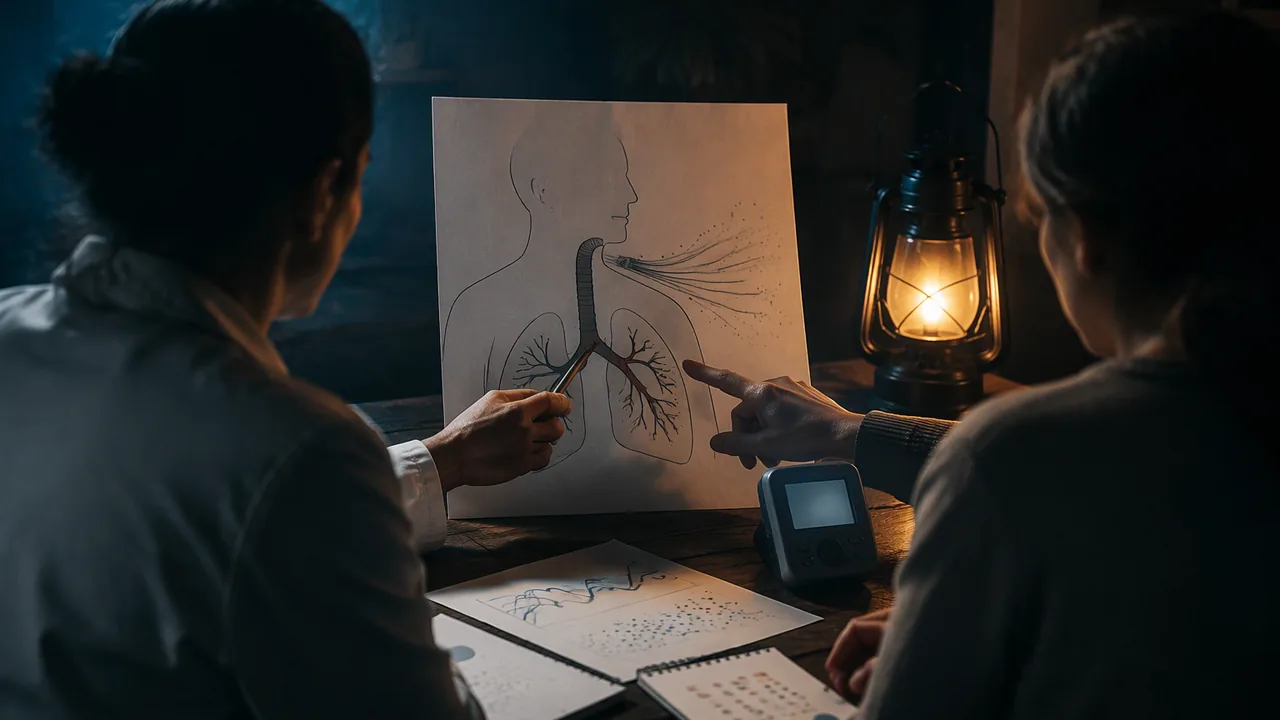
script and record a role-play in which a clinician explains a hypothetical condition to a patient with the help of a visual, and form defensible evaluations of how well the visual and the explanation communicated.
Instruction
Every day clinicians have to explain something complicated and worrying to people without medical training, often in a few minutes. Many reach for a picture: a sketch on paper, a plastic model, an image on a screen. This lab asks you to script and record that moment and then critique it, because it is one of the places where media art matters most in medicine.
Health literacy. Health literacy is a person’s ability to find, understand and use health information to make decisions. U.S. federal health agencies promote plain-language practices because many adults find typical medical information hard to use. Plain language uses common words, short sentences and the most important point first, and checks understanding. A widely used method is teach-back: the clinician asks the patient to explain the information back in their own words, which tests the explanation rather than the patient.
The cases. You choose one of six hypothetical cases in the reading for this lesson, each written from MedlinePlus and NIH descriptions. Examples: asthma (respiratory), where the airways become inflamed and narrowed and produce extra mucus, making breathing difficult; high blood pressure (cardiovascular), which often has no symptoms and is found by measurement; type 2 diabetes (endocrine), in which the body does not use insulin well and blood glucose stays too high; kidney stones (urinary); eczema (integumentary); osteoporosis (skeletal), in which bones become weaker and more likely to break. The cases are fictional. You will never be asked about your own or your family’s health.
The role-play. The clinician has three minutes. They must explain what is happening in the body, using one visual aid you prepare (a sketch, your clay model, or an OpenStax figure you have annotated), say which examination technique or test found it, and use teach-back. The patient asks at least two questions a real patient might ask. You write the script for both roles, then record it as audio or video. You can voice both parts yourself (say who is speaking, or change position or voice between lines), or a family member can read the patient’s lines from a printed card while you play the clinician. If you have time, record a second, shorter take with a different case, playing the patient this time. If performing is a barrier, you may submit the written script with the visual instead.
What makes a health visual work. It shows the one thing the patient needs to understand, not everything the clinician knows. It compares normal with affected (a normal airway beside a narrowed one). It uses labels in everyday words. It works in black and white, in case it is photocopied, and does not rely on red-green contrast, which many viewers cannot distinguish.
Critique that is defensible. Wait a day, then play your recording back as if a stranger had made it and complete the critique form in the reading with three criteria: accuracy (was the science right?), clarity (would a patient understand?) and visual support (did the visual do work the words could not?). A defensible evaluation names the criterion, gives evidence from the performance and suggests one change. “The narrowed-airway sketch made the cause of wheezing clear, but the word ‘bronchioles’ was never explained; label it ‘small airways’.” That is the standard. If a family member or other adult watches the recording (optional), ask them only what they understood, and compare it with what you meant.
📖 Read for this lesson
The reading opens over the lesson; close it to come back to exactly where you were. The checks below draw on it.
Formative check
Work through these before moving on. They are not graded — they tell you whether the standard below has landed yet.
Which is the best example of teach-back?
A health visual that relies on red-green contrast will work for every viewer.
A day after recording, play your role-play back and write one defensible evaluation of it for each criterion (accuracy, clarity, visual support): criterion, evidence from the recording, one specific change.
How confident are you that you can script and record a clear health explanation with a visual aid, and critique an explanation defensibly?
Practice
Work these on paper or in your notebook, then open Check your answer. Aim for all of Fluency and Application; try at least one Challenge.
Printable version: this unit’s practice workbook (PDF)
Fluency
Build speed and accuracy with the core skill.
- Define health literacy, plain language and teach-back.
Check your answer
Answer: Health literacy: a person’s ability to find, understand and use health information to make decisions. Plain language: common words, short sentences and the most important point first. Teach-back: the clinician asks the patient to explain the information in their own words, which tests the explanation rather than the patient.Plain-language practices are promoted by U.S. federal health agencies. - List the four requirements the clinician’s three-minute explanation must meet in the role-play.
Check your answer
Answer: Explain what is happening in the body; use one prepared visual aid; say which examination technique or test found it; use teach-back.The patient must also ask at least two questions a real patient might ask. - Name the three critique criteria for the recording and the question each asks.
Check your answer
Answer: Accuracy: was the science right? Clarity: would a patient understand? Visual support: did the visual do work the words could not?A defensible evaluation names the criterion, gives evidence and suggests one change.
Application
Use the skill in context. Show your reasoning.
- Rewrite in plain language for an invented patient: ‘Your bronchioles exhibit inflammation and constriction with increased mucus secretion.’
Check your answer
Answer: Model: ‘Your small airways are swollen and tight, and they are making extra mucus. That makes the path for air narrower, which is why breathing is hard.’Common words, short sentences, main point first, technical word explained or dropped. - Turn this into teach-back: ‘Do you understand what high blood pressure is?’
Check your answer
Answer: Model: ‘I want to make sure I explained this well. Can you tell me in your own words what high blood pressure is and how we found it?’Teach-back asks for an explanation in the patient’s words and frames it as a test of the clinician. A yes-or-no ‘do you understand’ does not check anything. - Write one defensible evaluation for the visual-support criterion of this invented recording: the clinician held up a detailed diagram of the whole skeleton while explaining osteoporosis, and the weaker bone was never pointed out.
Check your answer
Answer: Model: ‘On visual support, the full-skeleton diagram showed everything the clinician knows rather than the one thing the patient needed; the weaker bone was never shown. Change: draw a normal bone beside a weaker one from the same view and point to the difference.’Criterion, evidence from the performance, one specific change. A health visual shows the one thing the patient needs and compares normal with affected. - Your visual aid shows a healthy airway in green and a narrowed one in red. Give two problems and two fixes.
Check your answer
Answer: Problems: many viewers cannot distinguish red from green, and the visual may be photocopied in black and white. Fixes: add everyday-word labels (‘open airway’, ‘narrowed airway’) and use value contrast or patterns (light versus dark, plain versus hatched) so it works in grayscale.A health visual should work in black and white and not rely on red-green contrast. - Your script has the clinician speak for 150 seconds, the patient ask two questions taking 10 seconds each, and the clinician answer each in 15 seconds. Does it fit the three-minute limit? Show the arithmetic.
Check your answer
Answer: No. The script runs 200 seconds (3 minutes 20 seconds), 20 seconds over the limit, so cut 20 seconds.150 + 2 x 10 + 2 x 15 = 150 + 20 + 30 = 200 seconds. 3 minutes = 180 seconds; 200 – 180 = 20 seconds over.
Review
Keep earlier skills sharp.
- Review 1.3: The role-play critique uses criteria, evidence and a suggestion. Which of the Unit 1 critique rules says to begin every evaluative statement with these?
Check your answer
Answer: Begin every evaluative statement with the criterion and the evidence, critique the work not the maker, and give one specific suggestion for every weakness.The same rules apply to your own drafts and recordings.
Six Invented Patient Cases with NIH Facts, a Two-Role Script, a Patient Card, a Worked Example and a Self-Critique Form
SLS original cases and script; condition facts paraphrased from NHLBI (asthma; high blood pressure), NIDDK (type 2 diabetes; kidney stones) and NIAMS (atopic dermatitis; osteoporosis) web pages, retrieved Sept. 26, 2026; recording instructions, patient card and self-critique adaptation are SLS original (2026-11-10) · SLS original, paraphrasing public-domain NIH pages
Why this reading. The lab asks you to choose a hypothetical case written from MedlinePlus and NIH descriptions, then script and record both roles yourself. Here are six cases, with the facts drawn from the NIH institutes’ own pages, a timed two-role script structure, a printable patient card for a family member who reads one role, a worked example, and the self-critique form. Every patient in these cases is invented by SLS, and every patient detail (name, age, wording) is fictional. The condition facts are from NIH pages retrieved 26 September 2026. The exam technique on each card is an SLS suggestion for the role-play, not a clinical protocol. Nothing here is medical advice.
Six case cards
| Case | The invented patient | What NIH says (paraphrased from the named institute’s page) | Exam technique for the role-play | Visual aid idea |
|---|---|---|---|---|
| A. Asthma (respiratory) | Jordan, 12, invented. Wheezes when running and at night; parents worried. | NHLBI: asthma is a chronic (long-term) condition that affects the airways in the lungs; the airways can become inflamed and narrowed at times, which makes it harder for air to flow out when you breathe out. | Auscultation (listening to the lungs) | Cross-section of a small airway, open beside narrowed |
| B. High blood pressure (cardiovascular) | Ms. Reyes, 52, invented. Feels fine; a pharmacy machine read high. | NHLBI: high blood pressure is when the force of blood on artery walls is often too high; symptoms usually do not occur until it causes serious problems. A healthy reading is under 120 systolic and under 80 diastolic (mm Hg); it is high with consistent readings of 130 or higher systolic, or 80 or higher diastolic. It helps prevent or delay kidney disease, heart attack, heart failure and stroke to control it. | Blood pressure measurement with a cuff | Artery drawn as a pipe; pressure as force on the wall |
| C. Type 2 diabetes (endocrine) | Mr. Okafor, 47, invented. Tired and thirsty for months. | NIDDK: in type 2 diabetes the body does not make enough insulin or does not use insulin well, so too much glucose stays in the blood and not enough reaches the cells. Symptoms develop slowly and can be so mild you may not notice them; many people have none. Diagnosis is by blood tests. | Blood test (not a physical exam); inspection of feet | Glucose as dots in a vessel outside a cell that has a locked door |
| D. Kidney stones (urinary) | Sam, 29, invented. Sudden severe pain in the side. | NIDDK: kidney stones are hard, pebble-like pieces of material that form in one or both kidneys when high levels of certain minerals are in the urine. A stone that gets stuck can block the flow of urine and cause severe pain or bleeding; seek care right away for severe pain or bleeding. | Palpation (pressing the flank to find tenderness) | Kidney cut open with a small stone, and the tube to the bladder |
| E. Eczema (integumentary) | Priya, 9, invented. Itchy, dry patches at the elbows. | NIAMS: atopic dermatitis, often called eczema, is a chronic (long-lasting) disease that causes inflammation, redness and irritation of the skin; skin becomes extremely itchy; red, dry patches; rashes that may ooze or bleed when scratched. | Inspection (looking at the skin) | Skin layers with a rash patch, normal beside affected |
| F. Osteoporosis (skeletal) | Mrs. Kim, 68, invented. Curious after a friend broke a wrist. | NIAMS: osteoporosis is a bone disease that develops when bone mineral density and bone mass decrease, or when the structure and strength of bone change. It is a “silent” disease: you typically have no symptoms and may not know you have it until you break a bone. (The NIAMS page lists Bone Mineral Density Tests among related information.) | Inspection (posture) and a bone density test is arranged | Bone cross-section: dense inner mesh beside thin mesh |
The four classic examination techniques are inspection, palpation, percussion and auscultation. Cases B and C are found by measurement or a blood test, so the clinician should say that and name what the exam adds instead. If your case needs more detail than the card, invent it and mark it as invented; do not add clinical facts you have not sourced.
Recording it on your own
Write both roles as a script first. Then choose one way to record: (1) Both voices yourself. Say “Clinician:” or “Patient:” before each line, or record the clinician’s lines and the patient’s lines as two takes and put them together in a free audio or video editor. Move your camera or change seats between roles so a viewer can follow. (2) A family member reads the patient. Print the patient card below for them; they read only the patient column, and you play the clinician. They play an invented person, so they share nothing about themselves. Time the recording with a phone stopwatch; aim for three minutes.
The timed role-play (three minutes)
| Time | Clinician does | Patient does |
|---|---|---|
| 0:00–0:20 | Greets by name; says what will happen in three minutes | Gives the invented worry in one sentence |
| 0:20–0:50 | Names the exam technique and what it can and cannot show | Answers one question in character |
| 0:50–2:00 | Explains what is happening in the body using one visual; most important point first | Points at the picture and asks one question |
| 2:00–2:40 | Teach-back: “So I know I explained it well, can you tell me in your own words what is happening?” | Explains back, with one small mistake on purpose |
| 2:40–3:00 | Corrects the mistake kindly; states one next step | Says what they will do next |
Patient card (print it for a family member, or read it yourself)
You are playing an invented patient. Read only these lines, in order, when the clinician pauses: (1) your worry, in one sentence, from the case card; (2) an answer to the clinician’s question, in character; (3) a question about the picture, such as “What is that part?”; (4) the teach-back answer, explaining in your own words with one small mistake on purpose; (5) what you will do next. You never talk about your own health.
A worked example (SLS original, Case A)
Clinician: “Jordan, I’m going to listen to your chest with this stethoscope. It doesn’t hurt. It lets me hear how air moves. [listens] Look at this drawing. On the left is a small airway when you feel fine: wide open. On the right is the same airway during a bad spell: the wall is swollen and narrow, so air has a hard time getting out. That is what makes the wheeze. Now, so I know I explained it well, can you tell me in your own words what is happening in your airways?” Patient (Jordan): “The tube gets fat, so air is stuck?” Clinician: “Nearly. The wall swells and the tube gets narrow, so air cannot get out easily. Your next step is to talk about a plan with the doctor.” Notice: short sentences, a term explained in the same breath (“airway”), the biggest idea first, and the teach-back framed as a test of the clinician.
Self-critique form (fill it in a day after recording)
Play the recording back as if a stranger had made it, and pause after each section. If a family member or other adult watches it (optional), ask only “What did you understand?” and write their answer next to item 2.
- Accuracy. Name one statement and check it against the card’s NIH facts: matches, or not. Evidence: the sentence you heard.
- Clarity. Count the terms that were not explained. Was the most important point first? Did the teach-back ask for an explanation in the patient’s words?
- Visual support. Could the patient see the difference the clinician described? Was color the only way to tell two things apart? (Many people cannot easily tell red from green; a good visual also uses labels, patterns or light and dark.)
- For each of the three, write: criterion, evidence, one specific change.
Rule: critique the explanation, not yourself as a person. You never need to share anything about your own or your family’s health, and no one should be asked to.
Sources: NHLBI, Asthma (nhlbi.nih.gov); NHLBI, High Blood Pressure (nhlbi.nih.gov); NIDDK, Type 2 Diabetes (niddk.nih.gov); NIDDK, Kidney Stones: Definition and Facts (niddk.nih.gov); NIAMS, Atopic Dermatitis (niams.nih.gov); NIAMS, Osteoporosis (niams.nih.gov)